
Agriculture automation is transforming farms by integrating robots and smart systems that boost productivity and reduce labor needs. Autonomous tractors, drones, and robotic harvesters increase efficiency and allow farmers to focus on strategic tasks. AI enhances precision, resource management, and crop health monitoring, shaping the future of farm jobs toward more technical roles. As innovation accelerates, understanding these changes can help you navigate the evolving farming landscape—continue exploring to see what’s next.

Get business pricing on tech for your team
- Business-only prices and quantity discounts
- Tax-exempt purchasing
- Multiple users, one account, clear invoices
Key Takeaways
- Agricultural robots increase efficiency, crop yields, and resource management while reducing labor costs and dependency on seasonal workers.
- Automation transforms farm jobs by shifting roles from manual labor to technical tasks like robot maintenance and data analysis.
- AI-driven systems enable real-time monitoring, early disease detection, and precise application of inputs, enhancing sustainability and productivity.
- Regional adoption varies, with North America leading and emerging markets rapidly integrating automation technologies.
- Challenges such as high costs and technical expertise needs present opportunities for innovation and smarter farm management solutions.
As an affiliate, we earn on qualifying purchases.
The Rise of Autonomous Farming Equipment
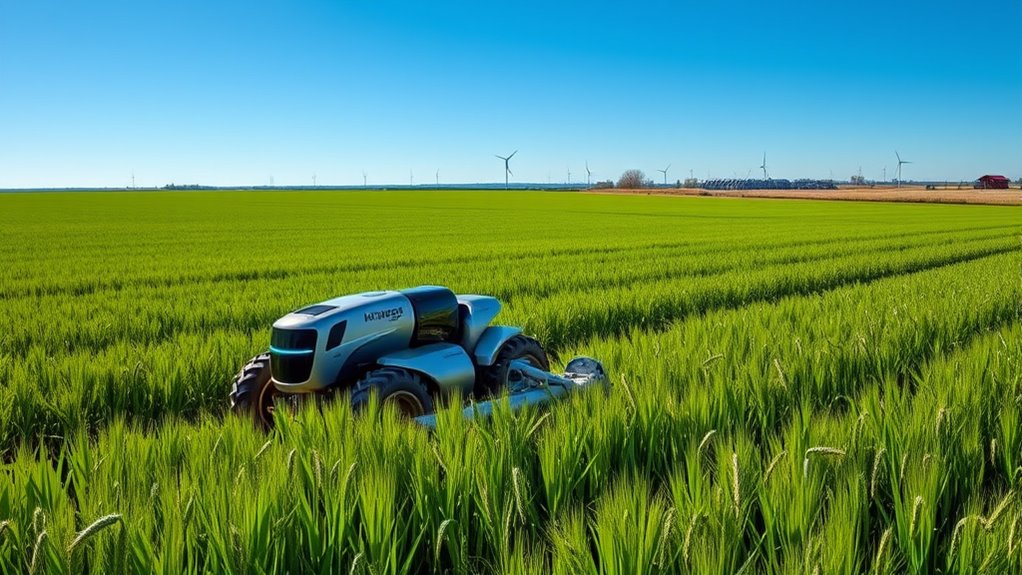
The rise of autonomous farming equipment is transforming agriculture by enabling you to perform tasks more efficiently and with greater precision. These machines can operate around the clock, reducing the need for manual labor and minimizing human error. Autonomous tractors, for example, navigate fields using GPS and AI, planting seeds, applying fertilizers, and harvesting crops with minimal oversight. Drones and UAVs monitor crop health, collect data, and target specific areas for treatment, saving time and resources. This automation accelerates planting cycles and enhances productivity, especially on large-scale farms. As technology advances, these systems become more reliable, energy-efficient, and adaptable to various crops and terrains. The result is a smarter, more sustainable approach to farming that meets growing food demands.
agriculture drone for crop monitoring
As an affiliate, we earn on qualifying purchases.
As an affiliate, we earn on qualifying purchases.
Key Types of Agricultural Robots Transforming Farms
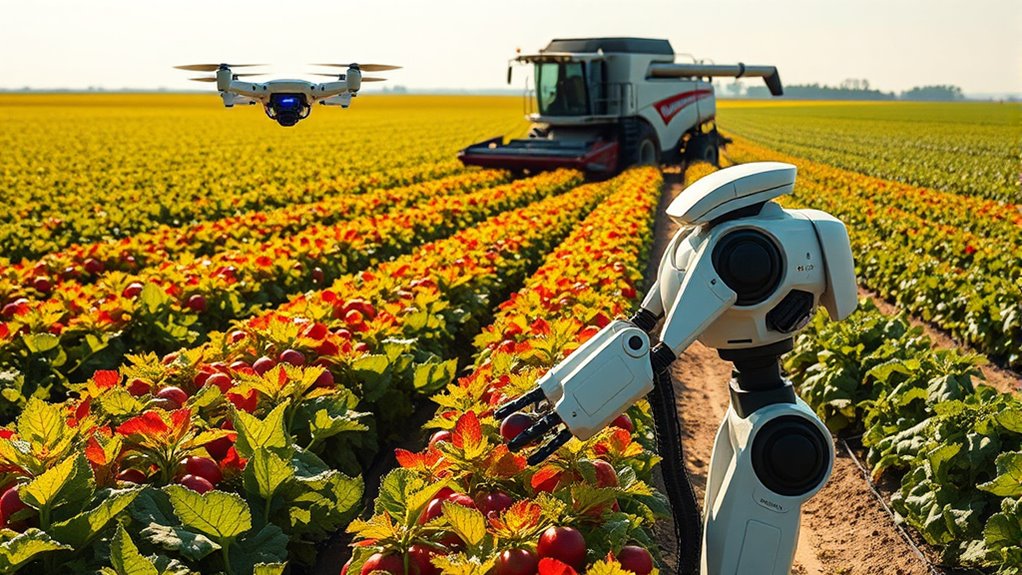
Autonomous crop harvesters and livestock monitoring robots are revolutionizing farm operations today. These robots increase efficiency, reduce labor costs, and improve precision in managing crops and animals. Understanding their roles helps you see how technology is transforming agriculture for a sustainable future. Incorporating market research into the development of these technologies ensures they meet the evolving needs of farmers.
Autonomous Crop Harvesters
Autonomous crop harvesters are revolutionizing modern agriculture by increasing efficiency and minimizing labor dependency. These robots can work around the clock, reducing harvest time and crop losses. Here are four key benefits:
- Precision harvesting: They identify ripe crops, ensuring minimal waste and ideal quality.
- Speed and efficiency: Autonomous harvesters cover large fields quickly, handling tasks faster than manual labor.
- Cost savings: Reducing the need for seasonal labor cuts expenses and lowers operational costs.
- Adaptability: Equipped with AI, they adjust to varying crop conditions and field layouts, enhancing versatility.
- Additionally, advancements in sensor technology improve their ability to accurately assess crop maturity and optimize harvesting processes.
As these robots become more advanced, you’ll see farmers relying less on manual labor and more on automated solutions to meet growing food demands efficiently and sustainably.
Livestock Monitoring Robots
Livestock monitoring robots are rapidly transforming farm management by providing real-time data on animal health, behavior, and productivity. These autonomous systems track essential signs, movement, and feeding patterns, alerting you to health issues early and reducing disease spread. Equipped with sensors, cameras, and AI, they analyze behavior to detect anomalies, ensuring timely interventions. You can deploy them across large herds without increasing labor demands, improving efficiency and animal welfare simultaneously. Some models include drones that survey pasture conditions and monitor livestock from above. As these robots gather extensive data, you gain deeper insights into herd performance, optimize resource use, and make informed management decisions. Additionally, data-driven decision making is enhanced as the collected information supports targeted management strategies. This technology enhances productivity while reducing labor costs, shaping the future of livestock farming.
As an affiliate, we earn on qualifying purchases.
How AI Enhances Precision and Efficiency in Agriculture

AI enables you to monitor crops with high accuracy through advanced sensors and drone technology, giving you real-time insights into plant health and growth. It also helps optimize resource use by adjusting water, fertilizer, and pesticide application precisely where needed. This combination boosts efficiency, reduces waste, and promotes sustainable farming practices. Additionally, integrating precision tuning techniques from automotive applications can further enhance machinery performance and energy efficiency on the farm.
AI-Driven Crop Monitoring
How exactly does AI transform crop monitoring to boost precision and efficiency? AI uses advanced sensors, drones, and computer vision to collect real-time data on crop health, soil conditions, and pest presence. This information allows you to make targeted decisions, reducing waste and increasing yields. Here’s how AI enhances your monitoring:
- Early Detection: AI identifies diseases and pest infestations before they spread.
- Resource Optimization: It guides precise application of water, fertilizers, and pesticides.
- Continuous Monitoring: Drones and sensors provide constant updates, minimizing manual checks.
- Data Analytics: AI analyzes patterns over time, helping you refine farming strategies.
This technology streamlines your workflow, saves costs, and promotes sustainable practices, revolutionizing how you oversee crop health.
Automated Resource Optimization
By leveraging advanced AI algorithms and sensor data, you can fine-tune resource application with remarkable precision. AI analyzes real-time information from soil sensors, weather forecasts, and crop health data to determine exactly where and when to apply water, fertilizers, and pesticides. This targeted approach minimizes waste, reduces environmental impact, and boosts crop yields. Automated systems adjust input levels dynamically, ensuring *best* resource use across different field zones. You save costs while promoting sustainability. Additionally, AI-driven models predict future resource needs based on growth patterns and environmental conditions, enabling you to plan more effectively. Incorporating cultural and regional knowledge can further optimize resource management by aligning practices with local climate and crop preferences. This combination of data and automation transforms resource management into a highly efficient, precise process, helping you produce more with less while safeguarding the environment and maintaining profitability.
As an affiliate, we earn on qualifying purchases.
Market Drivers Fueling Robot Adoption in Agriculture

The surge in global food demand and labor shortages acts as a powerful catalyst for adopting agricultural robots. You’re driven to find solutions that boost productivity and reduce costs. Here are four key market drivers fueling robot adoption:
- Rising food demands, projected to increase by 60% by 2050, push farms to optimize yields efficiently.
- Labor shortages and rising wages make automation a necessity to maintain production levels.
- Advances in AI and robotics enable precise farming, reducing waste and environmental impact.
- Government incentives and sustainability initiatives encourage farmers to invest in smart technology.
- Understanding affiliate marketing disclosures helps consumers stay informed about the financial relationships behind product recommendations.
These factors combine to accelerate adoption, ensuring farms meet future challenges while remaining competitive. As technology becomes more reliable and affordable, you’ll see robots transforming traditional agriculture into a high-tech industry.
Regional Leaders and Emerging Markets in Farm Robotics
You’ll notice that North America leads in farm robotics adoption thanks to high investments and supportive policies. Meanwhile, emerging markets in Asia-Pacific, South America, and Africa show great growth potential as labor costs rise and food demands increase. These regional dynamics shape the future landscape of agricultural automation worldwide. As automation technology becomes more accessible, AI in Education may also influence how agricultural training programs evolve to prepare the next generation of farm workers.
North America’s Technological Edge
North America has established itself as a leader in agricultural robotics, driven by high levels of technological investment, supportive regulatory frameworks, and a strong agricultural sector committed to innovation. You’ll find that this region’s advantages include:
- Heavy R&D spending on robotics and AI, fostering cutting-edge solutions.
- Favorable policies and subsidies encouraging smart farming adoption.
- A mature agricultural industry with large-scale farms enthusiastic to implement automation.
- Collaboration between tech firms and farmers to develop customized robotic systems.
- The availability of variety of materials, which allows for tailored solutions to meet diverse farm needs.
This combination accelerates technological progress and deployment, allowing North America to stay ahead. As a result, farm automation here isn’t just advancing; it’s shaping the future of agriculture, making the region a global leader in farm robotics innovation.
Emerging Markets’ Growth Potential
Emerging markets are poised to play an increasingly significant role in the global farm robotics landscape, driven by rising labor costs, expanding food demand, and technological adoption. Countries in Asia-Pacific, South America, and Africa are experiencing rapid growth in farm automation, motivated by the need for higher productivity and cost efficiency. As labor shortages and costs escalate, farmers turn to robotics for tasks like planting, harvesting, and crop monitoring. These regions benefit from increasing investments, government incentives, and lower technology costs, enabling wider adoption. While current deployment levels are modest compared to North America and Europe, the market potential is substantial. Continued technological advances and infrastructure improvements will accelerate growth, transforming agriculture in these regions and creating new opportunities for local economies and farmers. Additionally, the integration of cost-effective technologies is making automation more accessible in emerging markets, further driving adoption and innovation.
The Impact of Automation on Farm Labor Dynamics

Automation is transforming farm labor dynamics by reducing reliance on manual, physically demanding tasks and shifting the workforce toward more technical roles. As robots take on planting, harvesting, and weeding, your role evolves from manual laborer to operator, maintainer, or data analyst. This shift creates new opportunities but also challenges for workers needing retraining. Consider these impacts:
Automation reshapes farm labor, creating new tech roles and requiring retraining for workers.
- Job displacement in traditional roles, especially seasonal and manual positions.
- Growth in technical jobs like robot maintenance, programming, and data management.
- Increased productivity allowing farmers to focus on strategic planning and sustainability.
- Regional disparities, with some areas experiencing job loss faster than others due to varying robot adoption rates.
- The integration of nail tips and other aesthetic enhancements in farm-related settings is emerging as a niche for farm workers and enthusiasts alike, blending technology with personal expression.
While automation enhances efficiency, staying adaptable and developing new skills becomes essential for farm workers steering this changing landscape.
Technological Innovations Shaping Future Farming Solutions
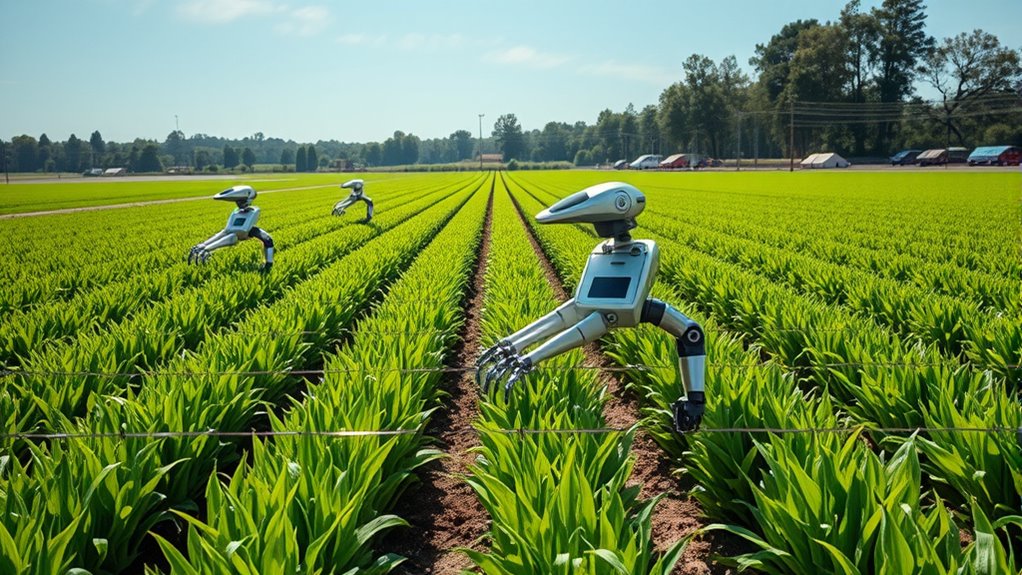
Technological innovations are propelling farming into a new era of efficiency and sustainability. Advanced AI systems now enable robots to navigate fields with obstacle avoidance and optimize routes in real time. Drones and UAVs provide high-resolution data, allowing precise crop monitoring, spraying, and early problem detection. Autonomous tractors and harvesters improve productivity by executing repetitive tasks accurately and consistently. Energy-efficient batteries and modular robotic designs make equipment more reliable and adaptable across different crops and terrains. Software platforms integrate AI, IoT, and cloud computing, offering farmers real-time analytics and decision support. These innovations reduce input waste, lower costs, and enhance sustainability. As technology continues evolving, you’ll see smarter, more connected farming solutions that transform traditional agriculture into a highly efficient, data-driven industry.
Challenges and Opportunities in Implementing Agricultural Robots
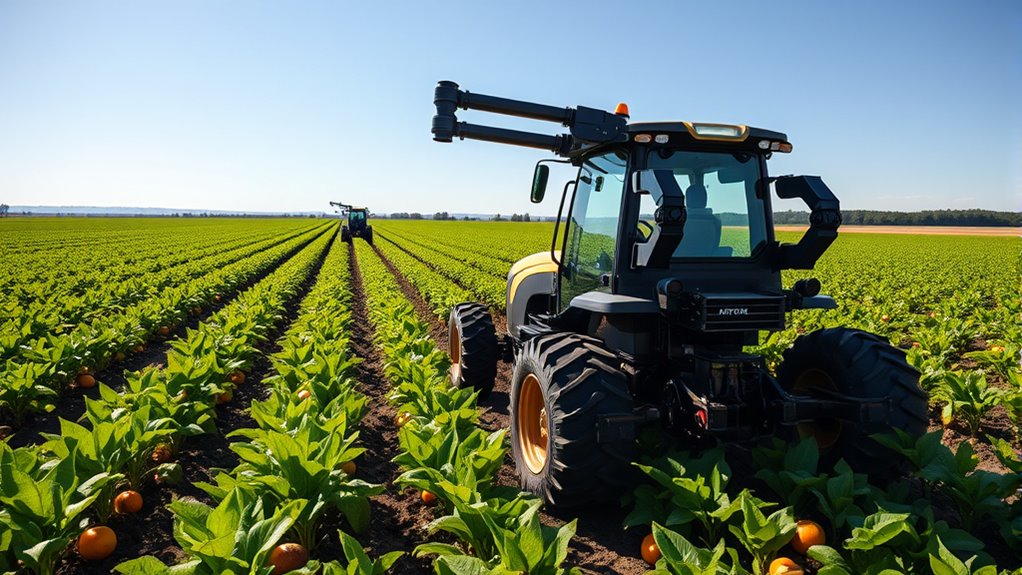
Implementing agricultural robots presents both significant opportunities and notable challenges that you need to contemplate carefully. First, high upfront costs for equipment and technology can be a barrier, especially for small-scale farmers. Second, integrating robots into existing farm operations requires technical expertise and training, which may slow adoption. Third, reliability issues such as equipment malfunction and unpredictable weather can hinder efficiency. Fourth, addressing data privacy and security concerns is essential as these systems collect vast amounts of farm data. However, opportunities abound in improving productivity, reducing labor costs, and enabling precision farming practices that minimize environmental impact. Embracing these innovations can lead to sustainable growth, but success depends on overcoming technical, financial, and operational hurdles.
The Role of Government Policies and Subsidies
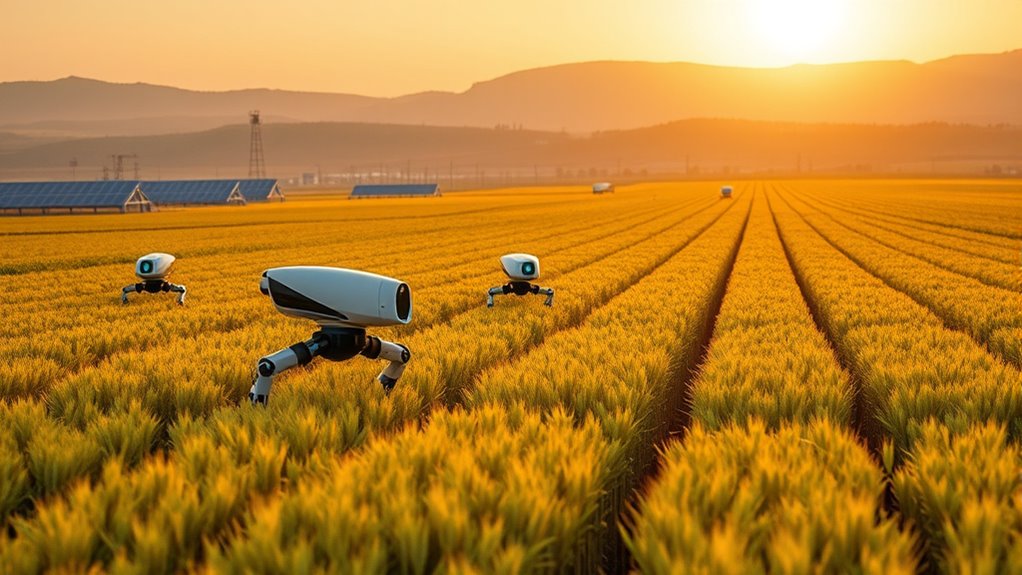
Government policies and subsidies play a crucial role in accelerating the adoption of agricultural robots worldwide. By providing financial support, governments help farmers offset high initial costs of robotics, making advanced technology accessible to small and large farms alike. Policies promoting sustainable farming encourage investment in automation that reduces chemical use and improves efficiency. Grants, tax incentives, and research funding stimulate innovation and deployment of new robotic solutions. Additionally, regulations that streamline approval processes and establish safety standards foster confidence in adopting these technologies. In regions like North America and Europe, government backing considerably boosts market growth, while emerging markets benefit from targeted programs. Overall, proactive policies and subsidies create an environment where robotics can thrive, helping farmers meet growing food demands sustainably and competitively.
Preparing the Workforce for a Robotic-Driven Farming Future

As farms increasingly adopt robotics and AI-driven systems, preparing the workforce becomes essential to guarantee a seamless shift. You’ll need to develop new skills and adapt to changing roles in agriculture. Here are four key steps to help you get ready:
- Upskill and reskill through training programs focused on robotics, automation, and data analysis.
- Learn maintenance and troubleshooting to ensure robots operate smoothly and minimize downtime.
- Become proficient in digital tools for farm management, enabling better decision-making.
- Embrace continuous learning to stay updated on emerging technologies and industry best practices.
Frequently Asked Questions
What Are the Environmental Impacts of Widespread Agricultural Robot Deployment?
Widespread use of agricultural robots can positively impact the environment by reducing chemical use through precise application, minimizing soil disturbance, and lowering water consumption with efficient irrigation. They also decrease emissions by optimizing machinery operation and reducing fuel use. However, you should consider potential concerns about electronic waste and energy sources, which could offset some benefits if not managed sustainably. Overall, responsible deployment can lead to more eco-friendly farming practices.
How Do Small Farms Afford and Implement Advanced Farming Robots?
Small farms can afford and implement advanced farming robots by seeking government grants, subsidies, and financial incentives designed to support technology adoption. You might also consider leasing or renting equipment to reduce upfront costs. Partnering with local cooperatives or agritech providers can help access shared resources and expertise. Additionally, focusing on scalable, modular robotics allows you to gradually integrate automation, making it more affordable and manageable for your farm’s size and budget.
What Ethical Considerations Arise From Automation in Agriculture?
You might think automating farms raises no ethical questions, but it actually sparks debates about environmental impact, worker displacement, and data privacy. As robots take over tasks, you could argue it’s unfair to diminish the value of human labor or risk over-reliance on technology. Balancing innovation with social responsibility becomes essential, so you need to consider how automation affects communities, sustainability, and the integrity of farming practices.
How Secure Are Farm Data Systems Against Cyber Threats?
You should know that farm data systems face increasing cyber threats, but their security depends on robust measures like encryption, firewalls, and regular updates. Implementing multi-layered security protocols and monitoring network activity help prevent breaches. You can also use strong passwords and limit access to sensitive information. Staying vigilant, training staff, and collaborating with cybersecurity experts are essential to protect your farm’s data from evolving cyber threats.
Will Automation Lead to Rural Depopulation or Community Decline?
Automation acts like a double-edged sword, shaping rural communities in complex ways. It may cause some depopulation as farms consolidate and traditional jobs fade, but it also breathes new life into rural areas with tech-focused roles and improved farm productivity. You might see fewer farmers, but stronger, smarter communities emerge. Embracing this change can help you turn potential decline into opportunity, ensuring rural areas stay vibrant and resilient.
Conclusion
As you embrace the future of farming, remember that automation brings growth, efficiency, and innovation. It demands adaptation, skills, and openness to change. You’ll face challenges, but also opportunities to lead and innovate. By understanding technology, supporting policies, and preparing your workforce, you can shape a sustainable, productive, and resilient agricultural landscape. Embrace progress, harness potential, and cultivate success—because the future of farming depends on your willingness to evolve.
Halloween Picks
halloween
As an affiliate, we earn on qualifying purchases.