
Business schools are rapidly integrating AI and big data analytics into their MBA programs to prepare students for a tech-driven world. They’re including courses on machine learning, predictive analytics, and ethical AI, often combined with practical tools like Python and Tableau. Many offer online or hybrid formats to increase accessibility. As AI reshapes careers and leadership, understanding these developments can give you a competitive edge—you’ll uncover more insights as you explore further.
Open a free Amazon Business account
Business pricing, bulk buying and tax-exempt orders.
As an affiliate, we earn on qualifying purchases.
Key Takeaways
- Business schools integrate AI and big data analytics into core curricula, emphasizing technical skills and ethical considerations.
- Many offer specialized concentrations and dedicated majors combining AI technical skills with responsible use principles.
- Online and hybrid MBA programs focus on flexible, accessible AI training, promoting ethical awareness and bias mitigation.
- Curricula include practical tools like Python and Tableau, preparing students for AI-driven decision-making roles.
- Leadership programs emphasize strategic AI application, ethical oversight, and managing societal impacts of technology.
Python programming for data analysis
As an affiliate, we earn on qualifying purchases.
As an affiliate, we earn on qualifying purchases.
Embedding AI and Big Data Analytics Into Business Curricula

Have you noticed how AI and big data analytics are transforming business education? More MBA programs are embedding these technologies into their core curricula to prepare you for the evolving landscape. You’ll find courses like predictive analytics, AI-driven market research, and practical tools such as Tableau and Python. Leading schools like Wharton and Chicago Booth now offer specialized concentrations that blend technical skills with ethical considerations, helping you understand AI’s broader societal impacts. Programs emphasize hands-on projects and real-world applications, so you develop practical skills in generative AI and machine learning. This integration guarantees you’re equipped to leverage AI strategically, making data-driven decisions while understanding the societal, legal, and economic implications of AI adoption in business. Supporting ethical considerations is essential for responsible AI use and aligns with the holistic approach to education.
Tableau data visualization software
As an affiliate, we earn on qualifying purchases.
As an affiliate, we earn on qualifying purchases.
The Rise of Online and Hybrid MBA Models Focused on AI Skills

As the demand for flexible, accessible business education grows, online and hybrid MBA programs centered on AI skills are gaining prominence. You can now pursue specialized AI-focused MBAs entirely online, like the University of Southern Indiana’s 12-month program, which offers asynchronous coursework for quick completion. These formats leverage mobile-first designs, enabling you to learn AI tools and strategic management anywhere. Hybrid models combine remote learning with periodic in-person sessions, balancing flexibility and networking opportunities. This approach supports reskilling efforts, with half of employees needing to adapt to new technologies by 2025. Additionally, understanding the role of advanced technology such as AI in projectors and other devices highlights the importance of staying current with technological trends. By offering accessible pathways to AI expertise, these programs meet the evolving needs of professionals seeking to stay competitive in a rapidly changing business landscape.
As an affiliate, we earn on qualifying purchases.
Shifting Career Opportunities and Employment Trends Driven by AI
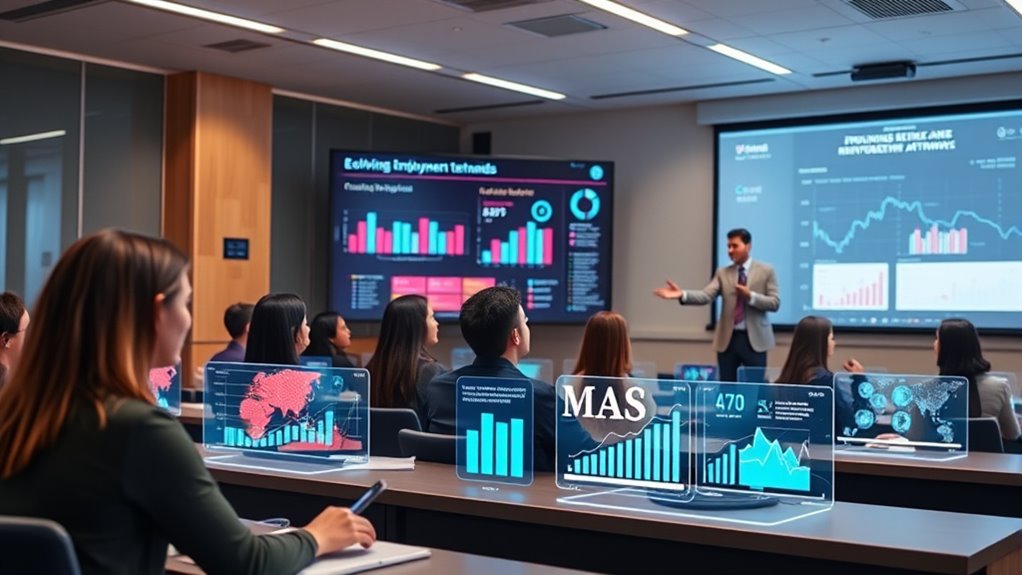
As AI reshapes the business landscape, you’ll find increased demand for skills in data analysis, machine learning, and ethical AI practices. This shift is transforming leadership roles, emphasizing strategic thinking and creativity over routine tasks. Emerging industries like fintech, healthcare, and supply chain management now offer new career pathways driven by AI advancements. Additionally, understanding for sale 100 can provide insights into market trends and economic factors influencing these new opportunities.
Increased Demand for AI Skills
The growing integration of AI skills into MBA programs is fundamentally shifting career opportunities and employment trends across industries. You’ll find that employers increasingly seek candidates proficient in AI, data analytics, and machine learning. Graduates with these skills command higher salaries and have better job prospects—86% secure employment within three months, and their pay rises by an average of 22% within six months. AI is transforming roles in finance, healthcare, consulting, marketing, and supply chain management, creating new leadership opportunities. As automation handles routine tasks, organizations value strategic, creative thinkers with AI expertise. This demand pushes you to develop technical proficiency and business acumen, making you more adaptable and competitive in a rapidly evolving job market driven by AI advancements. Proper planning around retirement planning can help ensure long-term financial security in this changing landscape.
Shift in Leadership Roles
AI is transforming leadership roles by shifting the focus from routine management to strategic and creative decision-making. You’ll find that traditional tasks like data entry or basic reporting become automated, freeing you to prioritize innovation and high-level planning. Leaders now need strong AI literacy to interpret insights generated by advanced analytics and leverage these for competitive advantage. As automation handles operational tasks, your role evolves into guiding teams through complex problems that require human judgment, empathy, and ethical considerations. Career opportunities expand into areas like AI strategy, ethical oversight, and digital transformation leadership. This shift demands that you develop new skills—combining technical understanding with leadership agility—to navigate the changing landscape and drive sustainable growth in your organization. Additionally, understanding scenic views and natural beauty can help leaders appreciate the importance of sustainability and environmental considerations in strategic planning.
Emerging Industry Opportunities
Emerging industry opportunities are rapidly expanding as AI continues to reshape the business landscape, opening doors to new career paths across various sectors. You’ll find demand growing for AI-savvy professionals in fields like fintech, healthcare, and supply chain management. As automation automates 30% of traditional workflows, your strategic and creative skills become more valuable. The AI market is projected to hit $1.847 trillion by 2030, driving hiring across industries. Here are key opportunities:
- Development of AI-driven products in finance, healthcare, and marketing.
- Leadership roles focused on AI strategy, ethics, and responsible deployment.
- Specialized consulting services advising firms on AI integration and innovation.
- Emphasizing the importance of farmhouse bedroom design principles can inspire innovative workspace setups for AI professionals, fostering creativity and comfort in the evolving workspace.
online MBA programs with AI focus
As an affiliate, we earn on qualifying purchases.
As an affiliate, we earn on qualifying purchases.
Modernizing MBA Programs With Specialized AI Courses and Concentrations

To stay relevant in today’s competitive business landscape, MBA programs are increasingly incorporating specialized AI courses and concentrations. You’ll find programs that blend technical skills like machine learning, data science, and predictive analytics with leadership and strategic thinking. Many top schools, such as Wharton and Chicago Booth, now offer dedicated AI majors or minors that cover both the practical applications and ethical considerations of AI. These courses emphasize real-world projects, giving you hands-on experience with tools like Python and Tableau. Additionally, curricula address AI’s societal impacts, ensuring you’re prepared to lead responsibly. The integration of AI in Education principles into business curricula further enhances learning outcomes and prepares students for future challenges. By focusing on specialized AI education, your MBA can better equip you for emerging roles across industries, making you more adaptable and valuable in an evolving job market.

As you push for technological innovation in your MBA program, you must also prioritize ethical AI development to prevent harm. Managing bias risks is essential to guarantee AI tools serve all stakeholders fairly, rather than reinforcing existing inequalities. Promoting responsible innovation means balancing cutting-edge progress with societal accountability, so you lead ethically sound business practices. Additionally, implementing robust safety measures is crucial to address vulnerabilities and ensure AI systems remain trustworthy and aligned with societal values.
Ethical AI Development
Balancing technological innovation with ethical responsibility is one of the most pressing challenges in developing AI today. As a future business leader, you must understand how to embed ethics into AI development to prevent harm and guarantee fairness. Here are key considerations:
- Transparency: Make AI decision-making processes clear and understandable to build trust and accountability.
- Bias Mitigation: Actively identify and reduce biases in data and algorithms to promote equitable outcomes.
- Societal Impact: Evaluate AI’s broader effects on employment, privacy, and social equity, aiming for responsible innovation. Incorporating recycled products in AI hardware can also promote sustainability in technological development.
Managing Bias Risks
Managing bias risks in AI development requires proactive strategies to identify and address discriminatory patterns before they cause harm. You need to implement rigorous data auditing, ensuring training datasets are diverse and representative. Regularly test algorithms for biased outputs, adjusting models to mitigate unfair treatment across different groups. Incorporate fairness metrics into development processes to monitor ongoing performance. Educate your teams on the ethical implications of biased AI and foster a culture of accountability. Transparency is vital—document decision-making processes and involve diverse stakeholders in reviews. Recognize that bias can be embedded unintentionally, so continuous assessment and refinement are essential. Additionally, understanding how fetal development occurs during pregnancy can inform ethical considerations in AI applications. By actively managing bias risks, you help guarantee AI systems promote equity, uphold societal values, and maintain public trust.
Promoting Responsible Innovation
Promoting responsible innovation in AI requires organizations to actively address the ethical challenges that come with technological advances. You need to foster an environment where innovation aligns with societal values and minimizes harm. To do this effectively, consider:
- Implementing extensive ethical guidelines that govern AI development and deployment.
- Encouraging interdisciplinary collaboration to assess societal impacts, including law, psychology, and economics.
- Embedding ethical training into curricula, emphasizing transparency, fairness, and accountability.
Leading Business Schools at the Forefront of AI Education and Research

Leading business schools are rapidly establishing themselves as pioneers in AI education and research, recognizing the transformative potential of artificial intelligence in the business world. You’ll find top institutions like Wharton and Chicago Booth leading the charge with extensive AI-focused curricula, including courses on machine learning, predictive analytics, and ethical considerations. These schools offer specialized majors and concentrations that blend technical skills with responsible AI use. They also host research centers dedicated to advancing AI applications in finance, marketing, and operations, fostering industry partnerships. Significantly, these programs integrate hands-on projects and real-world applications, preparing graduates for AI-driven careers. As a result, you gain access to cutting-edge knowledge, innovative tools, and a network aligned with the forefront of AI-driven business transformation.
The Impact of AI on Leadership Development and Strategic Decision-Making

Artificial intelligence is transforming leadership development and strategic decision-making by providing executives with advanced tools that enhance insight and foresight. You now leverage AI-driven analytics to identify trends faster, predict market shifts accurately, and optimize resource allocation. This shift enables you to make more informed, data-backed decisions with greater confidence. Consider these key impacts:
- Improved Scenario Planning: AI models simulate complex scenarios, helping you anticipate outcomes and craft resilient strategies.
- Enhanced Decision Quality: Real-time data analysis reduces biases and supports objective judgment.
- Leadership Skill Evolution: Focus shifts from traditional intuition to mastering AI tools, fostering a more analytical, tech-savvy leadership style.
Embracing these advancements sharpens your ability to navigate an increasingly complex business landscape effectively.
Future Perspectives: Evolving Skills and Opportunities in the AI-Driven Business Landscape

As AI continues to reshape leadership and strategic decision-making, it also signals a shift in the skills you’ll need to thrive in the evolving business landscape. You’ll need a blend of technical expertise, such as data analysis, machine learning, and AI tool proficiency, alongside strong human-centric skills like creativity, ethical judgment, and emotional intelligence. Future opportunities will expand across sectors like fintech, healthcare, and supply chain management, where AI-driven insights drive innovation. You should also develop agility in adapting to rapid technological changes and understand AI’s societal impacts. As demand for AI-savvy leaders grows, continuous learning and reskilling become essential. Embracing these evolving skills positions you for leadership roles that leverage AI to solve complex problems and create sustainable business value.
Frequently Asked Questions
How Are Business Schools Measuring AI Curriculum Effectiveness?
You’re likely to see business schools measuring AI curriculum effectiveness through a combination of student performance, project quality, and industry feedback. They track how well students grasp AI concepts via assessments and practical exercises. Additionally, they consider employment rates in AI-related roles, salary increases, and employer satisfaction. Some schools also gather alumni feedback and monitor how curriculum updates improve graduates’ readiness to lead in AI-driven business environments.
What Skills Beyond Technical Knowledge Are Emphasized for Ai-Ready MBA Graduates?
You’ll find that beyond technical skills, MBA programs emphasize strategic thinking, ethical judgment, and leadership. You’re encouraged to develop responsible decision-making, understand AI’s societal impacts, and communicate effectively across diverse teams. These skills help you navigate complex AI-driven environments, ensuring you lead with integrity and innovation. By balancing technical expertise with human-centric abilities, you become a well-rounded, adaptable leader prepared for the evolving AI landscape.
How Do MBA Programs Address Ai-Related Ethical Dilemmas in Leadership?
You’ll find that MBA programs emphasize understanding AI’s societal and ethical impacts, encouraging you to contemplate responsible use and potential biases. They incorporate courses on law, economics, and psychology to help you navigate dilemmas like privacy, fairness, and accountability. Through case studies, hands-on projects, and discussions, you learn to make ethical decisions, ensuring AI benefits society while maintaining trust and integrity as a future business leader.
What Partnerships Exist Between Business Schools and AI Industry Leaders?
You’ll find that many business schools partner with AI industry leaders like Google, Microsoft, and IBM to enhance their programs. These collaborations provide access to cutting-edge AI tools, real-world projects, and expert insights. You might participate in industry-sponsored research, internships, or guest lectures, giving you a competitive edge. These partnerships also help shape curricula that stay current and relevant for your future leadership roles in AI-driven business environments.
How Will AI Influence Future MBA Admissions and Selection Criteria?
AI will substantially shape future MBA admissions and selection criteria by emphasizing technical skills, data literacy, and ethical understanding. You’ll need to demonstrate proficiency in AI tools, analytics, and strategic thinking related to AI applications. Schools will prioritize candidates with experience in AI-driven projects and a mindset for innovation. Your ability to adapt to rapidly evolving tech landscapes and contribute to responsible AI use will be key factors in standing out in the admissions process.
Conclusion
As you navigate the evolving AI-driven business world, remember that adaptation is key. Business schools are reshaping curricula, focusing on tech skills and ethical responsibility to prepare you for future opportunities. Embrace these changes, because as the saying goes, “The only constant in life is change.” Staying agile and committed to continuous learning will ensure you thrive in this new era. Your ability to adjust will define your success.
NFL season / tailgating Picks
team gear
As an affiliate, we earn on qualifying purchases.