
Executive Summary
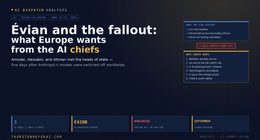
Europe is undergoing a rapid shift in how it builds, controls and powers artificial‑intelligence (AI) infrastructure. Until recently, most European organisations depended on global hyperscalers and foreign technology companies to provide cloud and AI services. Growing geopolitical tensions, the strategic importance of data and the ever‑increasing energy needs of AI workloads have made digital sovereignty a priority. In 2025 three high‑profile projects signalled a sea‑change: NATO’s partnership with Google Cloud to deploy an air‑gapped sovereign cloud, EDF and OpCore’s plan to convert a decommissioned French coal plant into one of Europe’s largest AI data centres, and Deutsche Telekom’s alliance with NVIDIA to build an “Industrial AI Cloud” in Germany. These projects are part of a broader movement to build secure AI “factories” and embed data centres into Europe’s energy and industrial systems.
This white paper analyses the strategic context behind these moves, provides detailed case studies of each project, identifies cross‑cutting trends such as the repurposing of legacy energy assets, and offers recommendations for policy‑makers and industry leaders. The report draws on official press releases, government statements and independent analyses.
European data center cooling systems
As an affiliate, we earn on qualifying purchases.
As an affiliate, we earn on qualifying purchases.
1 Introduction: Europe’s Digital Turning Point
1.1 Why digital sovereignty matters
Europe’s digital landscape is shaped by a geoeconomic turning point. Interdependencies that previously encouraged integration are now seen as vulnerabilitiesip-quarterly.com. Control over data centres and cloud platforms determines who sets standards and whose interests prevailip-quarterly.com. The United States dominates hyperscale cloud, software platforms and AI modelsip-quarterly.com, while China pursues a state‑directed Digital Silk Roadip-quarterly.com. Europe’s share of the global information and communications technology market fell from 22 % in 2013 to 18 % by 2023, whereas the U.S. increased its share to 38 %ip-quarterly.com. Of the fifty largest tech companies, only five are Europeanip-quarterly.com. The EU therefore faces the dual challenge of catching up technologically while preserving its democratic values and data protection standardsip-quarterly.com.
1.2 The European AI policy landscape
The European Commission’s AI Continent Action Plan (April 2025) seeks to make the EU a global leader in AI and proposes building large‑scale AI data and computing infrastructuresdigital-strategy.ec.europa.eu. It calls for the creation of AI factories and gigafactories and an InvestAI facility to stimulate private investmentdigital-strategy.ec.europa.eu. Complementary initiatives, such as the Apply AI Strategy and GenAI4EU, aim to spur adoption across public and industrial sectorsdigital-strategy.ec.europa.eu. Yet policy alone cannot deliver sovereignty; Europe must build its own compute infrastructure, semiconductors, and software stacksip-quarterly.com.
1.3 Energy and infrastructure bottlenecks
AI workloads are extremely energy‑intensive. Data centres now occupy the nexus of climate policy, digital acceleration, economic resilience and energy securitycerre.eu. The Centre on Regulation in Europe (CERRE) warns that without the right policies, the power demand of data centres risks pushing Europe’s already strained grids into gridlockcerre.eu. CERRE’s report calls for flexible regulatory approaches to unlock 50–60 GW of demand‑side flexibility by 2035cerre.eu and emphasises that data centres need to be treated like any other grid users while providing system flexibility and AI‑driven optimisationcerre.eu. The repurposing of old power stations (often scheduled for closure to meet climate targets) into data centres offers a “speed to power” advantage; these sites already have access to grid connections and water coolingreuters.com.

VEVOR 12U Open Frame Server Rack, 23-40 in Adjustable Depth, Free Standing or Wall Mount Network Server Rack, 4 Post AV Rack with Casters, Holds All Your Networking IT Equipment AV Gear Router Modem
Adjustable Depth: 23-40'' adjustable depth is used for servers and network equipment, ensuring enough space for AV equipment,…
As an affiliate, we earn on qualifying purchases.
As an affiliate, we earn on qualifying purchases.
2 Case Study 1: NATO × Google Cloud – Sovereign AI for Defence
2.1 Overview of the contract
On 24 November 2025, the NATO Communication and Information Agency (NCIA) announced a multi‑million‑euro contract with Google Cloud to deliver highly secure, sovereign cloud and AI capabilitiesgooglecloudpresscorner.comprnewswire.com. The deal will deploy the Google Distributed Cloud (GDC) air‑gapped platform to support NATO’s Joint Analysis, Training & Education Centre (JATEC)googlecloudpresscorner.com. Unlike standard cloud services, GDC air‑gapped provides a hardened, completely disconnected environment, physically separated from the internet and public cloudgooglecloudpresscorner.com. This allows NATO to run AI and analytics on its most sensitive data while meeting the strictest sovereignty requirementsprnewswire.com.
2.2 Why it matters
- Operational autonomy – NATO needs to process classified data and run AI models without exposing them to external networks. The air‑gapped environment ensures absolute control over data residency and operationsprnewswire.com.
- Modernising defence – The contract is part of NCIA’s digital transformation strategy. NCIA CTO Antonio Calderon emphasised that partnership with industry would deliver a secure, scalable cloud environment for JATECprnewswire.com.
- Signal to industry – By selecting GDC air‑gapped, NATO demonstrates that defence workloads require sovereign, high‑performance AI infrastructure rather than generic public cloud. This may accelerate similar sovereign cloud offerings for other defence and intelligence agencies.
- Dependence on U.S. vendors – While the platform is sovereign in operation (air‑gapped), it uses U.S. technology. This underscores the gap in Europe’s own hardware and platform capabilitiesip-quarterly.com and highlights the need to build indigenous AI stacks.
2.3 Implications for Europe
The NATO‑Google partnership provides a blueprint for secure, sovereign AI in defence. It also exposes a tension: Europe must partner with U.S. hyperscalers to meet immediate needs, yet longer‑term sovereignty requires investing in European chip design, secure software stacks and supply chainsip-quarterly.com. The project aligns with EU initiatives to build AI factories and demonstrates that defence workloads can drive early adoption of sovereign clouds.

Mastering the Private Cloud with Debian 13.3: Build Your Own Secure, Sovereign Infrastructure with Trixie From Nextcloud and Docker to Proxmox and Automated Network Backups
As an affiliate, we earn on qualifying purchases.
As an affiliate, we earn on qualifying purchases.
3 Case Study 2: EDF × OpCore – Converting a Coal Plant into a Sovereign Data Centre
3.1 Project overview
On 17 November 2025, France’s state utility Électricité de France (EDF) and OpCore (a joint venture of Iliad Group and InfraVia Capital Partners) announced exclusive negotiations to develop a hyperscale data centre campus at the former Montereau‑Vallée‑de‑la‑Seine coal‑fired power plant. The project is estimated at €4 billion and will deliver several hundred megawatts of computing capacity, making it one of the largest computing hubs in Europereuters.com. EDF’s press release confirms that the site will host one of Europe’s largest computing centres and serve as a cornerstone for the AI sectoredf.fr.
3.2 Rationale and design
- Rehabilitation of a historic site – The coal plant, shut down in 2004, will be redeveloped with a focus on energy efficiency and environmental standardsedf.fr. Repurposing existing industrial land provides rapid access to power and cooling infrastructure, addressing the “speed to power” problem noted in the Reuters analysis of Europe’s aging plantsreuters.com.
- Accelerated grid connection – EDF launched a call for expressions of interest to promote very high‑power data centres on its sitesedf.fr. By leveraging EDF’s position as France’s third‑largest industrial landowner and its ability to offer fast‑track grid connections, the project aims to begin commissioning in 2027reuters.com. EDF emphasises that support from the French state’s fast‑track grid connection system will accelerate implementationedf.fr.
- Digital sovereignty and economic reindustrialisation – French economy minister Roland Lescure said the investment shows France’s intention to lead the AI revolution and reaffirm its determination to reindustrialise and make France a major digital powerreuters.com. OpCore CEO Thomas Reynaud highlighted that the project will create one of the largest strategic facilities Europe needs to retain control of its digital destinyedf.fr. EDF CEO Bernard Fontana stressed that providing low‑carbon electricity to digital actors strengthens the country’s digital sovereignty while supporting local economic momentumedf.fr.
- Environmental and community benefits – The project aims for “environmental exemplarity,” including energy sobriety, optimization of flows and local integrationedf.fr. It is expected to create hundreds of direct and indirect jobsedf.fr and demonstrates how AI infrastructure can support regional development.
3.3 Strategic significance
The EDF‑OpCore project exemplifies Europe’s strategy of repurposing ageing energy infrastructure to meet AI demand. Europe’s old coal and gas plants are closing to meet climate goals; converting them into data centres offers utilities a way to offset closure costs and secure long‑term revenuereuters.com. Tech firms benefit from existing grid connections and water cooling, reducing project timelinesreuters.com. By anchoring AI compute in France, the project aligns with the EU’s call for AI factories and gigafactories and supports national digital sovereignty. Nevertheless, it underscores the need to upgrade grid capacity and integrate data centres into spatial and electricity‑system planningcerre.eu.

Ultimate Snowflake Cortex AI for Generative AI Applications: Design, Build, and Deploy Generative AI Solutions with Snowflake Cortex for Real-World … (Cloud Data Engineering — Warehousing Path)
As an affiliate, we earn on qualifying purchases.
As an affiliate, we earn on qualifying purchases.
4 Case Study 3: Deutsche Telekom × NVIDIA – The Industrial AI Cloud
4.1 Key details of the partnership
On 4 November 2025, Deutsche Telekom and NVIDIA announced a €1 billion partnership to build the Industrial AI Cloud, described as the world’s first sovereign AI factory for industry. The project will go live in Q1 2026reuters.com and operate from a refurbished data centre in Munich equipped with up to 10,000 NVIDIA Blackwell GPUsreuters.com. SAP will provide the software stack, enabling enterprises to develop and deploy industrial AI applicationsreuters.com.
4.2 Purpose and architecture
- A new factory model – NVIDIA CEO Jensen Huang described the platform as a modern factory producing “digital intelligence” akin to physical factories producing goodsblogs.nvidia.com. The Industrial AI Cloud harnesses NVIDIA hardware (DGX B200 systems and RTX PRO servers) and software (CUDA‑X, Omniverse, AI Enterprise) integrated with Deutsche Telekom’s networktelekom.com. The infrastructure will give industrial companies early access to GPU capacity and allow them to run digital twins, robotics, predictive maintenance and training of foundation modelsblogs.nvidia.com.
- Sovereign and private sector‑led – The platform is built in German data centres and is marketed as “Made for Germany.” It positions Germany as Europe’s leading sovereign AI hotspottelekom.com. Federal ministers welcomed the investment as a critical step towards making Germany a top technology country and emphasised that partnerships like this show that Germany is an attractive location for digital investmentstelekom.com. The project is a purely private‑sector initiative; however, it aligns with the government’s Made 4 Germany initiative and the wider European AI strategy.
- Ecosystem and use cases – The AI factory is supported by a growing ecosystem. Companies like Siemens, Mercedes‑Benz, BMW, Agile Robots and Quantum Systems intend to use the platform for complex simulations, robotics training, and AI‑powered dronesblogs.nvidia.comreuters.com. Deutsche Telekom CEO Tim Höttges stated that over 100 companies have joined the initiative and that investments could be doubled if uptake is strongreuters.com.
4.3 Implications
This project illustrates how industrial AI is driving new infrastructure models. Manufacturing and robotics require deterministic performance and data sovereignty; the Industrial AI Cloud provides dedicated compute, high bandwidth and German jurisdiction. Yet, like the NATO case, it relies heavily on U.S.‑designed hardware. It shows Europe’s willingness to partner with global technology leaders while maintaining sovereign control over data and operations.
5 Cross‑Cutting Trends and Analysis
5.1 Sovereignty as a design principle
Each case prioritises data residency, operational control and jurisdiction. NATO insisted on an air‑gapped cloud that is physically isolated from the internetprnewswire.com. EDF‑OpCore emphasised that the Montereau data centre would advance France’s digital sovereignty and economic independenceedf.fredf.fr. Deutsche Telekom markets its AI factory as a sovereign German platform with a “Deutschland‑Stack” combining SAP and NVIDIA technologytelekom.com. Sovereignty extends beyond data localisation; it includes energy supply, governance and control over the AI value chain.
5.2 Repurposing industrial infrastructure
Repurposing old coal and gas plants into data centres is becoming a strategic trend. Europe’s aging power plants offer ready‑made grid connections and cooling facilitiesreuters.com. For utilities, leasing or developing these sites provides new revenue streams and offsets closure costsreuters.com. For tech companies, it shortens timelines by bypassing lengthy permitting processesreuters.com. The EDF‑OpCore project and similar conversions underscore the importance of aligning AI infrastructure with energy transition goals.
5.3 Energy system integration and policy
Data centres’ growing electricity demand raises risks of grid strain and carbon emissions. CERRE’s report warns that without policy action data centre power demand could push Europe’s grid into gridlockcerre.eu. Policy recommendations include streamlining permitting, incentivising grid flexibility and clean energy use, integrating data centres into spatial planning and improving transparencycerre.eu. Projects like EDF‑OpCore’s campus, which pairs low‑carbon electricity with AI compute, show how data centres can support energy resilience when integrated properly.
5.4 Dependence on non‑European technology
All three projects rely on U.S. hardware and platforms (Google Cloud, NVIDIA GPUs, SAP). This dependence reflects Europe’s limited domestic semiconductor capacity and lack of hyperscale cloud providersip-quarterly.com. Policymakers must address this by investing in European chip design, foundries and open‑source software. The EU’s AI factories initiative and industrial policies should prioritise building indigenous compute resources to reduce reliance on external suppliersip-quarterly.com.
5.5 Public–private partnerships and regulatory agility
The examined projects reveal an emerging model of public–private collaboration. Government agencies (NCIA), state‑owned utilities (EDF) and private telecom giants (Deutsche Telekom) are partnering with technology firms to develop sovereign AI infrastructure. These collaborations often leverage fast‑track regulatory schemes (e.g., France’s accelerated grid connection) and combine national funds with private investment. EU regulators need agile frameworks that balance security, sustainability and innovation.
6 Challenges and Risks
- Energy consumption and sustainability – AI data centres consume vast amounts of electricity. Without stringent efficiency measures and integration with renewable energy, they could conflict with Europe’s climate goals. CERRE suggests deploying battery storage, demand response and renewable PPAscerre.eu.
- Grid bottlenecks – The pace of AI expansion could overwhelm transmission and distribution networks. Grid connection delays already stretch over a decade in some parts of Europereuters.com. Regulators should designate “ready‑to‑connect” zones and enable data centres to contribute to grid flexibilitycerre.eu.
- Security and resilience – Air‑gapped systems provide high security but can be expensive to maintain. Sovereign data centres must implement robust cybersecurity, physical security and disaster recovery. NATO’s model could inform best practices for other sectors.
- Vendor lock‑in – Heavy reliance on U.S. hardware and proprietary software risks lock‑in and strategic dependencyip-quarterly.com. European initiatives like Gaia‑X have faced challenges; Europe needs to support open architectures and ensure interoperability.
- Regulatory complexity and compliance burden – Europe’s “Brussels effect” has led to a proliferation of digital regulations (over 100 initiatives since 2010ip-quarterly.com). While consumer protection is essential, excessive compliance can hinder innovation and burden startupsip-quarterly.com. Future policies should balance trust and agility.
7 Recommendations
7.1 Build European AI factories and chip capacity
• Accelerate implementation of the EU’s AI factories and gigafactories programmedigital-strategy.ec.europa.eu. Provide financial incentives for companies to deploy high‑performance computing clusters in Europe and ensure that at least part of the hardware supply chain is European.
• Invest in European semiconductor manufacturing and specialised AI accelerators to reduce dependence on foreign chips. Encourage open hardware initiatives and partnerships with European research institutes.
7.2 Integrate digital and energy planning
• Adopt CERRE’s recommendation to integrate data centres into energy system planningcerre.eu. Create ready‑to‑connect zones near renewable generation and require new data centres to participate in demand response and provide battery or thermal storagecerre.eu.
• Repurpose decommissioned energy sites where possible. Utilities should identify suitable sites and work with data‑centre operators to convert them, ensuring community engagement and environmental standards.
7.3 Support open, sovereign software stacks
• Promote open source, interoperable AI and cloud platforms to prevent vendor lock‑in. European institutions should support initiatives that create open AI models and sovereign cloud frameworks, building on but going beyond projects like Gaia‑X.
• Establish sovereign data governance frameworks that allow interoperability across borders while ensuring data residency and privacy. This could involve common standards for encrypted data exchange and federated learning.
7.4 Encourage public–private innovation ecosystems
• Leverage public procurement to spur innovation in sovereign AI infrastructure. Defence, health care, energy and transport agencies should adopt early pilot projects and share best practices.
• Create cross‑sectoral AI clusters that bring together utilities, telecom operators, software vendors, universities and startups. These clusters can co‑develop solutions such as AI for grid optimisation, industrial robotics and digital twins.
7.5 Streamline regulation and foster agility
• Simplify permitting procedures for strategic data‑centre projects and introduce use‑it‑or‑lose‑it provisions to avoid connection queuescerre.eu.
• Ensure that regulations under the AI Act, Data Act and other EU digital laws are clear and proportional, particularly for SMEs. Provide guidelines and “AI Act service desks” to help companies comply without stifling innovation.
8 Conclusion
2025 marked an inflection point for Europe’s AI infrastructure. NATO’s air‑gapped cloud deal, EDF‑OpCore’s conversion of a coal plant, and Deutsche Telekom’s industrial AI factory illustrate Europe’s determination to build sovereign, high‑performance AI environments. These projects demonstrate new models—air‑gapped defence clouds, repurposed energy sites and private‑sector AI factories—that bridge security, energy and industrial policy. They also expose Europe’s dependence on foreign hardware and the urgent need to expand domestic capabilities. By aligning digital sovereignty with energy resilience and industrial competitiveness, Europe can transform its AI ambitions into a sustainable and strategic reality.
Appendix: Major AI Infrastructure Projects in Europe (2025)
| Project | Date announced | Partners | Investment & capacity | Location & highlights |
|---|---|---|---|---|
| NATO × Google Cloud (GDC Air‑Gapped) | 24 Nov 2025 | NATO Communication and Information Agency (NCIA) & Google Cloud | Multi‑million‑euro contract; deploys Google Distributed Cloud air‑gapped for NATO’s JATEC; provides a completely disconnected, highly secure environmentprnewswire.com. | Brussels and Sunnyvale; supports NATO’s Joint Analysis, Training & Education Centre; aims to modernise NATO’s digital infrastructure and enhance data sovereignty.googlecloudpresscorner.com |
| EDF × OpCore High‑Power Data Centre | 17 Nov 2025 | EDF, OpCore (Iliad & InfraVia) | €4 billion investment; several hundred megawatts of capacityreuters.com; scheduled for commissioning in 2027reuters.com. | Montereau‑Vallée‑de‑la‑Seine, France; conversion of a decommissioned coal plant; aims to create one of Europe’s largest computing hubs and boost French and European AI sovereigntyedf.fr. |
| Deutsche Telekom × NVIDIA Industrial AI Cloud | 4 Nov 2025 |