
The $285 billion AI sell-off made headlines. But beneath the noise, something far more consequential was happening: the infrastructure for an autonomous agent economy shipped — all in the same week.

Get business pricing on tech for your team
- Business-only prices and quantity discounts
- Tax-exempt purchasing
- Multiple users, one account, clear invoices
In mid-February 2026, while most of the tech world was fixated on AI stock corrections and OpenClaw’s explosive rise to 188,000 GitHub stars, something structurally significant happened beneath the surface. Coinbase, Cloudflare, Stripe, and OpenAI all shipped major agent infrastructure within days of each other. No coordination. No joint press conference. Just convergence.
Wallets for machines. Markdown for agents. Payment tokens for software buyers. Shell access for autonomous code execution.
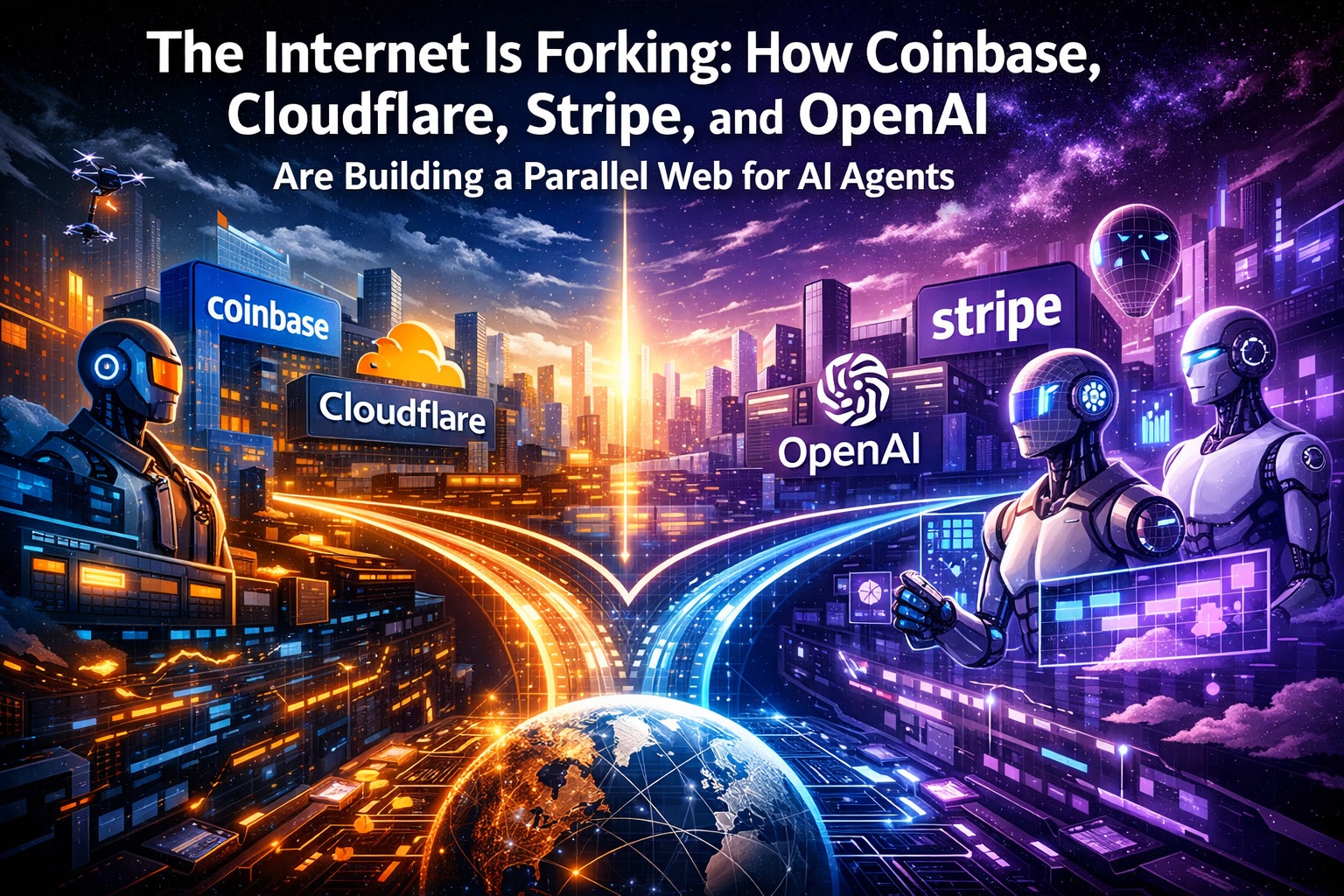
These aren’t incremental product updates. They are the primitive building blocks of a parallel internet — one designed not for humans clicking through web pages, but for software that reads, decides, transacts, and acts without ever opening a browser.
The web is forking. And it’s happening faster than almost anyone expected.
The Two-Layer Internet
The thesis is straightforward: the internet is splitting into two distinct layers that share the same underlying infrastructure but serve fundamentally different consumers.
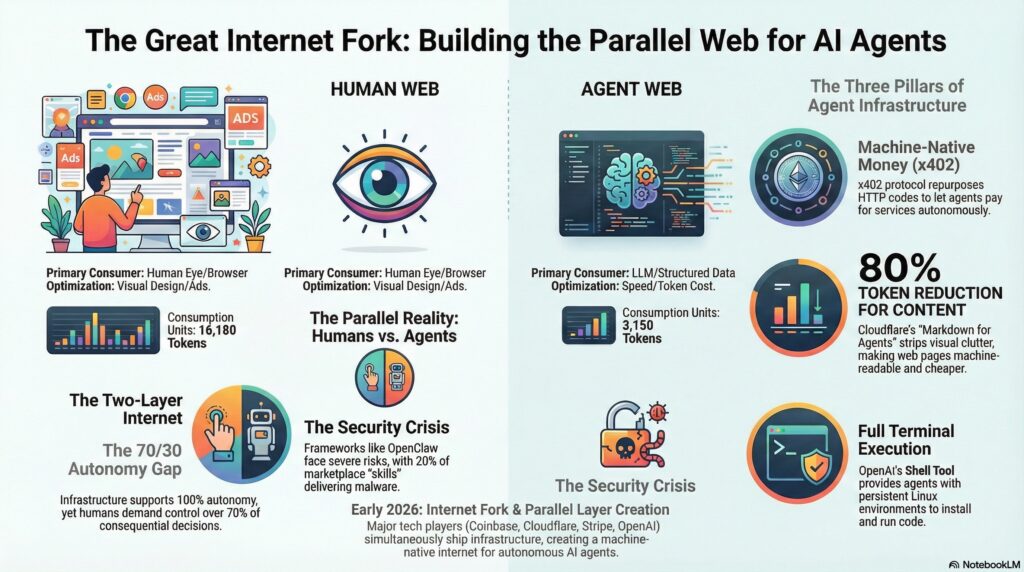
The first layer — the Human Web — is the one we’ve been building for three decades. It’s optimized for visual experience: fonts, layouts, CSS animations, cookie banners, and checkout flows designed around human attention and trust signals.
The second layer — the Agent Web — is a parallel structure of APIs, structured data feeds, markdown-formatted content, and machine-readable payment protocols. It’s designed for software that doesn’t need a visual interface, doesn’t browse casually, and doesn’t get distracted by banner ads. It reads structured data. It evaluates options programmatically. It transacts autonomously. And it does so at a speed and scale that no human could match.
What happened in February 2026 is that all the major pieces of this second layer shipped simultaneously.
As an affiliate, we earn on qualifying purchases.
The Money Layer: Agents Get Wallets and Payment Rails
The most consequential development may be the least discussed: AI agents can now hold and spend money independently.
Coinbase launched Agentic Wallets — the first wallet infrastructure purpose-built for autonomous agents. These aren’t traditional developer wallets repurposed for bots. They are non-custodial wallets secured inside Trusted Execution Environments, with programmable spending limits, session-level controls, and compliance screening built in. Private keys never touch the agent’s logic layer.
The wallets run on the x402 protocol, which repurposes the long-dormant HTTP 402 (“Payment Required”) status code as a machine-native payment standard. When an agent hits a paywall or API that requires payment, x402 handles the transaction programmatically — no human approval loop, no checkout page, no credit card form. The protocol has already processed over 50 million transactions since its initial launch.
The implications compound quickly. An agent can now monitor DeFi yields across protocols, rebalance positions at 3 AM, pay for its own API access, and purchase compute resources — all without a human touching anything. Coinbase describes this as the shift from agents that advise to agents that act.
Simultaneously, Stripe shipped its Agentic Commerce Suite with Shared Payment Tokens — a new payment primitive that lets AI agents securely pass buyer credentials to merchants without ever seeing the underlying credit card numbers. Major brands including Coach, Kate Spade, URBN (Anthropologie, Free People, Urban Outfitters), Etsy, and platforms like Shopify, Wix, and BigCommerce are already integrating.
Stripe co-developed the Agentic Commerce Protocol (ACP) with OpenAI, and it’s already live: ChatGPT users in the US can purchase from Etsy sellers directly inside the chat interface. That’s not a demo. It’s production agentic commerce, running today.
Visa, PayPal, Google, and Mastercard are building their own agent-to-commerce protocols, creating what American Banker described as an arms race for agentic payment rails. Cloudflare recently announced partnerships with Visa and Mastercard specifically for securing agentic commerce flows.
The money layer isn’t theoretical. It’s operational.
As an affiliate, we earn on qualifying purchases.
The Content Layer: Cloudflare Treats Agents as First-Class Citizens
If agents are going to transact, they need to read the web efficiently. And that’s exactly the problem Cloudflare just solved at infrastructure scale.
Cloudflare launched Markdown for Agents — a feature that automatically converts any HTML page on its network to clean, structured markdown when an AI agent requests it. The mechanism uses standard HTTP content negotiation: an agent sends a request with Accept: text/markdown in the header, and Cloudflare’s edge network intercepts, converts, and returns a stripped-down, semantically clean version of the content.
The efficiency gains are dramatic. Cloudflare used its own blog post as a benchmark: the HTML version consumed 16,180 tokens, while the markdown conversion used just 3,150 tokens. That’s an 80 percent reduction in the token cost of reading a single page. At scale — across the roughly 20 percent of global web traffic that flows through Cloudflare’s network — this transforms the economics of agent-driven web interaction.
Cloudflare’s explicit framing is telling: they called this treating agents as “first-class citizens” alongside human visitors. The web is no longer built for one type of consumer.
Meanwhile, search itself is being rebuilt from scratch. Exa.ai has emerged as the leading search engine designed specifically for AI agents, delivering structured data with sub-200-millisecond latency. Where Google returns ten blue links optimized for human scanning, Exa returns semantically ranked results with full page content, ready for LLM consumption. The company raised $85 million specifically to build what it calls “perfect search” for AI systems — no ads, no SEO gaming, just high-quality knowledge retrieval optimized for machine consumers.
Google’s John Mueller publicly called the concept of serving markdown to AI bots “a stupid idea.” But the market is moving the other direction — and fast.
As an affiliate, we earn on qualifying purchases.
The Execution Layer: Agents Get a Terminal
Content and money aren’t enough. Agents also need to execute code, install dependencies, and interact with the world programmatically. OpenAI’s latest API updates provide exactly that.
The new Shell Tool gives agents access to full Debian 12 terminal environments — either hosted by OpenAI or running locally. These aren’t sandboxed code interpreters. They’re complete Linux environments pre-loaded with Python, Node.js, Java, Go, and Ruby, with persistent storage and network access for installing libraries and calling third-party APIs.
Alongside Shell, OpenAI introduced Skills — versioned instruction bundles that function as reusable playbooks for agent behavior. A skill packages instructions, scripts, and assets into a deployable unit that agents can mount and execute when needed. Enterprise AI search company Glean reported that using the Skills framework improved their tool accuracy from 73 to 85 percent.
Server-side Compaction rounds out the picture by solving the context window problem for long-running agent sessions. E-commerce platform Triple Whale reported successfully running an agent through a session involving 5 million tokens and 150 tool calls without accuracy degradation.
Together, these three primitives — execution environments, modular skills, and context management — transform agents from conversational assistants into persistent digital workers capable of running for hours or days on complex, multi-step tasks.
trusted execution environment wallets
As an affiliate, we earn on qualifying purchases.
As an affiliate, we earn on qualifying purchases.
Emergent Behaviors: When Agents Chain Capabilities
The real story isn’t any single primitive. It’s what happens when agents start chaining capabilities across services.
Consider a workflow that’s already possible today: an agent receives an Amazon product link, crawls the structured data, feeds the product information into a video generation model, and produces a finished UGC-style marketing video — without any human touching the process. From link to deliverable, fully autonomous.
Or consider Polymarket, the blockchain-based prediction market where autonomous trading agents have extracted an estimated $40 million in arbitrage profits between April 2024 and April 2025. One bot reportedly turned $313 into $414,000 in a single month by exploiting the tiny latency window between confirmed price movements on exchanges and Polymarket’s own price updates. Another bot generated $2.2 million in two months using ensemble probability models trained on news and social sentiment.
The Polymarket data reveals something profound: agents aren’t just executing human-defined strategies. They’re developing emergent economic behaviors — seeking out pricing inefficiencies, optimizing their own operational costs, and in some cases, earning money specifically to subsidize their own compute expenses. These aren’t assistants. They’re economic actors.
But there’s an important reality check here. The viral “get rich quick with Polymarket bots” narratives are largely misleading. The bots that generate serious returns require high-frequency infrastructure, dedicated RPC nodes, sub-100-millisecond execution latency, and sophisticated risk management. Only 0.51 percent of Polymarket users earned more than $1,000 in the year studied. The opportunity is real, but the barrier to entry is far higher than the YouTube tutorials suggest.
The Security Crisis: Agents as Adversaries
When software can spend money, execute code, and interact with the world autonomously, the security model fundamentally changes. Every agent must be treated as a potential adversary.
OpenClaw — the open-source agent framework formerly known as Clawdbot — illustrates this perfectly. The project exploded to over 188,000 GitHub stars in roughly sixty days, making it one of the fastest-growing open-source repositories in history. Its creator, Austrian developer Peter Steinberger, was hired by OpenAI in February 2026 to lead personal agent development. Sam Altman called him the person who would drive the next generation of personal agents.
But the security implications of OpenClaw’s rapid adoption have been severe. Within three weeks of its surge in popularity, researchers discovered CVE-2026-25253, a critical remote code execution vulnerability exploitable even against instances bound to localhost. The ClawHavoc campaign identified over 800 malicious skills in OpenClaw’s ClawHub marketplace — roughly 20 percent of the entire registry — primarily delivering credential-stealing malware. Over 30,000 internet-exposed instances were identified running without authentication.
CrowdStrike warned that a misconfigured OpenClaw deployment could function as a “powerful AI backdoor agent capable of taking orders from adversaries.” Palo Alto Networks called the combination of private data access, untrusted content exposure, and external communication capabilities a “lethal trifecta.” One of OpenClaw’s own maintainers cautioned that anyone who can’t run a command line safely shouldn’t be using the project.
The security community’s response has been rapid. IronClaw, a Rust-based reimplementation from Near AI, runs untrusted tools inside WebAssembly sandboxes with capability-based permissions — credential injection at the host boundary, endpoint allowlisting, leak detection scanning, and resource limits. SecureClaw from Adversa AI provides 55 audit checks mapped to all 10 OWASP Agentic Security Initiative threat classes.
But the fundamental tension remains unresolved. The agent infrastructure being built assumes high autonomy — full wallet control, shell access, unrestricted API calls. The human trust model demands oversight, approval loops, and verifiable identity. OpenClaw agents can hold wallets and execute financial transactions without ever proving who they are. The payment infrastructure works. The identity infrastructure doesn’t exist yet.
The 70/30 Gap
This is perhaps the defining tension of the agent economy’s early phase. The infrastructure is being built for 100 percent autonomy — full financial independence, complete code execution, unrestricted web access. But research and real-world deployment consistently show that humans want to remain in the loop for approximately 70 percent of consequential decisions.
Call it the 70/30 gap: infrastructure built for full autonomy meeting demand for human control.
Coinbase addresses this with programmable spending limits and session caps. Stripe’s Shared Payment Tokens can be scoped to specific merchants, bounded by time and amount. OpenAI’s Shell Tool supports approval gates. But these are per-interaction guardrails bolted onto an architecture designed for independence.
The deeper question — whether human trust can scale at the same pace as agent capability — remains unanswered. A Global Payments study found that 42 percent of businesses would be concerned if AI agents started purchasing on behalf of consumers. The capability is shipping faster than the comfort level.
What This Means for Builders
If you’re building products, publishing content, or running online commerce, the fork in the web has practical implications right now.
For content publishers, enabling Cloudflare’s Markdown for Agents means your content becomes machine-readable at a fraction of the token cost. This isn’t optional long-term optimization — it’s the difference between your content being consumable by agents or being ignored in favor of competitors who made the switch.
For commerce businesses, Stripe’s Agentic Commerce Suite offers a single integration path to make products discoverable and purchasable through AI agents. The brands already onboarding — Etsy, URBN, Ashley Furniture, major ecommerce platforms — aren’t experimenting. They’re positioning for a channel that will grow from novelty to necessity.
For developers, the combination of OpenAI’s Skills and Shell tools, Coinbase’s x402 protocol, and Exa’s agent-native search creates a full stack for building agents that read, reason, execute, and transact. The pieces are no longer scattered across experimental APIs and proof-of-concept demos. They’re production-ready, documented, and shipping.
For security teams, every OpenClaw deployment, every agent with wallet access, every autonomous execution environment is a new attack surface. The Agentic Security Initiative’s threat taxonomy isn’t theoretical — it maps to vulnerabilities being actively exploited in the wild, right now.
The Fork Is Not Coming. It Arrived.
The parallel web for agents isn’t a prediction. It’s deployed infrastructure. Coinbase’s wallets are processing transactions. Cloudflare is serving markdown to agents across 20 percent of global web traffic. Stripe is enabling commerce through ChatGPT. OpenAI agents are executing code in managed containers.
The $285 billion sell-off was about market sentiment adjusting to reality. The infrastructure story running beneath it is about something far more durable: the internet is becoming bilingual, serving both humans and machines as native consumers. And the companies that positioned themselves at the protocol layer — payments, content delivery, search, execution — are building the equivalent of HTTP, TCP/IP, and DNS for the agent economy.
The human web isn’t going away. But it’s no longer the only web being built for.
Thorsten Meyer is the founder of ThorstenmeyerAI.com, covering the intersection of AI infrastructure, agentic systems, and the technologies reshaping how software interacts with the world.
Fall Picks
fall essentials
As an affiliate, we earn on qualifying purchases.