
Thorsten Meyer | ThorstenMeyerAI.com | February 2026
Executive Summary
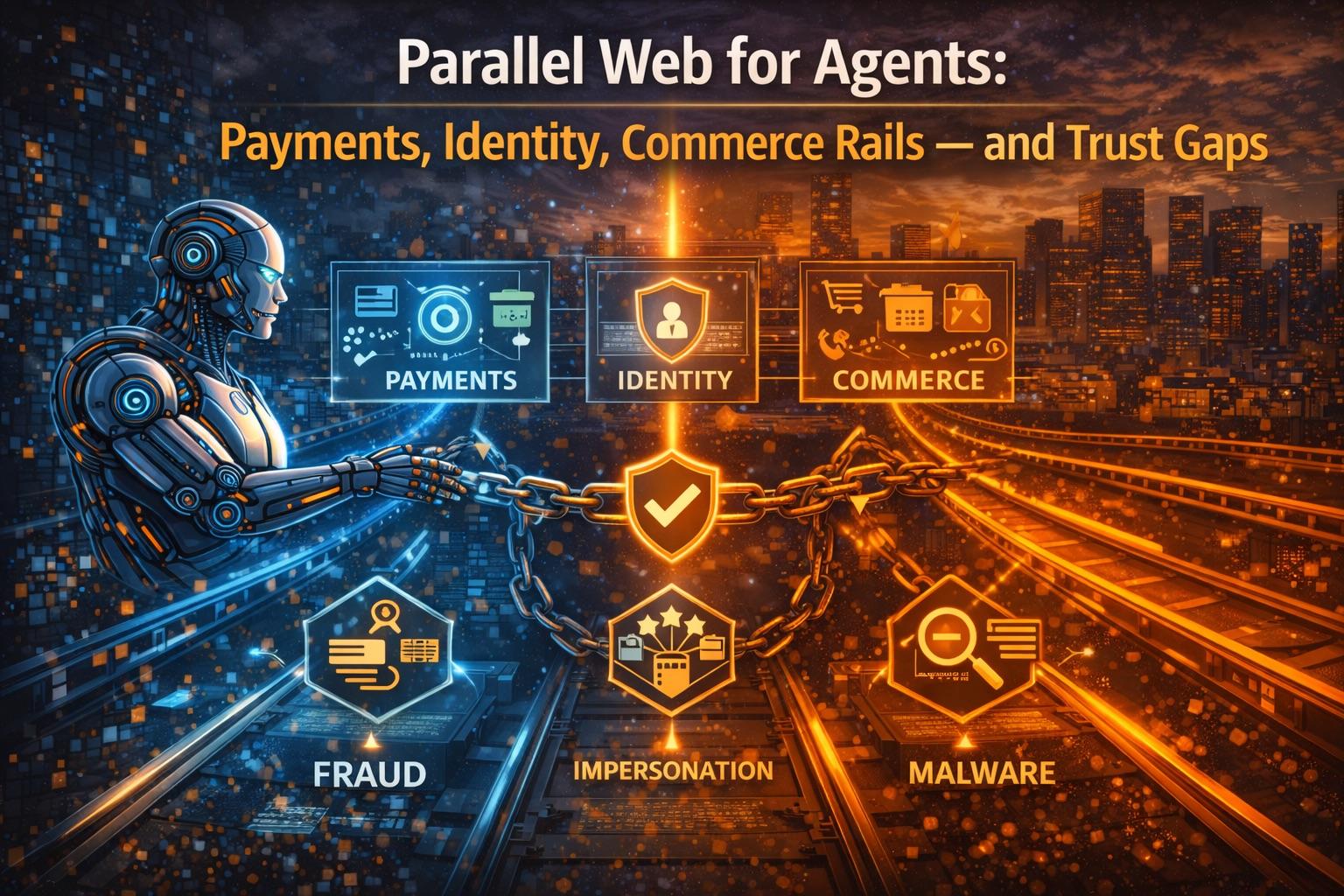
A machine-facing internet layer is emerging. AI agents are no longer just recommending purchases — they are completing them. Visa’s Trusted Agent Protocol, Mastercard’s Agent Suite, Stripe’s Agentic Commerce Protocol, and PayPal’s agent toolkits launched within months of each other. 45% of consumers already use AI for part of their buying journey (IBM IBV, January 2026). 47% are willing to delegate repetitive purchases to agents (Checkout.com). By 2028, 90% of B2B buying will be AI-agent intermediated, pushing $15 trillion in spend through automated exchanges (Gartner).
The opportunity is real: $3–5 trillion in global agentic commerce by 2030 (McKinsey). Autonomous procurement agents can capture 15–30% efficiency gains in sourcing, vendor management, and replenishment. Enterprises that expose machine-readable policies, pricing, and terms will capture agent-routed demand. Those that don’t will become invisible to the fastest-growing transaction channel in a decade.
The trust gaps are equally real. Only 21.9% of organizations treat agents as independent, identity-bearing entities. 45.6% rely on shared API keys for agent-to-agent authentication. Only 28% can trace agent actions back to human sponsors. 82% of executives believe existing policies protect against unauthorized agent actions — while 88% of organizations have reported confirmed or suspected security incidents involving agents. Courts have not issued definitive rulings on liability for fully autonomous agent behavior. The parallel web is being built. The trust infrastructure is not.
| Metric | Value |
|---|---|
| Consumers using AI in buying journey | 45% (IBM IBV) |
| Willing to delegate repetitive purchases | 47% (Checkout.com) |
| B2B buying AI-agent intermediated by 2028 | 90% (Gartner) |
| B2B spend through agent exchanges by 2028 | $15 trillion (Gartner) |
| Global agentic commerce by 2030 | $3–5 trillion (McKinsey) |
| US B2C agentic commerce potential | $1 trillion (McKinsey) |
| US e-commerce agentic spending | $190–385 billion (Morgan Stanley) |
| E-commerce influenced by agents by 2030 | 30% of value (Getnet/Santander) |
| AI agents in operation by end 2026 | 1 billion+ (IBM/Salesforce) |
| Agents treated as identity-bearing entities | 21.9% |
| Shared API keys for agent auth | 45.6% |
| Agent actions traceable to human sponsors | 28% |
| Real-time agent inventory maintained | 21% |
| Full security approval for agent fleet | 14.4% |
| Agents operating without security oversight | 50%+ |
| Executives confident in existing policies | 82% |
| Organizations: confirmed/suspected incidents | 88% |
| Courts: definitive autonomous liability rulings | None |
As an affiliate, we earn on qualifying purchases.
1. The Parallel Web Is Being Built
The infrastructure for agent-driven commerce is no longer theoretical. The world’s largest payment networks, processors, and platforms have committed to agentic rails within the past 12 months.
Payment Network Moves
| Player | Initiative | Status | What It Does |
|---|---|---|---|
| Visa | Trusted Agent Protocol | Launched Oct 2025 | Open framework distinguishing legitimate agents from bots at checkout |
| Visa | Intelligent Commerce | Pilots early 2026 | Expanded framework for secure agentic commerce, Asia-Pacific and Europe |
| Mastercard | Agent Suite | Announced Jan 2026, Q2 launch | Enterprise platform to build, test, deploy commerce agents |
| Mastercard | Agent Pay | Active | Agent-initiated payment authentication |
| Stripe | Agentic Commerce Protocol | Active (with OpenAI) | Agent checkout infrastructure, integrated with BigCommerce |
| PayPal | Agent Toolkit | Active | API toolkit for AI-initiated transactions |
| Coinbase | Agent Commerce Kit | Active | Crypto-native agent transaction tools |
| FIS | Agentic Commerce | Partnership with Visa/Mastercard | Processing infrastructure for agent-initiated transactions |
Visa predicts millions of consumers will use AI agents to complete purchases by the 2026 holiday season. This is not a research roadmap. These are production services with transaction volume targets.
The Machine-Readable Commerce Layer
| What Agents Need | What Most Commerce Offers | Gap |
|---|---|---|
| Machine-readable pricing | Human-readable product pages | Agents can’t reliably extract pricing |
| Structured product data | Marketing copy and images | No semantic product understanding |
| API-accessible policies | PDF terms and conditions | Agents can’t evaluate terms |
| Real-time inventory signals | “In stock” / “Out of stock” labels | No programmatic availability |
| Machine-readable loyalty/guarantees | Marketing program descriptions | Agents can’t compare value |
| Standardized checkout protocols | Human-designed checkout flows | Agents hit CAPTCHAs, bot filters |
Retailers and B2B sellers that expose policies, guarantees, and pricing in machine-readable formats will capture agent-routed demand. McKinsey’s analysis is direct: products must be machine-readable, and procurement will shift to autonomous machine-to-machine transactions. The retailer optimized for human browsing is invisible to agent purchasing.
The B2B Opportunity Is Larger
| Market Segment | Projection | Source |
|---|---|---|
| Global agentic commerce (2030) | $3–5 trillion | McKinsey |
| US B2C agentic revenue (2030) | Up to $1 trillion | McKinsey |
| US e-commerce agentic spend | $190–385 billion | Morgan Stanley |
| B2B spend through agent exchanges (2028) | $15 trillion | Gartner |
| B2B buying AI-intermediated (2028) | 90% | Gartner |
| Procurement efficiency from agents | 15–30% | McKinsey |
The B2B numbers dwarf B2C. $15 trillion in B2B spend flowing through AI agent exchanges by 2028 — compared to $1 trillion maximum in US B2C. The reason: B2B procurement is routine, policy-governed, and repetitive. It is the ideal domain for agent automation. Sourcing routine materials, generating supplier quotes, managing low-value purchase orders, and evaluating supplier risk are all tasks where agents can operate within defined policies faster and cheaper than humans.

Python for Data Analysis: Data Wrangling with Pandas, NumPy, and IPython
As an affiliate, we earn on qualifying purchases.
As an affiliate, we earn on qualifying purchases.
2. Enterprise Opportunity
Enterprises that build agent-ready infrastructure gain three structural advantages: speed, cost, and distribution.
Faster Procurement and Sourcing
| Capability | Human Process | Agent Process | Gain |
|---|---|---|---|
| Supplier quote collection | Days to weeks | Minutes to hours | 10–50x faster |
| Routine PO generation | Manual review + approval chain | Auto-generate within policy | 5–15x faster |
| Price comparison across vendors | Analyst research | Real-time API queries | Near-instant |
| Compliance check | Manual document review | Automated policy matching | 80–90% faster |
| Replenishment ordering | Inventory check → requisition → approval | Auto-trigger on threshold | Continuous |
McKinsey estimates autonomous category agents capture 15–30% efficiency through automating non-value-added procurement activities. The gain is not in replacing strategic sourcing decisions. It’s in eliminating the manual friction in routine, policy-compliant transactions.
Lower Machine-to-Machine Friction
| Friction Point | Current State | Agent-Native State |
|---|---|---|
| Authentication | Human login, MFA | Agent identity + delegated authority |
| Negotiation | Email/call cycles | Programmatic bid/ask within parameters |
| Contract review | Legal review (days/weeks) | Machine-readable terms, auto-match |
| Payment | Invoice → approval → payment (30–90 days) | Instant settlement within spend limits |
| Compliance verification | Manual document exchange | Automated certification check |
When both buyer and seller systems are agent-native, the transaction cycle compresses from days or weeks to minutes. The friction is not in the decision — it’s in the handoffs, approvals, and manual verification steps that agents can execute programmatically.
New Distribution Through Agent-Native Interfaces
| Distribution Shift | What Changes |
|---|---|
| Discovery | Agents query APIs and structured data, not browse websites |
| Comparison | Agents evaluate structured attributes, not marketing copy |
| Selection | Agents optimize on policy-defined criteria (price, terms, compliance) |
| Checkout | Agents use payment protocols, not form-filling |
| Reorder | Agents auto-replenish based on consumption signals |
The distribution implication is stark: if your product data is not machine-readable, agents cannot discover, compare, or purchase it. Agent-native interfaces become a distribution channel — and sellers without them become invisible to the 90% of B2B buying that Gartner projects will be agent-intermediated by 2028.
secure agent authentication API keys
As an affiliate, we earn on qualifying purchases.
As an affiliate, we earn on qualifying purchases.
3. Enterprise Risk: The Trust Gap Architecture
The parallel web’s trust infrastructure is immature. Three gaps define the enterprise risk landscape.
Gap 1: Weak Agent Identity Assurance
| Identity Problem | Current State | Source |
|---|---|---|
| Agents as identity-bearing entities | 21.9% of teams | Gravitee/Strata |
| Shared API keys for agent auth | 45.6% | Gravitee |
| Static API keys for authentication | 44% | Strata |
| Username/password for agents | 43% | Strata |
| Shared service accounts | 35% | Strata |
| Trace actions to human sponsors | 28% | Strata |
| Real-time agent inventory | 21% | Strata |
| Formal identity management strategy | 23% | Strata |
| Security leaders: IAM can handle agents | 18% highly confident | Strata |
Only 21.9% of organizations treat agents as independent, identity-bearing entities. The rest use shared API keys, static credentials, or repurposed service accounts. When an agent makes a purchase, approves a vendor, or commits to a contract — who authorized it? The answer, for 78% of organizations, is unclear.
The Visa Trusted Agent Protocol addresses one piece: distinguishing legitimate agents from bots at checkout. But the enterprise identity problem is deeper. Agent-to-agent authentication, delegated authority chains, and real-time credential management require purpose-built identity infrastructure that 77% of organizations have not built.
Gap 2: Unclear Liability in Autonomous Transactions
| Liability Question | Current Answer |
|---|---|
| Who is liable when an agent makes an unauthorized purchase? | Unclear — no definitive court rulings |
| Does agent action constitute user consent? | Under legal debate |
| How does Strong Customer Authentication apply to agents? | Regulations assume human payer |
| Who is responsible for agent errors in B2B procurement? | Contract-dependent, often silent |
| What if the agent was compromised (goal hijacking)? | Vendor? Deployer? User? Unresolved |
| Can an agent form a binding contract? | Legally uncertain in most jurisdictions |
Courts have not issued definitive rulings allocating liability for fully autonomous agent behavior. Payment regulations — including the EU’s Strong Customer Authentication (SCA) requirements — assume a human payer who is “made aware of the payment amount and the payee.” Agent-initiated payments challenge this assumption: is the authentication target the consumer’s identity, or the agent’s delegated authority?
The legal uncertainty creates enterprise risk in both directions: too much agent autonomy creates liability exposure; too little agent autonomy negates the efficiency gains.
Gap 3: Fragmented Standards and Platform Lock-In
| Standard/Protocol | Owner | Scope | Interoperability |
|---|---|---|---|
| Trusted Agent Protocol | Visa | Agent checkout authentication | Open framework, Visa ecosystem |
| Agent Suite / Agent Pay | Mastercard | Agent commerce platform | Mastercard ecosystem |
| Agentic Commerce Protocol | Stripe/OpenAI | Agent checkout infrastructure | Stripe/OpenAI ecosystem |
| Agent Toolkit | PayPal | Agent-initiated transactions | PayPal ecosystem |
| Know Your Agent (KYA) | Emerging concept | Agent identity verification | No standard yet |
| ISO 42001 (AI management) | ISO | AI governance certification | Broad, not agent-specific |
Every major payment network has launched its own agent commerce protocol. None are interoperable. An agent authorized through Visa’s Trusted Agent Protocol cannot seamlessly transact through Mastercard’s Agent Pay. Stripe’s Agentic Commerce Protocol works with OpenAI and specific merchant platforms. The result is platform fragmentation in the earliest stage of the parallel web — creating lock-in risk for enterprises that build on a single protocol before standards converge.
The Executive Perception Gap
| Perception | Reality |
|---|---|
| 82% of executives: existing policies protect against unauthorized agent actions | 88% of organizations have reported confirmed/suspected security incidents |
| 50%+ of agents operate without security oversight | Only 14.4% have full security approval for their agent fleet |
| Human oversight rated essential by 68% | Only 62% require human validation for financial approvals |
| 40% increasing identity/security budgets for agents | Only 23% have formal identity management strategies |
The perception gap is the most dangerous finding. Executives believe they are protected. The data says they are not. 82% confidence against 88% incident rate. This gap is where agent-driven financial losses will originate — not from technology failure, but from governance confidence that the data does not support.
As an affiliate, we earn on qualifying purchases.
4. What to Do Now
Action 1: Pilot Low-Risk Autonomous Transaction Flows
Start with transactions where the cost of agent error is low and the efficiency gain is high:
| Pilot Category | Why It’s Low-Risk | Expected Gain |
|---|---|---|
| Office supply replenishment | Low value, routine, reversible | 5–15x faster reorder |
| Standard material reorder | Policy-defined specs, approved vendors | 15–30% procurement efficiency |
| Subscription renewals | Pre-approved, recurring, predictable | Eliminate manual renewal cycle |
| Travel booking (within policy) | Policy-bounded, cancellable | Reduce booking friction |
| Invoice matching and approval | Verification task, not commitment | 80–90% faster processing |
The pilot is not about proving agents can transact. It’s about building the operational infrastructure — identity, logging, policy enforcement, exception handling — that scales to higher-risk transactions later.
Action 2: Enforce Policy-Based Spend Delegation
| Delegation Layer | Control |
|---|---|
| Per-transaction limit | Maximum dollar amount per agent action |
| Per-day aggregate limit | Total daily agent spend ceiling |
| Per-vendor restriction | Approved vendor list (agent cannot add vendors) |
| Per-category constraint | Agent can only purchase within assigned categories |
| Escalation threshold | Transactions above threshold pause for human approval |
| Anomaly detection | Spending pattern deviation triggers suspension |
Spending limits exist at multiple levels: per-transaction, per-day, per-vendor, and per-category, stacking to create multi-layered controls. Transactions above defined thresholds pause for managerial review. Anomalies trigger escalation, not automatic execution. The delegation model is the enterprise’s primary defense against agent-driven financial exposure.
Action 3: Keep Humans in the Loop for Financial and Contractual Commitments
| Decision Type | Agent Authority | Human Required |
|---|---|---|
| Routine purchase (< threshold) | Execute autonomously | Audit trail review |
| Above-threshold purchase | Prepare and recommend | Approve before execution |
| New vendor onboarding | Research and recommend | Approve and verify |
| Contract terms acceptance | Flag and summarize | Review and sign |
| Payment terms modification | Identify and alert | Negotiate and approve |
| Dispute resolution | Gather evidence | Decide and authorize |
68% of organizations rate human oversight as essential or very important. 62% require human validation for financial approvals. But the implementation gap is wide — organizations express the priority without operationalizing the thresholds.
The principle: agents prepare, analyze, and recommend. Humans authorize commitments. The boundary is not theoretical — it’s the spend threshold, the vendor list, the contract authority level that defines where agent autonomy stops and human authority begins.
Action 4: Build Machine-Readable Commerce Interfaces
| What to Expose | Format | Why |
|---|---|---|
| Product catalog | Structured API (JSON/GraphQL) | Agents can discover and compare |
| Pricing and terms | Machine-readable schema | Agents can evaluate and negotiate |
| Inventory and availability | Real-time API | Agents can verify before commitment |
| Compliance certifications | Structured attestation | Agents can auto-verify supplier eligibility |
| Return/warranty policies | Machine-readable terms | Agents can evaluate risk |
If you sell into B2B markets, machine-readable interfaces are becoming a distribution requirement. The 90% of B2B buying that will be agent-intermediated by 2028 cannot interact with PDF catalogs, human-designed portals, or marketing websites. The seller without structured APIs is invisible to the fastest-growing purchasing channel.
Action 5: Prepare for Agent Identity Infrastructure
| Step | What to Do |
|---|---|
| 1 | Inventory all agents with purchasing or transactional authority |
| 2 | Assign unique, non-shared identities (not static API keys) |
| 3 | Implement delegated authority chains (agent → human sponsor → policy) |
| 4 | Deploy real-time monitoring of agent transactions |
| 5 | Establish Know Your Agent (KYA) verification for counterparty agents |
| 6 | Plan for multi-protocol support (Visa, Mastercard, Stripe ecosystems) |
Only 21% maintain real-time agent inventories. Only 23% have formal agent identity strategies. The enterprises that build agent identity infrastructure now — before standards converge — will be positioned to adopt whichever protocols win. The enterprises that wait will retrofit under pressure.
5. What to Watch
Payment protocol convergence. Visa, Mastercard, Stripe, and PayPal have each launched proprietary agent commerce protocols. Interoperability is the open question. Watch for: cross-network agent authentication standards, merchant adoption rates across protocols, and whether the Trusted Agent Protocol evolves into an industry standard or remains Visa-specific. The enterprise that bets on one protocol before convergence risks expensive migration.
Know Your Agent (KYA) frameworks. Building on Know Your Customer (KYC), KYA frameworks will consolidate agent identity and safety protocols. Watch for: regulatory adoption of KYA requirements, insurance carrier requirements for agent identity verification, and enterprise procurement mandating KYA compliance from vendors. The legal uncertainty around agent liability will drive regulatory demand for verifiable agent identity — the only question is timing.
B2B agent-intermediated procurement thresholds. Gartner’s projection — 90% of B2B buying agent-intermediated by 2028 — implies that B2B sellers without machine-readable interfaces will lose most of their addressable market within 24 months. Watch for: early adopter procurement platforms mandating API-accessible catalogs, large buyers requiring agent-compatible supplier interfaces, and procurement efficiency data that accelerates adoption curves.
The Bottom Line
45% of consumers use AI in their buying journey. 47% will delegate repetitive purchases. 90% of B2B buying will be agent-intermediated by 2028. $15 trillion in B2B spend will flow through AI agent exchanges. The parallel web is not a concept. It’s infrastructure being deployed by Visa, Mastercard, Stripe, and every major payment processor simultaneously.
The trust gaps are equally concrete. 21.9% treat agents as identity-bearing entities. 45.6% rely on shared API keys. 28% can trace agent actions to human sponsors. 82% of executives believe they’re protected — while 88% have experienced agent-related incidents. Courts have issued no definitive rulings on autonomous agent liability.
The enterprise opportunity is speed, cost, and distribution. The enterprise risk is identity, liability, and lock-in. The correct posture is not to wait for standards to converge — it’s to pilot low-risk flows, enforce policy-based delegation, keep humans in the loop for commitments, and build the agent identity infrastructure that makes autonomous commerce auditable.
The parallel web is being built whether you participate or not. The question is whether your commerce infrastructure is readable by the agents that will intermediary 90% of B2B purchasing within 24 months.
Thorsten Meyer is an AI strategy advisor who has observed that the most expensive mistake in 2026 is not adopting agentic commerce too early — it’s having a product catalog that agents can’t read. More at ThorstenMeyerAI.com.
Sources
- IBM IBV — 45% Consumers Use AI in Buying Journey; 62% Growth in AI App Usage (January 2026)
- Checkout.com — 47% Willing to Delegate Repetitive Purchases to AI Agents (December 2025)
- McKinsey — $3–5 Trillion Global Agentic Commerce by 2030; Up to $1T US B2C
- McKinsey — Autonomous Category Agents: 15–30% Procurement Efficiency
- Gartner — 90% B2B Buying AI-Agent Intermediated by 2028; $15T Through Agent Exchanges
- Morgan Stanley — $190–385 Billion US E-Commerce Agentic Spending (December 2025)
- Getnet/Santander — 30% Global E-Commerce Influenced by Agents by 2030 ($17.5T GMV)
- IBM/Salesforce — 1 Billion+ AI Agents in Operation by End 2026
- Visa — Trusted Agent Protocol: Open Framework for Legitimate Agent Checkout (October 2025)
- Visa — Intelligent Commerce: Agentic Commerce Pilots Asia-Pacific and Europe (Early 2026)
- Mastercard — Agent Suite: Enterprise Agent Commerce Platform (January 2026, Q2 Launch)
- Stripe/OpenAI — Agentic Commerce Protocol with BigCommerce Integration
- Gravitee — State of AI Agent Security 2026: 88% Confirmed/Suspected Incidents
- Gravitee — 14.4% Full Security Approval; 50%+ Agents Without Oversight
- Strata — AI Agent Identity Crisis: 21.9% Independent Identities; 45.6% Shared API Keys
- Strata — 28% Trace Agent Actions to Human Sponsors; 21% Real-Time Inventory
- Strata — 18% Security Leaders Confident IAM Handles Agents; 23% Formal Strategy
- Strata — 82% Executive Confidence vs 88% Incident Rate
- IBM IBV — 83% Express Privacy/Data Misuse Concerns with Agent Commerce
- CPO Magazine — Courts: No Definitive Rulings on Autonomous Agent Liability (2026)
© 2026 Thorsten Meyer. All rights reserved. ThorstenMeyerAI.com