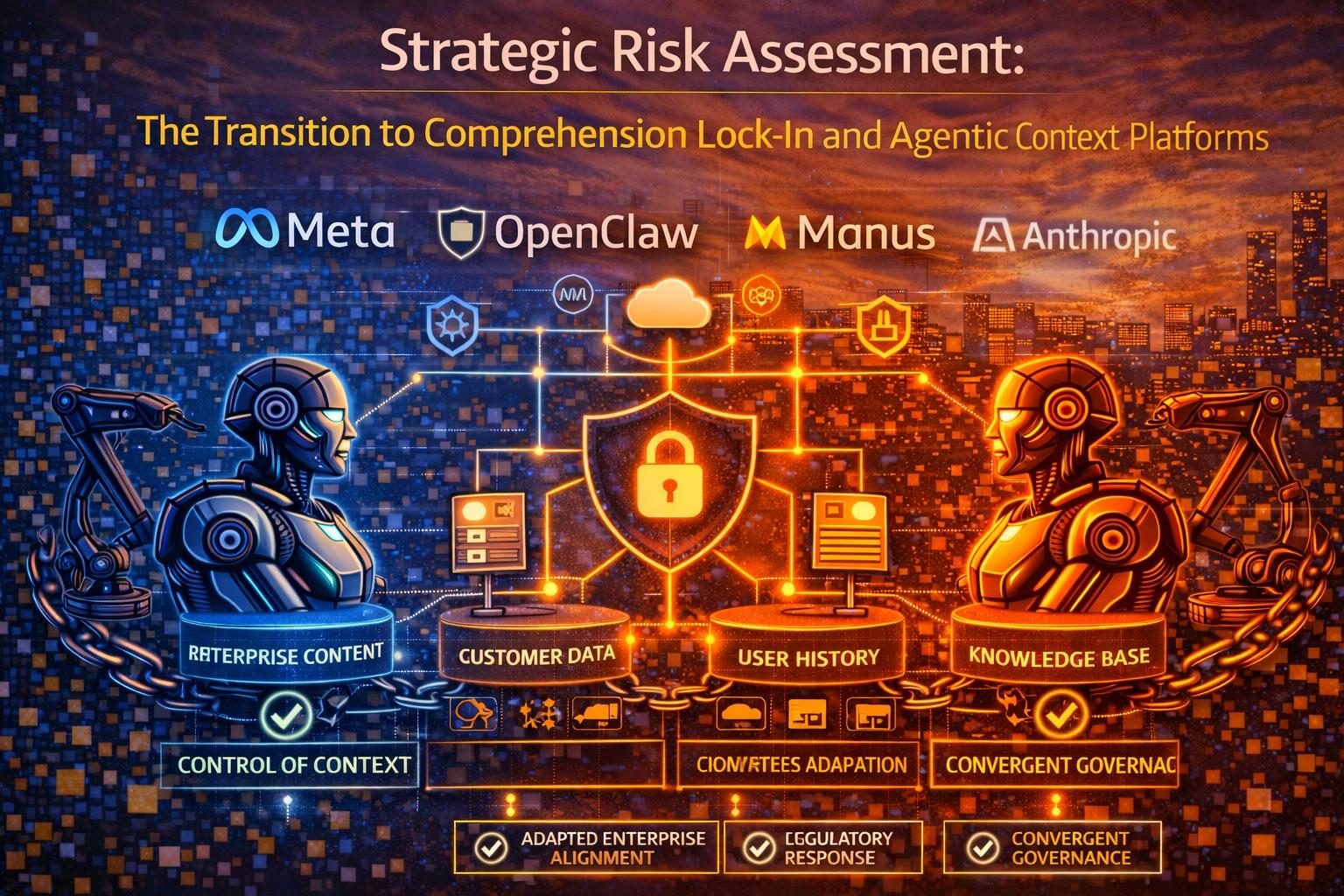

1. The Strategic Pivot: From AI Models to Institutional Context Platforms
The enterprise AI landscape is undergoing a fundamental structural pivot. We are transitioning from Phase 1 (Model Provision), where LLMs functioned as sophisticated query-response engines, to Phase 4 (Context Platforms), where the model becomes a stateful runtime environment. The emergence of the 2-million-token context window—as seen in the leaked GPT-5.4 framework—is not a mere performance “feature.” It is a fundamental infrastructure shift. By eclipsing the 1-million-token windows of GPT-5.2 and Gemini 2.5 Pro, these platforms move AI from a disposable tool to a persistent institutional brain capable of holding an organization’s entire reasoning history in active memory.

Get business pricing on tech for your team
- Business-only prices and quantity discounts
- Tax-exempt purchasing
- Multiple users, one account, clear invoices
The following table details the rapid evolution of AI value within the enterprise through the 2026 horizon:
The Four-Phase Evolution of AI Enterprise Value (2022–2026+)
| Phase | AI Role | Strategic Enterprise Value |
| Phase 1 (2022–2024) | Model Provider | Improved speed/quality of answers to discrete questions. |
| Phase 2 (2024–2025) | API Platform | Establishment of a developer tool ecosystem and custom integrations. |
| Phase 3 (2025–2026) | Agent Execution | Codex writes code, runs tests, and ships PRs autonomously. |
| Phase 4 (2026+) | Context Platform | Stateful runtime environments that synthesize and understand total organizational history. |
The “Frontier” architecture (launched February 5, 2026) represents a concerted effort to replace the human synthesis layer through four core components: Business Context (a semantic layer connecting disparate data sources), Agent Execution (reasoning and memory from past interactions), Evaluation & Optimization (autonomous feedback loops), and Security & Governance (trust infrastructure). Collectively, these components attempt to internalize how information flows and how decisions are made, effectively automating the connective reasoning that previously required human oversight. This shift highlights the critical vulnerability of modern organizations: fragmented knowledge.
2. The Fragmented Knowledge Problem and the Human Synthesis Layer
Modern organizations operate under a “Knowledge Cabinet” metaphor. Vast amounts of data are stored in isolated digital repositories, yet the “synthesis layer”—the connective tissue explaining why a decision was made—resides exclusively within human cognition. This creates a catastrophic strategic vulnerability: when key personnel depart, they take the synthesis layer with them. The filing cabinets remain full, but the organization becomes functionally brain-dead.
The following “Knowledge Cabinets” illustrate the loss of implicit synthesis that occurs during personnel turnover:
- GitHub/GitLab: Holds code and architectural logs. Lost Synthesis: The rationale behind chosen architectures; the history of what was tried and failed.
- Slack/Teams: Holds informal reasoning and updates. Lost Synthesis: The undocumented “why” behind formal decisions; the nuance of interpersonal logic.
- Salesforce/HubSpot: Holds customer records and deal histories. Lost Synthesis: Relationship nuances, negotiation trust signals, and unspoken customer expectations.
- Jira/Linear: Holds project plans and blockers. Lost Synthesis: Internal politics, dependencies, and trade-offs that dictated priority shifts.
- Confluence/Notion: Holds documentation. Lost Synthesis: The ability to distinguish “living” context from stale, abandoned procedures.
- Email: Holds commitments and escalations. Lost Synthesis: The chain of accountability and informal agreements.
Without a functional reasoning layer to connect these silos, full filing cabinets are useless. AI context platforms aim to capture this synthesis, leading directly to a new form of technology capture: Comprehension Lock-In.
3. Comprehension Lock-In: Evaluating the Deepest Form of Capture
Comprehension Lock-In represents a qualitatively different risk compared to traditional data or API lock-in. While traditional capture is built on the friction of moving records, comprehension lock-in is built on the platform’s unique “understanding” of the institution. If a platform has spent two years synthesizing code reviews, board decks, and customer feedback into a coherent reasoning model, that synthesized intelligence becomes an asset that cannot be easily exported or replicated.
The Lock-In Spectrum
| Lock-In Type | What is Captured | Switching Cost | Recovery Time |
| Data | Records, schemas, formats | High | Weeks to Months |
| API | Code dependencies | Medium-High | Months |
| Workflow | Processes, rules | High | Months |
| Prompt/Tuning | Optimized prompts, fine-tuning | Medium | Weeks |
| Embedding | Vector databases | Very High | Months (Re-embedding) |
| Comprehension | Institutional Understanding | Extreme | Years (if ever) |
The consequence of attempting to switch context providers is a “Brain Reset.” Because organizational intelligence is stored within the platform’s state, a migration results in the total loss of accumulated context, cross-system reasoning history, and stale-knowledge detection. The organization’s cognitive infrastructure is effectively wiped, forcing a return to zero. This risk necessitates a close look at the competing methodologies for capturing institutional context.
4. Competitive Methodologies: Top-Down vs. Bottom-Up Capture
The race to capture enterprise context has led to divergent strategies between the industry leaders, OpenAI and Anthropic.
Strategic Approaches to Context Capture
| Parameter | OpenAI (Frontier) | Anthropic (Claude Code) |
| Strategy | Top-Down (Architectural) | Bottom-Up (Organic) |
| Entry Point | Enterprise Platform ($14B ARR) | Developer Terminal ($2.5B ARR) |
| Context Artifacts | Business Context Semantic Layer | CLAUDE.md files, Session Histories |
| Learning Mechanism | Platform-level Optimization | Project conventions and daily corrections |
A profound “Strategic Irony” exists here: while OpenAI’s top-down architectural ingestion allows for massive data dumps, Anthropic’s bottom-up organic capture may be more durable. Context captured through how people actually work—what they ask, correct, and revisit—reflects the “living truth” of an organization more accurately than a structured data dump. This battle for the canonical source of truth is currently constrained by technical hurdles that could lead to systemic failure.
5. The Four Technical Pillars and the Risk of Systemic Failure
The success of the context platform thesis relies on four technical pillars. The failure of even one collapses the multi-billion dollar investment.
- Multiplicative Intelligence: Reasoning must scale with context size. Risk: Context window size is a vanity metric if reasoning quality does not scale; a 2M window that produces overconfident hallucinations is a liability.
- Memory That Does Not Rot: Platforms must distinguish valid knowledge from outdated data. Risk: Memory that does not decay is memory that does not update, leading to dangerous reliance on stale information.
- The Retrieval Bottleneck: Systems must reconstruction event timelines. Risk: At 2 million tokens, the failure mode is “drowning” in information rather than missing it.
- Execution Trust: For autonomous agents, the margin for error is non-existent.
The “Compound Failure Math” for autonomous workflows reveals the severity of this risk:
Compound Failure Math for Autonomous Workflows
| Error Rate per Step | 10-Step Workflow | 50-Step Workflow | 100-Step Workflow |
| 5.0% | 40% Total Failure | 92% Total Failure | 99.4% Total Failure |
| 1.0% | 10% Total Failure | 39% Total Failure | 63% Total Failure |
| 0.5% | 5% Total Failure | 22% Total Failure | 39% Total Failure |
| 0.1% | 1% Total Failure | 5% Total Failure | 10% Total Failure |
Production-grade autonomy requires a target accuracy of 99.5%+ per step. Current systems are nowhere near this threshold for multi-domain tasks, exposing a gap that technical infrastructure alone cannot close.
6. Institutional Constraints and the Governance Maturity Gap
While technical infrastructure is ready—with advanced economies seeing broadband penetration at 98.9%—institutional readiness is lagging. Governance maturity currently sits at 21%, meaning 79% of organizations are adopting AI without frameworks to manage the knowledge these systems hold. This is particularly critical as 11.2% youth unemployment signals that entry-level synthesis work is most at risk.
Institutional Knowledge Risks include:
- Knowledge Concentration: Organizational understanding held by a single provider with no portability standards.
- Regulatory Gap: The AI Act (August 2026) focuses on risk classification, while the DMA Review (May 2026) may only begin to address the right to export “synthesized understanding.”
- Subsidy Dependency: Platform-subsidized context accumulation creates a reliance that makes market contestability impossible.
These risks are structural. As noted in the OECD context, the lack of standards for “knowledge portability” creates a market where the “brain” of the company cannot be moved.
7. Strategic Framework: Auditing and Managing Context Risk
Leaders must treat context accumulation as a strategic, portable asset. Ownership of the synthesis layer is a $600 billion bet; maintaining optionality requires immediate action.
Practical Action Plan for Leaders
| Action | Owner | Timeline |
| AI-Ready Knowledge Structuring | CTO + Knowledge Mgmt | Q2 2026 |
| Contractual Context Portability Requirements | Legal + CTO | Q2 2026 |
| Synthesis Layer Risk Mapping | CTO + CHRO | Q2 2026 |
| Top-Down vs. Bottom-Up Strategy Evaluation | CTO + Engineering | Q2–Q3 2026 |
| Autonomous Accuracy Benchmarking | CTO + CISO | Q3 2026 |
Risk Audit Checklist for the Synthesis Layer:
- [ ] Identify Synthesis Holders: Map the people who currently provide the “connective tissue” between systems.
- [ ] Map Reset Impact: Quantify exactly what would be lost if a specific platform’s state was reset to zero.
- [ ] Vendor-Neutral Documentation: Audit documentation to ensure it is structured for ingestion by any platform.
- [ ] Export Rights: Secure contractual rights to export context graphs, reasoning histories, and organizational learning data.
- [ ] Accuracy Verification: Require evidence of 99.5%+ accuracy on production-representative tasks before deploying autonomous agents.
The Bottom Line: The battle for AI supremacy has shifted from model benchmarks to the ownership of the synthesis layer. With $14B in OpenAI ARR and a $600 billion infrastructure bet on the line, “Intelligence Lock-In” is the ultimate strategic frontier. Organizations that fail to secure the rights to their own synthesized context will discover that switching AI providers is not a technical migration—it is a cognitive reset of the entire institution. Ownership of organizational truth is the only way to retain long-term autonomy.
enterprise knowledge management software
As an affiliate, we earn on qualifying purchases.
As an affiliate, we earn on qualifying purchases.
AI context platform for organizations
As an affiliate, we earn on qualifying purchases.
As an affiliate, we earn on qualifying purchases.
organizational data integration tools
As an affiliate, we earn on qualifying purchases.
As an affiliate, we earn on qualifying purchases.
As an affiliate, we earn on qualifying purchases.
Fall Picks
fall essentials
As an affiliate, we earn on qualifying purchases.