Anthropic just made its most consequential enterprise move yet — and most of the companies in its crosshairs don’t realise it yet.
On the surface, Claude for Word looks like a productivity add-in. It lives in the Microsoft Word sidebar, it reads your contracts, it edits clauses, it works through comment threads, and it outputs every change as a tracked revision you can accept or reject in Word’s native review pane. Tidy. Useful. Incremental.
Except it isn’t incremental at all.

What it actually does
Claude for Word is Anthropic planting its flag in the document layer — the one place where the majority of high-value knowledge work still happens. The feature set is precise and deliberate: it reads complex multi-section documents, understands defined terms and cross-references, navigates with semantic search rather than keyword matching, and fills templates while inheriting the document’s existing heading and paragraph styles.
ThorstenmeyerAI.com · Analysis · April 2026
Claude for Word is not a feature. It’s a market signal.
Anthropic has planted its flag in the document layer — the one place where the majority of high-value knowledge work still happens. Five industries are in the crosshairs. Most of them don’t realise it yet.
The signal in numbers
Five industries in the crosshairs
Why this is infrastructure, not software
What affected companies should do
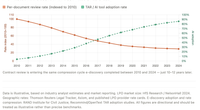
Legal AI adoption trajectory: standalone tools vs native integrations
Data is illustrative, based on industry analyst estimates and market research. Legal industry market size: IBIS World / Statista global legal services 2024. Adoption projections are editorial estimates based on friction analysis and comparable technology adoption curves in adjacent professional services markets. Disruption exposure ratings are assessments based on product category overlap analysis. All figures should be treated as directional rather than precise.
More pointedly: it triages counterparty redlines, flags provisions that deviate from standard market position ranked by severity, and can make an indemnification clause mutual with a single prompt. These are not generic text tasks. These are the specific, billable tasks that a junior associate, a paralegal, or a legal process outsourcer gets paid to execute — often for hours at a time.
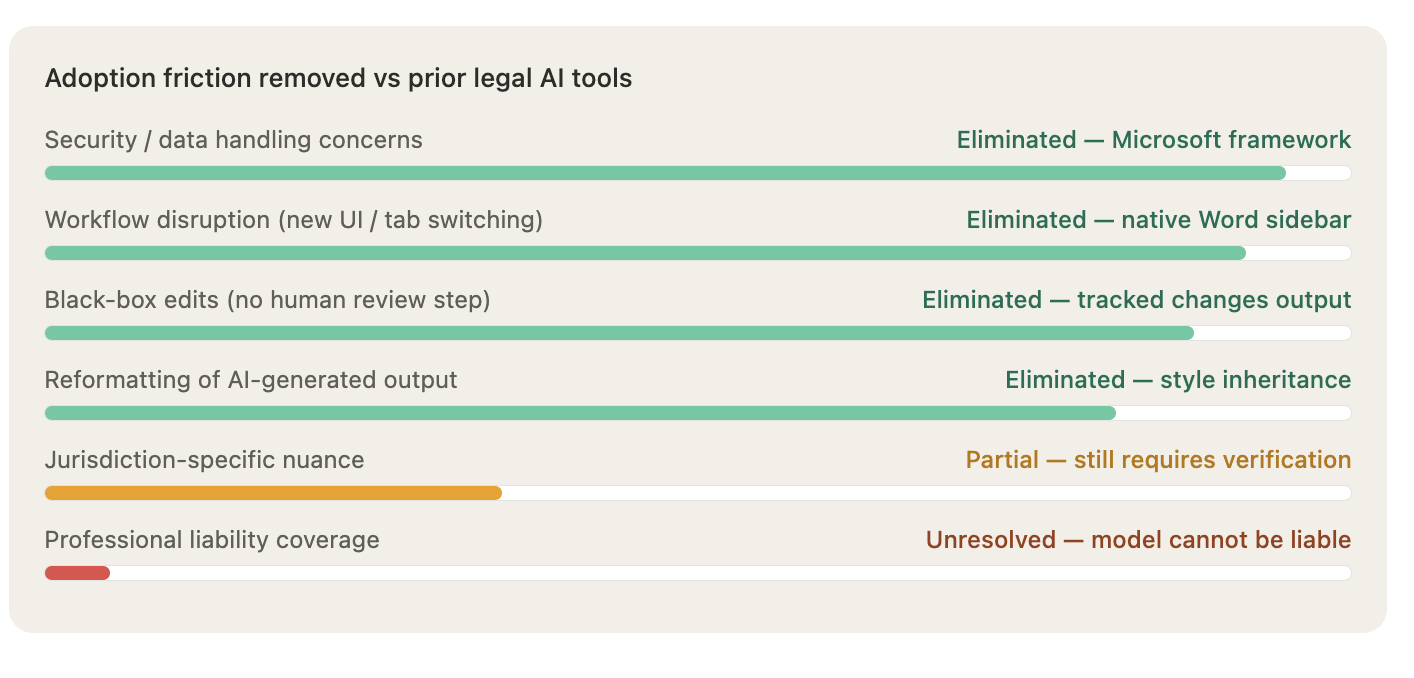
And it all happens inside Word. No tab switching. No copy-paste into a separate AI interface. No reformatting. The AI is now in the instrument, not standing next to it.
The product is currently in beta and limited to Team and Enterprise plan customers. Cross-document context with Claude for Excel and PowerPoint is already live. The trajectory is unmistakable.

Microsoft Word 2007 Old Version
- Document creation and sharing: Helps create and share professional documents
- User-friendly interface: Easy-to-use writing tools included
- Efficient document assembly: Predefined parts and styles for quick construction
As an affiliate, we earn on qualifying purchases.
As an affiliate, we earn on qualifying purchases.
The industries in the crosshairs
The map is not complicated once you draw it honestly.
Legal tech SaaS vendors are the most directly exposed. Any company whose core product is essentially “AI-powered document review, delivered via a Word integration” is now competing directly with the model provider that almost certainly powers their product. The same capability that cost a firm a per-seat SaaS subscription now ships natively with the Claude plan their IT department already bought. The differentiation case — workflow integrations, matter management, firm-specific playbooks — is real, but it just got harder and more urgent to articulate.
Legal process outsourcing and document review operations face a different but equally uncomfortable question. The economic case for offshore or near-shore document review has always rested on the cost of human attention being cheaper than software alternatives at scale. Claude for Word shifts that calculus sharply. First-pass contract review, redlining, and consistency checking were precisely the tasks that justified that model. They’re also precisely the use cases Anthropic lists first in its marketing copy. This is not coincidence.
Paralegals and junior knowledge workers operating in document-heavy environments will feel this in hiring patterns before they feel it in headcount directly. When a mid-size firm can have a senior lawyer run a Claude-assisted first pass on a contract stack at a fraction of the time cost, the business case for maintaining large teams of document-focused juniors weakens. This doesn’t mean mass displacement overnight — institutional inertia, liability structures, and trust take time to shift. But the direction is clear.
Template and forms vendors face a softer but real threat. When Claude can draft from a template while inheriting document styles and populating provisions from context, the library of pre-written boilerplate loses its moat. The intelligence is now in the model, not the template. Vendors whose value proposition was “here is the right language for this clause” are now offering something the document already has access to.
Document-centric consulting and advisory work — due diligence, compliance gap analysis, regulatory review — is further insulated by relationships, judgment, and accountability. But the research and assembly layer of that work, the hours spent reading and summarising and flagging, is compressing. Firms that charged for human reading time are entering a period where clients will increasingly ask why they should.

The AI-Powered Paralegal: Practical Tools and Prompts for Legal Research, Contract Review and Document Drafting (: The Paralegal AI Trilogy)
As an affiliate, we earn on qualifying purchases.
As an affiliate, we earn on qualifying purchases.
The deeper strategic logic
Anthropic is not stumbling into legal. The dedicated page for Claude for Word leads with legal contract review. The example prompts — summarise key commercial terms, flag provisions that deviate from market position, make the indemnification mutual — are written by someone who understands what lawyers actually do with documents. This is targeted positioning, not opportunistic feature shipping.
The strategic logic is also sound from Anthropic’s perspective. Legal is a global trillion-dollar industry. The vast majority of practitioners live in Word. AI adoption in legal is accelerating but fragmented across dozens of point solutions. By embedding Claude directly into the document layer, Anthropic is not asking lawyers to change their workflow. It is inserting intelligence into the workflow lawyers already have. That is a much easier adoption motion than any standalone legal AI tool has managed.
It also positions Claude for Word as infrastructure rather than software. Infrastructure is sticky. Once a firm’s documents, templates, and comment conventions are being processed through Claude in Word, switching costs compound quietly.

Book & Document Scanner, Large Format A2/A3 26MP USB Document Camera with Auto-Flatten & Fingerprint Removal, Multi-Language OCR, Upgraded AI-Powered Gemini Integration, for Windows/macOS
- Interchangeable A2/A3 Scanner: Switches between large and standard formats
- High-Resolution 26MP Sensor: Captures detailed images with 600 DPI enhancement
- Auto-Flatten & Fingerprint Removal: Automatically flattens pages and removes fingerprints
As an affiliate, we earn on qualifying purchases.
As an affiliate, we earn on qualifying purchases.
What the affected companies should do
The response available to legal tech vendors is one that has always been theoretically available but is now operationally urgent: build what a general-purpose model cannot replicate by default.
That means deep integration with matter management systems, billing platforms, and firm-specific precedent libraries. It means jurisdiction-specific knowledge bases, regulatory update monitoring, and audit trails that satisfy compliance requirements. It means the things that require institutional context that Anthropic does not have and cannot easily acquire. The general-purpose review capability is commoditising. The differentiation has to come from everything layered around it.
For LPOs and staffing-oriented businesses, the pivot is from labour arbitrage to expertise. The operations that survive will be the ones that can tell clients they are providing judgment, not just reading — that they catch what the model misses, that they carry professional liability, that they understand the client’s specific risk posture in ways that a generic AI instruction cannot.
For the consulting layer, the story is the same one that good consultants have always told when technology compressed the work: we sell the interpretation, not the information.
As an affiliate, we earn on qualifying purchases.
The irony that will define the next few years
The deepest tension in this market is that most of the legal AI tools currently threatened by Claude for Word are themselves built on Claude, GPT-4o, or Gemini. The foundation model providers are simultaneously the infrastructure their customers depend on and the most dangerous competitor those customers now face.
This is not unique to legal. It is the structural condition of building a product on top of a general-purpose model. The model provider controls the cost curve, the capability roadmap, and increasingly — as Claude for Word demonstrates — the distribution surface. The product companies built differentiation on top of a layer that the layer’s owner is now occupying directly.
The companies that will survive this are the ones that understood early that model capability was always going to become commoditised, and built their moat in everything that surrounds it. The ones still primarily selling access to AI-powered document review, with limited workflow depth, face a difficult 18 months.
Claude for Word is not the end of legal tech. It is, however, the beginning of a harder conversation about what legal tech is actually for.
Claude for Word is currently in beta, available to Team and Enterprise plan customers. Cross-document context across Word, Excel, and PowerPoint is supported in a single conversation.