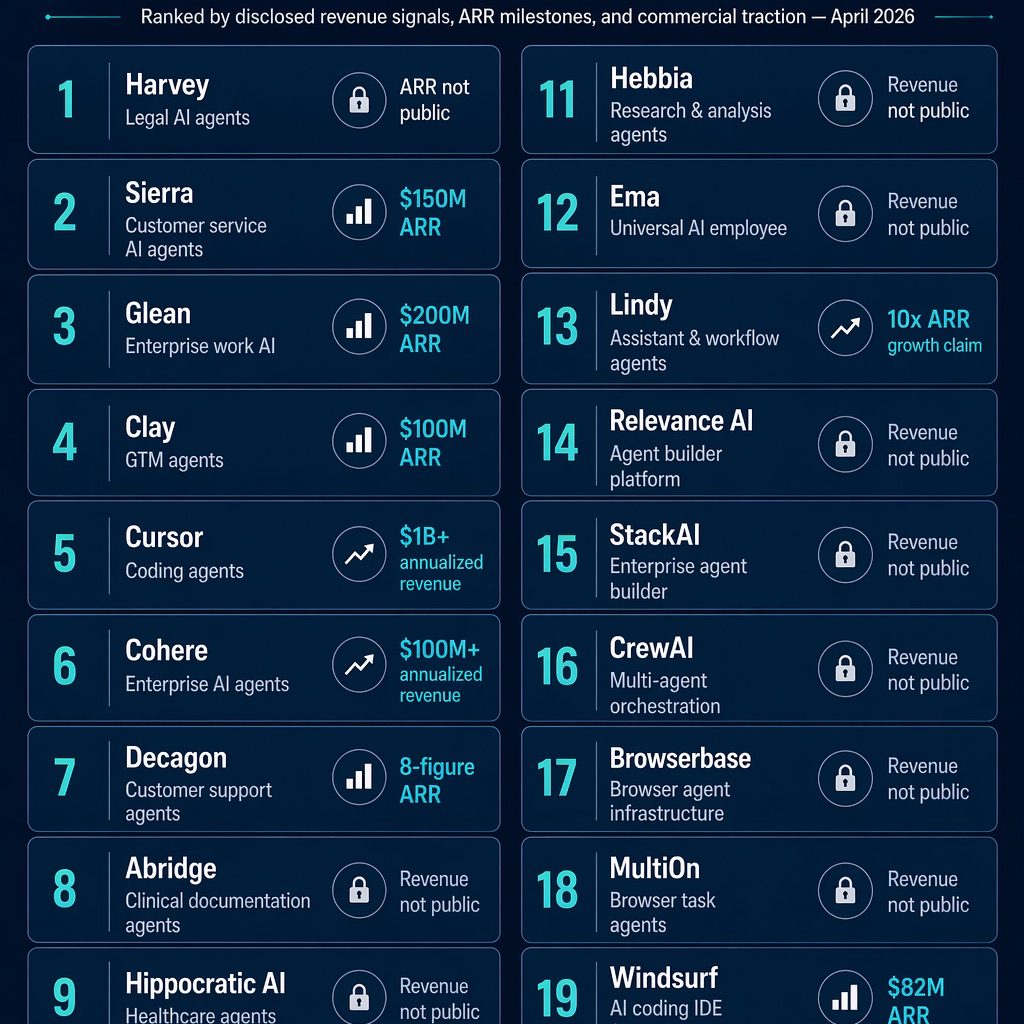

The AI agent era has entered a new phase. The conversation is no longer centered on whether agents are possible. It is now centered on which companies are turning agents into real businesses with real budgets, real workflows, and real customer dependence.

Get business pricing on tech for your team
- Business-only prices and quantity discounts
- Tax-exempt purchasing
- Multiple users, one account, clear invoices
That shift is happening in a larger market that is scaling at unusual speed. Menlo Ventures reported that enterprise generative AI spend reached $37 billion in 2025, up sharply from prior years, and that the application layer captured the largest share of that spending. That matters because agent startups live in that application layer, where the value is not just model access but workflow execution.
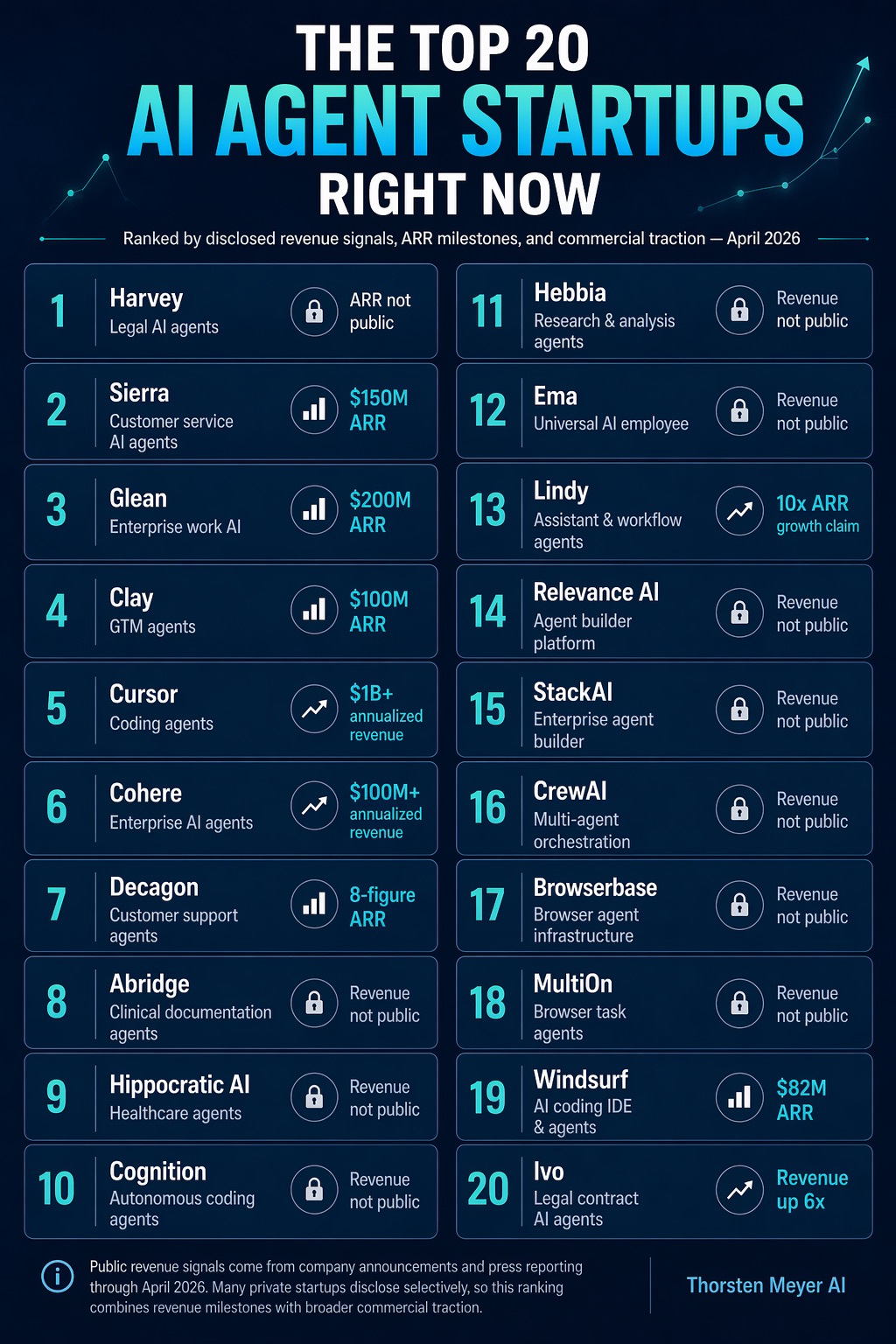
There is one important caveat before naming names. There is no single audited public leaderboard for “top AI agent startups by revenue.” Most of these companies are private. Some share ARR. Some share annualized run rate. Some share nothing at all, leaving investors and reporters to piece together momentum through funding rounds, customer adoption, and selective disclosures. So the smartest way to rank the category is not as a fake precision spreadsheet, but as a list of the startups with the strongest combination of revenue traction, product-market fit, and strategic importance in the AI agent stack.
1. Harvey
Harvey is one of the clearest examples of a vertical AI agent startup becoming a serious software company. Reuters reported on March 25, 2026 that Harvey raised $200 million at an $11 billion valuation, and specifically described its expansion around AI agents for legal work such as contract analysis, due diligence, compliance, and litigation tasks. That combination of domain depth, workflow ownership, and enterprise willingness to pay puts Harvey firmly in the top tier.
As an affiliate, we earn on qualifying purchases.
2. Sierra
Sierra has become one of the defining customer-facing AI agent companies. The company said it crossed $100 million ARR in seven quarters and then reached $150 million ARR by February 2026, driven by enterprise demand for customer service and engagement agents. In practical terms, Sierra is important because it represents one of the first big proof points that companies will trust agents in live customer conversations when the economics and experience are compelling enough.
AI-powered customer service chatbot
As an affiliate, we earn on qualifying purchases.
As an affiliate, we earn on qualifying purchases.
3. Glean
Glean started as enterprise search, but it has expanded into a broader enterprise AI and agent platform. Reuters reported in 2025 that Glean reached a $7.2 billion valuation, and the company later said it had doubled to $200 million ARR by December 2025. Glean’s strategic position is unusually strong because it sits on top of enterprise knowledge, which makes it a natural control point for internal agents that need trusted context across documents, apps, and teams.
As an affiliate, we earn on qualifying purchases.
4. Clay
Clay is one of the strongest examples of AI agents reshaping go-to-market operations. The company has said it crossed $100 million ARR and has framed itself as an operating layer for sales and growth teams rather than just a prospecting tool. That distinction matters. The more agent startups move from “assist” to “run workflows,” the more defensible they become. Clay is already there.
As an affiliate, we earn on qualifying purchases.
5. Cursor
Cursor has become one of the most commercially important agent-style companies in software. Reuters reported in 2025 that Cursor reached $100 million in recurring revenue at exceptional speed, and later reported it had crossed $1 billion in annualized revenue in late 2025. Whether you define Cursor as an AI coding copilot or an increasingly agentic software creation platform, the market has already decided one thing: developers will pay for systems that meaningfully compress time to output.
6. Cohere
Cohere is not just a model company anymore. Reuters reported in May 2025 that Cohere crossed $100 million in annualized revenue, with strong enterprise traction tied to secure deployments and enterprise AI products. Its relevance to the agent category comes from where enterprise demand is going: companies want deployable AI systems that can operate inside sensitive workflows, not just model access.
7. Decagon
Decagon has emerged as one of the strongest customer support agent startups. Reuters reported in June 2025 that Decagon raised $131 million at a $1.5 billion valuation, and the company said it had grown from zero to eight-figure ARR over the prior year. That profile makes Decagon one of the clearest pure-play AI agent companies in the market.
8. Abridge
Abridge is a reminder that some of the most powerful AI agent businesses do not look flashy at first glance. In healthcare, documentation, reimbursement, and clinician workflow are painfully expensive bottlenecks. Reuters reported that Abridge raised $300 million at a $5.3 billion valuation in June 2025, reflecting how valuable workflow automation becomes when it is embedded in mission-critical systems.
9. Hippocratic AI
Hippocratic AI sits in one of the hardest and most valuable verticals for agent systems: healthcare. Reuters reported in November 2025 that the company reached a $3.5 billion valuation. Its importance is not just funding scale. It signals that specialized, safety-oriented, healthcare-native agents are becoming one of the most investable categories in AI.
10. Cognition
Cognition matters because it pushed the category from “copilot” toward “AI worker.” Its acquisition of Windsurf, reported by Reuters in July 2025, underlined how strategic the coding-agent market has become. Even where product definitions remain blurry, the commercial direction is clear: software engineering is becoming one of the first major domains where agent systems can produce high-value work repeatedly.
11. Hebbia
Hebbia stands out in research-heavy work where the real challenge is not chatting with a model but navigating huge bodies of unstructured information. That is why it has become so relevant in law, finance, and complex analysis. Hebbia’s positioning shows a larger truth about AI agents: the best ones are not generic. They are shaped around a narrow, high-value job to be done.
12. Ema
Ema’s “Universal AI Employee” framing is ambitious, but it aligns closely with where enterprise buyers are heading. Companies increasingly want agents that can support customer support, internal operations, employee help desks, and cross-functional workflows inside a governed system. That is a much more important market than general-purpose chatbot novelty.
13. Lindy
Lindy represents the fast-moving assistant-to-agent segment for founders, operators, and smaller teams. Its significance is not that it is bigger than Harvey or Sierra. It is that it reflects a second wave of agent adoption: not just enterprise platform deals, but lighter-weight agent tools that can automate real business tasks for individuals and SMBs.
14. Relevance AI
Relevance AI belongs on this list because it is focused on helping companies build agent workforces for sales, onboarding, expansion, and customer operations. It is one of the clearest signals that enterprises do not just want one assistant. They want systems of role-based agents that can operate across departments.
15. StackAI
StackAI matters because enterprise AI deployment is increasingly an orchestration and governance problem. The companies that win in this layer may not be the loudest, but they help determine whether agents can be deployed safely across large organizations. That makes them strategically important, even when their public revenue disclosures are thinner.
16. CrewAI
CrewAI has become one of the most recognizable names in multi-agent orchestration. The reason it matters is simple: as soon as a company wants more than a single-task bot, it needs coordination, workflow logic, controls, and observability. Multi-agent systems are not the whole future, but they are clearly part of it.
17. Browserbase
Browserbase is one of the strongest examples of agent infrastructure becoming its own market. Many useful agents still need to interact with websites, dashboards, portals, and tools that do not expose clean APIs. That makes browser-native infrastructure strategically valuable because it enables action, not just reasoning.
18. MultiOn
MultiOn remains one of the better-known web-task agent startups. It embodies one of the category’s core ideas: an agent should not stop at answering a question if it can navigate the web, complete steps, and deliver an outcome. That thesis still has enormous upside, even if the category is still maturing.
19. Windsurf
Windsurf deserves recognition because it showed there is room for multiple scaled winners in AI coding. Reuters reported that Windsurf had reached $82 million ARR and more than 350 enterprise customers before Cognition moved to acquire it. That is a meaningful commercial signal in one of the fastest-moving segments of the entire software industry.
20. Ivo
Ivo is an important late addition because it highlights how fast legal AI is broadening beyond a single breakout leader. Reuters reported in January 2026 that Ivo raised $55 million, that its revenue had grown sixfold since its prior funding, and that major customers included Uber, Shopify, IBM, Reddit, and Canva. It is smaller than Harvey, but its momentum is strong enough to make it one of the more credible emerging agent companies in legal workflows.
What This List Really Reveals
The biggest takeaway is that “AI agents” is not one market. It is several markets converging under one label.
One part of the market is customer-facing agents, where Sierra and Decagon are proving that service and support can become an agent-native software category. Another is workflow intelligence, where Harvey, Hebbia, Abridge, and Hippocratic AI show that document-heavy and compliance-heavy industries are ideal for vertical agents. A third is coding agents, where Cursor, Cognition, and Windsurf demonstrate that developers will pay at extraordinary scale when the software actually saves time and increases output.
What ties these winners together is not that they use LLMs. Almost everyone does. What ties them together is that they sit close to measurable outcomes. They save labor. They unlock revenue. They reduce response time. They compress documentation cycles. They shorten engineering loops. In other words, they do not sell intelligence as spectacle. They sell it as operational leverage.
That is also why revenue quality matters more than hype. A startup can look exciting on social media and still fail to become essential software. But when a company is deeply embedded in legal review, healthcare documentation, customer support, enterprise search, or code production, it starts to matter in a much more durable way. That is where the real AI agent businesses are emerging.
The Bigger Thesis
The most important shift in AI is not that models are getting better. It is that software is being rebuilt around action.
For a long time, software was built around interfaces that waited for humans to click, search, review, and submit. Agent startups are changing that pattern. The best ones are turning software into a system that can observe context, make bounded decisions, and complete meaningful work inside real tools and real business processes.
That is why this category matters so much. If chat was the first consumer-friendly expression of generative AI, then agents are becoming the first enterprise-grade expression of it. And the companies on this list are the ones most aggressively trying to define what that market looks like before the incumbents lock it down.
Closing Thought
The top AI agent startups are not winning because they say the word “agent” the loudest. They are winning because they have found workflows where autonomy is useful, governable, and economically obvious.
That is the real dividing line in 2026. Not AI versus non-AI. Not chatbot versus chatbot. But software that can meaningfully act versus software that still waits to be used.
If you publish this on Thorsten Meyer AI, it will work best as a thought-leadership piece rather than a literal audited revenue ranking. That is the intellectually honest framing, and it is also the more interesting one.
Fall Picks
fall essentials
As an affiliate, we earn on qualifying purchases.