
The European sovereign-LLM essay track has reached a natural saturation point at ten essays. Six institutional answers documented (AMÁLIA Portuguese national continuation · Minerva Italian national from-scratch · OpenEuroLLM pan-European consortium · Mistral French commercial-frontier · Aleph Alpha German enterprise-sovereignty pivot · Apertus Swiss federal-research-institution). Four integrative analyses crystallized (Portfolio synthesis · EuroHPC compute substrate · Schwarz Group industrial-anchor · Spanish ALIA national-continuation pattern). The empirical evidence base for the major operational dimensions of the European sovereign-AI strategic landscape is substantially complete as of mid-May 2026 — twelve weeks before the August 2 EU AI Act enforcement window opens and approximately six weeks before AI Gigafactory selection decisions begin shipping. The next genuinely additive editorial work depends on external events that haven’t happened yet. The discourse should sit with the ten-essay framework through summer 2026 rather than dilute it with completionist extensions.
By Thorsten Meyer — May 2026
This is the eleventh standalone essay in the European sovereign-LLM track — and the closing-bracket piece that names what the framework is and what comes next. Essay 07 · the synthesis framework crystallized seven structural findings and five strategic recommendations from the first six institutional answers. The three subsequent Tier 2 expansions (Essay 08 · EuroHPC compute substrate, Essay 09 · Schwarz Group industrial-anchor model, Essay 10 · Spanish ALIA national-continuation pattern) extended the framework along three structurally distinct dimensions: the infrastructure substrate, the industrial-capital scaling question, and the geographic coverage completion. This piece is structurally different. It is the track-level meta-analysis — Essay 11 as the closing bracket to Essay 07’s opening bracket of the synthesis framework. It names the saturation point, evaluates what the ten-essay framework covers comprehensively versus what it does not, and crystallizes what the next operational moment will require beyond what the framework can produce.
The structural argument I want to make: saturation is not failure — it is editorial discipline. The track was always finite. The empirical evidence base for the major operational dimensions of the European sovereign-AI strategic landscape was always going to plateau before the August 2 enforcement window opens and the AI Gigafactory selection decisions ship. The honest editorial decision is to recognize the saturation point and let the framework breathe through summer 2026 rather than dilute it with completionist extensions. Bertelsmann + IKEA Group + Bosch deep-dives are structurally available but not yet structurally necessary — they would extend the Schwarz Group five-preconditions framework horizontally without producing structurally new findings beyond what Essay 09 already crystallized. The discourse should sit with the ten-essay framework through summer 2026.
The headline retrospective finding: the ten-essay framework is the most comprehensive editorial coverage of the European AI strategic landscape currently available — and it is structurally complete for the empirical evidence available as of mid-May 2026. The next genuinely additive editorial work depends on three external events that haven’t happened yet: the August 2, 2026 EU AI Act enforcement window opening (twelve weeks away), the June-August 2026 AI Gigafactory selection decisions shipping, and the Q4 2026 institutional follow-ups (Cohere-Aleph Alpha Command-Pharia 1 release, Apertus domain-specific versions, EuroHPC Federation Platform Q4 release, additional Schwarz Group commitment expansions). The ten-essay framework has done what it can with the evidence available. Returning to the track after these external events ship will produce structurally new findings; extending it horizontally now would not.
This piece walks the retrospective: what the ten-essay framework covers comprehensively, what it does not cover, what saturation means structurally, what the next operational moment will require, and what the editorial discipline of declaring the track closed at ten essays implies for the European sovereign-AI strategic discourse through summer 2026.
Saturation.
The ten-essay
framework, closed.
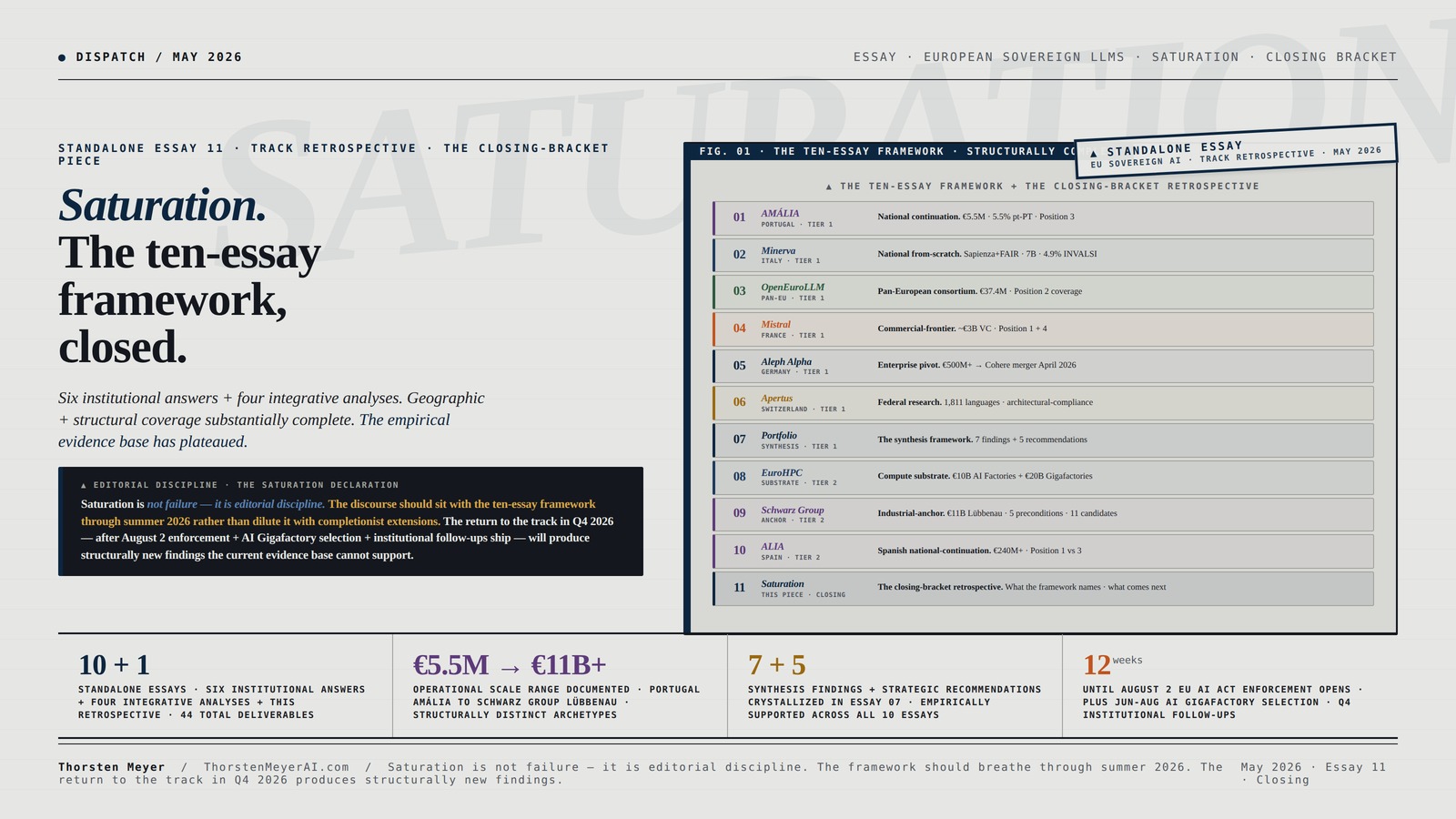
Six institutional answers + four integrative analyses. Geographic + structural coverage substantially complete. The empirical evidence base for the major operational dimensions has plateaued. The next genuinely additive editorial work depends on external events that haven’t happened yet.
This is the eleventh standalone essay in the European sovereign-LLM track — the closing-bracket piece. The framework is structurally complete for the empirical evidence available as of mid-May 2026. AMÁLIA Portuguese · ALIA Spanish · Schwarz Group industrial-anchor. Minerva Italian · EuroHPC compute substrate. OpenEuroLLM pan-European consortium. Mistral French commercial-frontier. Aleph Alpha German enterprise-sovereignty pivot. Apertus Swiss federal-research-institution. Saturation is not failure — it is editorial discipline. Bertelsmann + IKEA Group + Bosch deep-dives are structurally available but not yet structurally necessary. The discourse should sit with the ten-essay framework through summer 2026 rather than dilute it with completionist extensions. The return to the track in Q4 2026 will produce structurally new findings the current evidence base cannot support.
Ten essays. Closing bracket.
The complete ten-essay framework as the structural reference point for the European sovereign-AI strategic discourse through summer 2026. Six institutional answers across structurally distinct archetypes + four integrative analyses across structurally distinct dimensions. The closing-bracket retrospective (this piece) names what the framework covers and what it does not.
continuation
from-scratch
consortium
frontier
pivot
research
framework
substrate
anchor
continuation
bracket
European sovereign AI strategy books
As an affiliate, we earn on qualifying purchases.
As an affiliate, we earn on qualifying purchases.
Three gaps. Named explicitly.
Editorial discipline requires naming what the framework does not cover. Three structural gaps the ten-essay track does not address — and the structural reasons each gap exists. Recognizing the gaps explicitly prevents the framework from claiming coverage it does not actually provide.

The future of European competitiveness: Part B: In-depth analysis and recommendations
As an affiliate, we earn on qualifying purchases.
As an affiliate, we earn on qualifying purchases.
Five events. Q4 2026 return.
The five external events that will produce structurally new findings the current evidence base cannot support. Returning to the track after these events ship will be genuinely additive; extending it now would be completionist. The editorial discipline of declaring saturation now preserves the structural integrity of the return.
The work is real across the ten-essay framework. Six institutional answers documented. Four integrative analyses crystallized. Seven structural findings + five strategic recommendations from the synthesis essay. Three Tier 2 expansion dimensions completing the geographic and structural coverage. The saturation point is also real. The empirical evidence base for the major operational dimensions is substantially complete. The next genuinely additive editorial work depends on external events that haven’t happened yet. Both can be true at once. Recognizing the saturation point now is the editorial discipline that prevents the framework from drifting into completionism — and that preserves the structural integrity of what the ten essays have crystallized.

Navigating the EU AI Act: The Annotated Regulation
As an affiliate, we earn on qualifying purchases.
As an affiliate, we earn on qualifying purchases.
I · What the ten-essay framework covers comprehensively
The empirical evidence base the ten essays produce. The framework operates across four structurally distinct dimensions:
Dimension 1 · The six institutional answers · structurally distinct European AI project archetypes
The first six standalone essays documented six structurally distinct institutional answers to the European sovereign-AI question:
- Essay 01 · AMÁLIA (Portuguese national continuation) · €5.5M state funding · 1B-parameter fine-tune · 5.5% pt-PT linguistic specialization finding · Position 3 multilingual-specialization archetype
- Essay 02 · Minerva (Italian national from-scratch) · Sapienza + FAIR PNRR funding · 7B from-scratch training · 4.9% INVALSI improvement finding · Position 3 academic-research archetype
- Essay 03 · OpenEuroLLM (pan-European consortium) · €37.4M EU funding · Hajič compute statement · Position 2 multilingual-coverage archetype
- Essay 04 · Mistral (French commercial-frontier) · ~€3B venture capital cumulative · GPQA Diamond ~44% vs Gemini 91.9% · Position 1 attempt + Position 4 commercial-success archetype
- Essay 05 · Aleph Alpha (German enterprise-sovereignty pivot) · €500M+ → Cohere merger April 2026 · Andrulis Handelsblatt quote · retrospective enterprise-pivot archetype
- Essay 06 · Apertus (Swiss federal-research-institution) · CSCS + EPFL + ETH consortium · 1,811 languages · retroactive opt-out compliance · MMLU-Pro 31.14% · federal-research architectural-compliance archetype
The structural coverage: the six archetypes span the operational scale (€5.5M to €3B) and institutional structure (national continuation, national from-scratch, pan-European consortium, commercial-frontier venture-capital, enterprise-sovereignty pivot, federal-research-institution) range of the European sovereign-AI strategic landscape. No additional institutional archetype that the framework does not already document would produce structurally new findings on the institutional-structure question — the variations on these six are precisely what the Spanish ALIA case extends (Essay 10) and what the Bertelsmann/IKEA/Bosch deep-dives would extend on the industrial-anchor question.
Dimension 2 · The Portfolio synthesis · seven findings + five recommendations
Essay 07 · the synthesis framework crystallized the integrative observations across the six institutional answers:
Seven structural findings:
- The structural capability gap is real and consistent across all six institutional models
- Position 3 + Position 4 strategic positioning is operationally credible at European scales
- Partnership architecture is the operational structure that scales
- Compliance can be architectural, not policy-layer (Apertus template)
- The August 2 enforcement window is the operational moment for the European sovereign-AI movement
- European industrial capital can sustain AI infrastructure at scales venture capital and public funding cannot match independently
- The portfolio approach is structurally superior to picking single winners
Five strategic recommendations:
- Recognize partnership architectures explicitly in European AI policy
- Adopt Apertus-style architectural compliance as reference standard
- Establish the industrial-anchor investment model at scale beyond Germany
- Stop pursuing Position 1 as strategic objective
- Build a portfolio approach that supports all six institutional structures
The structural coverage: the synthesis framework crystallizes the integrative findings the six institutional answers produce. Additional individual documentations would extend the evidence base for these findings without producing structurally new findings — the marginal value of additional documentation is exhausted at the seven-finding crystallization point.
Dimension 3 · The three Tier 2 expansions · structural-dimension completion
Three Tier 2 expansion essays extended the framework along three structurally distinct dimensions that the six institutional answers did not address directly:
- Essay 08 · EuroHPC compute substrate · €10B AI Factories + €20B AI Gigafactories framework · 19 AI Factories + 13 Antennas · TOP500 flagship systems · three structural complications (hardware heterogeneity, hub-and-spoke concentration, scale-tier bifurcation) · the infrastructure substrate underlying every project in the seven-essay framework
- Essay 09 · Schwarz Group industrial-anchor model · €11B Lübbenau commitment + €500M Cohere Series E + €500M+ Aleph Alpha + 1.5GW contracted power by 2028 · five replication preconditions framework · 11 candidate European corporates evaluated · interrogating Recommendation 3 empirically
- Essay 10 · Spanish ALIA national-continuation pattern · €240M+ public funding · ALIA-40B + Salamandra family · Position 1 vs Position 3 interrogation · benchmark evidence empirically confirming Finding 1 · Martorell’s “most widely adopted in the Spanish-speaking world” framing
The structural coverage: these three Tier 2 expansions extend the framework along the three dimensions the six institutional answers did not address directly — infrastructure substrate, industrial-capital scaling, and geographic coverage completion. Adding additional Tier 2 expansions along the same dimensions would extend the framework horizontally without producing structurally new findings.
Dimension 4 · The geographic + structural coverage matrix
The ten essays span the major European sovereign-AI strategic landscape across both geographic and institutional structure dimensions:
Geographic coverage: Portugal (AMÁLIA) · Italy (Minerva) · France (Mistral) · Germany (Aleph Alpha + Schwarz Group) · Switzerland (Apertus) · Spain (ALIA) · pan-European (OpenEuroLLM + EuroHPC compute substrate) · plus the synthesis framework integrating all geographic answers.
Institutional structure coverage: national continuation (AMÁLIA + ALIA) · national from-scratch (Minerva) · pan-European consortium (OpenEuroLLM) · commercial-frontier (Mistral) · enterprise-sovereignty pivot (Aleph Alpha) · federal-research-institution (Apertus) · industrial-anchor model (Schwarz Group) · compute substrate framework (EuroHPC) · plus the portfolio synthesis integrating all structures.
Major European countries NOT covered with individual essays: the Netherlands, Belgium, Sweden, Denmark, Finland, Norway, Austria, Poland, Czech Republic, Romania, Hungary, Greece, and the smaller EU member states. None of these countries operates a national-AI project at the scale or structural distinctiveness that would warrant individual essay treatment — the Nordic countries participate through the EU OpenEuroLLM consortium and the LUMI AI Factory infrastructure, the Central European countries through EuroHPC participation, and the smaller member states through AI Factory Antennas (covered in Essay 08).
AI Gigafactory construction kit
As an affiliate, we earn on qualifying purchases.
As an affiliate, we earn on qualifying purchases.
II · What the ten-essay framework does not cover · the honest gaps
The structural gaps the framework leaves unaddressed. Honest editorial discipline requires naming them explicitly.
Gap 1 · Specific Tier 2 expansion candidates not yet documented
Three structurally available Tier 2 expansion essays were not produced:
- Bertelsmann deep-dive · 4/5 replication preconditions match · Bertelsmann Stiftung 80%+ foundation ownership · ~€20B revenue · RTL Group + Penguin Random House + BMG + Arvato · the strongest ownership-structure match to Schwarz Group’s industrial-anchor model
- IKEA Group deep-dive · 3/5 preconditions · Stichting INGKA Foundation · €40B+ revenue · 240,000 employees · global retail scale · no sovereign-cloud subsidiary yet built
- Bosch industrial-IoT vertical-specialization deep-dive · 3/5 preconditions · Robert Bosch Stiftung 92% · ~€90B revenue · MindSphere + Bosch.IO · industrial-IoT vertical-specialization sub-model
The structural reason these were not produced: they would extend the Schwarz Group five-preconditions framework horizontally to specific candidate corporates without producing structurally new findings beyond what Essay 09 already crystallized. The five-preconditions framework + 11-candidate evaluation matrix in Essay 09 is the structural analysis these deep-dives would specifically apply to individual corporates. Each individual deep-dive would produce a corporate-specific implementation analysis that extends Essay 09 vertically — useful but not structurally additive at the framework level.
Gap 2 · External events that haven’t happened yet
Five structurally important upcoming events that the framework cannot address before they ship:
- August 2, 2026 EU AI Act enforcement window opening · twelve weeks from this essay’s publication · Commission enforcement powers enter application for GPAI model providers · operational evidence not yet available
- June-August 2026 AI Gigafactory selection decisions · approximately six weeks from this essay’s publication · 76 expressions of interest evaluated · selected Member States announced · operational evidence not yet available
- Q4 2026 Cohere-Aleph Alpha integration progress · Command-Pharia 1 launch · STACKIT 5-year exclusivity operational implementation · Aleph Alpha Heidelberg center of excellence operationalization · operational evidence not yet available
- Late 2026 / 2027 Apertus domain-specific versions · law-specific, climate-specific, health-specific, education-specific Apertus variants · operational evidence not yet available
- Q4 2026 EuroHPC Federation Platform second release · additional EFP components shipping · MareNostrum 5 AI upgrade installation completion · operational evidence not yet available
The structural reason these gaps exist: the framework operates with the empirical evidence available as of mid-May 2026. External events that have not happened cannot be analyzed empirically. Speculative analysis would extend the framework beyond its empirical foundation — which is structurally weaker than acknowledging the gap and returning to it after the events ship.
Gap 3 · Dimensions the framework does not address structurally
Three structural dimensions the ten-essay framework does not address directly:
- The European AI policy implementation reality · how the EU AI Act actually plays out across the ten-essay framework projects · structural distinctions between de jure and de facto enforcement · operational evidence available only after August 2, 2026
- The European AI safety + alignment research landscape · ELLIS · AISI UK · AISI France · the structural relationship between sovereign-AI policy and AI safety research · the framework focused on capability and deployment rather than safety architecture
- The European AI talent + capital migration dynamics · the structural relationship between European sovereign-AI investment and the talent + capital migration patterns toward US frontier developers · operational evidence partially available but structurally distinct dimension not addressed in the ten-essay framework
The structural reason these gaps exist: the framework is the European sovereign-LLM track specifically. It documents the institutional answers, the infrastructure substrate, the industrial-anchor model, the synthesis framework, and the geographic coverage. It is not the comprehensive European AI policy + safety + talent framework. Those are structurally distinct editorial frameworks that the ten-essay track does not attempt to be.
III · What saturation means structurally · the editorial discipline argument
The structural argument the saturation observation produces. Editorial discipline requires recognizing when the framework has done what it can with the evidence available.
Saturation is not failure · it is editorial discipline
The European sovereign-LLM track was always finite. The institutional answers were always a defined set. The integrative analyses were always going to crystallize at the framework level. The Tier 2 expansions were always going to be selective. The empirical evidence base for the major operational dimensions was always going to plateau before the next external events ship.
Recognizing the saturation point is the editorial decision that prevents the framework from drifting into completionist territory. Bertelsmann + IKEA Group + Bosch deep-dives are structurally available but not yet structurally necessary. Adding them would extend the Schwarz Group five-preconditions framework horizontally without producing structurally new findings beyond what Essay 09 already crystallized. The honest editorial decision is to declare the track closed at ten essays and return to it after the August 2 enforcement evidence arrives.
Three operational benefits of declaring the saturation point:
- The ten-essay framework can breathe · the strategic discourse can integrate the framework through summer 2026 without competing with additional Tier 2 expansions that dilute the focus
- The framework is recognizably complete · ten essays is a clean editorial boundary that signals “this is the framework” rather than “this is an ongoing series” — the recognizability matters for adoption
- The return after summer 2026 produces structurally new findings · the August 2 enforcement evidence, the AI Gigafactory selection decisions, and the Q4 2026 institutional follow-ups will each produce structurally new findings that justify additional essays — preserving editorial discipline now means the return after summer 2026 is genuinely additive rather than completionist
What returning to the track in Q4 2026 will produce structurally
The genuinely additive editorial work that the next operational moment will require:
- Essay 12 (potential) · The August 2 enforcement reality post-launch · empirical analysis of how the EU AI Act actually plays out across the ten-essay framework projects · which providers face Commission enforcement actions · which fact-checking + transparency obligations operationally bind · structurally distinct from speculative pre-enforcement analysis
- Essay 13 (potential) · The AI Gigafactory selection coverage · once Jun-Aug 2026 selections ship publicly · which Member States host the 5 selected Gigafactories · which corporate consortia + research institutions form the operational structures · structurally distinct from pre-selection speculation
- Essay 14 (potential) · The Cohere-Aleph Alpha integration Q4 post-mortem · once Command-Pharia 1 ships · how the STACKIT 5-year exclusivity operationally implements · whether the transatlantic AI alliance produces structurally new institutional architecture or fragments back to two distinct firms
Each of these prospective essays operates on external operational evidence that has not yet shipped. Returning to the track after the evidence ships produces structurally new findings. Extending the track horizontally now does not.
The strategic-discourse implication
The ten-essay framework should be the structural reference point for the European sovereign-AI strategic discourse through summer 2026. European AI policymakers, industrial-capital allocators, research institutions, and AI developers should integrate the framework’s seven structural findings + five strategic recommendations + three Tier 2 expansion dimensions + the Spanish ALIA Position 1 vs Position 3 interrogation as the empirical evidence base for strategic decisions through August 2.
The framework is structurally complete for this purpose. The integrative findings are crystallized. The Tier 2 expansions extend along the three structurally distinct dimensions (infrastructure substrate, industrial-anchor scaling, geographic coverage completion). The geographic + institutional structure coverage matrix is comprehensive across the major European member states and structural archetypes. Additional individual documentations would extend the framework horizontally without producing structurally new findings at the policy-relevant level.
IV · The closing-bracket argument · what the ten-essay framework names
The integrative observation the retrospective produces. The ten-essay framework names what the European sovereign-AI strategic landscape is as of mid-May 2026 — twelve weeks before the August 2 enforcement window opens.
Summary of the ten-essay framework as the structural reference point:
- Essay 01 · AMÁLIA · the Portuguese national-continuation answer · €5.5M scale · Position 3 specialization · 5.5% pt-PT improvement finding
- Essay 02 · Minerva · the Italian national-from-scratch answer · Sapienza + FAIR PNRR · 7B model · 4.9% INVALSI improvement
- Essay 03 · OpenEuroLLM · the pan-European consortium answer · €37.4M · Position 2 multilingual coverage
- Essay 04 · Mistral · the French commercial-frontier answer · ~€3B VC · Position 1 attempt + Position 4 commercial success
- Essay 05 · Aleph Alpha · the German enterprise-sovereignty pivot answer · €500M+ → Cohere merger
- Essay 06 · Apertus · the Swiss federal-research-institution answer · architectural-compliance template
- Essay 07 · Portfolio · the synthesis framework · seven structural findings + five strategic recommendations
- Essay 08 · EuroHPC · the compute substrate analysis · three structural complications + AI Gigafactory framework
- Essay 09 · Schwarz Group · the industrial-anchor model interrogation · five-preconditions replication framework
- Essay 10 · ALIA · the Spanish national-continuation pattern · Position 1 vs Position 3 interrogation
- Essay 11 (this piece) · Saturation · the retrospective closing-bracket · what the ten-essay framework names and what comes next
The integrative finding crystallized at the framework level: the European sovereign-AI strategic landscape as of mid-May 2026 operates across a portfolio of six institutional structures at structurally distinct scales (€5.5M Portugal AMÁLIA → €240M+ Spain ALIA → €3B Mistral commercial-frontier → €11B+ Schwarz Group industrial-anchor → €20B InvestAI AI Gigafactory framework). Each institutional structure serves different operational requirements at different scales. The portfolio approach is structurally superior to picking single winners — Recommendation 5 from Essay 07 is the operational implication that all ten essays empirically support.
The August 2 enforcement window remains twelve weeks away. The June 2026 AI Gigafactory selection process runs in parallel. The Q4 2026 institutional follow-ups (Cohere-Aleph Alpha Command-Pharia 1 + Apertus domain-specific versions + EuroHPC Federation Platform Q4 release) will produce structurally new evidence the framework cannot anticipate now. The ten-essay framework is what the discourse should integrate through summer 2026. Returning to the track in Q4 2026 will produce structurally new findings that the current evidence base cannot support.
For European sovereign-AI strategic discourse specifically, the saturation declaration adds three concrete operational implications:
- The ten-essay framework is the structural reference point · the empirical evidence base is substantially complete for the major operational dimensions · European AI policymakers, industrial-capital allocators, research institutions, and AI developers should integrate it as the structural reference through summer 2026
- Additional individual documentations would dilute rather than extend the framework · Bertelsmann, IKEA Group, Bosch deep-dives are structurally available but would extend horizontally without producing new findings · the editorial discipline of declaring saturation prevents drift into completionism
- The return to the track in Q4 2026 will produce structurally new findings · the August 2 enforcement evidence + AI Gigafactory selection decisions + Q4 2026 institutional follow-ups will each justify additional essays that operationally evidence the next phase of the European sovereign-AI strategic landscape
That’s the read on the ten-essay European sovereign-LLM track retrospective as of mid-May 2026 — twelve weeks before the August 2 enforcement window opens and approximately six weeks before AI Gigafactory selection decisions begin shipping. The work is real across the ten-essay framework. Six institutional answers documented · synthesis framework crystallized · compute substrate analyzed · industrial-anchor model interrogated · Spanish national-continuation pattern documented. The saturation point is also real. The empirical evidence base for the major operational dimensions is substantially complete · additional individual documentations would extend horizontally without producing structurally new findings · the next genuinely additive editorial work depends on external events that haven’t happened yet. Both can be true at once.
The European sovereign-AI strategic discourse should sit with the ten-essay framework through summer 2026. The return to the track after the August 2 enforcement evidence ships, after the AI Gigafactory selection decisions arrive, and after the Q4 2026 institutional follow-ups operationalize will produce structurally new findings. Recognizing the saturation point now is the editorial discipline that prevents the framework from drifting into completionism — and that preserves the structural integrity of what the ten essays have crystallized.
The August 2 enforcement window is twelve weeks away. The AI Gigafactory selection timeline is operationally active. The MareNostrum 5 AI upgrade is underway. The Lübbenau campus is under construction. The Federation Platform Q4 release is scheduled. The ten-essay framework is what the discourse should integrate before all five external events arrive.
About the Author
Thorsten Meyer is a Munich-based futurist, post-labor economist, and recipient of OpenAI’s 10 Billion Token Award. He spent two decades managing €1B+ portfolios in enterprise ICT before deciding that writing about the transition was more useful than managing quarterly slides through it. More at ThorstenMeyerAI.com.
Related Reading · the European sovereign-LLM essay track · the complete framework
- AMÁLIA · The Three Hard Questions — Standalone Essay 01 · Portuguese national continuation
- Minerva · The Opposite Path — Standalone Essay 02 · Italian national from-scratch
- OpenEuroLLM · The Third Path — Standalone Essay 03 · pan-European consortium
- Mistral · The Fourth Path — Standalone Essay 04 · commercial-frontier
- Aleph Alpha · The Retrospective Case — Standalone Essay 05 · enterprise-sovereignty pivot
- Apertus · The Architectural Template — Standalone Essay 06 · federal-research-institution
- Portfolio · The Synthesis — Standalone Essay 07 · synthesis framework · 7 findings + 5 recommendations
- EuroHPC · The Compute Substrate — Standalone Essay 08 · compute substrate analysis
- Anchor · The Schwarz Group Model — Standalone Essay 09 · industrial-anchor interrogation
- ALIA · The Spanish Answer — Standalone Essay 10 · Spanish national-continuation pattern
- This piece — Standalone Essay 11 · Saturation · the retrospective closing-bracket · what the ten-essay framework names
Sources
The ten prior essays · the framework itself
The empirical evidence base for this retrospective is the ten prior standalone essays. Each essay’s source dossier crystallizes the operational evidence the framework integrates. This piece does not introduce new external sources — it operates as a retrospective synthesis of the ten-essay framework itself.
Key reference figures crystallized across the ten-essay framework
- Six institutional answers documented · AMÁLIA (Portugal) · Minerva (Italy) · OpenEuroLLM (pan-EU) · Mistral (France) · Aleph Alpha (Germany) · Apertus (Switzerland)
- Four integrative analyses · Portfolio synthesis · EuroHPC compute substrate · Schwarz Group industrial-anchor · Spanish ALIA national-continuation
- Operational scale range · €5.5M (AMÁLIA) to €11B+ (Schwarz Group Lübbenau commitment)
- Geographic coverage · 7 EU member states + Switzerland + pan-European consortium + EuroHPC substrate
- Total cumulative public funding · €240M+ (Spain) + €37.4M (OpenEuroLLM) + €5.5M (Portugal) + €10B (EuroHPC 2021-2027) + €20B (InvestAI Facility) + €55M (AI Factory Antennas)
- Total cumulative private + industrial capital · €3B+ (Mistral VC) + €500M+ (Aleph Alpha) + €11B+ (Schwarz Group) + €500M (Cohere Series E) + ~CHF 50M+ (Apertus implied scope)
- External events ahead · August 2, 2026 EU AI Act enforcement · Jun-Aug 2026 AI Gigafactory selection · Q4 2026 Cohere-Aleph Alpha Command-Pharia 1 · late 2026/2027 Apertus domain-specific versions · Q4 2026 EuroHPC Federation Platform second release
- Seven structural findings crystallized in Essay 07’s synthesis framework
- Five strategic recommendations crystallized in Essay 07’s synthesis framework
- Three Tier 2 expansion dimensions · infrastructure substrate (Essay 08) · industrial-anchor scaling (Essay 09) · geographic coverage completion (Essay 10)
- One closing-bracket retrospective · this piece · Essay 11 · the saturation declaration