
Prediction markets do something most software can’t: they put a price on the future. A contract trading at 62 cents is, in effect, a crowd of people with money on the line saying “this is about 62% likely.” That’s a remarkable thing — a continuously-updated, money-weighted probability for a question that hasn’t been answered yet.
Polybot is an open-source experiment that asks a simple, dangerous question about those prices: can an AI agent, reading the same public information, form a probability estimate good enough to disagree with the market — and should it ever act on the disagreement?
It’s a trading bot for Polymarket, and it’s just as much a risk lesson as it is a piece of trading software. So before anything else, the part that matters most:
This is not financial advice, and nothing here is a recommendation to trade, invest, or use this software. Automated trading carries a substantial risk of loss, up to and including all of your capital. Prediction-market access is legally restricted or prohibited in many jurisdictions (including for US persons), and it is entirely your responsibility to know what is lawful where you are. Polybot is experimental open-source code with no guarantee of accuracy, profitability, or fitness for any purpose. If you’re weighing anything in this space, treat it as risk capital you can afford to lose entirely, and talk to a qualified professional — I’m not one.
With that established plainly: it’s MIT-licensed and open source, at forezai.com/polybot.html and on GitHub. It opens the portfolio’s Markets family. Here’s what makes it interesting as an idea, and why the honest version of it is so heavily hedged.
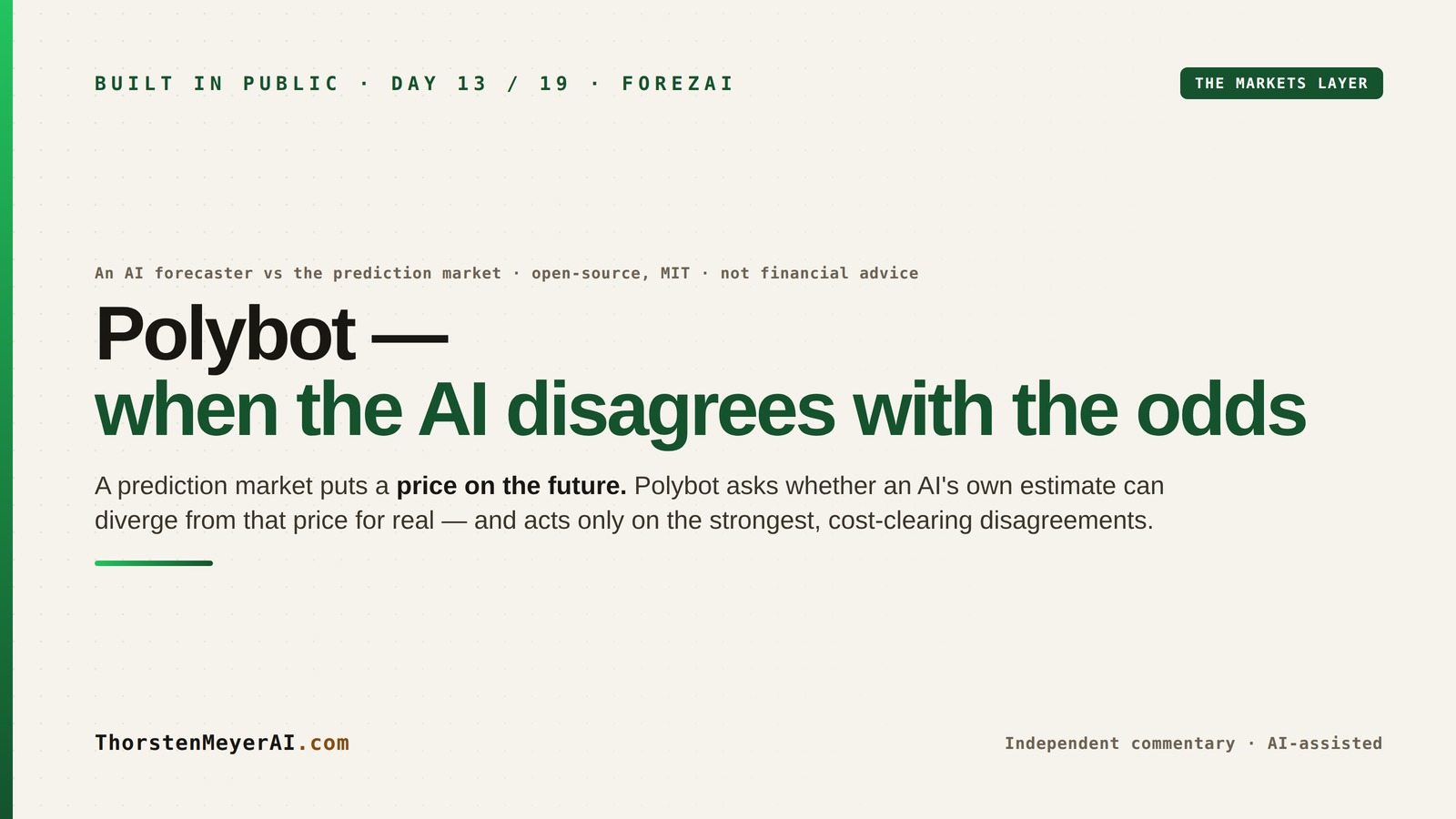
Polybot — when the AI disagrees with the odds
A prediction market puts a price on the future. Polybot asks: can an AI’s own estimate diverge from that price for real — and should it ever act on the gap?
Not financial, investment, legal or tax advice; not a recommendation or solicitation to trade, invest or use any software. Forezai · Polybot is experimental open-source software (MIT), provided “as is” without warranty of accuracy or profitability. Trading and automated trading carry a substantial risk of loss including total loss of capital; past or backtested performance does not indicate future results. Prediction-market participation is restricted or prohibited in some jurisdictions (including for US persons) — you are solely responsible for compliance with applicable law. Consult a licensed professional before any financial decision. Produced with AI assistance under human editorial oversight; independent commentary, the author’s own views. Product and company names are trademarks of their respective owners; mention does not imply endorsement.
The baseline: markets are hard to beat
Start with the humbling part, because any honest discussion of this has to. A market price already aggregates the information, opinions, and money of everyone trading it. That makes prices informationally dense and, much of the time, pretty good — which is exactly why beating them is hard. The default assumption for any system that claims to find an edge against a market should be skepticism, not excitement.
So the interesting question Polybot poses isn’t “how do we win.” It’s narrower and more honest: when, if ever, does an AI’s independent estimate diverge from the market price in a way that’s real rather than noise — and how do you act on that without fooling yourself? Most attempts to answer that end in the market being right and the clever system being wrong. That’s the prior worth keeping.

Use Claude to Build an AI Trading Bot: 90 Days with Stocks and Prediction Markets (AI Trading Bot Series Book 1)
As an affiliate, we earn on qualifying purchases.
As an affiliate, we earn on qualifying purchases.
The method: estimate versus price
Mechanically, the idea is clean. An AI agent researches a market’s question using public information, forms its own probability estimate, and compares that estimate to the market’s implied price. The gap between the two is the only thing that matters — the hypothesized edge.
The crucial design choice is what happens with that gap. A naive bot trades on every disagreement. A sane one treats the gap as a hypothesis and only acts when it’s large enough to clear a threshold that accounts for everything working against it: fees, slippage, the very real chance the model is simply wrong, and the base-rate likelihood that the market knows something the model doesn’t. And because Polybot is built on the portfolio’s provenance instinct, each estimate comes with the agent’s reasoning recorded — so a decision can be inspected after the fact, not just executed.
That auditability is the genuinely useful part, money aside. Being able to ask “why did it think this was mispriced?” — and read the answer — turns a black-box gambling machine into something closer to a forecasting notebook that occasionally acts.
It also points at the only honest way to judge a system like this: calibration over time, not the result of any single trade. One winning bet proves nothing — a stopped clock wins sometimes — and one loss disproves nothing either. The real question is whether, across hundreds of estimates, the things the AI calls 70% likely actually happen about 70% of the time. That’s a slow, unglamorous measurement that resists the temptation to declare victory after a lucky streak, and it’s the standard any serious version of this has to be held to. A bot that can’t show it’s calibrated is just a confident guesser with extra infrastructure.
Use Claude to Build an AI Trading Bot: 90 Days with Stocks and Prediction Markets (AI Trading Bot Series Book 1)
As an affiliate, we earn on qualifying purchases.
As an affiliate, we earn on qualifying purchases.
Risk-first, and mostly skip
Here’s the discipline that separates a research tool from a way to lose money quickly: the default action is to do nothing. Most markets, most of the time, should produce no trade — either because the AI’s estimate roughly agrees with the price, or because the disagreement isn’t big enough to survive costs and uncertainty.
That’s “edit by subtraction” pointed straight at trading, and it’s the hardest discipline in the whole domain. The instinct is to find action everywhere; the sane system finds it almost nowhere, sizes positions small against strict exposure limits, and treats not trading as the normal, correct outcome. A bot that trades constantly is a bot bleeding fees into noise. The valuable version trades rarely, small, and only on its strongest disagreements — and is honest that even those can be wrong.

AI + Prediction Markets: The New Edge: How to Use Artificial Intelligence Tools to Research, Scan, and Win in Prediction Markets (Markets Intelligence Series)
As an affiliate, we earn on qualifying purchases.
As an affiliate, we earn on qualifying purchases.
Why it’s an experiment, not a money machine
It would be dishonest to frame Polybot as anything other than a research artifact, and the reasons are worth stating because they’re the reasons most such systems disappoint.
Edge is a hypothesis, not a property. An AI’s confident estimate is still an estimate, and confidently-wrong is a normal failure mode for language models. Backtests flatter. A strategy that looks brilliant on history routinely dies on contact with live markets, because the past doesn’t include the slippage, the thin liquidity, and the ways a market adapts. Costs are merciless on thin edges — fees and slippage can quietly convert a small theoretical advantage into a steady loss. And markets are adversarial: anything that works tends to stop working as others find it.
The honest value here isn’t a return. It’s the methodology — a transparent, auditable way to pit an AI’s forecast against a market’s — plus the discipline it encodes, plus the fact that it’s open enough to learn from. Treat it as a way to study forecasting, not a way to fund a lifestyle.

Make: Arduino Bots and Gadgets: Six Embedded Projects with Open Source Hardware and Software (Learning by Discovery)
Used Book in Good Condition
As an affiliate, we earn on qualifying purchases.
As an affiliate, we earn on qualifying purchases.
The thesis fit
Polybot carries the portfolio’s spine cleanly. It’s local-first — it can run on owned compute, so the experiment costs compute rather than a subscription. It’s provider-agnostic — the forecasting model is swappable, which matters because no single model should be trusted as an oracle, least of all about the future. And it’s auditable, recording the reasoning behind each estimate, which is the only honest way to run anything that touches money.
On the constellation, it’s the first Markets node — the family where the portfolio’s instincts (open, local, provider-agnostic, disciplined) meet the most unforgiving possible test: a live, adversarial market that keeps score in cash.
The honest bear case
This section is longer than usual, on purpose. You can lose everything. Automated trading removes the human pause that sometimes saves you, and a bug, a bad assumption, or a confidently-wrong model can compound losses faster than you can react. Legality is not optional — prediction-market participation is restricted or banned in many places, and “the bot did it” is not a defense; know your jurisdiction before you go near it. AI forecasts carry no special authority — an LLM’s probability estimate can be worse than the market’s, and it will state a wrong number with the same fluency as a right one. Live results rarely match backtests. Thin edges die to fees. And there’s a behavioral trap: automation makes it easy to scale up a “working” system right before it stops working.
None of these are reasons the project is uninteresting. They’re reasons it should be approached as an experiment by people who can afford to lose what they put in, and never as a strategy presented to anyone as a path to returns.
The bull case, plainly — measured
With every one of those caveats standing: as a research artifact, Polybot is genuinely worthwhile. It’s an open, inspectable way to study whether and when AI forecasting can diverge usefully from market consensus; it’s honest by construction, recording its reasoning and defaulting to inaction; it encodes real risk discipline instead of hiding it; and it’s a clean expression of the local-first, provider-agnostic, auditable thesis applied to the hardest scorekeeper there is.
Its value is as a way to learn — about forecasting, about markets, about how often a clever system is simply wrong — not as a device that makes money. Held to that honest standard, it’s a sharp and useful thing. Held to any other, it’s a way to lose capital with extra steps.
Not financial, investment, legal, or tax advice; not a recommendation or solicitation to trade, invest, or use any software. Forezai · Polybot is experimental, open-source software under the MIT license, provided “as is” without warranty of any kind, including no warranty of accuracy or profitability. Trading and automated trading involve a substantial risk of loss, including total loss of capital; past or backtested performance does not indicate future results. Prediction-market participation is restricted or prohibited in some jurisdictions (including for US persons) — you are solely responsible for compliance with all applicable laws. Consult a qualified, licensed professional before making any financial decision. This article was produced with AI assistance under human editorial oversight; it is independent commentary and the author’s own views, which may change. Product and company names are trademarks of their respective owners; mention does not imply affiliation, sponsorship, or endorsement. © 2026 Thorsten Meyer · Powered by Thorsten Meyer AI. See Imprint/Impressum and Privacy Policy.