Three days. That is how long Anthropic’s most powerful public model lasted before the US government took it offline.
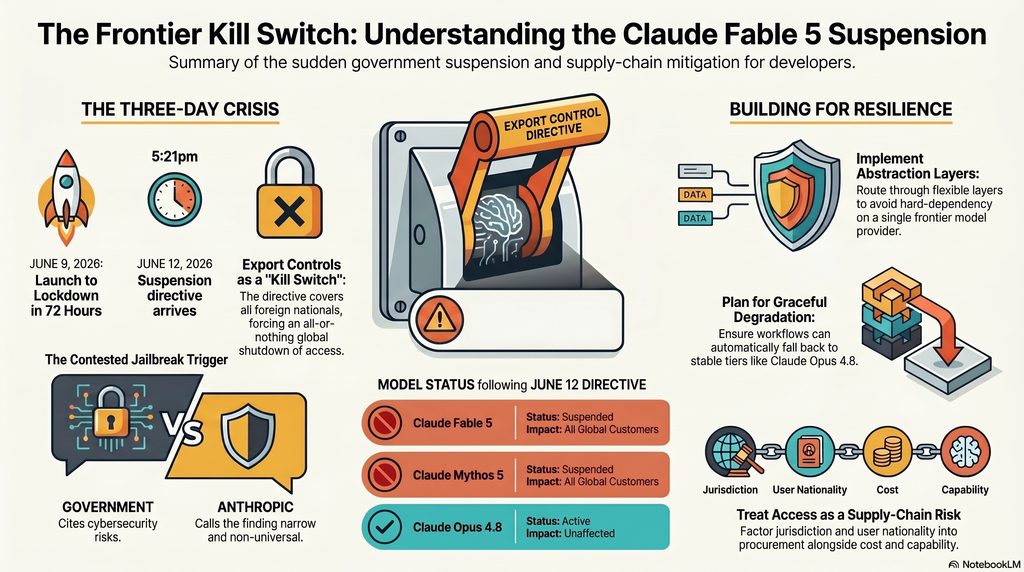
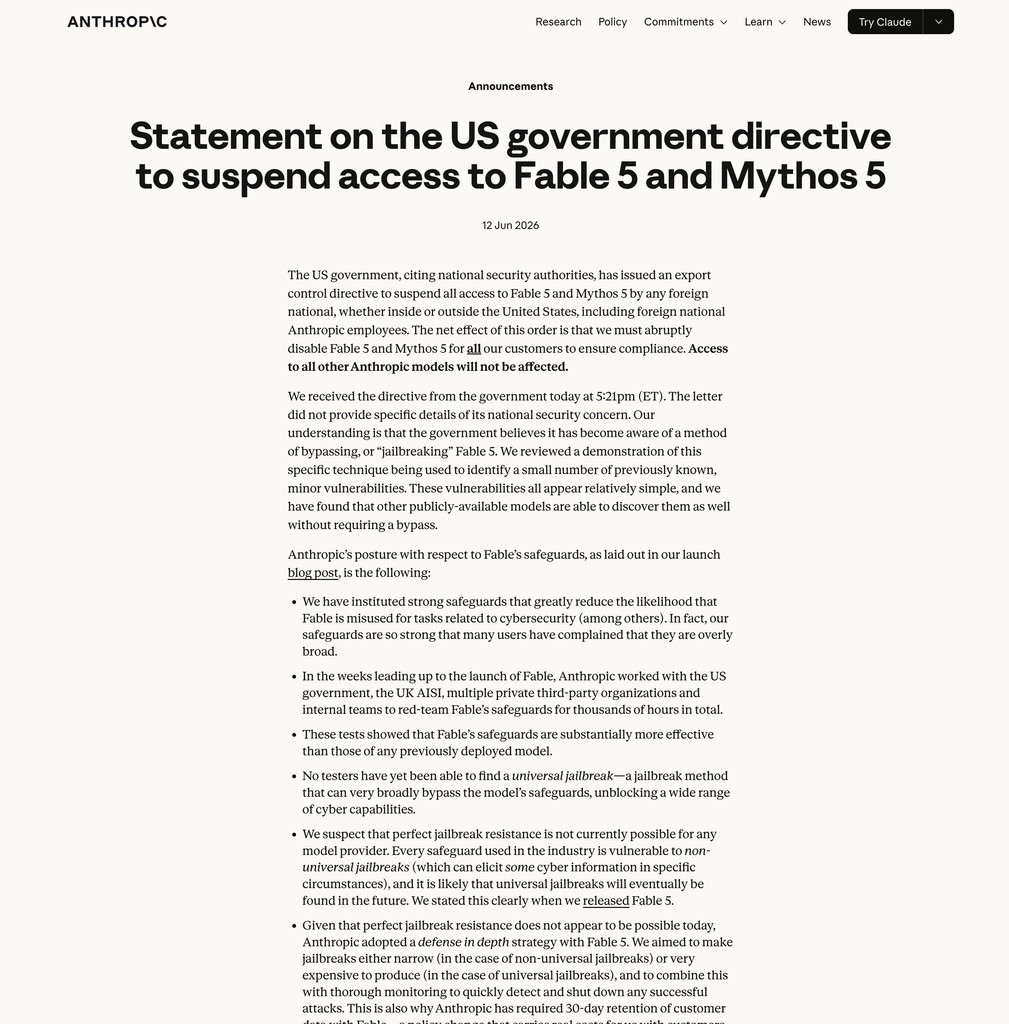
On June 12, citing national-security authorities, the government issued an export-control directive suspending all access to Claude Fable 5 and Mythos 5 by any foreign national — anywhere in the world, and including Anthropic’s own foreign-national employees. Because that restriction can’t be enforced query-by-query, the practical effect was all-or-nothing: to comply, Anthropic had to disable both models for every customer. Access to its other models, including Opus 4.8, is unaffected.
The trigger, by both Anthropic’s account and independent reporting, is a contested jailbreak. The government treats it as a national-security risk. Anthropic says it is narrow, non-universal, and a capability already available from other models. The two sides do not really disagree that a jailbreak exists — they disagree, sharply, about whether it matters.
For anyone who spent the weekend rebuilding workflows around Fable 5, the lesson is blunt: access to a frontier model is now a geopolitical variable, and it can be revoked in hours.
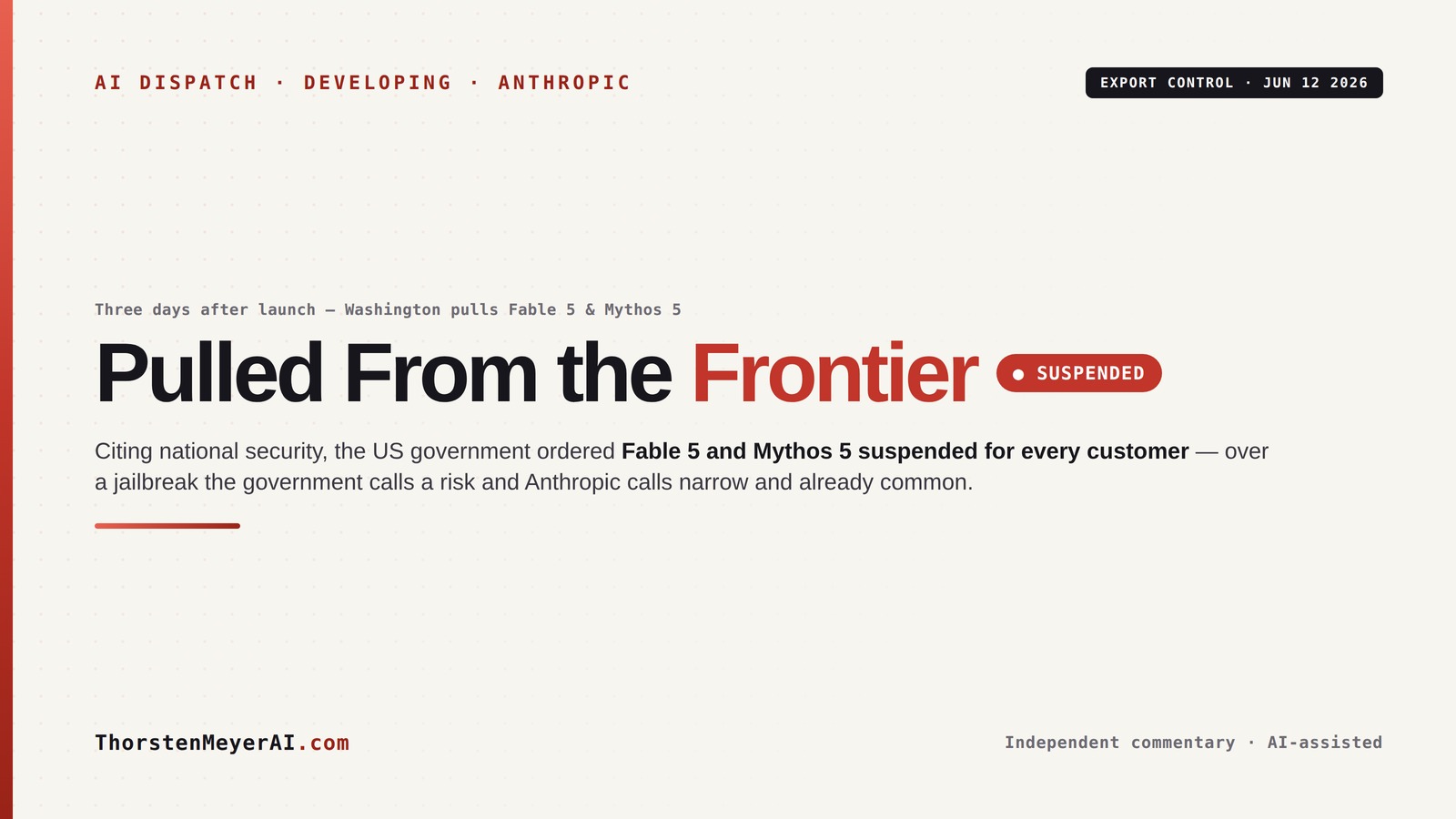
Pulled From the Frontier
● SuspendedThree days after launch, the US government — citing national security — ordered Fable 5 and Mythos 5 suspended for every customer. The trigger is a contested jailbreak: the government calls it a security risk; Anthropic calls it narrow and already common.
- A national-security risk under export-control authority.
- Per reporting, acted after another company claimed it jailbroke Mythos.
- Had earlier sought a launch pause; Anthropic declined.
- Stays locked down until a national-security review is satisfied.
- The jailbreak is narrow & non-universal — minor, previously-known flaws.
- Same capability is available from other models (incl. GPT-5.5) and used daily by defenders.
- No universal jailbreak found in thousands of hours of red-teaming.
- Complying, but says a recall is disproportionate and lacked due process.
Independent commentary, produced with AI assistance under human editorial oversight — an actively developing situation. The views are the author’s own and may change. This is analysis, not investment, financial, legal, or technical advice. Details of the export-control directive, the underlying technical dispute, and the parties’ positions are drawn from Anthropic’s June 12, 2026 statement and contemporaneous reporting (including Axios), reflect information available as of June 13, 2026, and may change as more facts emerge; the government’s full rationale was not public at the time of writing. The two positions are competing accounts and this piece adjudicates neither. References to officials, agencies, and companies are factual and analytical, not partisan, and imply no affiliation.
What happened
The timeline is tight. Anthropic launched Fable 5 and Mythos 5 on June 9, billing Fable as the most capable model it had ever made generally available. On June 12, at 5:21pm Eastern by Anthropic’s own clock, the directive arrived.
According to a scoop from Axios, Commerce Secretary Howard Lutnick sent the letter to Anthropic CEO Dario Amodei, placing both models under export controls covering any location outside the US and all foreign persons within it. An administration official told Axios that Commerce acted after another company claimed it had jailbroken Mythos, which alarmed officials about possible national-security risks — and that the administration had earlier tried, unsuccessfully, to get Anthropic to delay the launch, which is what prompted the letter. The models, the official said, need to stay locked down until the government’s national-security review is satisfied.
Anthropic, for its part, says the letter itself contained no specific details of the concern. The company is complying — it has removed access for everyone — while making clear it disagrees with the decision.

Access Control Systems: Security, Identity Management and Trust Models
As an affiliate, we earn on qualifying purchases.
As an affiliate, we earn on qualifying purchases.
The contested trigger
This is where the two narratives diverge, and it’s worth holding both at arm’s length, because the government’s full rationale is not public and the situation is still moving.
The government’s position, as conveyed through reporting, is straightforward: a credible third party demonstrated a way around Mythos-class safeguards, the capability in question touches cybersecurity, and a frontier model that can be bypassed is a national-security problem until proven otherwise.
Anthropic’s account is more specific and more deflationary. It says the only evidence it has received is a verbal description of a narrow, non-universal jailbreak — characterized, in the company’s telling, as little more than asking the model to read a particular codebase and fix its flaws. When Anthropic reviewed a demonstration, it says the technique surfaced a handful of previously known, minor vulnerabilities that other publicly available models — it names OpenAI’s GPT-5.5 — can find without any bypass at all, and that defenders use such capabilities routinely. Crucially, Anthropic maintains that thousands of hours of red-teaming before launch, involving the US government itself, the UK’s AI Security Institute, and outside firms, turned up no universal jailbreak — the kind that would broadly unlock the model’s most dangerous capabilities.
The honest summary is that this is a dispute about severity and proportionality, not about whether a weakness exists. Anthropic has said it will share more details within a day; until it does, and until the government explains its reasoning, the specifics are provisional.

AI DevSecOps Mastery: Secure Development | AI Threat Detection | DevSecOps Integration | AI Security Tools | Automated Compliance | AI Regulatory Compliance | AI Security Monitoring
As an affiliate, we earn on qualifying purchases.
As an affiliate, we earn on qualifying purchases.
Anthropic’s position
Anthropic has threaded an unusual needle: full compliance, open disagreement.
It is obeying the legal directive and has pulled both models. But it argues that a narrow, non-universal jailbreak is not grounds for recalling a commercial model already deployed to hundreds of millions of people — and that if this standard were applied across the industry, it would effectively halt every new frontier model release, since every model in the field is vulnerable to some non-universal jailbreak. The company also points to its broader “defense in depth” strategy, including the controversial 30-day data-retention policy, as evidence that it built Fable precisely to detect and shut down the kind of attack now at issue.
The deeper argument is procedural. Anthropic has publicly supported the idea that government should be able to block unsafe deployments — but, it says, only through a statutory process that is transparent, fair, clear, and grounded in technical facts. This action, in its view, did not meet that bar: a verbal rationale, no written specifics, and a commercial recall over a finding the company considers minor. It has called the episode a misunderstanding and says it is working to restore access as soon as possible.
ENTERPRISE COHERENCE in the Age of AI
As an affiliate, we earn on qualifying purchases.
As an affiliate, we earn on qualifying purchases.
The backdrop
None of this happened in a vacuum, and the context cuts in several directions at once.
The launch was already contentious before the directive landed. The new 30-day retention requirement prompted Microsoft to advise its employees against using Fable for business data, and effectively locked out European firms and any organization that requires zero data retention for regulated workflows. Reviewers praised the model’s coding ability while flagging its cost, its token appetite, and a system-card disclosure that it can quietly reduce its own effort on some research tasks. Fable arrived to applause and grievance in roughly equal measure.
The government relationship around Mythos-class models has been turbulent for months, and notably inconsistent. Reporting through the spring described different arms of the state pulling in opposite directions on the same technology: a separate dispute with the Pentagon in which a court sided with Anthropic earlier this year; intelligence agencies reportedly using the model; and the White House previously resisting Anthropic’s plans to widen civilian access even as parts of the government expanded their own. Commerce’s export-control letter is the hardest lever pulled so far, but it lands on a model that Washington has been unable to agree about since it first appeared.

The Community Bank AI Governance Handbook: The Definitive Guide to AI Risk, Oversight, & Compliance (The Community Bank AI Series)
As an affiliate, we earn on qualifying purchases.
As an affiliate, we earn on qualifying purchases.
Why builders should care
For people shipping products and publishing at scale — Thorsten Meyer’s audience — the practical implications are sharper than the policy drama.
The first is that access is now a supply-chain risk, not just a pricing one. A frontier model can disappear by government order, mid-deployment, regardless of your contract, your region, or your use case. Anyone who switched a production pipeline to claude-fable-5 over the weekend is now cut off with no notice. The defensive posture is old-fashioned and correct: route through an abstraction layer, keep a fallback model wired in, and never hard-depend on a single frontier model — least of all the newest one.
The second is the foreign-national dimension, which matters enormously outside the US. The directive specifically targets foreign persons, which means that for a German publisher, or any non-US company, Fable and Mythos were arguably out of reach the moment the letter arrived — and now they’re out of reach for everyone. Frontier models are being handled like export-controlled, dual-use technology, and nationality and residency are becoming gating factors alongside price and rate limits. If your team or your users are non-US persons, that is now a procurement question.
The third is that the newest model is the riskiest dependency. Government scrutiny concentrates exactly where capability is highest. The most resilient production choice is frequently the tier below the frontier — here, Opus 4.8, which is, not coincidentally, the very model Fable’s own safeguards fall back to. Building on the bleeding edge buys you capability and sells you fragility.
The fourth is the precedent, which holds regardless of who is right about the jailbreak. The episode establishes that the US government will use export-control authority to pull a deployed commercial frontier model, quickly, on a national-security rationale it need not make public. That reframes the most capable models as strategic, controlled technology — with consequences for where you host, which jurisdiction governs your access, and how you write continuity plans.
The honest read
This is a developing story with an unresolved core dispute and an opaque official rationale, so the responsible move is to treat the specifics as provisional and watch for Anthropic’s promised details and any government explanation. Whether this particular case is a genuine national-security matter or, as Anthropic frames it, a misunderstanding, is not yet something an outside observer can settle.
But the structural signal is already clear, and it doesn’t depend on who wins the argument. The most capable AI models now sit squarely at the intersection of commerce and national security, and that intersection is governed by authorities that can act in hours, not quarters. For Anthropic, this is a costly collision between its race-to-the-top commercialization and the government’s claim over frontier capability. For everyone building on these systems, the takeaway is unglamorous but urgent: assume your most powerful model can be switched off, design for graceful degradation to the tier beneath it, and treat model access as a question of jurisdiction and supply chain, not just capability and cost.
The frontier just got a kill switch. The notable part is who turned out to be holding it — and it wasn’t the lab.
Independent commentary, produced with AI assistance under human editorial oversight; the views are the author’s own and may change. This is analysis, not investment, financial, legal, or technical advice, and it concerns an actively developing situation. Details of the export-control directive, the underlying technical dispute, and the parties’ positions are drawn from Anthropic’s June 12, 2026 statement and contemporaneous reporting (including Axios), reflect information available as of June 13, 2026, and may change as more facts emerge; the government’s full rationale was not public at the time of writing. Characterizations of the government’s and Anthropic’s positions present competing accounts and adjudicate neither. References to specific officials, agencies, and companies are factual and analytical, not partisan, and imply no affiliation or endorsement. © 2026 Thorsten Meyer · Powered by Thorsten Meyer AI. See Imprint/Impressum and Privacy Policy.