
The Control Series, Part 4 of 6 · Chokepoint: Model Access. Part 3 ended on a distinction — power, compute, and data are levers you squeeze slowly; access is the one you can pull all at once. This is the switch.

Get business pricing on tech for your team
- Business-only prices and quantity discounts
- Tax-exempt purchasing
- Multiple users, one account, clear invoices
There are two ways the AI you rely on can go dark tomorrow, and in 2026 both of them happened.
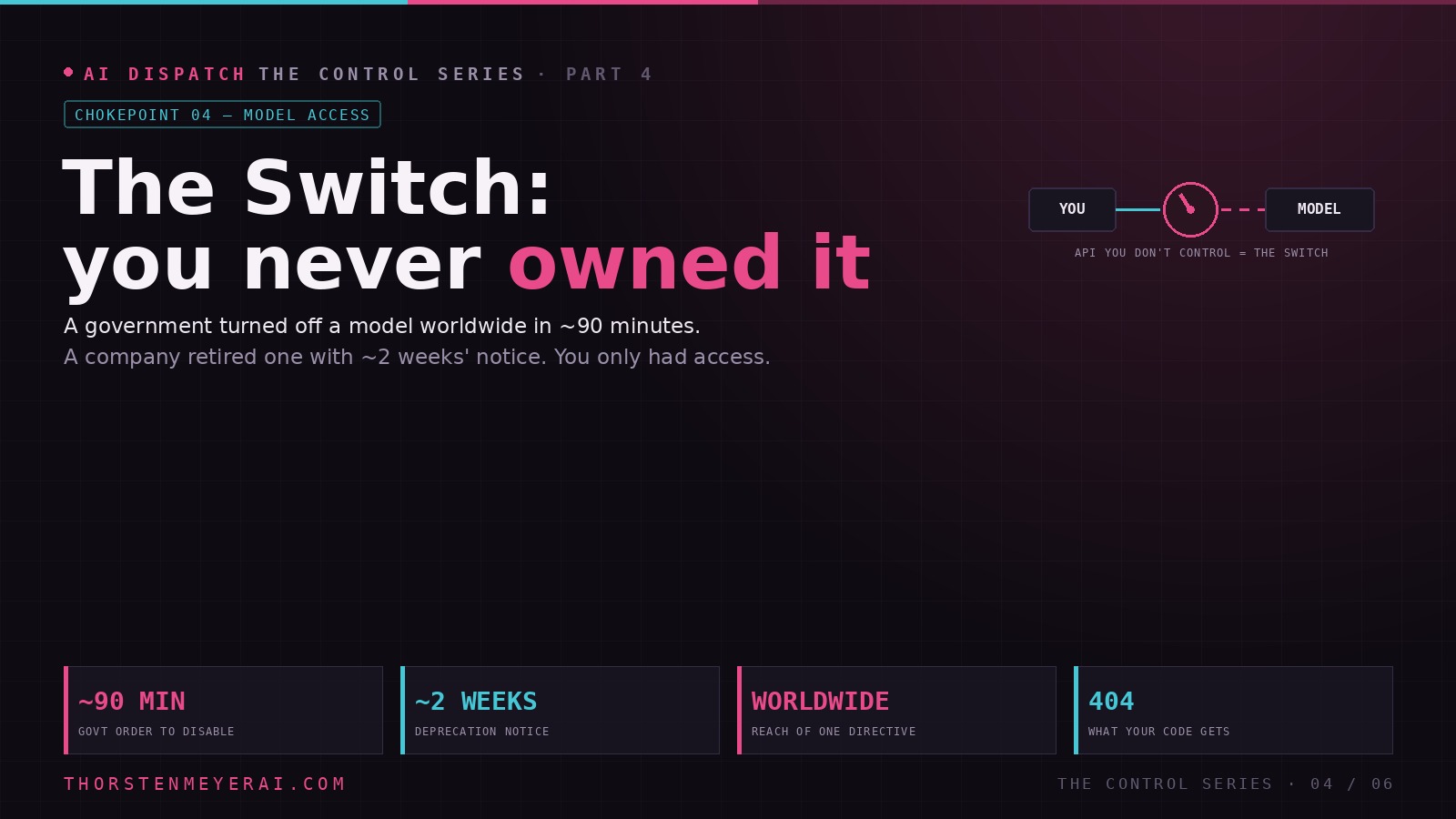
A government can order it off. On June 12, the U.S. issued an export-control directive that forced Anthropic to disable its newest models — Fable 5 and Mythos 5 — for every customer on earth, on roughly ninety minutes’ notice, citing national security. And a company can simply retire it. Weeks earlier, OpenAI pulled GPT-4o and a clutch of other models out of ChatGPT with about two weeks’ warning, with API shutdowns to follow and a hard migration after that — calls to the old model now return errors.
Different actors, different motives, identical lesson: you don’t own the model you build on. You access it. And access can be revoked — by a state, by a roadmap, by a price change, by a line on a map.
This is the most acute chokepoint in the series, because it’s the only one that flips instantly. Here are its two faces, why both work, and what you can actually do about it.
The Switch: You Never Owned It
In 2026 a government turned off a frontier model worldwide in ~90 minutes — and a company retired a beloved one with ~2 weeks’ notice. You don’t own the model you build on. You access it. Access can be revoked.
Access is the only chokepoint that flips in an afternoon — and the version that hits you won’t be Washington, it’ll be a deprecation. Open weights you host can’t be deprecated, geofenced, repriced, or revoked. Short of that: route through a provider-agnostic gateway, keep a tested fallback, and treat every model string as a dependency that will be pulled.
The dramatic switch: a government turns off a model
The Anthropic episode is the precedent everyone will cite for years. The directive suspended all access to Fable 5 and Mythos 5 by any foreign national — inside or outside the United States, including Anthropic’s own foreign-national employees — which left the company no way to comply except to disable both models worldwide. By the company’s account, the letter arrived in the evening and gave no detailed rationale; by midnight the most capable models it had ever shipped were offline. Talks with the White House are set for the days after this writing, with the controls still in place.
What makes it a chokepoint and not just a one-off is the mechanism. Export controls were built for physical goods with physical bottlenecks — chips you can serial-number, ore you can inspect at a port. Applied to a deployed model served over an API, they don’t function as a border; they function as an emergency off-switch on a U.S. company’s own software. A former administration AI adviser called the move baffling, noting the apparent inconsistency of loosening chip-export rules toward China while cutting close allies off from a model many were already using for cyber defense. Whatever the merits of the specific security concern — genuinely contested, and not the point here — the demonstration is what matters: a government showed it can reach into the model layer and pull the switch, fast, for everyone.
As an affiliate, we earn on qualifying purchases.
The mundane switch: a roadmap turns off a model
The government switch is the dramatic version. The version that will actually touch most builders is duller and far more frequent: deprecation.
When OpenAI retired GPT-4o and several siblings from ChatGPT in February, then scheduled the API shutdowns, it wasn’t a national-security event — it was a product decision, driven by the plain economics of not running old GPUs on legacy inference stacks when newer models are cheaper to serve. The company had tried the same retirement in 2025 and reversed it after a user revolt; this time, with daily GPT-4o usage down to a fraction of a percent, it went through. Reasonable enough. But for anyone with that model string hardcoded into production, “reasonable” still arrives as a deadline, and eventually as a 404.
Deprecation is only one dial. Access can also be geofenced — models withheld from entire regions for regulatory reasons, so the same product is simply unavailable depending on where your users sit. It can be repriced — the subsidized model that anchored your unit economics suddenly costs more. It can be rate-limited, terms-restricted, or changed underneath you when a silent update shifts a model’s behavior and breaks your carefully tuned prompts. None of these require a government. Each is a hand on the same switch.
As an affiliate, we earn on qualifying purchases.
Why both work: access is not ownership
Strip away the difference between a Commerce Department letter and a product changelog and the underlying exposure is identical: almost the entire economy reaches frontier AI through a handful of APIs it does not control. That API is the single point at which access can be granted, throttled, or cut — and you are on the wrong side of it.
This is the quiet cost of the thing that made AI so easy to adopt in the first place. “Just call the API” was the democratizing pitch — no data center, no training run, no weights to manage. But access without ownership is precisely what makes you switch-off-able. The convenience is the dependency. As a Deutsche Bank economist put it during the Anthropic fallout, in a line that applies equally to a kill order and a deprecation notice: you can’t rely on something that could be switched off.
AI model backup and deployment tools
As an affiliate, we earn on qualifying purchases.
As an affiliate, we earn on qualifying purchases.
Who holds the switch
Three sets of hands, often working different dials at once.
Governments hold the dramatic one — export controls, the frontier-model review regime, and the power to declare a model a national-security risk and order it dark, plus regional bans that wall off whole markets.
The labs hold the frequent ones — what models exist, for how long, at what price, in which regions, under what terms. Every deprecation, geofence, and pricing change is a small turn of the same valve.
The gateways and clouds hold the plumbing — the API endpoints and cloud contracts through which all of it flows, and through which any of it can be interrupted.
Access at the model layer is gated, repriceable, and revocable — the same signature this series has found at power, compute, and data. The difference is latency: those squeeze over quarters; this flips in an afternoon.
As an affiliate, we earn on qualifying purchases.
My take
Be fair to the people holding the switch, because not every pull is sinister. Maintaining a years-old model burns compute that could train the next one; consolidation is rational. Export controls on genuinely dangerous capabilities have a real national-security logic. Geofencing is often a regulator’s doing, not a lab’s malice. The individual decisions are usually defensible.
It’s the asymmetry that should focus the mind: in every case, you carry the risk and someone else holds the switch. And the version that will actually hit you is almost never the geopolitical one. Most builders will go their whole career without receiving an export-control letter. Every builder who hardcodes a single provider’s model will, sooner or later, eat a deprecation, a price hike, or a region lock. The kill switch isn’t mainly a story about Washington. It’s a Tuesday.
So the hedge is the same one this series keeps arriving at, and at this layer it’s unusually concrete. Open weights you host yourself cannot be deprecated, geofenced, repriced, or revoked — once you have them, no one can reach across the API and take them back, because there is no API in the middle. Short of that: route through a provider-agnostic gateway so swapping models is a config change, not a rewrite; keep a tested fallback on a second provider; and treat any model string in your code as a dependency that will be pulled, not one that might be. None of this is ideology. It’s the difference between a vendor’s roadmap being an inconvenience and being an outage.
The watch items are specific and near-term: whether the Anthropic controls lift after the White House talks, and what precedent survives if they do; whether “export control on a model” becomes a repeatable instrument rather than a one-off; whether deprecation-notice norms lengthen toward the six-to-twelve months enterprises actually need; whether the EU’s rules push more geofencing; and whether provider-agnostic gateways and self-hosted open weights move from hedge to default.
Next in the series
If access is the switch on the line between you and the model, distribution is the war over who owns the line itself — the app, the interface, the surface where AI reaches a human. Part 5 takes it up: why SpaceX paid $60 billion for a coding tool, and why the interface may be the most valuable chokepoint of all, precisely because it’s the one users actually touch.
You never owned the model. The next question is whether you’ll own the door to it.
Sources: Anthropic’s official statements; Axios; CNBC; SiliconANGLE; IAPP; the R Street Institute; OpenAI deprecation documentation; The Register; VentureBeat; and developer-community reporting (Jan–June 2026). The Fable 5 / Mythos 5 controls remained in effect at the time of writing. Analysis and opinions are the author’s.
Fall Picks
fall essentials
As an affiliate, we earn on qualifying purchases.