
Part 4 of a five-day series on the 2026 memory crunch. Parts 1–3 covered RAM; this one is about the drive your data lives on.

Get business pricing on tech for your team
- Business-only prices and quantity discounts
- Tax-exempt purchasing
- Multiple users, one account, clear invoices
For most of the last decade, storage was the one part of a build that kept getting cheaper. A terabyte NVMe drive was an impulse buy. You over-provisioned without thinking, because why not — capacity was practically free.
That era is over too. A 2TB NVMe SSD that sold for $120–150 in 2024 now lists at $300–480. A 1TB drive has roughly doubled. Enterprise SSD contract prices jumped a record 53–58% in a single quarter at the start of 2026, and SanDisk moved to double the price of its enterprise 3D NAND. Across the underlying flash, contract prices have multiplied roughly four to four-and-a-half times in nine months.
The same fire that took your RAM has reached your storage. But it arrived by a different — and more interesting — path, because storage isn’t just collateral damage this time. AI eats it directly.
The SSD squeeze: storage joined the party
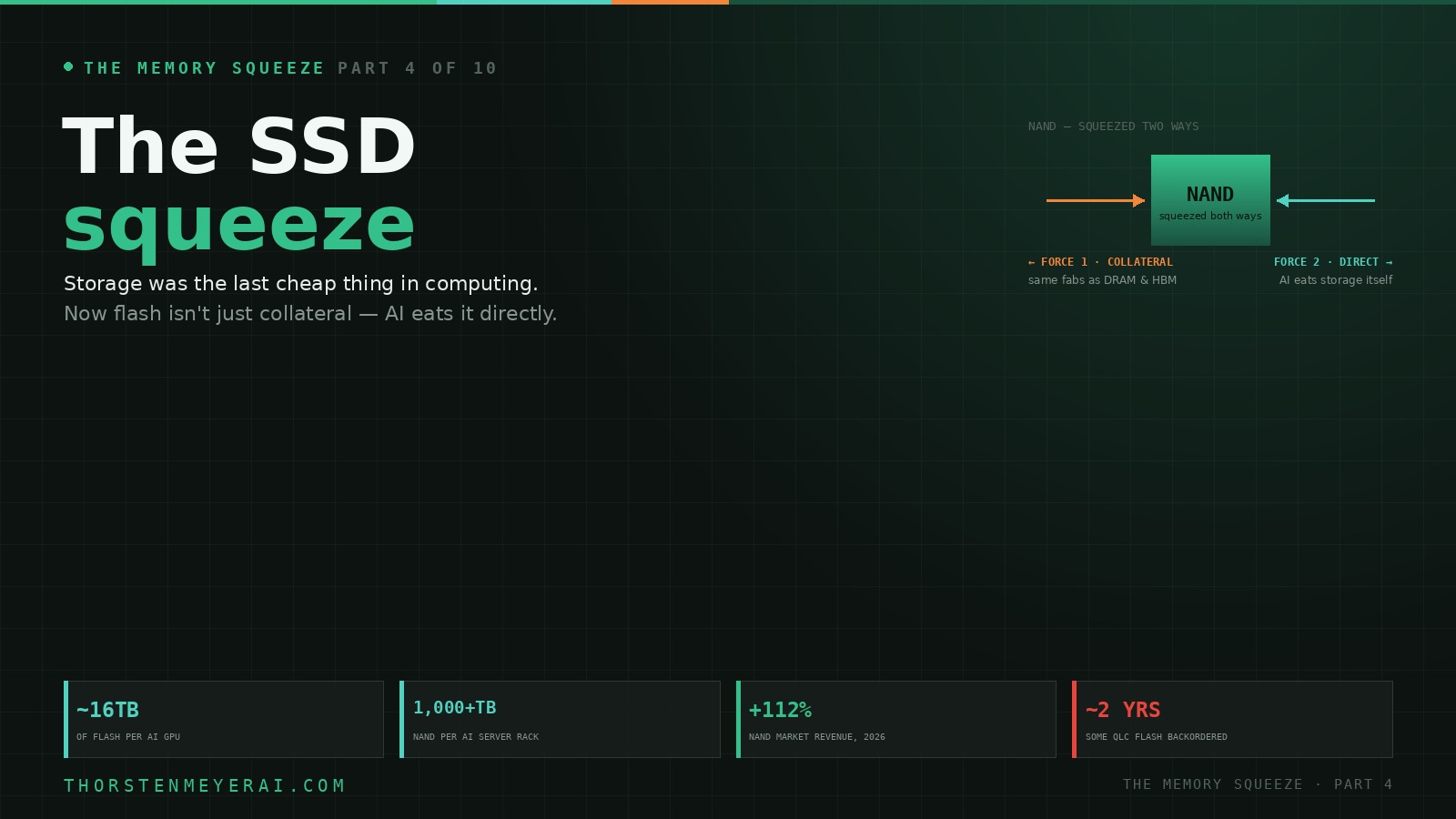
Storage was the last cheap thing in computing. Not anymore — a 2TB NVMe that was $120–150 in 2024 now lists at $300–480. And this time flash isn’t only collateral damage: AI eats storage directly.
both ways
Flash got hit twice — once as collateral sharing fabs with HBM, once directly as AI inference turned fast storage into something it consumes by the petabyte. That second force won’t fade; it grows with every model, every RAG pipeline, every cache that must live somewhere fast. Buy what you need now; favor TLC with DRAM cache, don’t overpay for Gen 5, watch for counterfeits. Relief isn’t forecast before late 2027. When the cheapest component in computing has a two-year waitlist, “commodity” no longer fits. Next: The High-End PC & Workstation Tax.
NAND got pulled in from two directions
The first reason is the one you already know from the rest of this series: NAND competes for the same fabs. Flash production lines fight DRAM and HBM for the same cleanroom space, the same capital budget, and the same engineering attention. When Samsung, SK Hynix, and Micron tilt toward high-margin HBM and high-capacity enterprise memory, NAND output suffers in parallel. Storage caught the squeeze simply by sharing a factory with the thing the world suddenly wanted.
The second reason is new, and it’s what makes this more than a rerun of the RAM story: AI consumes enormous amounts of storage on its own. A single high-end AI GPU may need on the order of 16TB of TLC or QLC flash to feed it efficiently. A standard AI server rack can demand over 1,000TB of NAND. And as generative AI shifts from training to inference, new storage-hungry patterns appear — retrieval-augmented generation hammering high-IOPS enterprise SSDs to query vector databases, and Nvidia’s newest racks putting a dedicated 512GB SSD on every compute tray to hold the model’s key-value cache. Storage stopped being the passive bucket your data sits in and became an active part of how AI runs. That demand is structural, and it’s accelerating: the NAND market is forecast to grow over 100% in revenue in 2026 alone.
As an affiliate, we earn on qualifying purchases.
The discipline question, again
As with DRAM, the supply side is not exactly rushing to relieve the pressure — and the honest read is the same balance struck in Part 1.
The makers have tightened, not loosened. Samsung reportedly trimmed its annual NAND wafer target; SK Hynix scaled its back too. Micron has said it can satisfy only 55–60% of its main customers’ demand. The flash maker Phison says its entire 2026 production is sold out and that it’s deliberately prioritizing higher-margin server customers over retail. New fabs are years away, and the candid logic was put plainly across the industry: why pour billions into new capacity when the shortage itself is so profitable? Samsung’s memory division is posting record profits, the vast majority from this squeeze.
None of that requires a conspiracy. AI demand for storage is real and large; the wafer competition with HBM is real; building fabs genuinely takes two-to-three years. But when three or four firms control nearly all supply, quietly cut wafer targets, and openly prefer the margins that scarcity brings, it’s fair to ask — as with DRAM — how much of today’s price is pure shortage and how much is comfortable discipline. The answer is probably “both,” and buyers should plan as if the discipline part isn’t going anywhere.
As an affiliate, we earn on qualifying purchases.
Who’s getting squeezed
The pain isn’t evenly distributed; it concentrates by who can pay and what kind of flash they need.
Enterprise buyers feel it first and hardest — but the cost-blind hyperscalers (Google, Amazon, Meta, OpenAI) placing open-ended orders are also the ones monopolizing the top-tier supply, leaving everyone else to ration. Consumers see it in drives that doubled or tripled, and in a quieter move: PC makers are now shipping 2026 models with the same name but downgraded base storage — 512GB where last year’s model had 1TB. Industrial and automotive buyers may be worst off in a different way: they need the durable TLC and pSLC flash that makers are deprioritizing in favor of AI-bound QLC, and lead times there have stretched past 20 weeks, with some QLC reportedly backordered as much as two years. Even hard drives — the supposed cheap fallback — are rising, and long-term storage supply agreements have stretched to a record five years. When the Internet Archive is struggling with disk costs, you know the squeeze reached the floor of the market.
As an affiliate, we earn on qualifying purchases.
What to actually buy
The buyer’s logic from Part 3 carries straight over, because NAND rides the same demand wave as DRAM: buy the storage you genuinely need now, not later. Waiting is more likely to cost more than less.
A few storage-specific notes. Favor TLC NAND with a DRAM cache for anything you care about — better endurance and far more consistent performance than cache-less QLC drives, which are fine only as cheap bulk capacity. Don’t overpay for PCIe Gen 5: it carries a steep premium and only helps sustained sequential workloads on a Gen-5 board; for gaming, general use, and most creative work, a good Gen 4 drive performs virtually identically for far less. And in a market this hot, watch for counterfeits — fake drives of popular models are circulating; buy established brands from authorized sellers and test on arrival. If you run a model library for local inference, storage is one place capacity-per-dollar is still relatively saner than DRAM — but “saner” now means doubled, not cheap, so size it deliberately.
As an affiliate, we earn on qualifying purchases.
The take
Storage was the last cheap thing in computing, and it isn’t anymore. What makes the SSD squeeze more than a footnote to the RAM story is that flash got hit twice over: once as collateral, sharing fabs with the HBM that ate everything, and once directly, as AI inference turned high-speed storage into a first-class component it consumes by the petabyte. That second force is the one that won’t fade, because it grows with every model deployed, every RAG pipeline, every cache that has to live somewhere fast.
Relief, as everywhere in this series, isn’t forecast before late 2027 at the earliest, and the long-term floor has almost certainly reset above where you remember it. The single most telling number isn’t a price — it’s that some QLC flash is reportedly backordered two years out. When the cheapest, most abundant component in computing has a two-year waitlist, “commodity” is no longer the right word for any of it.
Next in the series, we add it all up where builders feel it most: The High-End PC and Workstation Tax.
Sources: TrendForce (NAND contract-price moves, market-revenue forecasts); Tom’s Hardware (SanDisk enterprise NAND doubling, Phison sold-out/lead-time comments); DropReference and oscoo (consumer SSD street prices); Unibetter and Silicon Analysts (AI per-GPU/per-rack NAND consumption, enterprise vs. consumer wafer economics); StorageSwiss (structural-reallocation analysis); Nomura via Tom’s Hardware (Nvidia ICMSP/BlueField KV-cache storage demand). Figures reflect reporting as of late June 2026 and are fast-moving; prices are point-in-time. Analysis and recommendations are the author’s and not financial advice.
Fall Picks
fall essentials
As an affiliate, we earn on qualifying purchases.