
On Tuesday, this site covered a free 3-billion-parameter model that reads a 40-page PDF in one pass on hardware you own. That was the technology story.
This is the other half. Because the gap that model closes — the space between paper and databases — was never empty. For fifty years it was one of the world’s great labor absorbers. Data-entry keyers. Claims processors. KYC operations staff. Medical coders. The back offices of Manila, Bengaluru, and a thousand mid-sized firms that never called it “document processing” — they called it Monday.
The Post-Labor question isn’t whether the technology works. Tuesday established that it does, at marginal cost approaching zero. The question is what happens to the people whose job was being that gap — and the honest answer, on the current numbers, is more complicated than either the doom headlines or the reassurance slides.
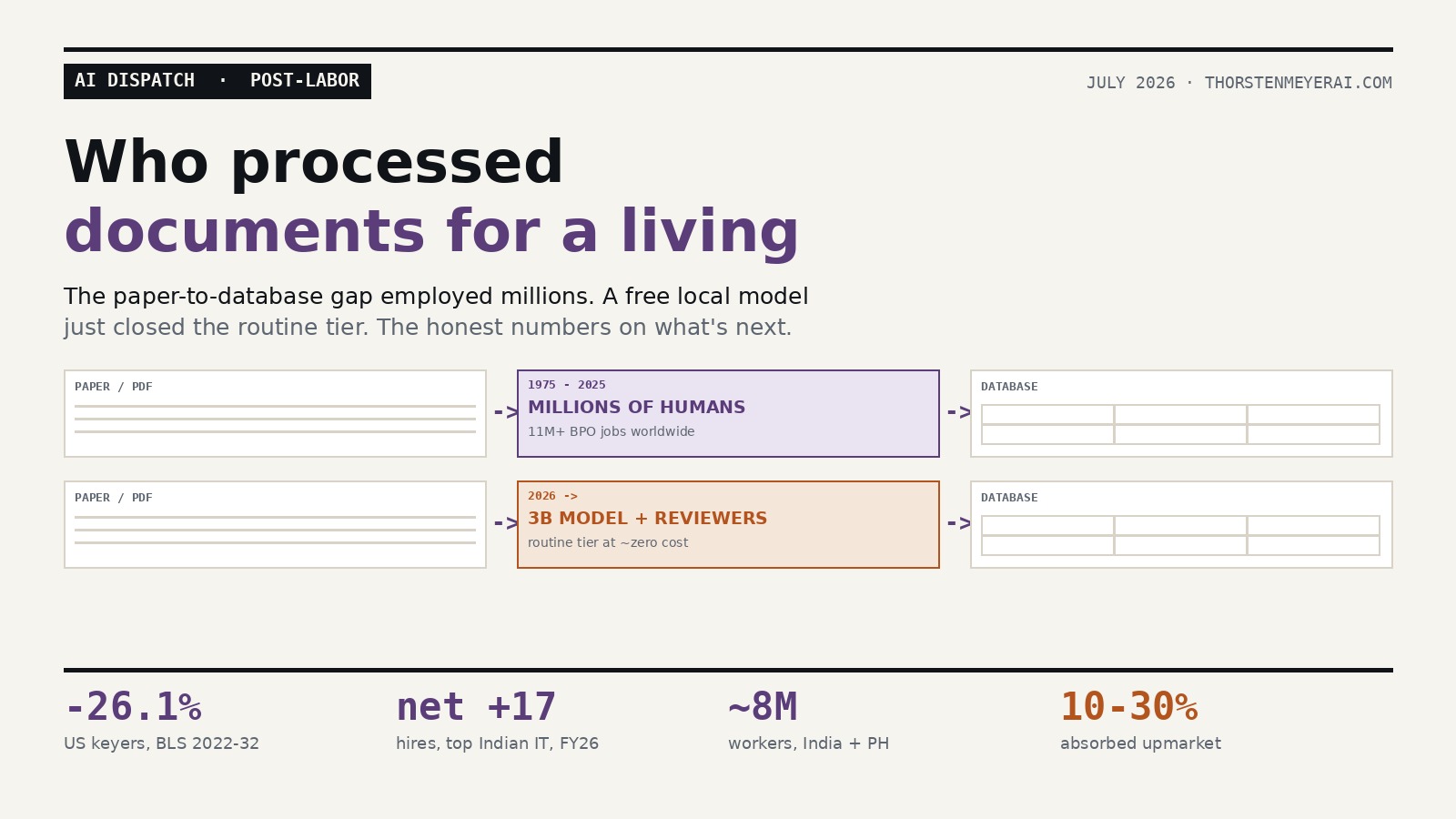
The gap between paper and databases
employed millions. It’s closing.
Data entry, claims, KYC, coding, BPO back offices — a global labor category built on moving information between formats. A free local model now does the routine tier at marginal cost ≈ watts. The honest numbers on what happens next.
Augmentation at the task level is displacement at the headcount level — spread over budget cycles instead of press releases.
The measured numbers — not projections
Also measured: both countries still ADDED BPO jobs in 2025 (~120K India, ~80K PH); only ~20% of customer-service leaders report AI-driven cuts (Gartner). Both truths hold — displacement follows the task, not the job title.
What shrinks vs what holds
Automates first
- Data entry and form processing
- Transaction handling, routine QA
- The entry-level on-ramp itself — hiring pipelines close before layoffs begin
Holds — for now, honestly
- Exceptions: the crumpled scan, the ambiguous field
- Liability and compliance-sensitive judgment
- Escalations and fraud patterns — growing faster than the routine tier shrinks (so far)
OCR accuracy ≠ process automation: 93% benchmarks still leave the hard 7% — and the liability — to humans. Fewer of them, at a different skill level.
Analyst estimate: GCCs and AI-adjacent roles can absorb 10–30% of displaced traditional BPO workers. “Move up the value chain” is arithmetic before it is policy — and new jobs don’t appear in the same cities, buildings, or skill brackets as the old ones. Beratervorsicht: the 2–3M-disruption / 1M-by-2030 projections circulating are analyst claims; the measured facts above are stark enough.

Epson Workforce ES-400 II Color Duplex Desktop Document Scanner for Computers Including PC and Mac with Auto Document Feeder and Image Adjustment Tools
- Fast Document Scanning: 50-sheet Auto Document Feeder for quick scans
- High-Speed Software: Epson ScanSmart for easy preview and sharing
- Seamless Software Integration: Compatible with most document management systems
As an affiliate, we earn on qualifying purchases.
As an affiliate, we earn on qualifying purchases.
The invisible occupation
Start with the country that measures it best. The US Bureau of Labor Statistics counts 152,900 data-entry keyers as of 2024, at a median wage of $37,970 (May 2023). BLS projects the occupation to decline 26.1% over 2022–2032 — the fastest decline of any administrative occupation it tracks. And that’s only the people whose title is the task: BLS counts a further 1.3 million bookkeeping, accounting, and auditing clerks for whom data entry is a significant portion of the role. The agency’s own 2024–34 projections release states it plainly: automated systems, including AI, are expected to contribute to declining employment of office and administrative support workers.
Now scale out. Globally, business process outsourcing employs over 11 million people in a market valued around $262 billion (2024, Grand View Research). The two anchor economies: India’s IT-BPM industry employs roughly 6 million people and contributes about 7% of GDP; the Philippine BPO sector employs around 2 million and generates ~$40 billion annually — the country’s second-largest dollar earner. A meaningful share of that work is exactly what Tuesday’s model does: reading documents, extracting fields, moving information from one format into another.
Why did this employ so many humans for so long? Because the work is harder than it looks and errors are expensive: manual data entry runs a 1–4% error rate per field (JAMIA), and in financial services a single entry error costs an estimated $53–98 to detect and fix. Enterprises paid millions of salaries because the alternative — bad data — cost more.
AI-powered PDF data extraction tools
As an affiliate, we earn on qualifying purchases.
As an affiliate, we earn on qualifying purchases.
What the numbers actually show right now
Here is where this article earns its section name, because the honest 2026 picture refuses to match either narrative.
The displacement signals are real. India’s TCS made its largest workforce reduction ever — about 12,000 roles — and Oracle cut a reported 12,000 positions in India in April 2026 amid its AI buildout. The most telling statistic isn’t a layoff at all: India’s top IT firms added a net 17 employees across the first nine months of fiscal 2026 — from thousands of hires the year before. That is not restructuring. That is the entry-level pipeline — the classic on-ramp for document-and-process work — closing. In the US, layoffs explicitly attributed to AI reached about 55,000 in 2025 per Challenger, Gray & Christmas.
And yet headline employment hasn’t crashed. Both anchor economies added BPO jobs in 2025 — roughly 120,000 in India and 80,000 in the Philippines. A Gartner survey found only about 20% of customer-service leaders had actually cut headcount because of AI. The IMF’s Philippine labor-market analysis (Working Paper 25/43, February 2025) found about one-third of Philippine workers highly exposed to AI — but roughly 60% of those roles are complementary, meaning augmentation is likelier than replacement. The industry body IBPAP still projects the Philippine workforce reaching 2.5 million by 2028 — an industry projection, weight it accordingly.
Both things are true because displacement follows the task, not the job title. The same IMF paper identifies BPO as the sector with the highest proportion of jobs at displacement risk and calls changes in the industry “macro-critical” for the Philippines — with roughly 3% of Philippine workers in BPO roles where low AI complementarity poses direct displacement risk. Routine document work — data entry, form processing, transaction handling — automates first. Escalations, exceptions, judgment, and compliance-sensitive work are, so far, growing faster than the routine tier shrinks.
Beratervorsicht, as always, on the forward numbers: industry analysts project 2–3 million BPO and IT workers across India and the Philippines facing disruption this decade, with around 1 million directly impacted by 2030. Treat these as claims by parties in the transformation business, not as measurements — the measured facts above are stark enough without them.

Burning Suite – Burn and Copy Software – CD/DVD/Blu-ray – Data, Music, Video – the all-in-one solution for Win 11, 10
- Data Backup and Protection: Securely back up files on optical discs
- Save Hard Drive Space: Archive large files to discs to free space
- Wide Format Compatibility: Convert and burn various file formats easily
As an affiliate, we earn on qualifying purchases.
As an affiliate, we earn on qualifying purchases.
The absorption problem
If there is one number in this research that deserves board-level attention, it is not a displacement figure. It is an absorption figure: analysts estimate that higher-value destinations — Global Capability Centers, AI-adjacent roles like data curation and model QA — can realistically absorb only 10–30% of displaced traditional BPO workers.
The optimistic story — “workers move up the value chain” — is arithmetic before it is policy. If routine document processing sheds hundreds of thousands of roles and the upmarket tier absorbs a quarter of them, the remainder don’t vanish into statistics. They land in two economies where this sector is, in the IMF’s word, macro-critical, concentrated in specific cities, specific buildings, specific commuter corridors. New jobs, as the transition literature keeps finding, do not automatically appear in the same places or skill brackets as the displaced ones. Geographic and demographic mismatch, not aggregate job counts, is the actual crisis design problem — the same conclusion the Response Matrix reached across ten jurisdictions: the binding constraint is rarely retraining budgets; it’s that levers must operate where displaced workers actually live.

Document Imaging Technology: How Automated Solutions Are Revolutionizing the Way Organizations and People Work
As an affiliate, we earn on qualifying purchases.
As an affiliate, we earn on qualifying purchases.
What doesn’t automate — yet, and honestly
Tuesday’s article made this point from the technology side and it belongs here from the labor side: OCR accuracy is not process automation. A 93% benchmark score means the pipeline still needs humans for the exceptions — the crumpled scan, the ambiguous field, the fraud pattern, the case where being wrong carries liability. Degraded real-world documents remain a weak spot even for the best models. Exception handling, accountability, and regulated judgment keep humans in these loops longer than any demo suggests.
But note what that human role becomes: reviewing the machine’s uncertain cases rather than keying the confident ones. That is a different job, employing fewer people, at a different skill level — which is precisely why “augmentation” and “displacement” are not opposites. Augmentation at the task level is displacement at the headcount level, spread over budget cycles instead of announced in press releases. The net-17 number is what that looks like from the outside: nobody fired, nobody hired.
Bottom line
A free model that reads documents locally didn’t create this trajectory — BLS was projecting data-entry keying as America’s fastest-declining administrative occupation before Unlimited-OCR existed. What the 2026 wave changes is the floor: when capable document intelligence costs watts instead of wages, the cost argument for keeping the routine tier human goes to zero, and only friction, liability, and exception-handling hold the line.
The current phase is genuinely augmentation — the 2025 hiring numbers say so. The entry-level collapse says what the next phase looks like. The 10–30% absorption estimate says the “move up the value chain” answer covers a fraction of the people involved. And the macro-critical concentration in two economies says the adjustment will be geographic, visible, and political.
The paper-to-database gap employed millions because closing it was valuable. It still is. The value just stopped being paid out as wages.
Sources
- US Bureau of Labor Statistics, Occupational Outlook Handbook — 152,900 data-entry keyers (2024); median wage $37,970 (May 2023 OEWS); 26.1% projected decline 2022–2032, fastest of any administrative occupation; 1.3M bookkeeping/accounting/auditing clerks with substantial data-entry content (compiled in Parsli, “67 Data Entry Statistics,” updated May 2026)
- US Bureau of Labor Statistics, “Employment Projections — 2024–2034” news release — automated systems including AI expected to contribute to declining office and administrative support employment
- Cucio, M. and Hennig, T., “Artificial Intelligence and the Philippine Labor Market: Mapping Occupational Exposure and Complementarity,” IMF Working Paper 25/43 (February 2025) — one-third of workers highly exposed; ~60% complementarity among exposed; BPO highest displacement-risk share; “macro-critical” designation
- The Manila Times, “The AI Reckoning” (June 30, 2026) — ~3% of Philippine workers in low-complementarity BPO roles; ~1.9M BPO employment basis
- Outsource Accelerator / Nikkei Asia reporting (May 2026) — Philippines BPO ~2M workers / ~$40B; India ~6M / ~7% GDP; TCS ~12,000 reduction (largest ever); Oracle ~12,000 India cuts (April 2026); net +17 employees across top Indian IT firms, first nine months fiscal 2026
- Gupta, D., “AI vs Outsourcing: The Future of Jobs 2026–2035” (June 2026) — 2025 BPO job additions (~120K India, ~80K Philippines); Gartner ~20% headcount-reduction finding; Challenger, Gray & Christmas ~55,000 US AI-attributed layoffs (2025); analyst 2–3M disruption / ~1M-by-2030 projections; 10–30% GCC absorption estimate — projections flagged as analyst claims
- VA Masters, “Philippines Outsourcing Industry Report 2026” (March 2026) — 67% BPO AI-tool adoption; ~100,000 projected AI-adjacent roles; risk concentration in routine voice and data-entry work
- Creathink Solutions, “Philippine BPO Industry in 2026” (May 2026) — IBPAP 2.5M-by-2028 workforce projection (industry projection); routine-vs-judgment task bifurcation
- Grand View Research (via Parsli) — global BPO market ~$261.9B (2024); JAMIA — 1–4% per-field manual entry error rate; financial-services error cost $53–98
- ThorstenMeyerAI.com — “Baidu’s Unlimited-OCR Reads a 40-Page PDF in One Pass” (July 21, 2026); Post-Labor Transition Atlas, Response Matrix (Phase 2)
All projections are labeled as such; measured statistics are dated to their collection period. No individual worker accounts are reproduced here; the aggregate numbers carry the story.