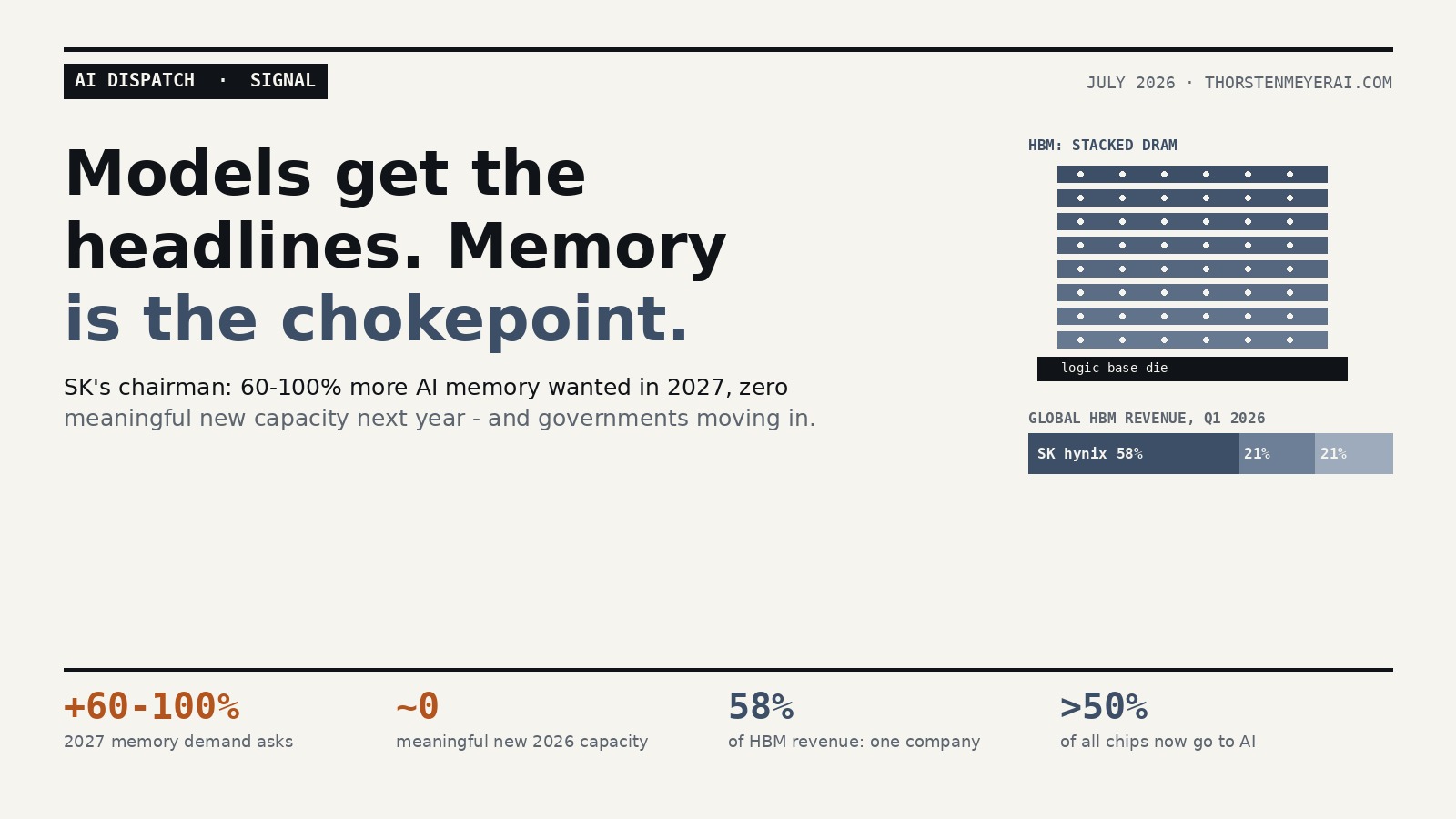
The AI sovereignty debate has a fixed cast: models, GPUs, maybe lithography. Last week, the chairman of SK Group — whose SK hynix makes the memory those GPUs are useless without — stood at a press briefing on the sidelines of the Korea Chamber of Commerce and Industry’s Jeju Forum and, per The Korea Herald’s reporting, described the layer everyone skips.
The numbers he gave deserve to be read slowly.
Models get the headlines.
Memory is the chokepoint.
SK Group’s chairman at the Jeju Forum, per The Korea Herald: customers want 60–100% more AI memory in 2027, governments now treat memory access as economic security — and no company has meaningful new capacity arriving next year.
The gap, in his own numbers
customer requests to SK hynix vs this year. AI already consumes over half of all semiconductors; total demand growth floored at 50–60%.
“No company has meaningful new capacity coming online next year.” The gap year is already locked in — fabs don’t move faster than physics.
Result, per Chey: near-chaotic lobbying — no longer just from companies. Foreign governments are intervening for domestic industries; next, governments pressure governments.
Tighter than the chokepoints you worry about
SK hynix’s race against its own warning
Company figures and projections as announced — none of it lands in 2026.
Half true: unified-memory Apple Silicon doesn’t queue for HBM — a fleet you own is insulated from allocation politics, and owned hardware converts supply-chain risk into sunk cost.
The other half: LPDDR and HBM share DRAM wafer economics — chipflation reaches workstation memory too, and training compute stays fully hostage. Local inference changes who feels the shortage, not whether it exists.
Week tie-in: if memory demand grows into capacity that doesn’t exist, doing the job in 3B parameters on memory you already own isn’t aesthetics — it’s engineering under constraint.
High Bandwidth Memory (HBM) modules
As an affiliate, we earn on qualifying purchases.
As an affiliate, we earn on qualifying purchases.
What Chey Tae-won actually said
Per the Korea Herald and subsequent wire coverage (July 18–20): customers have asked SK hynix for 60 to 100 percent more AI memory in 2027 than they are taking this year. With AI now accounting for more than half of total semiconductor consumption, Chey put overall demand growth at a floor of 50–60 percent. Against that, the supply side in his words: No company has meaningful new capacity coming online next year.
That sentence is the whole story. Everything else is consequences.
The consequences he listed are not subtle. The imbalance — most acute in high-bandwidth memory, the stacked DRAM bonded to AI accelerators — is producing what he described as near-chaotic lobbying, and no longer just from corporate buyers: foreign governments have begun treating memory access as a matter of economic security and intervening for their domestic industries. His prediction for the next phase: today companies absorb the pressure; soon governments will pressure governments.

Yahboom Jetson Orin Nano 8GB Super Development Board
- AI Performance: 34/67 TOPS for AI tasks
- GPU Architecture: 1024-core Ampere GPU with Tensor Cores
- CPU Specification: 6-core Arm Cortex-A78AE v8.2
As an affiliate, we earn on qualifying purchases.
As an affiliate, we earn on qualifying purchases.
More concentrated than the things we worry about
Here’s why this column ranks memory above most of the sovereignty topics that get the headlines: concentration. Per Counterpoint Research, SK hynix held 58 percent of global HBM revenue in Q1 2026, with Micron and Samsung at roughly 21 percent each. Three companies, one of them holding a majority — and all the capacity that matters sitting in a peninsula and a handful of fabs. TSMC gets the geopolitical think-pieces; the HBM oligopoly is tighter, and demand has outrun supplier guidance for two consecutive years.
What makes Chey’s remarks unusual is that he spent much of them arguing against his own windfall. Current pricing, he said, is abnormal and has to normalize — sustained high memory prices push device makers into what he called “chipflation,” attract new entrants (he pointed to Elon Musk’s interest in semiconductor manufacturing as an early sign), and invite the kind of geopolitical retaliation Asian exporters have seen before. A monopolist warning that his own margins are a strategic liability is a data point worth more than most analyst notes.
SK hynix’s response, per the same reports: the Yongin mega-cluster’s first clean room moved forward to February 2027 (from May), an additional 21.6 trillion won (~$14.5B) committed in March, the Cheongju M15X plant converting into a dedicated HBM base, and global fab-site candidates under review. In January the company had already announced roughly 19 trillion won (~$12.9B) for a Cheongju packaging plant, citing a projected 33% HBM CAGR through 2030 — a company projection, weight accordingly. Note the physics of all of it: none of this capacity arrives in 2026. The gap year is already locked in.
As an affiliate, we earn on qualifying purchases.
The honest local-inference footnote
This site argues for local inference weekly, so the temptation is obvious: unified-memory Apple Silicon doesn’t queue for HBM, therefore the Mac-fleet approach sidesteps the chokepoint. That’s half true, and the half matters.
True: inference on unified LPDDR memory doesn’t compete for the HBM allocations hyperscalers are lobbying over, and a fleet you already own is insulated from allocation politics entirely.
Also true: LPDDR and HBM come out of the same DRAM wafer economics, and when the industry’s chairman-in-chief warns of chipflation, that reaches consumer and workstation memory pricing too — future fleet expansion gets more expensive along with everything else. And training-scale compute remains fully hostage to the HBM queue; local inference changes who feels the shortage, not whether it exists.
The defensible claim is narrower and still significant: owned hardware converts a supply-chain risk into a sunk cost. In a market where governments are starting to treat memory allocation as economic security, having your inference capacity already on your desk is a hedge — one that was cheap when acquired and is getting less cheap to replicate.

Avolusion PRO-5X (White) 8TB USB 3.0 External Gaming Hard Drive for PS5 / PS4 Game Console (Renewed)
- Storage Capacity: 8TB USB 3.0 External Drive
- Designed for 24/7 Use: 7200RPM Enterprise HDD
- Play PS4 Games: Run directly from USB storage
As an affiliate, we earn on qualifying purchases.
As an affiliate, we earn on qualifying purchases.
Why this sits in a week about small models
Tuesday through Friday, this week’s throughline has been small, specialized, local models. Chey’s numbers are the macro backdrop that makes that thesis load-bearing rather than aesthetic: if AI-memory demand grows 60–100% into capacity that doesn’t exist, the cost of frontier-scale inference has a floor that’s rising — and the value of getting the job done in 3 billion parameters on memory you already own compounds accordingly. The sub-4B specialist wave isn’t just an accuracy story. It’s what engineering under a memory constraint looks like.
Sources
- The Korea Herald, “SK chief warns AI memory shortage could turn geopolitical” (July 2026) — primary report: press briefing at KCCI Jeju Forum (which Chey chairs); 60–100% 2027 customer demand; AI >50% of semiconductor consumption; 50–60% demand-growth floor; no-meaningful-new-capacity statement; near-chaotic lobbying; economic-security framing; chipflation argument; Musk reference; Yongin acceleration to Feb 2027; 21.6T won March commitment; M15X conversion
- Counterpoint Research (via Korea Herald) — SK hynix 58% of global HBM revenue, Q1 2026; Micron ~21%, Samsung ~21%
- ANI / The Print / Asianet syndication of the Korea Herald report (July 20, 2026) — corroborating wire coverage
- Hardware Busters, “SK’s Chairman Calls RAM Prices ‘Abnormal'” (July 2026) — pricing-normalization framing for the build/consumer market
- SK hynix announcement (January 2026, via MEXC news) — ~19 trillion won (~$12.9B) Cheongju packaging plant; company-projected 33% HBM CAGR 2025–2030 (vendor projection, flagged)
All demand figures are Chey’s stated customer-request and consumption estimates as reported; capacity projections are company statements. Exact briefing date varies across reports (mid-July 2026); the Korea Herald account is treated as primary.