
Five frontier models, five effort levels each, and one question most teams get wrong: who does what, and how do you know it’s done?

Get business pricing on tech for your team
- Business-only prices and quantity discounts
- Tax-exempt purchasing
- Multiple users, one account, clear invoices
Most teams using AI for software development make the same two mistakes. They pick one model for everything, and they solve every hard moment by turning the effort setting up. The first mistake wastes money on routine work. The second wastes it on problems that more thinking won’t fix, because the missing ingredient was never effort. It was a clear requirement, a real test or an independent check.
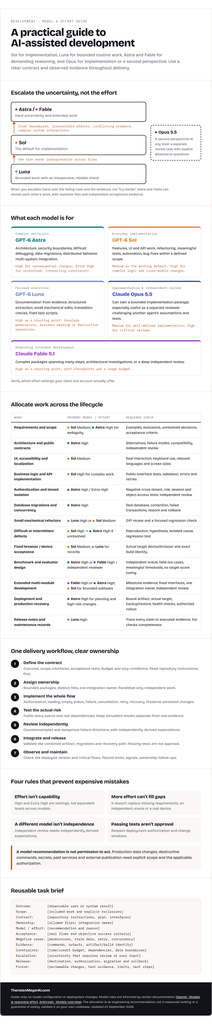
I’ve put together a one-page guide to fix both: A practical guide to AI-assisted development. It covers GPT‑6 Sol, Luna and Astra, Claude Opus 5.5 and Claude Fable 5.1. It applies to software, web, mobile, API and data work. Its core idea fits in one sentence: use Sol for implementation, Luna for bounded routine work, Astra and Fable for demanding reasoning, and Opus for implementation or a second perspective, with a clear contract and observed evidence throughout delivery.
Here’s the thinking behind it.
DEVELOPMENT · MODEL & EFFORT GUIDE
A practical guide to AI‑assisted development
Sol for implementation, Luna for bounded routine work, Astra and Fable for demanding reasoning, and Opus for implementation or a second perspective. Use a clear contract and observed evidence throughout delivery.
Escalate the uncertainty, not the effort
A second perspective at any level: a separate review task with explicit adversarial questions.
When you escalate, hand over the failing case and the evidence, not “try harder.” Astra and Fable can review each other’s work, with separate files and independent acceptance evidence.
What each model is for
Complex decisions
GPT‑6 Astra
Architecture, security boundaries, difficult debugging, data migrations, distributed behavior, multi‑system integration.
High for consequential changes; Extra High for unresolved, interacting constraints.
Everyday implementation
GPT‑6 Sol
Features, UI and API work, refactoring, meaningful tests, automation, bug fixes within a defined scope.
Medium as the working default; High for complex logic and cross‑module changes.
Focused execution
GPT‑6 Luna
Documentation from evidence, structured extraction, small mechanical edits, translation checks, fixed test scripts.
High as a starting point. Escalate permissions, business meaning or destructive operations.
Implementation & independent review
Claude Opus 5.5
Can own a bounded implementation package; especially useful as a separate reviewer challenging another agent’s assumptions and tests.
Medium for well‑defined implementation; High for critical reviews.
Demanding extended development
Claude Fable 5.1
Complex packages spanning many steps, architectural investigations, or a deep independent review.
High as a starting point, with checkpoints and a usage budget.
Verify which effort settings your client and account actually offer.
Allocate work across the lifecycle
| WORK | PRIMARY MODEL / EFFORT | REQUIRED CHECK |
|---|---|---|
| Requirements and scope | Sol Medium; Astra High for ambiguity | Examples, exclusions, unresolved decisions, acceptance criteria |
| Architecture and public contracts | Astra High | Alternatives, failure modes, compatibility, independent review |
| UI, accessibility and localization | Sol Medium | Real interaction, keyboard use, relevant languages and screen sizes |
| Business logic and API implementation | Sol High for complex work | Public‑interface tests, validation, errors and retries |
| Authentication and tenant isolation | Astra High / Extra High | Negative cross‑tenant, role, session and object‑access tests; independent review |
| Database migrations and concurrency | Astra High | Real database, contention, failed transactions, restore and rollback |
| Small mechanical refactors | Luna High or Sol Medium | Diff review and a focused regression check |
| Difficult or intermittent defects | Sol High → Astra High if unresolved | Reproduction, hypothesis, isolated cause, regression test |
| Fixed browser / device acceptance | Sol Medium; Luna for records | Actual target device/browser and exact build identity |
| Benchmark and evaluator design | Astra High or Fable High + independent reviewer | Independent oracle, held‑out cases, meaningful thresholds, no target‑score tuning |
| Extended multi‑module development | Fable High or Astra High; Sol for bounded subtasks | Milestone evidence, fixed interfaces, one integration owner, independent review |
| Deployment and production recovery | Astra High for planning and high‑risk changes | Bound artifact, actual target, backup/restore, health checks, authorized rollout |
| Release notes and maintenance records | Luna High | Trace every claim to executed evidence; Sol checks completeness |
One delivery workflow, clear ownership
- 1Define the contract
Outcome, scope, interfaces, acceptance tests, budget and stop conditions. Read repository instructions first.
- 2Assign ownership
Bounded packages, distinct files, one integration owner. Parallelize only independent work.
- 3Implement the whole flow
Authorization, loading, empty states, failure, cancellation, retry, recovery. Preserve unrelated changes.
- 4Test the actual risk
Public entry points and real dependencies. Keep simulated results separate from real evidence.
- 5Review independently
Counterexamples and dangerous failure directions, with independently derived expectations.
- 6Integrate and release
Validate the combined artifact, migrations and recovery path. Passing tests are not approval.
- 7Observe and maintain
Check the deployed version and critical flows. Record limits, signals, ownership, follow‑ups.
Four rules that prevent expensive mistakes
Reusable task brief
Outcome:        [observable user or system result]
Scope:          [included work and explicit exclusions]
Contract:       [repository instructions, plan, interfaces]
Ownership:      [allowed files; integration owner]
Model / effort: [recommendation and reason]
Acceptance:     [real flows and objective success criteria]
Negative cases: [permissions, stale data, retry, concurrency]
Evidence:       [commands, outputs, artifact/build identity]
Constraints:    [time/credit budget, dependencies, data boundaries]
Escalation:     [uncertainty that requires review or user input]
Release:        [destination, authorization, migration and rollback]
Finish:         [reviewable changes, test evidence, limits, next steps]
As an affiliate, we earn on qualifying purchases.
Five working principles

Sol is the default. Most development work is implementation with clear interfaces and acceptance criteria. That’s Sol’s job, and starting there keeps costs sane.
Astra resolves hard uncertainty. Architecture, trust boundaries, complex concurrency and recovery are the places where a wrong decision is expensive and hard to undo. They deserve the strongest reasoning.
Luna handles bounded work. Repeatable tasks with an inexpensive, reliable check don’t need a flagship model. They need a cheap one and a good test.
Opus provides another perspective. A reviewer is only useful if it’s genuinely separate. Give Opus a distinct review task with explicit adversarial questions, not “does this look OK?”
Fable is for demanding extended work. Assign it a substantial, bounded package when difficult reasoning has to stay coherent across many steps.
As an affiliate, we earn on qualifying purchases.
What each model is for
GPT‑6 Astra: complex decisions. Architecture, security boundaries, difficult debugging, data migrations, distributed behavior and integration across several systems. Use High for consequential changes and Extra High for unresolved, interacting constraints. Drop to lower effort when the task is narrow and well understood.
GPT‑6 Sol: everyday implementation. Features, UI and API work, refactoring, meaningful tests, automation and bug fixes within a defined scope. Medium is the working default. High is for complex logic and cross-module changes.
GPT‑6 Luna: focused execution. Documentation from evidence, structured extraction, small mechanical edits, translation checks and running fixed test scripts. Start at High. Escalate anything involving permissions, business meaning or destructive operations.
Claude Opus 5.5: implementation and independent review. It can own a bounded implementation package, and it’s particularly useful as a separate reviewer that challenges another agent’s assumptions and tests. Use Medium for well-defined implementation and High for critical reviews. Check which settings your Claude client actually offers.
Claude Fable 5.1: demanding extended development. Complex packages spanning many steps, challenging architectural investigations, or a deep independent review when simpler approaches leave material questions unresolved. Start at High, set clear checkpoints and a usage budget, and confirm the benefit on your own tasks.
As an affiliate, we earn on qualifying purchases.
Allocating work across the lifecycle
The heart of the guide is a lifecycle table. Every row pairs a model and effort level with a required check, because a model recommendation without a verification step is just a guess.
| Work | Primary model / effort | Required check |
|---|---|---|
| Requirements and scope | Sol Medium; Astra High for ambiguity | Examples, exclusions, unresolved decisions, acceptance criteria |
| Architecture and public contracts | Astra High | Alternatives, failure modes, compatibility, independent review |
| UI, accessibility and localization | Sol Medium | Real interaction, keyboard use, relevant languages and screen sizes |
| Business logic and API implementation | Sol High for complex work | Public-interface tests, validation, errors and retries |
| Authentication and tenant isolation | Astra High / Extra High | Negative cross-tenant, role, session and object-access tests; independent review |
| Database migrations and concurrency | Astra High | Real database, contention, failed transactions, restore and rollback |
| Small mechanical refactors | Luna High or Sol Medium | Diff review and a focused regression check |
| Difficult or intermittent defects | Sol High → Astra High if unresolved | Reproduction, hypothesis, isolated cause, regression test |
| Fixed browser / device acceptance | Sol Medium; Luna for records | Actual target device/browser and exact build identity |
| Benchmark and evaluator design | Astra High or Fable High + independent reviewer | Independent oracle, held-out cases, meaningful thresholds, no target-score tuning |
| Extended multi-module development | Fable High or Astra High; Sol for bounded subtasks | Milestone evidence, fixed interfaces, one integration owner, independent review |
| Deployment and production recovery | Astra High for planning and high-risk changes | Bound artifact, actual target, backup/restore, health checks and authorized rollout |
| Release notes and maintenance records | Luna High | Trace every claim to executed evidence; Sol checks completeness |
Two rows show the logic especially well. For authentication and tenant isolation, the check isn’t “tests pass.” It’s negative tests: can tenant A see tenant B’s data, can a user escalate their role, can a stale session still act? That’s where security bugs actually live. For release notes, the cheapest model does the writing, but every claim has to trace back to something that was actually executed, and a second model checks completeness. Cheap work is fine when the check is strict.
As an affiliate, we earn on qualifying purchases.
One delivery workflow, clear ownership
The guide defines seven steps that apply whichever models you use.
- Define the contract. State the outcome, scope, interfaces, acceptance tests, budget and stop conditions. Read the repository’s instructions before editing anything.
- Assign ownership. Give each agent a bounded package and distinct files. One integration owner resolves shared changes. Parallelize only work that’s genuinely independent.
- Implement the whole flow. Handle authorization, loading, empty states, failure, cancellation, retry and recovery where relevant. Preserve unrelated changes.
- Test the actual risk. Use public entry points and real dependencies when practical. Keep simulated results separate from database, device, provider and production evidence.
- Review independently. Ask for counterexamples and dangerous failure directions, and use independently derived expectations. A different model alone is not independence.
- Integrate and release. Validate the combined artifact, migrations and recovery path. Respect deployment authorization and change windows, and don’t infer approval from passing tests.
- Observe and maintain. Check the deployed version and critical flows. Record limitations, operational signals, ownership and follow-up work.
Step five contains the line I’d most like teams to remember. Swapping the model doesn’t make a review independent. If both models read the same flawed spec and the same flawed tests, they’ll likely agree with each other. Independence comes from separately derived expectations: a different oracle, a held-out case, a question the implementer was never asked.
When to change model or effort
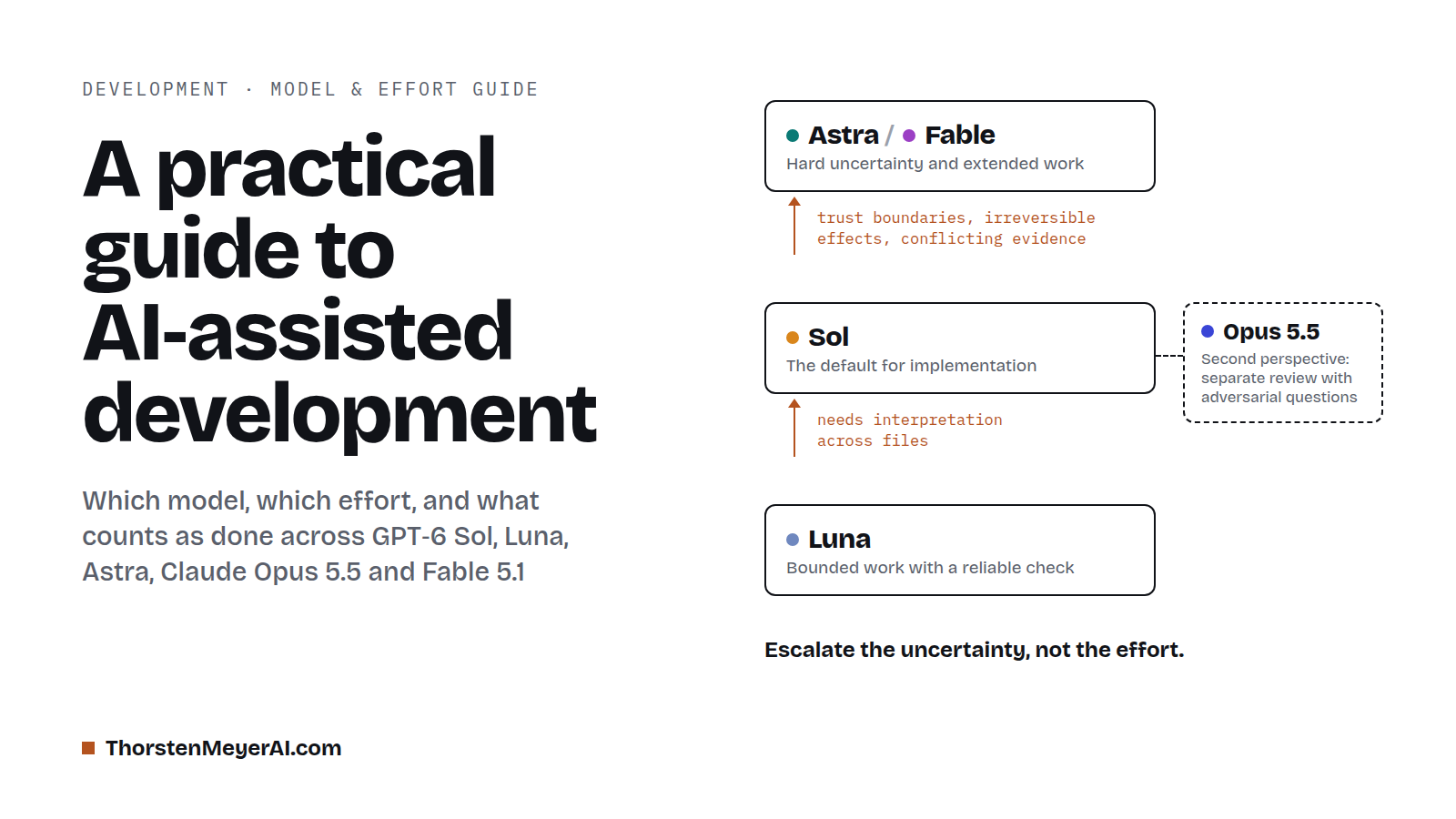
Escalate the uncertainty, not the effort. Move from Luna to Sol when a task needs interpretation across files. Move to Astra when trust boundaries, irreversible effects, conflicting evidence or complex system interactions remain unresolved. When you escalate, give the stronger model the failing case and the evidence, not just “try harder.”
Fable High is an alternative for demanding work over many steps or for a second deep investigation. The two can check each other: if Astra implements, Fable reviews, and if Fable implements, Astra reviews. Either way, assign separate files and independent acceptance evidence.
Keep effort proportional. A clear task with reliable checks can stay on a smaller model. High and Extra High are effort settings, not equivalent capability levels across models; Luna at High is not Astra at Medium. And more effort doesn’t replace missing requirements, an independent oracle or a real device.
One rule sits above all of this. Production data changes, destructive commands, secrets, paid services and external publication need explicit scope and the applicable authorization. A model recommendation is not permission to perform an action.
The reusable task brief
Every package of work starts with the same twelve-line brief. It’s the practical form of “define the contract”:
Outcome:        [observable user or system result]
Scope:          [included work and explicit exclusions]
Contract:       [repository instructions, plan, interfaces]
Ownership:      [allowed files; integration owner]
Model / effort: [recommendation and reason]
Acceptance:     [real flows and objective success criteria]
Negative cases: [permissions, stale data, retry, concurrency]
Evidence:       [commands, outputs, artifact/build identity]
Constraints:    [time/credit budget, dependencies, data boundaries]
Escalation:     [uncertainty that requires review or user input]
Release:        [destination, authorization, migration and rollback]
Finish:         [reviewable changes, test evidence, limits, next steps]
Three fields do most of the work. Negative cases forces someone to think about what should fail before anything is built. Evidence requires artifact and build identity, which closes the gap between “it worked on a build” and “it works on the build we shipped.” Escalation names in advance the uncertainty that should stop the agent and bring in a person, so you don’t discover it after the fact.
Basis and limits
The broad model roles come from vendor documentation. The allocation itself is an engineering recommendation. It isn’t a measured model ranking, and it isn’t a guarantee of safety. Model availability and effort controls vary by account and client, and the right answer for your team depends on your codebase.
So treat the guide the same way it tells you to treat a model’s output: as a claim to verify. Pick a few representative tasks from your own repository, run them through the allocation, and keep what the evidence supports.
The guide is a reference only and changes no model configuration or deployment. Current as of September 23, 2026. Sources: OpenAI, Models & reasoning effort; Anthropic, Models overview.
Fall Picks
fall essentials
As an affiliate, we earn on qualifying purchases.