
Vibe coding is revolutionizing how you develop software by letting you describe your goals with simple language, and AI models turn those prompts into functional applications. It shifts your role from manual coding to strategic design, making development faster and more accessible. This human–AI collaboration enhances workflows, reduces costs, and sparks innovation. If you keep exploring, you’ll discover how this new approach continues to reshape the future of programming and teamwork.
Key Takeaways
- Vibe coding transforms natural language prompts into functional software, enabling faster development through human–AI collaboration.
- It shifts programming focus from manual coding to goal articulation and strategic oversight, democratizing software creation.
- AI models generate code based on prompts, requiring iterative refinement and prompt engineering for quality control.
- This paradigm accelerates workflows, automates routine tasks, and fosters innovative, accessible development environments.
- Challenges include ensuring code quality, managing technical debt, and maintaining ethical standards in AI-assisted programming.
Top picks for "rise vibe paradigm"
Open Amazon search results for this keyword.
As an affiliate, we earn on qualifying purchases.
Understanding the Foundations of Vibe Coding

Have you ever wondered how natural language prompts can turn into functional software? Vibe coding makes this possible by allowing you to describe what you want in plain language, and AI models like GPT-4 generate the code for you. Instead of writing line-by-line, you focus on your intent, and the AI creates an initial version of your program. This process is iterative: you refine your prompts, and the AI improves the code until it works as desired. It shifts the traditional programming role, putting you in the driver’s seat as an describer of goals rather than a manual coder. This approach relies on powerful language models that understand context and translate your ideas into executable code, making software development more accessible and faster. Additionally, as AI-generated code becomes more reliable, it may influence the cost of software development and how teams collaborate on projects.
How Vibe Coding Transforms Developer Roles
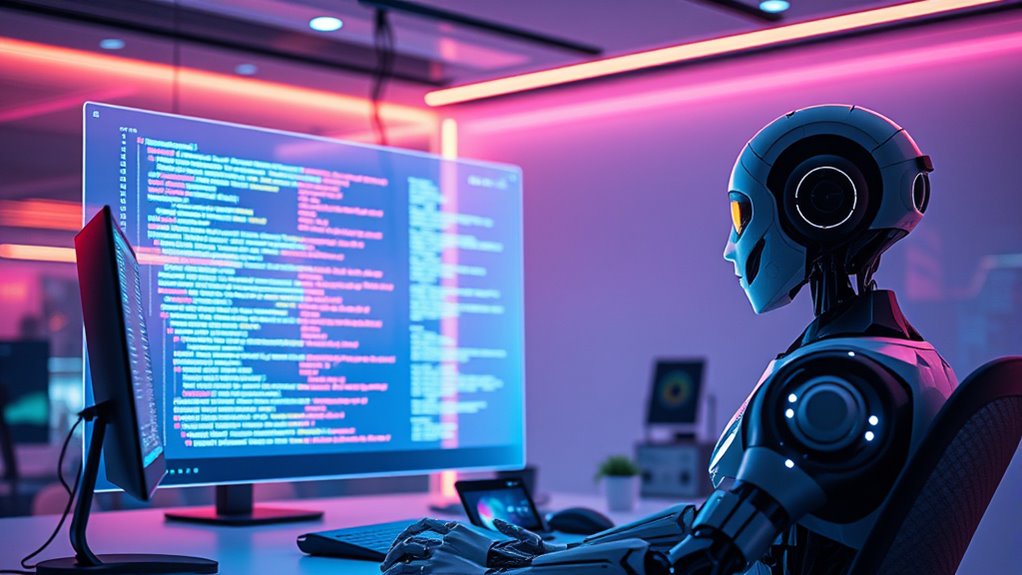
Vibe coding fundamentally reshapes developer roles by shifting the focus from manual code production to orchestration and oversight. You now act as an AI orchestrator, guiding and supervising AI-generated outputs. Your main responsibilities include reviewing, refining, and ensuring code quality, rather than writing every line yourself. New roles like prompt engineers emerge, requiring you to craft precise prompts that steer AI effectively. You focus more on system architecture and strategic planning while routine coding is delegated to AI. Embracing this shift encourages creative problem-solving and adaptability in navigating new tools and workflows.
Comparing Vibe Coding With Traditional Programming Approaches

When comparing vibe coding to traditional programming, you’ll notice differences in how you shape developer roles and work with code. Vibe coding simplifies prompt precision and accelerates development but offers less control over code quality and customization. Understanding these contrasts helps you decide which approach best fits your project’s needs and long-term goals. Additionally, vibe coding’s reliance on AI tools means that some projects may face limitations due to the platform’s capabilities and constraints. Recognizing the limitations of AI platforms is essential for effective planning and project execution.
Developer Role Evolution
The evolution of the developer role reflects significant shifts in skills and workflows driven by Vibe coding compared to traditional programming. You now focus more on high-level problem definition and intent expression, rather than mastering specific languages. This change means:
- You need only basic technical understanding, reducing barriers to entry.
- Your role shifts from manual coding, debugging, and optimization toward collaborating with AI for code generation.
- You can accelerate workflows with AI automation in testing, documentation, and prototyping.
- Your control over the code remains flexible but limited by AI-generated structures, requiring you to fine-tune or troubleshoot snippets.
Additionally, the rapid development cycle enabled by Vibe Coding allows for faster iteration and product deployment, transforming the typical project timeline. The ability to adapt quickly is further supported by grocery store hours, which exemplify how operational flexibility can enhance overall efficiency in various sectors.
Prompting Precision Differences
While natural language prompts make vibe coding accessible and flexible, they also introduce variability in accuracy compared to traditional programming. Traditional coding relies on explicit syntax and logic, enabling precise control and predictable results. With vibe coding, ambiguity in prompts can produce unexpected or suboptimal code, often requiring iterative refinement. The precision of traditional code stems from well-defined languages and compilers that guarantee consistent outcomes. Conversely, vibe coding’s prompt accuracy depends on AI model capabilities and user skill, making it less deterministic. Although vibe coding speeds up development, it sacrifices some precision and optimization, especially in complex tasks. The trade-off favors quick prototyping over meticulous control, making vibe coding ideal for simpler projects but less suited for scenarios demanding exactness. Additionally, understanding essential oils and their properties can enhance the effectiveness of health-related applications and recommendations.
Code Quality and Control
Vibe coding’s flexibility and speed come with trade-offs in code quality and control. You might find that AI-generated code requires frequent revisions, increasing code churn, and can lead to performance issues due to higher resource consumption. Maintaining structure in large projects becomes difficult, and debugging is more complex because you lack direct control. Compared to traditional programming, which allows you to:
- Manually optimize for performance and scalability
- Maintain consistent, understandable code structures
- Directly handle errors and debug effectively
- Control scalability and long-term security
Vibe coding accelerates development and makes projects accessible to beginners, but it often sacrifices the fine control and robustness you get with manual coding. This trade-off impacts long-term maintenance and the security of your applications. Furthermore, the lack of detailed documentation and standardized coding practices in AI-generated code can complicate future updates and team collaboration. Additionally, the absence of structured code can hinder scalability and increase technical debt over time.
Practical Applications and Use Cases of Vibe Coding

Practical applications of Vibe coding span diverse industries and use cases, transforming how organizations modernize legacy systems, guarantee data privacy, and develop new software solutions. In enterprise environments, it accelerates updates of mission-critical systems like Oracle applications, preserving institutional knowledge through AI-assisted code generation and streamlining cloud integration. For privacy-sensitive sectors such as healthcare, Vibe coding automates secure data handling routines, ensuring compliance and data sovereignty with on-premises processing. It also empowers non-developers to build profitable apps, chatbots, and SaaS platforms rapidly, often with minimal coding experience. Additionally, specialized AI tools enable the creation of customized solutions—like resume analyzers or resource optimization visualizers—by engaging in intuitive, iterative conversations. Furthermore, automating legacy system updates ensures that older software remains functional and secure in a rapidly evolving digital landscape. Overall, Vibe coding broadens innovation, reduces costs, and enhances system adaptability across multiple industries. Vibe coding’s versatility allows it to be integrated into various operational environments, further expanding its impact and utility.
The Collaborative Nature of Human and AI in Vibe Coding

The collaborative relationship between humans and AI in Vibe coding transforms software development by combining human creativity with machine efficiency. You guide AI tools with natural language prompts, shaping code generation through your input. This partnership allows you to: 1. Automate routine tasks, freeing time for complex problem-solving. 2. Use natural language and prompt engineering to craft precise code requests. 3. Refine AI-generated code through iterative feedback, improving quality. 4. Leverage AI’s contextual understanding to generate relevant, functional snippets. This synergy boosts productivity, fosters innovation, and democratizes coding by making it accessible to non-experts. By embracing greenhouse technology and principles, developers can create adaptable and sustainable software solutions. Together, you and AI create a dynamic environment where human insight and machine speed enhance software development, pushing the boundaries of what’s possible.
Limitations and Challenges Facing Vibe Coding Adoption
You might face concerns about code quality when relying on vibe coding, as AI-generated outputs can be inconsistent or insecure. Over time, this reliance could weaken your foundational programming skills, making debugging and troubleshooting more difficult. Addressing these challenges requires careful oversight and new skill development to guarantee effective collaboration with AI. Additionally, understanding ethical hacking principles can help in identifying vulnerabilities introduced by AI-generated code.
Code Quality Concerns
Despite the promise of rapid development, vibe coding faces significant challenges related to code quality that hinder its widespread adoption. Security vulnerabilities are common because AI-generated code may incorporate outdated or flawed patterns, often with less human oversight. You also rely heavily on AI outputs, which can lead to skipped security checks and inadequate error handling. Additionally, code from vibe coding can be difficult to maintain due to complexity and lack of documentation. To visualize, consider:
- Security vulnerabilities from outdated patterns
- Skipped security and error checks
- Difficulties in understanding and maintaining opaque code
- Increased technical debt hindering future updates
- The integration of AI in software development is projected to redefine user interactions but requires careful management to ensure code quality.
These issues make it difficult to ensure reliable, secure, and scalable applications, raising concerns about vibe coding’s long-term viability.
Skill Degradation Risks
Heavy reliance on vibe coding can erode your core programming skills, such as understanding algorithms, data structures, and memory management. As you depend more on AI-generated code, you risk losing essential problem-solving experiences gained from building features manually. This weakens your ability to troubleshoot independently when AI assistance isn’t available. Teams face knowledge gaps since no one fully understands the AI-produced code, reducing effective knowledge transfer. Recursive training, where developers learn mainly from AI-written code, further degrades foundational understanding. Over time, developers become proficient in prompting AI but struggle with debugging and creative thinking. This skill erosion hampers your career growth, diminishes code quality, and increases security risks, as your capacity to identify vulnerabilities and maintain complex systems declines. Additionally, reliance on AI tuning tools can lead to misguided modifications, which may compromise vehicle safety and performance if not thoroughly understood.
The Impact of Vibe Coding on Software Development Workflows

Vibe coding is transforming software development workflows by boosting speed, efficiency, and collaboration. You’ll notice faster delivery as routine tasks like debugging and testing are automated, reducing time-to-market by over half. This enables teams to incorporate comfort and support solutions into their development environments, promoting better focus and mental well-being. This allows you to focus on designing architecture and solving complex problems. Additionally, development cycles become more streamlined because quick testing and feedback loops accelerate iterations.
Here’s what you’ll experience:
- Faster project completion through automation of repetitive tasks.
- Increased productivity by offloading boilerplate code generation.
- Enhanced team collaboration, breaking down traditional role barriers.
- Improved workflow agility with rapid prototyping and feedback integration.
These changes make workflows more dynamic, collaborative, and adaptable, fundamentally reshaping how you develop software.
Tools and Platforms Enabling Vibe Coding Today
Are you curious about the tools shaping today’s vibe coding landscape? AI-driven platforms like Lovable turn natural language prompts into polished UI designs, supporting templates and mobile responsiveness. Vercel’s V0 creates full-stack apps from chat prompts, exposing code and database schemas, then deploying seamlessly. Enterprise tools enable you to describe app functions in chat, translating prompts into secure, compliant code. Google Cloud highlights vibe coding as an AI workflow that writes, refines, and debugs code conversationally, accelerating development. Wegic simplifies visual design with Figma imports, drag-and-drop interfaces, and prompt-driven exports for React or Vue. AI pair programming tools like GitHub Copilot embed into IDEs, providing real-time code suggestions from natural language comments. No-code platforms empower designers to craft interactive prototypes without manual coding, democratizing UI creation and speeding up project launches. Additionally, understanding IRAs allows developers to incorporate secure and compliant investment options into financial applications, enhancing user trust and functionality.
Future Trends and Evolving Practices in Vibe Coding
As vibe coding continues to evolve, its adoption is rapidly expanding, making it a fundamental approach for creating fast, expressive, and scalable digital experiences by 2025. You’ll see several key trends shaping this future:
- Increased adoption of vibe coding as a standard for building dynamic, user-friendly applications.
- AI-driven automation, with models like GPT-4 converting natural prompts into functional code swiftly.
- A shift in developer roles toward designing experiences, while AI manages syntax and implementation.
- Democratization of software development, enabling non-technical users to create solutions with multimodal inputs like voice, visuals, and text.
- Understanding the divorce process in various states will be essential for legal professionals and individuals navigating family law matters.
These practices will drive faster prototyping, broaden accessibility, and enhance creativity across industries.
Ethical and Maintenance Considerations in Human–AI Coding Collaboration

You need to prioritize code security and manage technical debt carefully to prevent vulnerabilities and maintain system integrity. Upholding ethical standards is essential to guarantee responsible AI collaboration and avoid unintended harm. Regularly reviewing and updating practices keeps your human–AI coding partnership aligned with evolving ethical and maintenance requirements. Incorporating digital literacy programs can enhance understanding and responsible use of AI tools among team members.
Ensuring Code Security
Ensuring code security in human–AI collaboration requires proactive measures to prevent vulnerabilities and protect sensitive data. First, avoid hardcoding secrets; use environment variables or secure secret management systems instead. Second, validate and sanitize all user inputs, both manually and with tools, to defend against injection attacks. Third, implement strong authentication (like OAuth and MFA) and enforce least privilege access controls, ensuring AI-generated code includes these security features through prompt engineering. Fourth, automate security checks using static analysis, dependency scans, and secret detection tools within CI/CD pipelines. These steps help catch vulnerabilities early, reduce exposure, and maintain a secure development environment, all while supporting rapid, vibe-driven coding practices. Additionally, integrating HEPA filtration systems can improve the overall air quality in the workspace, promoting a healthier environment for developers working long hours.
Managing Technical Debt
Managing technical debt in human–AI coding collaborations requires careful ethical and maintenance considerations. AI tools often produce quick fixes and temporary solutions that can become long-term liabilities. Over time, outdated systems and code shortcuts increase fragility and maintenance costs, especially as generative AI integrates into platforms designed for human interaction. This complexity raises risks of degraded code quality and sustainability issues. You must oversee AI-generated code to prevent low-quality, hard-to-maintain outputs that accelerate debt accumulation. Leaders allocate significant resources—up to 30% of IT budgets—to debt management, treating it like financial debt. Building AI-native architectures instead of retrofitting legacy systems helps reduce future debt. Continuous oversight and strategic planning are essential to ensure that AI-driven development remains maintainable, secure, and aligned with long-term organizational goals. Additionally, understanding beauty hours today list can aid in scheduling and resource allocation to support ongoing maintenance efforts.
Upholding Ethical Standards
Maintaining ethical standards in human–AI coding collaborations is vital for building trust and ensuring responsible development. To achieve this, you should focus on four key areas:
- Guarantee transparency and explainability by making AI decisions understandable and context-appropriate, which bolsters user trust.
- Promote fairness by actively identifying and mitigating biases, fostering inclusive decision-making that respects cultural diversity.
- Prioritize privacy and data protection through strict controls, compliance with regulations, and transparent communication about data use.
- Establish clear accountability by maintaining human oversight, implementing governance mechanisms, and continuously auditing AI behavior.
Frequently Asked Questions
How Does Vibe Coding Affect Long-Term Software Maintenance?
Vibe coding makes long-term maintenance more challenging because it produces inconsistent, organic code that’s hard to understand and modify over time. You might find yourself spending extra effort debugging and refactoring due to hidden inefficiencies and lack of clear structure. Relying heavily on AI-generated code can cause knowledge gaps within your team, increasing dependence on specific tools and risking difficulties if those tools change or become unavailable.
What Skills Are Essential for Effective Vibe Coding?
You need to develop a keen sense of prompt artistry, like a painter choosing just the right brushstrokes to bring a canvas alive. Strong critical thinking keeps your work sharp, ensuring AI outputs are secure and maintainable. Effective communication acts as a bridge, connecting ideas across teams. Adaptability fuels your ability to pivot swiftly, while curiosity keeps your skills fresh, helping you navigate the evolving landscape of vibe coding with confidence and finesse.
Can Vibe Coding Replace Traditional Coding Entirely?
Vibe coding can’t replace traditional coding entirely yet. While it speeds up development and makes coding more accessible, it still lacks the flexibility, control, and scalability needed for complex, large-scale projects. You’ll find vibe coding perfect for rapid prototyping and small tasks, but for detailed customization, safety, and long-term maintenance, you’ll still rely on traditional coding. Both approaches complement each other, shaping the future of software development.
How Secure and Reliable Is Ai-Generated Code in Critical Systems?
AI-generated code in critical systems carries inherent uncertainties, so you should approach it cautiously. While it offers rapid development, it often embeds vulnerabilities, especially if security isn’t explicitly prioritized. You must verify AI outputs thoroughly, incorporate security best practices, and remain vigilant about potential supply chain issues. Relying solely on AI without human oversight risks overlooking flaws that could compromise system integrity, so active security measures are essential.
What Are the Legal Implications of Ai-Created Software?
You face legal risks with AI-created software, like potential copyright violations if the AI reproduces licensed code without attribution. Ownership rights are uncertain, and liability for bugs or security flaws isn’t clearly defined, leaving you vulnerable. Confidential data could be accidentally disclosed or embedded, risking breaches. You must navigate evolving laws on intellectual property, accountability, and data privacy to protect yourself and your organization from legal consequences.
Conclusion
As you explore vibe coding, you’ll see how it’s revolutionizing collaboration—over 65% of developers report faster project turnaround times. This approach empowers you to work seamlessly with AI, enhancing creativity and efficiency. Embracing vibe coding not only transforms your role but also shapes the future of software development. By staying adaptable and ethical, you can uncover new possibilities and lead innovations in this exciting paradigm shift.