Thorsten Meyer AI Foundations · 08 / 08
Four rings, one question — and the layer that actually determines whether AI helps
The previous seven pieces have been about the machine. What a model is. How it thinks. What it’s good at. How to prompt it. When to trust it. Which one to pick. How it acts.
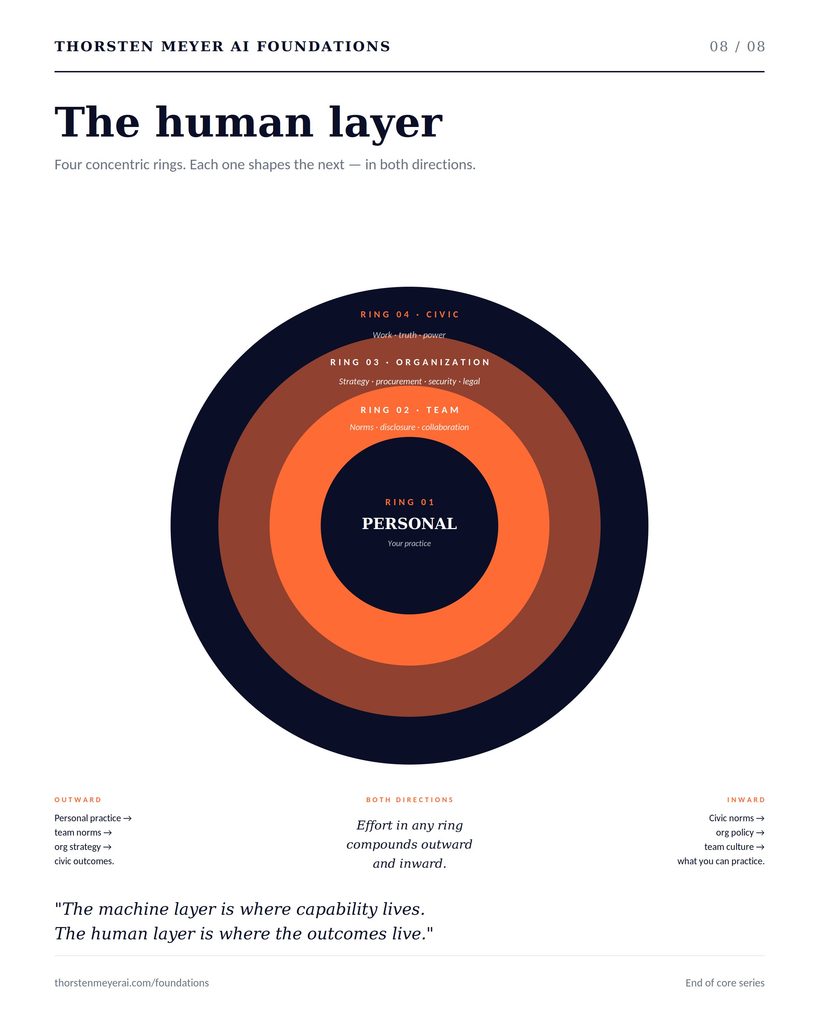
This one is about the humans. Specifically, about the four concentric rings in which AI shows up in your life, and how each ring demands a different kind of attention.
The machine layer gets most of the coverage — it’s new, it’s visible, it’s where the money is. The human layer gets less. It’s also where the actual outcomes are decided. A team with clear AI norms and an average model will outperform a team with the best model and no norms. An organization that thinks seriously about what AI should and shouldn’t do inside its walls will outperform one that doesn’t, almost regardless of which tools they’ve picked. The human layer is the one that compounds.
Four rings.

AI PRODUCTIVITY PLANNER FOR KNOWLEDGE WORKERS: Master ChatGPT & AI Workflows to Write Faster, Think Smarter, and Reclaim 10+ Hours Every Week
As an affiliate, we earn on qualifying purchases.
As an affiliate, we earn on qualifying purchases.
Ring 1: Personal
This is where you sit. The way you use AI in your own work — what you reach for it for, what you don’t, where it helps, where it makes you worse.
The honest personal question isn’t “how much AI can I use?” It’s “where does AI make me better, and where does it make me worse?” These are different questions with different answers for every person. A writer who uses AI for first drafts may produce more volume but lose their voice. A researcher who uses it for literature review may catch more references but develop less intuition for the field. A coder who accepts every suggestion may ship faster and understand their codebase less. The effects are real. They’re also personal. Nobody else can tell you where your line is.
A useful practice: separate what you use AI for from what you want to get better at. Things you want to get better at, do yourself. Things that are just friction between you and the real work, delegate freely. The specific list will change over time. That’s fine; the discipline of keeping the list separate is the point.
A second useful practice: periodically do the task without AI to see what happens. If the answer is “I’ve atrophied and can’t do this anymore,” that’s information. It doesn’t necessarily mean stop using AI — it might mean this was never a skill worth protecting. But it might mean the opposite. You won’t know until you check.
The personal ring is also where the subtler effects live — on attention, on patience, on tolerance for the messy middle of difficult problems. AI is extraordinarily good at skipping the messy middle. Sometimes that’s a win. Sometimes the messy middle was where the learning happened, and skipping it means you don’t learn. Hold both possibilities.
AI Tools and Techniques for Corporate Facilitators & Leaders: Unlock Innovative Strategies with ChatGPT for Enhanced Collaboration, Creativity, and Efficiency
As an affiliate, we earn on qualifying purchases.
As an affiliate, we earn on qualifying purchases.
Ring 2: Team
The team ring is where most AI value is realized in working life — and where most of the friction happens.
Teams need AI norms. Not policies in the HR sense; norms in the “how do we actually work” sense. Three questions every team should answer out loud, not by default.
What do we use AI for? Drafting. Translation. Code review. Meeting summaries. Research. Decide. Name it. When everyone agrees what AI is for, collaboration stops being a guessing game.
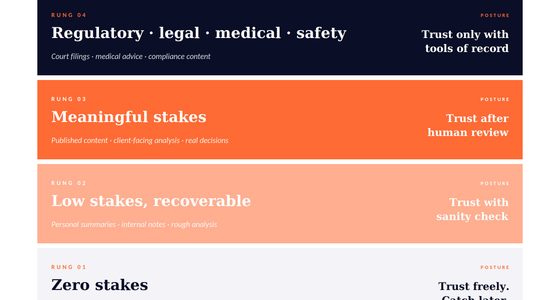
What do we review? Not every AI output needs human review. Rung 1 stakes (piece 05) don’t require it; rung 3 stakes do. Without agreement, the same team will have some members reviewing everything paranoidly and others shipping AI drafts directly to clients. Both are failure modes.
What do we disclose? When a deliverable was AI-assisted, do we say so? To whom? Under what circumstances? Reasonable teams differ on the answer. But they should have an answer, not an implicit norm that nobody has articulated and nobody reliably follows.
Beyond norms, teams face a real change in the texture of collaboration. AI writes the first drafts. Meetings spend less time on initial versions and more on judgment about them. People who are good at judging quickly become more valuable; people who were mainly valuable for producing drafts face a different career than they planned. This isn’t a prediction — it’s already happening. Teams that name the shift explicitly navigate it better than teams that pretend it isn’t happening.
A practical tool: a shared page somewhere that records the team’s AI norms. Short. Revisited quarterly. Written the way a real person would write it, not the way a compliance document reads. The point isn’t the document. The point is that the team has had the conversation.

Understanding the Mysteries of Human Behavior (Course Guidebook – Great Courses)
As an affiliate, we earn on qualifying purchases.
As an affiliate, we earn on qualifying purchases.
Ring 3: Organization
The organization ring is where AI meets strategy, procurement, security, and legal.
Strategically: AI changes the economics of many kinds of work, and therefore the economics of many products and services. The question isn’t whether to adopt AI — that decision was made for you by your competitors. The question is what to do about the parts of your business whose economics are shifting under you. Some parts will become dramatically cheaper to run. Some customers will become dramatically cheaper to serve. Some jobs will change shape. Some products that are viable at today’s margins will not be viable at tomorrow’s. The organizations that think clearly about which of these applies to them will be the ones that navigate the transition on their own terms.
Procurement: the model market (piece 06) is now a procurement problem — vendor selection, multi-model architecture, data policies, geographic constraints, renewal risk. Every one of these touches legal, finance, and IT. Treat AI as a first-class category of vendor, not a shadow experiment running on someone’s corporate card.
Security: prompt injection, data exfiltration via tool-using agents, model-assisted social engineering — these are live threats that don’t fit cleanly into existing security frameworks. Most organizations in 2026 have a security team that knows it needs to think about AI and a security framework that doesn’t yet. This gap is where the next 18 months of incidents come from. Getting in front of it is unglamorous and valuable.
Legal: copyright of AI-generated content, use of third-party IP in training and inference, agent actions with legal consequences, regulatory regimes that are genuinely new (the EU AI Act being the most developed). The organization needs a legal position. “We’ll figure it out case by case” is a position, but usually the wrong one.
The mistake organizations make is treating all of this as an IT problem. It is partly an IT problem. It is also a strategy problem, a people problem, a legal problem, and a risk-management problem. The organizations that do best at the organizational ring are the ones that form a small cross-functional group with real authority and ask it to keep asking the hard questions as the technology keeps changing.

Generative AI for Software Development: Building Software Faster and More Effectively
As an affiliate, we earn on qualifying purchases.
As an affiliate, we earn on qualifying purchases.
Ring 4: Civic
The civic ring is the biggest, most diffuse, and hardest to act on. It’s also the one that matters most over long time horizons.
Three questions sit at the civic ring. None of them have clean answers.
What happens to work? Not “will AI take our jobs” — that question is too crude. The real question is how specific kinds of work change, what new kinds emerge, how long transitions take, and who bears the cost of the transition. Every previous general-purpose technology has produced this kind of reshuffling. Early answers usually over-predict displacement and under-predict new categories. That doesn’t mean AI will be identical to previous transitions — the speed might be different — but it means the dramatic predictions are probably wrong in directions we can’t yet see.
What happens to truth? Generative AI has made it trivially cheap to produce plausible text, images, and video. The economic model of fact-based journalism is under strain. The supply of persuasive misinformation is now effectively infinite. The old verification heuristics (is it well-written? does it have sources? does it look real?) don’t work reliably anymore. Society hasn’t yet built the new ones. This is not a solved problem and pretending it is doesn’t help.
What happens to power? AI capability is concentrated in a handful of labs and a handful of countries. The economic returns to AI are concentrated in a handful of companies. These concentration patterns are not inevitable but they are the default trajectory, and they have consequences for democracy, for national sovereignty, for labor, and for the shape of the global economy. Thinking clearly about this is uncomfortable because the stakes are high and the levers are unclear. That doesn’t make the thinking less necessary.
The civic ring isn’t something most individuals can solve. But ignoring it is also a decision. The people working on AI — which, increasingly, means most knowledge workers — have an obligation to at least know what the questions are and which ones they find themselves pushing in a direction they’d be comfortable defending.
How the rings interact
The rings aren’t independent. Each inner ring shapes the ones outside it, and each outer ring shapes the ones inside.
Personal practice shapes team norms. A team full of people who use AI thoughtfully produces different norms than a team full of people who either refuse it or accept every output uncritically.
Team norms shape organizational strategy. An organization whose teams genuinely understand what AI is good at makes different strategic bets than one whose teams either fetishize or fear it.
Organizational strategy shapes civic outcomes. The companies making decisions about how to deploy AI in their products, how to treat the data they collect, whether to lobby for or against specific regulations — these decisions compound into the civic landscape whether anyone intends them to or not.
And the reverse flow matters too. Civic choices — regulations, standards, societal norms about disclosure and consent — constrain what organizations can do. Organizational policies constrain what teams can do. Team norms constrain what individuals find easy or hard to practice. Each outer ring sets the context for the one inside.
The practical implication is boring and important: effort invested in any one ring compounds outward and inward. Good team norms make your personal practice easier. Thoughtful organizational policy makes your team’s norms durable. And individual practice, across enough people, is how civic norms get built in the first place.
Closing the loop
Seven pieces of foundations, plus this one. The whole series has been an attempt to answer one question at many scales: how do we think clearly about AI?
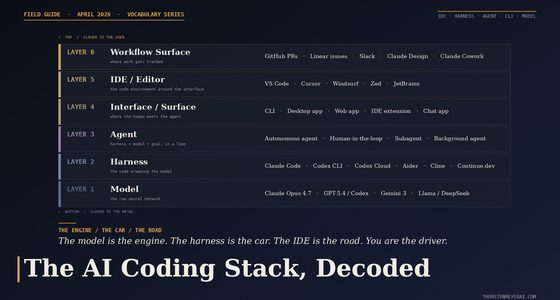
At the machine layer, clarity means not confusing model with application (piece 01), not misreading the dials (piece 02), not flattening jagged capability into a benchmark (piece 03), not mistaking specification for incantation (piece 04), not conflating hallucination with failure (piece 05), not picking models when you should be picking architectures (piece 06), and not waving at “agentic” as if it were one thing (piece 07).
At the human layer, clarity means separating what you use AI for from what you want to get better at, giving your team the conversation it’s been avoiding, giving your organization a real strategy rather than a set of experiments that added up to one by accident, and at least noticing which civic outcomes you’re contributing to.
The machine layer is where the capability lives. The human layer is where the outcomes live. Both matter. Neither is enough by itself.
Everything else — every sibling series in the pillar roadmap, every new capability that arrives, every strategic question that AI makes newly urgent — is what happens when you take these eight foundations seriously and start applying them to specific problems. Which is where Thorsten Meyer AI Operators, AI Strategy, AI Risk, and AI Builders begin.
Foundations is the floor. What you build on top is yours.
End of core series. Continue with the pillar series at thorstenmeyerai.com/foundations.