By Thorsten Meyer | November 28, 2026 | ThorstenMeyerAI.com

Get business pricing on tech for your team
- Business-only prices and quantity discounts
- Tax-exempt purchasing
- Multiple users, one account, clear invoices
Partly, and less reliably than it sounds. Researchers have found that language models build real inner maps of games, places and ideas. But those maps have holes, and a small change to a question can drop a model into one without warning.
This is the written companion to our explainer video. It follows one question from start to finish: does a machine that writes so fluently understand what it says, or does it only sound like it does?
Key takeaways
- Experts disagree: in a 2022 survey, language researchers split almost exactly in half on whether a text-only model could ever understand language.
- “Understanding” means different things: using language well, building an inner picture of the world, or linking words to real things.
- Models build inner maps: a model trained only on game moves rebuilt the game board inside itself, unseen.
- The maps are patchy: models that gave near-perfect taxi directions failed when streets closed. Reversed or reworded questions trip them up too.
- For you: fluent answers are not proof. Test AI with small changes, and give it the documents it should use.
Perfect directions, until one street closes
A model learned a city only from turn-by-turn taxi rides. Did it learn a map, or just routes?
Known roads: the model gave valid directions about 99% of the time.
One closed street: with a 1% chance of a detour at each turn, valid routes fell to 69%.
A true map would simply go around. The model’s inner map had impossible streets.
Products Worth Considering

Bose QuietComfort Headphones (2nd Gen), Wireless Over-Ear Noise-Cancelling Headphones, Black

Samsung 49-Inch Odyssey G93SC QD-OLED Curved Gaming Monitor

Anker SOLIX S2000 Portable Power Station, 2,010Wh, 1,500W
As an affiliate, we earn on qualifying purchases.
What this means for you
You can’t see where a model’s map is solid and where it is guesswork. So treat a smooth answer as a draft, not as proof of understanding.
Give your question a detour on purpose. Ask the same thing in other words. Turn it around: if the model knows “A is B”, check that it also knows “B is A”. In a maths or planning task, change the numbers and see whether the method still holds.
Give the AI the map. Paste the document, the data or the rules you want it to use. In the reversal-curse study, models could work out the reverse of a fact when that fact was in the prompt.
If your business relies on an AI tool, test it on your own cases, with small changes. High scores on public tests can come from shortcuts. Your customers will bring the detours.
What would it mean for an AI to “understand”?
Start with how these systems work. A language model writes by predicting the next word, again and again. We explained that step by step in How Large Language Models Work. The open question is what a model has to learn to predict that well.
“Understanding” is a slippery word here. In plain terms, people usually mean one of three things:
- Behaviour. Does the model use language the way a person would? This is what you see in a chat.
- An inner model. Does it build a picture of the world inside, beyond the words? This is a question about what happens inside the system.
- Grounding. Are its words linked to real things you can see, touch or do? Stevan Harnad called this the symbol grounding problem. He compared it to “trying to learn Chinese from a Chinese/Chinese dictionary alone” (Harnad, 1990).
A model can score well on one meaning and badly on another. That is a big reason why the debate goes in circles.
Here is a picture that helps. Imagine a taxi driver who has never seen a map and never looked out of the window. All they ever got were millions of old trip logs: left, right, straight on, stop. After a while, they give perfect directions. Did they memorise a big pile of routes? Or did they build a map of the city in their head?
From the passenger seat, both look the same. When you use a chatbot, you are always in the passenger seat. The picture has a limit, of course. A model is not a person, and nobody sits inside it. But the question it raises is exactly the one researchers test.
Why can’t the experts agree?
In May and June 2022, researchers surveyed the natural-language-processing research community. Of 480 people who completed the survey, 51% agreed with this statement: “Some generative model trained only on text, given enough data and computational resources, could understand natural language in some non-trivial sense.” The rest disagreed (Michael et al., 2022).
The same survey asked about a model with access to images, sensor data and more. Here, 67% agreed. Only 36% thought tests that use text alone could measure understanding.
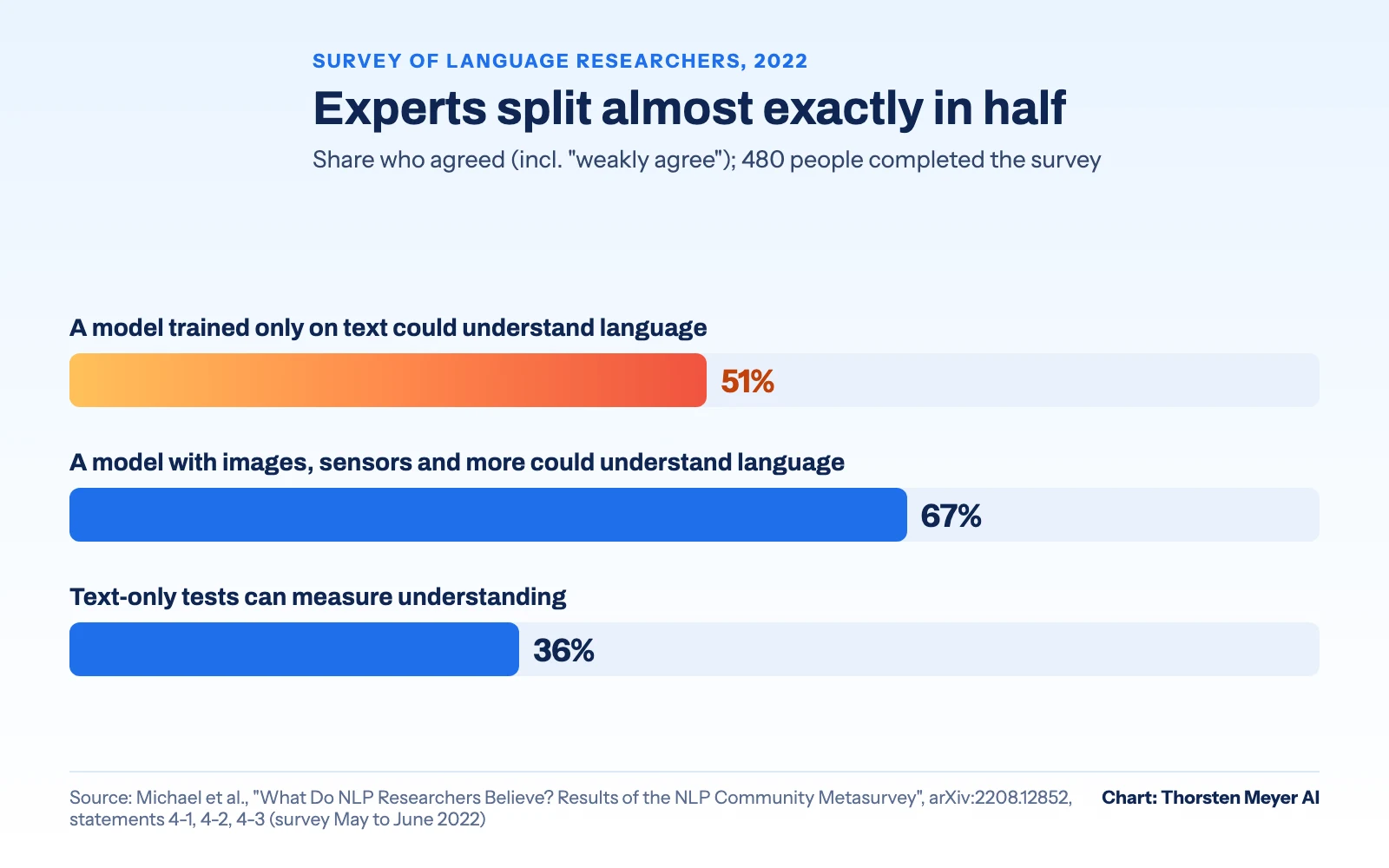
The authors left “understand” undefined on purpose. Respondents answered with their own definitions. That is part of why the answers split. As Melanie Mitchell and David Krakauer put it in their review, the debate has “real stakes for how much we can trust them” (Mitchell & Krakauer, 2023).
What do the doubters say?
The best-known argument is a thought experiment from 1980 by the philosopher John Searle, the Chinese Room. Searle imagined himself alone in a room with a book of instructions for handling Chinese symbols. Notes in Chinese come in under the door. He looks up the symbols and sends back the answers the rules produce. Outside, people “mistakenly suppose there is a Chinese speaker in the room”. Inside, he understands nothing (Stanford Encyclopedia of Philosophy).
Searle’s point: following rules for symbols can look like understanding without being understanding. Critics answered with the “systems reply”. The man does not understand Chinese, they said, but maybe the whole system does. Philosophers still argue about it.
In 2020, the linguists Emily Bender and Alexander Koller made a sharper version for language models (Bender & Koller, ACL 2020). Two people are stranded on separate islands. They chat through an old undersea cable. A very clever octopus taps the cable. It never sees the islands, only the messages. It learns to predict the replies, then cuts the cable and answers itself.
Small talk works. Then one islander is chased by an angry bear. She grabs a couple of sticks and asks for help building a weapon. The octopus has never seen a bear or a stick. It only knows which words tend to follow which. So it fails.
Their conclusion: “a system trained only on form has a priori no way to learn meaning.” Form is the shape of the text. Meaning is what it points to in the world. Bender and three co-authors later published “On the Dangers of Stochastic Parrots” (2021). Mitchell and Krakauer cite both papers for the view that text teaches models “the form of language but not the meaning”.
The doubters add a warning about us. Back in the 1960s, a simple chatbot called Eliza “still fooled people into believing it understood them”, Mitchell and Krakauer write. That trap is called the Eliza effect. We are wired to read understanding into fluent text.
What do models build on the inside?
The other side points to evidence from inside the models. Here, the clearest case is a board game.
A board nobody showed it
Othello is a game where you place stones on an 8-by-8 grid and flip your opponent’s stones. In a study presented at ICLR 2023, researchers trained a small language model on lists of moves only (Li et al.). “The model has no a priori knowledge of the game or its rules,” they write. It never saw a board. Just like our taxi driver, it only saw the logs.
It learned to play legal moves almost perfectly. Its error rate was 0.01%, about one mistake in ten thousand moves. To rule out pure memorising, the team removed a quarter of all possible games from training. The model still played legal moves on test games it had never seen.
Then the team looked inside with a probe. A probe is a small add-on program that tries to read a fact from a model’s inner signals. The probe could read the board position from those signals, with errors as low as 1.7% per square. The model had built its own board.
The strongest part came next. The researchers changed one stone on that inner board. The model’s next moves changed to fit the changed board. That suggests the inner board is not a side effect. The model uses it. A follow-up study found the board is stored in a simple form: “my colour” versus “opponent’s colour” (Nanda, Lee & Wattenberg, 2023).
In this small world, our driver had drawn a map.
Maps of places and times
Does that happen in big models trained on real text? There are signs that it does. In 2023, Wes Gurnee and Max Tegmark at MIT probed Meta’s open Llama-2 models (Gurnee & Tegmark, ICLR 2024). From the models’ inner signals, they could read rough map positions of places and rough dates of people, artworks and news events.
They are careful about what this means. Such representations “do not constitute a dynamic causal world model in their own right”. But they call them “basic ingredients” of one.
Concepts that work across languages
In May 2024, Anthropic reported that it had identified “millions of concepts” inside one of its Claude models (Anthropic). It calls these patterns features. One feature lit up for the Golden Gate Bridge. It fired for English text, for Japanese text and other languages, and even for an image of the bridge. When the team turned that feature up, the model said: “I am the Golden Gate Bridge… my physical form is the iconic bridge itself…”
In March 2025, Anthropic traced how a model answers a question like “What is the capital of the state where Dallas is located?” (Anthropic). Inside, the model first activated “Dallas is in Texas”. Then it linked that to “the capital of Texas is Austin”. When the researchers swapped Texas for California inside the model, the answer changed to Sacramento. In poems, the model also picked a rhyme before writing the line that leads to it.
Some researchers go further. Steven Piantadosi and Felix Hill argue that models “likely capture important aspects of meaning”. In their view, meaning comes from how concepts relate to each other, not only from a link to the outside world (Piantadosi & Hill, 2022).
None of this proves understanding. But it shows that “just autocomplete” undersells what happens inside.
Where does the understanding break?
Now the detours. If a model has a real map, it should cope when the road changes.
The taxi test
In a NeurIPS 2024 paper, a team from Harvard, MIT and Cornell trained models on turn-by-turn taxi rides in New York City (Vafa et al.). By the usual tests, the models did very well. Between 96% and 99% of their routes were valid. The model trained on shortest paths found the true shortest path 97% of the time.
Then the researchers reconstructed the map each model seemed to use. It bore “little resemblance to the actual streets of Manhattan”. It had streets in impossible directions and roads flying over other roads.
So they added detours, like closed streets. With a 1% chance of a detour at each turn, the share of valid routes from the shortest-path model fell from 99% to 69%. With a 10% chance, it fell to 8%. A model trained on random, wandering trips coped much better: it stayed at 99% and 100% at those levels. What a model learns from matters.

This is the memorising driver: perfect on known roads, lost on the first detour.
The reversal curse
Remember the question about a famous actor’s mother? In a 2023 study, GPT-4 named a celebrity’s parent correctly 79% of the time. Asked the reverse, who that parent’s child is, it was right only 33% of the time. The test used 1,573 such pairs (Berglund et al.). The authors call this the reversal curse. A model trained on “A is B” does not automatically learn “B is A”. If the fact is right there in the prompt, though, models can work out the reverse.

One harmless sentence
Researchers at Apple took simple school word problems and added one sentence that changes nothing (Mirzadeh et al., ICLR 2025). Their example: “Oliver picks 44 kiwis on Friday.” Later comes the extra line, “but five of them were a bit smaller than average.” Many models subtracted the five small kiwis, as if they didn’t count. Such added clauses caused performance drops “up to 65%”.
Other studies find the same pattern. Across 11 tasks, models did consistently worse on unusual “counterfactual” versions of familiar tasks (Wu et al., 2023). In one test, GPT-4 decoded a simple cipher 51% of the time when the answer was a likely sentence, but only 13% when it was unlikely (McCoy et al., 2023).
So does a fluent answer prove understanding? Not on its own. These studies tested models from 2023 and 2024. Whether today’s models fail in exactly the same way needs new tests.
So is it “just autocomplete”?
Yes and no. A language model does predict the next word. But to do that well, it can build structure inside: a game board, rough maps of places and times, steps between facts, a rhyme planned ahead.
That structure is real, and it is patchy. It can be excellent on familiar ground and fail on a small change. Mitchell and Krakauer describe a related trap called shortcut learning: a system “relies on spurious correlations in the data, rather than humanlike understanding”. Those shortcuts are often invisible until a test changes.
I think the useful question is not does it understand? It is is my question a main road, or a detour?
How should you use AI, given all this?
- Give it a detour on purpose. Rephrase the question. Reverse it. Change the numbers. If the answer changes in substance, treat it as unchecked.
- Give it the map. Paste the document or data you want it to use. The reversal-curse study found models can work out “B is A” when “A is B” is in the prompt.
- Don’t take fluency as proof. A smooth, confident answer is exactly what triggers the Eliza effect.
- Watch for unusual cases. Rare names, odd number formats and unusual task setups are detours. Check those answers twice. For checking facts, see our guide on why AI makes things up.
- For businesses: build a small test set from your own cases. Add variations. Public benchmark scores don’t tell you how a tool handles your detours.
What do we know, and what don’t we know?
What is documented: models trained on sequences can build inner representations that they use, at least in small worlds like Othello. Large models hold rough maps of places and times and concepts that work across languages. Models also fail on reversed facts, irrelevant sentences and detours.
What is claimed or open: whether these inner maps amount to understanding. That is partly a question of definitions, not only of data.
What we don’t know: how much of a model’s work the current tools can see. Anthropic itself says its method “only captures a fraction of the total computation” even on short, simple prompts. We also don’t know how researchers would answer the 2022 survey today.
What would tell us more: models that handle truly new situations, and better tools to read their inner maps.
So, does AI understand language?
Back to our driver. The evidence says they did draw a map. But parts of it are wrong, and some streets lead nowhere.
Our picture has a limit too. A real driver can step out of the car and look around. A text-only model never can. That is the grounding gap, and it may be why more researchers in that survey said yes for a model with images and sensors.
Today’s language models build real inner maps, but patchy ones. Their fluency tells you little about where the holes are. So use them where the roads are well travelled, and test them with detours.
Further reading on ThorstenMeyerAI.com
- How Large Language Models Work: From Your Prompt to the Answer, and When to Trust It
- How LLMs Learn From Sliding Windows: Context Windows, Attention and the Cost of Long Prompts
- Why AI Makes Things Up With a Straight Face, and How You Can Catch It
- How Diffusion Models Generate Images: From Pure Noise to a Picture, Step by Step
Sources
- J. Michael et al., “What Do NLP Researchers Believe? Results of the NLP Community Metasurvey,” arXiv:2208.12852, 2022
- M. Mitchell, D. C. Krakauer, “The Debate Over Understanding in AI’s Large Language Models,” arXiv:2210.13966, 2023
- D. Cole, “The Chinese Room Argument,” Stanford Encyclopedia of Philosophy, revised Oct 23, 2024 (on J. Searle, “Minds, Brains, and Programs,” Behavioral and Brain Sciences, 1980)
- E. M. Bender, A. Koller, “Climbing towards NLU: On Meaning, Form, and Understanding in the Age of Data,” ACL 2020
- S. Harnad, “The Symbol Grounding Problem,” Physica D, 1990, arXiv:cs/9906002
- S. T. Piantadosi, F. Hill, “Meaning without reference in large language models,” arXiv:2208.02957, 2022
- K. Li et al., “Emergent World Representations: Exploring a Sequence Model Trained on a Synthetic Task,” ICLR 2023, arXiv:2210.13382
- N. Nanda, A. Lee, M. Wattenberg, “Emergent Linear Representations in World Models of Self-Supervised Sequence Models,” arXiv:2309.00941, 2023
- W. Gurnee, M. Tegmark, “Language Models Represent Space and Time,” ICLR 2024, arXiv:2310.02207
- Anthropic, “Mapping the Mind of a Large Language Model,” May 21, 2024
- Anthropic, “Tracing the thoughts of a large language model,” Mar 27, 2025
- K. Vafa, J. Y. Chen, A. Rambachan, J. Kleinberg, S. Mullainathan, “Evaluating the World Model Implicit in a Generative Model,” NeurIPS 2024, arXiv:2406.03689
- L. Berglund et al., “The Reversal Curse: LLMs trained on ‘A is B’ fail to learn ‘B is A’,” arXiv:2309.12288, 2023
- I. Mirzadeh et al., “GSM-Symbolic: Understanding the Limitations of Mathematical Reasoning in Large Language Models,” ICLR 2025, arXiv:2410.05229
- Z. Wu et al., “Reasoning or Reciting? Exploring the Capabilities and Limitations of Language Models Through Counterfactual Tasks,” arXiv:2307.02477, 2023
- R. T. McCoy et al., “Embers of Autoregression,” arXiv:2309.13638, 2023
- E. M. Bender, T. Gebru, A. McMillan-Major, S. Shmitchell, “On the Dangers of Stochastic Parrots: Can Language Models Be Too Big?,” FAccT 2021 (title only; the publisher page refused our request)
Disclosure: Researched and drafted with AI assistance, including Anthropic’s Claude. Research by Anthropic and a model by OpenAI appear in this article; we report them neutrally and include the limits the researchers name themselves. The narration in the video is an AI voice clone of Thorsten Meyer. Our own text and graphics contain no affiliate links; offer and product boxes added by the site may contain Amazon affiliate links. Our graphics are our own and schematic where marked; they show no real people and no logos. Boxes added by the site may show product photos or people. Not investment, legal or tax advice.