By Thorsten Meyer | November 23, 2026 | ThorstenMeyerAI.com

Get business pricing on tech for your team
- Business-only prices and quantity discounts
- Tax-exempt purchasing
- Multiple users, one account, clear invoices
Every AI image starts as static. You type a lighthouse at dawn, and the system does not search for a lighthouse photo or paint one stroke by stroke. It starts from a grid of random noise, like the snow on an old television, and removes a little of that noise, then a little more, again and again, until a lighthouse is left.
That sounds like a magic trick. It is a well-documented piece of engineering, and every part of it, from the noise to the words that steer it, is described in public research papers. Knowing the trick also explains the familiar failures: garbled lettering, a cube that ends up beside the sphere instead of on top of it, and the occasional image that looks a lot like one the model was trained on.
This guide follows one picture through the whole process: how a diffusion model is trained by destroying images, how it creates new ones by reversing that, why it works in a compressed space, how your words steer it, and what the research and the courts have said about copying. It is part of our explainer series on how AI works. For the neural networks underneath, see What Actually Happens Inside a Neural Network? and How Deep Learning Works. The language models that write text are the subject of the series’ explainer How Large Language Models Work; this guide only borrows two of their parts, the text encoder and attention.
Key takeaways
- A diffusion model learns to remove noise. In training, real images are buried in noise over many small steps, and a neural network learns to predict the noise that was added. The 2020 paper that made the method practical used 1,000 steps.
- Generating is the same process run backwards. The model starts from pure noise and takes out a little noise at each step. Rough shapes appear first, details last. A widely used open-source pipeline runs 50 steps by default.
- The work happens in a compressed space. Latent diffusion shrinks an image before the noise work starts. In Stable Diffusion v1, a 512 × 512 picture becomes 48 times fewer numbers.
- Your words steer every step. A text encoder turns the prompt into numbers, and a guidance trick pushes each step toward the prompt. More guidance means closer to the text, at some cost in image quality.
- The limits follow from the design. Lettering, counting and placing objects are hard for these models, and researchers have pulled near-copies of training images out of them. A UK court found in 2025 that Stable Diffusion itself is not an “infringing copy”; other questions are still open.
Explainer · how a diffusion model draws
From static to a picture: noise in, noise out
In training, real pictures are buried in noise one small step at a time. To create, the model runs that film backwards: it starts from pure noise and removes a little at each step, steered by your prompt.
- 1Add noise. In training, real pictures are buried in noise over many small steps; the 2020 paper used 1,000.
- 2Guess the noise. A neural network learns to predict the noise that was added to each picture.
- 3Start from static. To create, the model begins with pure noise and removes a little at each step; a common default is 50 steps.
- 4Follow the prompt. Your words steer every step. Rough shapes appear first, details last.
Source: process as described in Ho, Jain and Abbeel, Denoising Diffusion Probabilistic Models (2020), and the Hugging Face diffusers documentation. Picture and noise levels are illustrative. Animation: Thorsten Meyer AI.
Products Worth Considering

Apple Watch Series 12 GPS 42mm Smartwatch

Jackery HomePower 2000 Plus v2 Portable Power Station, 2048Wh

Bose QuietComfort Wireless Noise Cancelling Headphones, Sandstone
As an affiliate, we earn on qualifying purchases.
Step 1: The idea, destroy a picture and learn to undo it
The core idea is more than a decade old. In 2015, Jascha Sohl-Dickstein and colleagues described it in a paper inspired by physics: “systematically and slowly destroy structure in a data distribution through an iterative forward diffusion process.” Then “learn a reverse diffusion process that restores structure in data.”
Picture a drop of ink in a glass of water. It spreads until the water is evenly grey. Diffusion models play that film forwards to create training material, and learn to play it backwards.
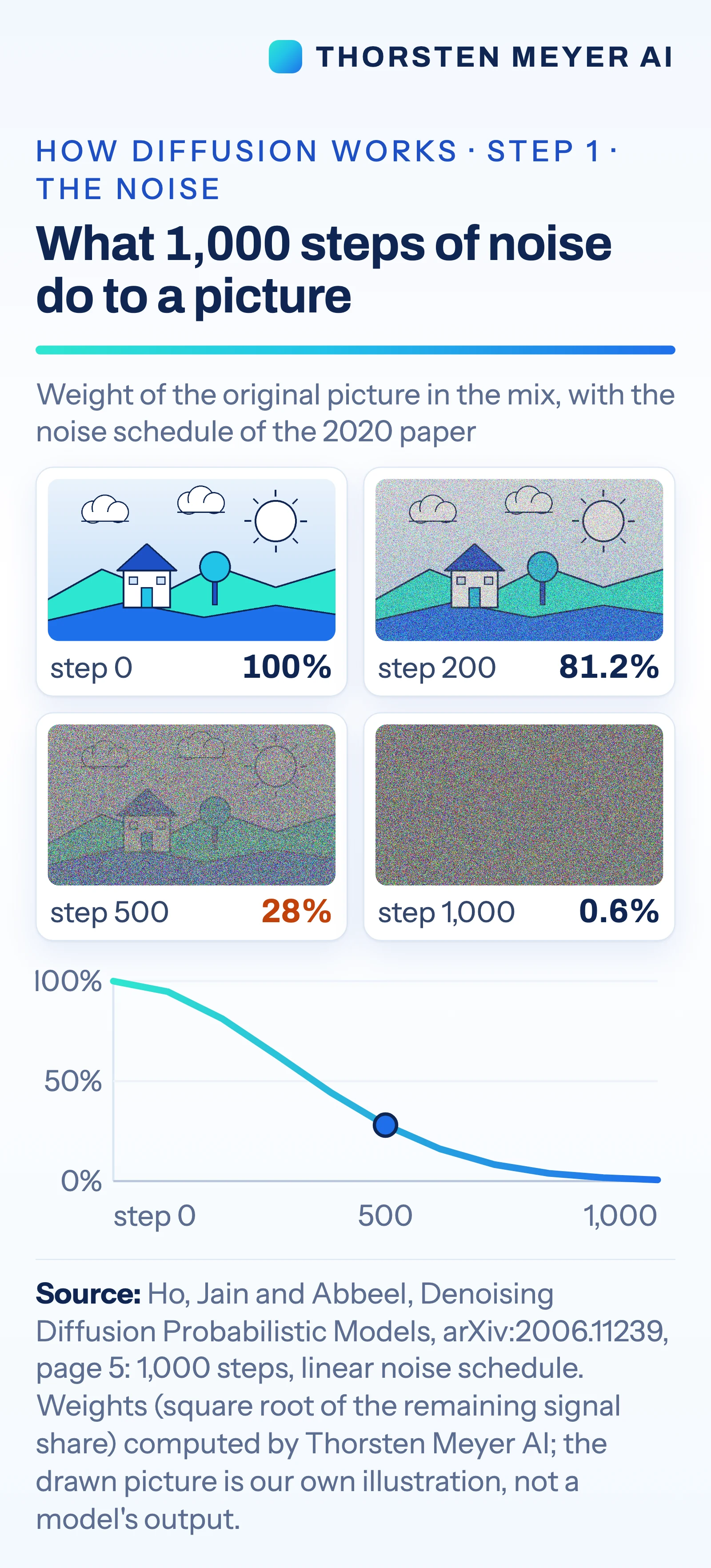
The method became practical with the 2020 paper “Denoising Diffusion Probabilistic Models” by Jonathan Ho, Ajay Jain and Pieter Abbeel of UC Berkeley. Their forward process is “a Markov chain that gradually adds noise to the data”, step by step, “until signal is destroyed.” They chose “T = 1000 for all experiments” and a noise schedule that adds a tiny amount at the first step and more at each later step.
What that does to a picture is easy to compute. After step t, the image is a weighted mix of the original picture and pure noise. With the paper’s schedule, the original still carries 81.2% of the weight after 200 steps, 28% after 500, and 0.6% after all 1,000. By the end, what is left is, for all practical purposes, noise.
Step 2: Training, or learning to guess the noise
Here is the clever part. Since the training data was noised on purpose, the noise that was added is known. So the neural network gets a simple job: look at a noisy image, plus the number of the step, and guess the noise. Ho and colleagues trained the network “to predict” that noise rather than the clean picture; predicting the clean image directly, they wrote, led “to worse sample quality early in our experiments.”
The model card of Stable Diffusion v1-4 describes the same objective in plain words: “The loss is a reconstruction objective between the noise that was added to the latent and the prediction made by the UNet.” The U-Net is the type of neural network that does the guessing.
Each training example is one noisy image at a random step and one guess. Repeat that across a huge collection of captioned images, for Stable Diffusion v1 subsets of a public web dataset called LAION-2B(en), and the network becomes very good at spotting noise in pictures of almost anything.
Why it matters: the model never learns to store pictures as a goal. It learns what noise looks like on top of plausible images. Whether it nevertheless keeps some images almost whole is a separate question, covered below.
Step 3: Generating, or running the film backwards
To make a new image, the model starts with pure noise, a canvas of random numbers. It guesses the noise, removes part of it, and repeats with the slightly cleaner result. In the 2020 paper this took the full 1,000 steps.
The pictures emerge from coarse to fine. Ho and colleagues observed: “Large scale image features appear first and details appear last.” The first steps settle where the sky, the ground and the main object go; the last steps add edges, texture and small details.
A thousand passes through a large network are slow, so later work cut the number of steps. The 2020 DDIM paper by Jiaming Song, Chenlin Meng and Stefano Ermon reported high-quality samples 10 to 50 times faster in wall-clock time than the original method, with the same training. Today’s tools let you choose: in the documentation of Hugging Face’s open-source diffusers library, the standard Stable Diffusion pipeline “defaults to 50” denoising steps, and “More denoising steps usually lead to a higher quality image at the expense of slower inference.”
Why it matters: every image is a fresh walk from random noise. Start from different noise and the same prompt gives a different picture. That is why image tools give you several variants. To repeat one exactly, you fix the random starting point; the diffusers documentation describes a random generator setting “to make generation deterministic.”
Step 4: Working in a compressed space
Running all those steps on every pixel is expensive. The latent diffusion paper by Robin Rombach and colleagues, first posted in December 2021, notes that training the strongest pixel-space models “often takes hundreds of GPU days”, with 150 to 1,000 days on V100 graphics processors as the example it cites. Their answer: compress the image first with an autoencoder, a network that squeezes a picture into a smaller grid of numbers and can unpack it again, and run the diffusion on that smaller grid.
The Stable Diffusion v1 model card spells out the factor. Its autoencoder “uses a relative downsampling factor of 8 and maps images of shape H x W x 3 to latents of shape H/f x W/f x 4.” For a 512 × 512 image with three colour channels, that means 786,432 numbers shrink to a 64 × 64 grid with four channels, 16,384 numbers. That is 48 times fewer numbers for every one of the denoising steps.
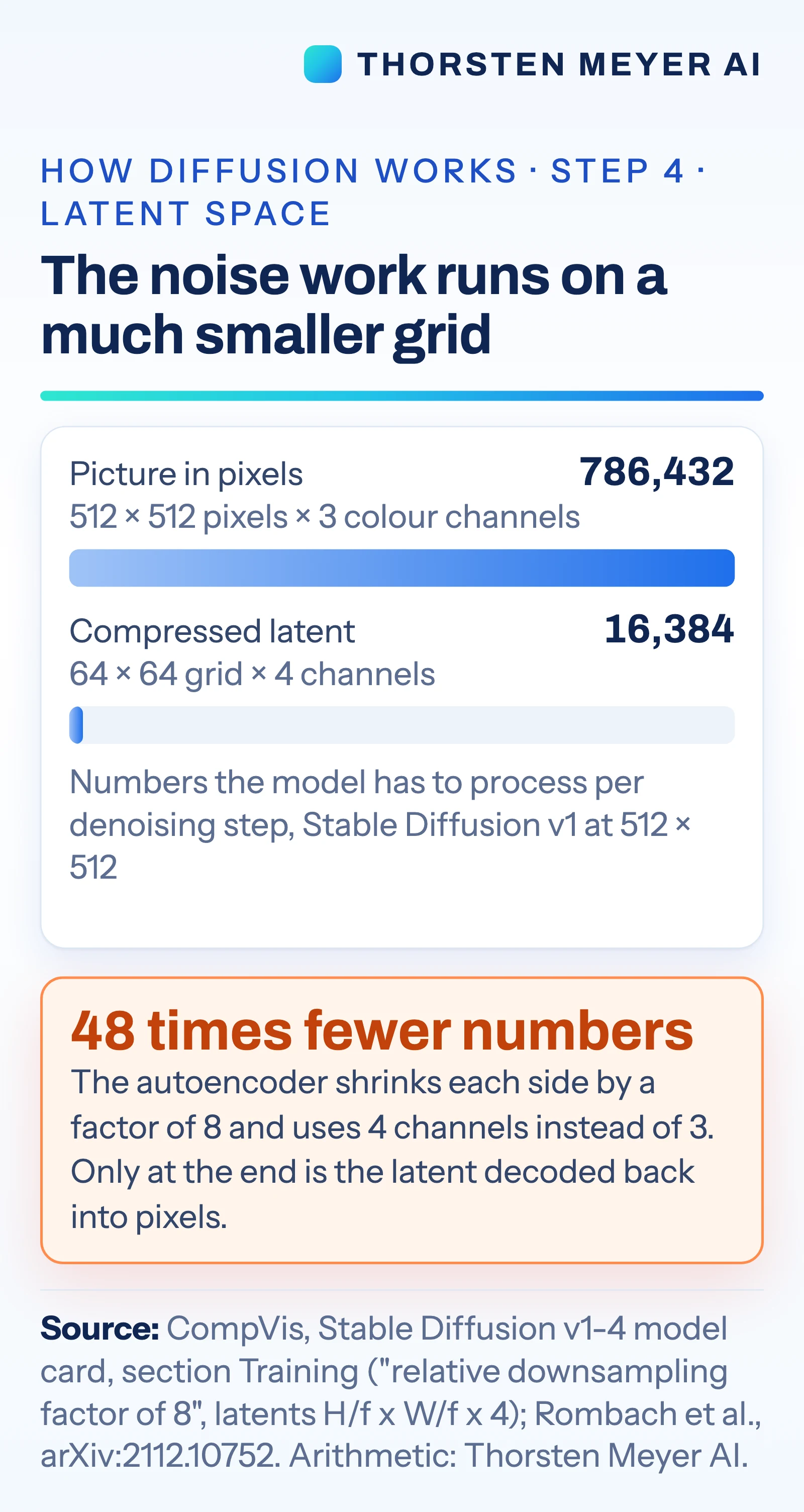
Only at the very end does the decoder turn the finished latent back into pixels. The authors describe their aim as a space that is “perceptually equivalent” to the pixels but much cheaper to compute in.
Why it matters: the authors built the compression to enable “DM training on limited computational resources”. Working on a smaller grid is what took the method out of the largest labs. It is also a plausible reason why very fine structures, such as small print, are hard: they have to survive a squeeze through a much smaller grid.
Step 5: How your words steer the picture
So far the model removes noise, but nothing tells it what to draw. Text enters in three pieces.
A text encoder. The prompt is turned into numbers by a model trained on images and their captions. The CLIP paper by Alec Radford and colleagues trained such a model on “a dataset of 400 million (image, text) pairs collected from the internet.” Stable Diffusion v1 uses “a fixed, pretrained text encoder”, a CLIP model called ViT-L/14. The authors of the Imagen paper, Chitwan Saharia and colleagues, found that the text side matters a lot: “increasing the size of the language model in Imagen boosts both sample fidelity and image-text alignment much more than increasing the size of the image diffusion model.”
Cross-attention. At every denoising step, the image grid can look at the prompt’s numbers and pull in what is relevant, the same attention mechanism that language models use between words. The latent diffusion authors introduced “cross-attention layers into the model architecture” to make this work for text.
Guidance. The last piece is a trick that makes the picture follow the prompt more closely. Jonathan Ho and Tim Salimans described classifier-free guidance in 2022. During training, the prompt is sometimes left out: “We use a single neural network to parameterize both models”, one with the prompt and one without. Stable Diffusion v1-4 was trained with “10% dropping of the text-conditioning.” When generating, the model makes both guesses at every step and pushes the result further in the direction the prompt points. In the diffusers pipeline the strength of that push, the guidance scale, “defaults to 7.5”. The documentation adds the trade-off: a higher value “encourages the model to generate images closely linked to the text prompt at the expense of lower image quality.”
Why it matters: the prompt does not describe a picture to a painter. It shifts the direction of every one of the denoising steps. Words the text encoder handles well steer well; words it rarely saw, other languages, or exact counts and positions steer poorly.
Step 6: The same engine as language models
Newer image and video models increasingly replace the U-Net with a transformer, the architecture behind large language models. A paper first posted in December 2022 by William Peebles and Saining Xie trained “latent diffusion models of images, replacing the commonly-used U-Net backbone with a transformer that operates on latent patches.” The image grid is cut into patches that play the role of tokens. They found that bigger transformers “consistently have lower FID”, a standard image-quality score where lower is better.
The diffusion idea stays the same: noise in, a guess of the noise out, repeated over many steps. Only the network that makes the guess changes.
The limits that follow from the design
What the model card lists. The Stable Diffusion v1-4 model card names its weak spots plainly: “The model cannot render legible text”; it “does not perform well on more difficult tasks which involve compositionality”, such as a red cube on top of a blue sphere; “Faces and people in general may not be generated properly”; and it “was trained mainly with English captions and will not work as well in other languages.” The list describes a 2022 model. It is useful because it shows which tasks are hard for the method; how far newer models have closed each gap has to be tested case by case.
Bias in, bias out. The card warns that the training data “consists of images that are primarily limited to English descriptions”, and that this “affects the overall output of the model, as white and western cultures are often set as the default.”
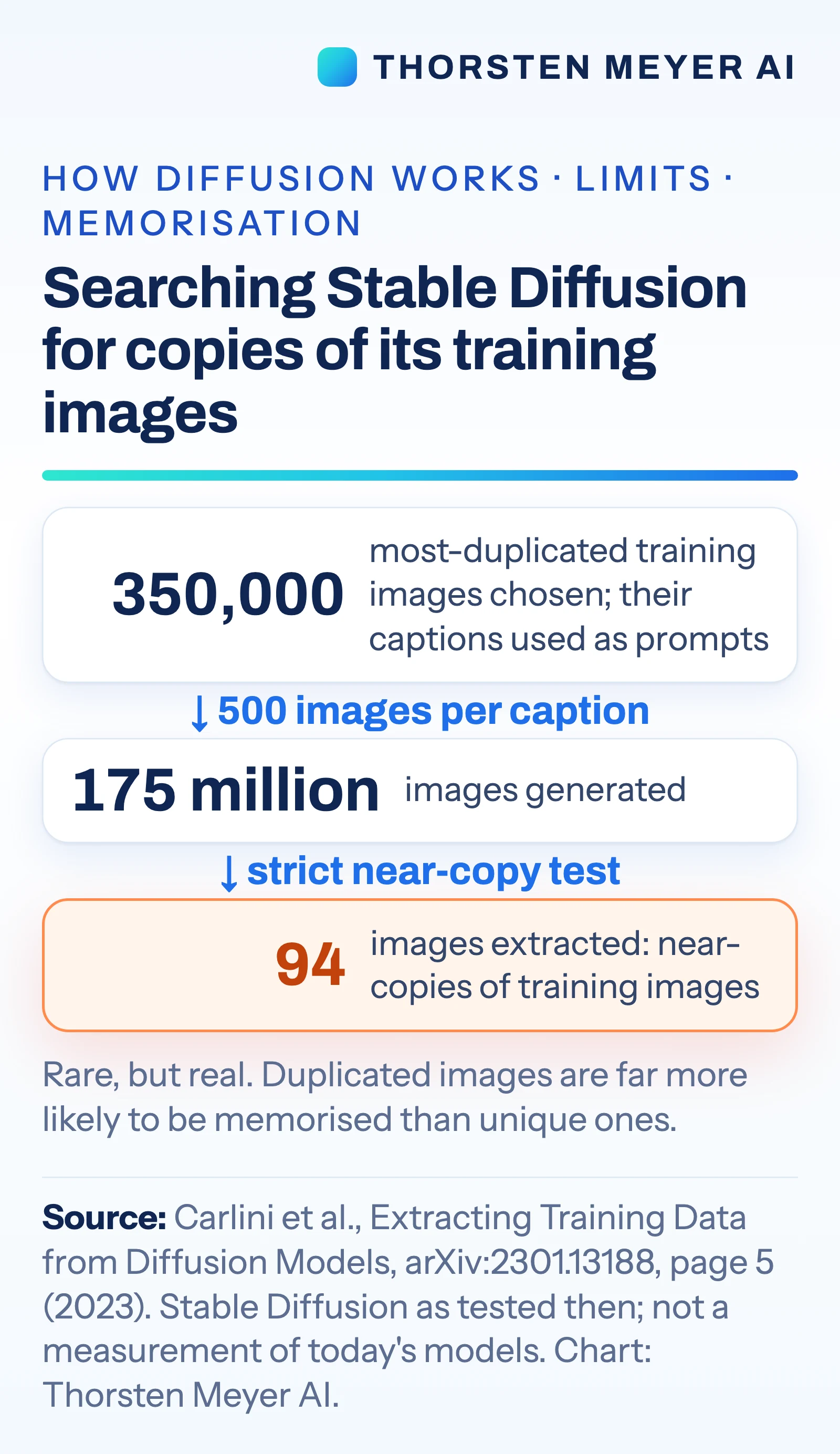
Memorisation. A 2023 study by Nicholas Carlini and colleagues, titled “Extracting Training Data from Diffusion Models”, went looking for copies on purpose. They took “the 350,000 most-duplicated examples” from Stable Diffusion’s training data, generated 500 images for each caption, 175 million images in total, and found “94 images” that matched training images closely under their strict test. That is a tiny share of a search aimed at the images most likely to be copied, so most of what a model makes is not a copy. But the authors are clear that “diffusion models memorize individual images from their training data and emit them at generation time”, and that duplicated images are “orders of magnitude more likely to be memorized than non-duplicated examples.” The model card itself says: “No additional measures were used to deduplicate the dataset. As a result, we observe some degree of memorization for images that are duplicated in the training data.” An earlier study by Gowthami Somepalli and colleagues also identified “cases where diffusion models, including the popular Stable Diffusion model, blatantly copy from their training data.”
What the courts and regulators have said
The UK High Court on Stable Diffusion. In Getty Images v Stability AI ([2025] EWHC 2863 (Ch)), handed down on 4 November 2025, the court dismissed the claim of secondary copyright infringement. The judge found that “an AI model such as Stable Diffusion which does not store or reproduce any Copyright Works (and has never done so)” is not an infringing copy under UK copyright law. The judgment also records that Getty Images had abandoned its claim about training, because there was “no evidence that the training and development of Stable Diffusion took place in the United Kingdom.” So the court did not decide whether training on the images was lawful. Getty Images succeeded in part on trademarks over watermarks in generated images, findings the judge called “both historic and extremely limited in scope.”
The court and the memorisation research ask different questions. The court looked at whether the model file itself is a copy on the evidence in that case; the researchers showed that a determined search can make a model reproduce some heavily duplicated training images. Both can be true at once.
Who owns the output in the US. The US Copyright Office’s report on copyrightability, published in January 2025, concludes that “Copyright does not extend to purely AI-generated material, or material where there is insufficient human control over the expressive elements”, and that “prompts do not alone provide sufficient control.” Human contributions, such as selecting, arranging or modifying the output, are judged “on a case-by-case basis.”
Labelling in the EU. Article 50 of the EU AI Act, in the consolidated text published on the European Commission’s AI Act Service Desk, requires providers of systems that generate synthetic images to “ensure that the outputs of the AI system are marked in a machine-readable format and detectable as artificially generated or manipulated.” Deployers who publish a deep fake “shall disclose that the content has been artificially generated or manipulated.”
We looked at a related UK case about generated images in the Grok images lawsuit: who is liable.
What it means for businesses
- Use generated images where originality is not the point. Mood images, drafts, storyboards and illustrations are the strong use. For logos, product shots of real goods, or anything you need to own exclusively, the US Copyright Office’s position on prompts is a reason for caution.
- Check outputs for familiar images. Memorisation is rare but documented, and most likely for pictures that appear many times online. A reverse image search before a generated image goes into a campaign is cheap insurance.
- Do not trust lettering, counts or positions. Put text, prices and logos in afterwards with normal design tools, and check every generated image for the number and arrangement of objects.
- Plan for labelling. If you publish in the EU, find out whether your image tool marks its outputs and keep that marking intact.
What it means for you
- A generated picture is a sample, not a memory. It comes from random noise steered by your words. Ask again and you get another one.
- Write prompts the encoder understands. Plain, concrete English descriptions steer best. Exact counts, small lettering and “on top of” relations are where to look for errors.
- Be careful with real people and real brands. The same mechanism that draws a convincing face draws a convincing fake one.
- Know what you own. In the US, an image made from a prompt alone is not protected by copyright, according to the Copyright Office report.
What is not known
- Today’s commercial recipes. The detailed public descriptions come from papers and model cards published between 2015 and 2023. Current vendors publish features and prices, but not their full training data or methods.
- How much newer models memorise. The 2023 extraction study tested models of that time. Comparable public measurements for today’s largest image models are not available in the sources we checked.
- How other courts will rule. The UK judgment did not decide whether training is lawful, and courts elsewhere may see the model question differently.
Sources
- Sohl-Dickstein, J. et al.: Deep Unsupervised Learning using Nonequilibrium Thermodynamics, arXiv:1503.03585, abstract
- Ho, J., Jain, A. and Abbeel, P.: Denoising Diffusion Probabilistic Models, arXiv:2006.11239, pages 2, 4, 5 and 7 of the PDF
- Song, J., Meng, C. and Ermon, S.: Denoising Diffusion Implicit Models, arXiv:2010.02502, abstract
- Rombach, R. et al.: High-Resolution Image Synthesis with Latent Diffusion Models, arXiv:2112.10752, pages 1 and 2 of the PDF
- Ho, J. and Salimans, T.: Classifier-Free Diffusion Guidance, arXiv:2207.12598, page 4 of the PDF
- Radford, A. et al.: Learning Transferable Visual Models From Natural Language Supervision, arXiv:2103.00020, abstract
- Saharia, C. et al.: Photorealistic Text-to-Image Diffusion Models with Deep Language Understanding, arXiv:2205.11487, abstract
- Peebles, W. and Xie, S.: Scalable Diffusion Models with Transformers, arXiv:2212.09748, abstract
- Carlini, N. et al.: Extracting Training Data from Diffusion Models, arXiv:2301.13188, abstract and page 5 of the PDF
- Somepalli, G. et al.: Diffusion Art or Digital Forgery? Investigating Data Replication in Diffusion Models, arXiv:2212.03860, abstract
- CompVis: Stable Diffusion v1-4 model card, sections Limitations, Bias and Training
- Hugging Face diffusers documentation: Text-to-image pipeline, parameters num_inference_steps and guidance_scale
- High Court of England and Wales: Getty Images v Stability AI, [2025] EWHC 2863 (Ch), judgment of 4 November 2025, paragraphs 9, 757 and 758 (pages 6, 203 and 204 of the PDF)
- US Copyright Office: Copyright and Artificial Intelligence, Part 2: Copyrightability, January 2025, page 8 of the PDF
- European Commission, AI Act Service Desk: Article 50, Transparency obligations, consolidated text as at 27 July 2026
Further reading on ThorstenMeyerAI.com
- What actually happens inside a neural network? Follow the numbers from a handwritten 7 to the answer
- How large language models work: from your prompt to the answer, and when to trust it
- How deep learning works: a plain-English guide
- The Grok images lawsuit in the UK: who is liable?
- What can AI really do today? The time horizon, explained
This guide explains published research, vendor documentation, a court judgment and official texts; it is not legal, career or investment advice. Researched and drafted with AI assistance, including Anthropic’s Claude. No company named here reviewed or sponsored this article. Our own text and graphics contain no affiliate links; offer and product boxes added by the site may contain Amazon affiliate links. Sources checked on November 23, 2026. Images: AI-generated illustration (Runware); animation, charts and the noise illustration by Thorsten Meyer AI from the published numbers; our own images show no real people or logos. Boxes added by the site may show product photos or people.