🔍 Read the full analysis: Rymvard Brings SAP HANA Memory Into The Data Center Capacity Ledger on Rymvard

Get business pricing on tech for your team
- Business-only prices and quantity discounts
- Tax-exempt purchasing
- Multiple users, one account, clear invoices
TL;DR
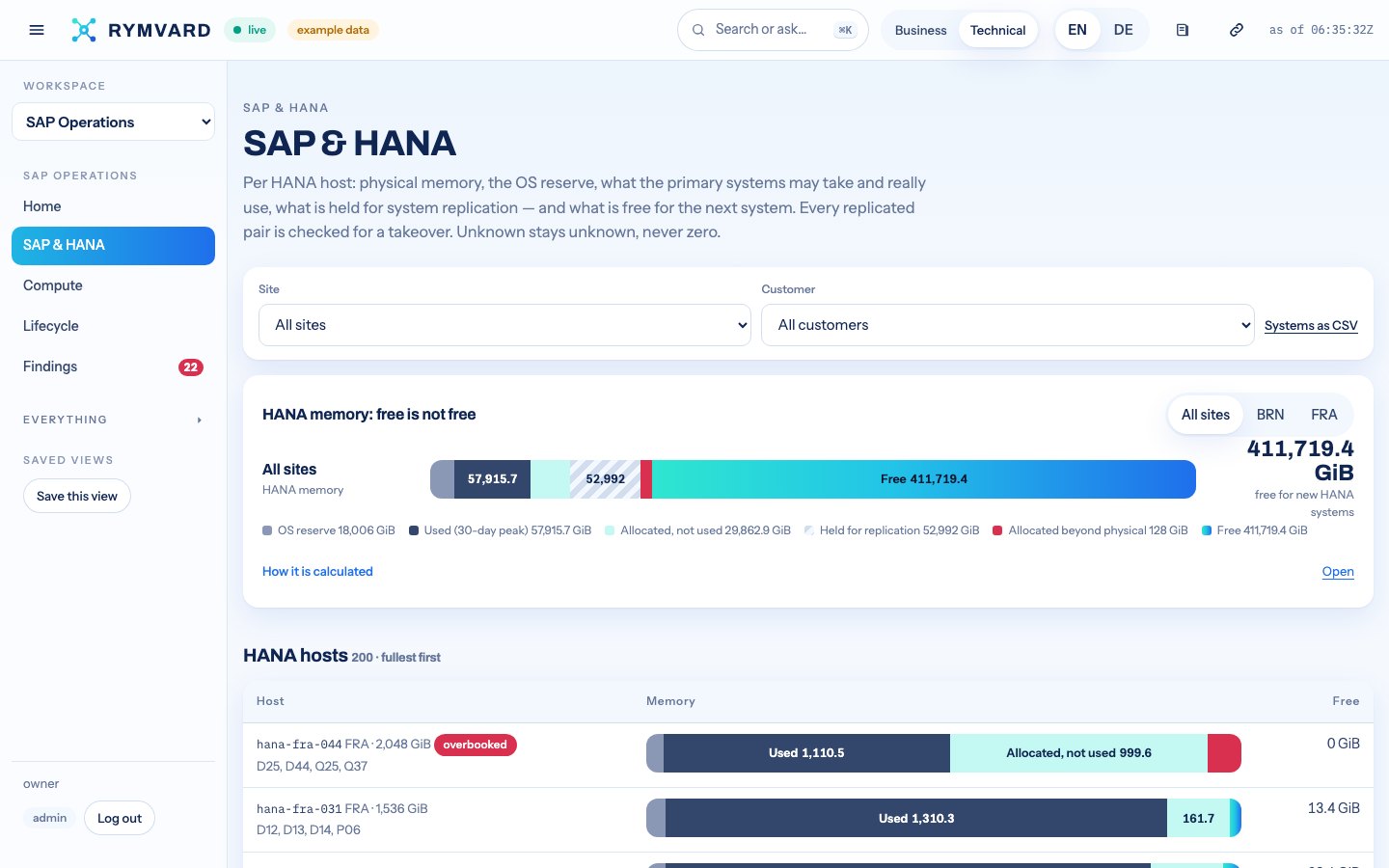
Rymvard released version 0.23 on October 4, 2026, adding SAP HANA memory accounting, placement planning and replication takeover checks to its data center capacity ledger. The early-access software connects to SAP through read-only interfaces; its reported test results came from a simulated estate, not a customer deployment.
Rymvard released version 0.23 on October 4, adding support for tracking SAP HANA memory in its data center capacity ledger. The early-access release is aimed at SAP hosting providers and operations teams, and adds host-level memory accounting, system placement proposals and checks of whether replication partners could accommodate a takeover.
For each HANA host, Rymvard divides physical memory into the operating-system reserve, memory used by HANA systems, allocated but unused memory, capacity reserved for replicas from other sites, and memory that remains free. The default operating-system reserve is 10 percent of the first 64 GiB and 3 percent of the remainder, unless the host specifies a different reserve. System usage is based on its 30-day peak. Allocations that exceed physical memory appear as overbooking rather than being masked as negative free capacity.
For systems using HANA system replication, the software checks whether a secondary host could accommodate the primary system’s allocation after takeover. It accounts for the replicated system moving to the secondary, and may count named test or development systems as stoppable. Production systems belonging to other customers are not treated as stoppable. Rymvard reports one of four outcomes: fits, fits after stopping named systems, does not fit with a shortfall in GiB, or unknown.
Data freshness affects that result: a replication status more than an hour old, or a memory figure more than 24 hours old, produces an unknown status rather than a passing result. Scale-out systems are assessed as a whole, using the weakest host pair. The release also proposes a host and replication-site partner for a new HANA system and estimates memory runway by site and quarter from planned go-lives weighted by their probability.
Rymvard says HANA instances are mirrored into its compute view, allowing SAP memory to appear in customer showback and lifecycle planning. A new SAP Operations workspace presents four indicators: free HANA memory, production systems without replication, takeovers that would fail, and hosts above 90 percent utilization.
Capacity Ledger · Early Access · October 4, 2026
Rymvard Brings SAP HANA Memory Into The Data Center Capacity Ledger
Version 0.23 adds host memory accounting, placement proposals and replication takeover checks. The release is aimed at SAP hosting providers and operations teams.
Where HANA Memory Goes
Each host is divided into explicit capacity buckets, making overbooking and free memory visible as separate conditions.
Default reserve: 10% of the first 64 GiB, then 3% of the remainder. Hosts may specify another reserve.
System usage is based on its 30-day peak.
Allocated memory not currently used remains visible in the ledger.
Capacity reserved for replication partners from other sites.
Remaining capacity after reserves, usage, allocations and replica commitments.
Can the Secondary Take Over?
Checks account for the primary system moving to its secondary host and can include named test or development systems as stoppable.
Protect other customers
Production systems belonging to other customers are not treated as stoppable to make room for a takeover.
Assess the whole system
Scale-out environments are assessed as a whole, using the weakest host pair.
Stale means unknown
Replication status older than one hour or memory data older than 24 hours yields an unknown result, not a pass.
From Placement to Runway
The release connects current memory accounting with proposed system placement and forward-looking site planning.
What the Example Estate Reported
Rymvard’s version 0.23 checks were exercised against a simulated landscape of 200 hosts, 161 systems and 39 replicated pairs.
Data In, No SAP Writes
The release describes read-only sources for HANA telemetry and landscape context. It does not say every installation needs every named source.
HANA collection
HTTPS to SAP Host Agent allows four read operations: ListInstances, ListDatabases, GetDatabaseStatus and GetComputerSystem. A separate TLS monitoring connection uses six fixed SELECT queries, with a 60-second limit per system and up to eight systems queried at once.
Landscape context
Read-only information may come from SAP Focused Run, ServiceNow, SAP Solution Manager through its System Landscape Directory, and SAP LaMa.
Customer Evidence Is Still Pending
Version 0.23 is early access. Rymvard has not identified a customer deployment or supplied customer outcomes for this release.
The strongest case is practical: memory overbooking and failover capacity can be difficult to reason about across hosts and sites. Treating stale data as unknown is a cautious choice, and the stated read-only design limits the scope of SAP interaction.
The open question is how accurately the ledger handles live landscapes, unusual configurations, changing workloads and local exceptions. The reported scenario is simulated; independent evaluations and real-world performance evidence are not included.
Early-access partners are the next step. Pricing is arranged directly with Rymvard; no broader availability date, public price list or named customer rollout has been announced.
Making HANA Failover Capacity Visible
The release focuses on a planning gap for providers whose limiting resource is memory, rather than power. A data center may have room in its wider infrastructure while a HANA host or replication partner lacks enough memory for an allocation. Showing overbooking and takeover shortfalls separately can make those constraints easier to spot before a system is placed or a failover is needed.
The operational value depends on the accuracy and freshness of the information feeding the ledger. Rymvard’s rule that stale measurements produce an unknown result is a cautious design choice: an old status is not treated as proof that capacity is available. Its proposed placement and quarterly runway views could also help teams compare near-term deployments with capacity at each site, though the stated scenarios do not establish savings, reliability improvements or customer outcomes.
For readers evaluating the product, the distinction between a simulated test and a live customer installation matters. The announced checks describe intended functionality, but the supplied test results do not show how the system performs across real customer landscapes, unusual configurations or changing workloads.
Products Worth Considering

Apple MacBook Air 13-inch with M5 Chip, 16GB Memory, 512GB SSD, Liquid Retina Display, and 12MP Center Stage Camera – Midnight

Apple MacBook Air 15-inch (2026) with M5 chip, 16GB memory, 512GB SSD — Midnight

Samsung 32 Odyssey G5 QHD Gaming Monitor
As an affiliate, we earn on qualifying purchases.
Read-Only Connections and Test Scope
Rymvard says its collector communicates with the SAP Host Agent over HTTPS and permits only four read operations: ListInstances, ListDatabases, GetDatabaseStatus and GetComputerSystem. A separate monitoring connection uses TLS and a fixed set of six SELECT queries, with a 60-second limit per system and a maximum of eight systems queried at once. Rymvard says it does not write to SAP.
The product also reads system, customer and environment information through read-only interfaces in SAP Focused Run, ServiceNow, SAP Solution Manager via its System Landscape Directory, and SAP LaMa. Those connections are intended to supply landscape details alongside the HANA memory view. The release description does not claim that these tools are required together; it names them as supported sources.
Rymvard reports testing version 0.23 against a simulated landscape of 200 HANA hosts, 161 systems and 39 replicated pairs. In that scenario, it identified one production system without replication, one takeover short by 512 GiB, one host overbooked by 128 GiB, and one replication in an error state. The company says the screens shown use an illustrative estate, not a customer environment, and that the examples do not imply a real customer, site or outcome.
“Nothing is ever written to SAP.”
— Rymvard
Customer Deployment Evidence Is Pending
Rymvard describes the product as early access. It has not identified a customer deployment or supplied customer outcomes for this release; the reported test landscape is simulated. The company also does not publish prices, saying terms are agreed with early-access partners.
Further details are not provided on how the software handles every possible SAP configuration, how its integrations are validated in individual environments, or how quickly capacity readings update beyond the stated age thresholds. The release describes the rules and limits, but independent evaluations and real-world performance data are not included.
Early-Access Evaluation Comes Next
The immediate next step is evaluation by early-access partners, under pricing arranged directly with Rymvard. The company has not announced a broader availability date, a public price list or a named customer rollout.
Prospective users will need to assess whether their SAP landscape tools and monitoring setup can supply the read-only information Rymvard expects, and whether the resulting memory and replication views match their operational requirements. Further clarity would come from customer deployments, documented integration coverage and evidence showing how the checks behave in live environments.
Where I land
I see version 0.23 as a focused operational addition, not yet a demonstrated customer outcome. The strongest case for it is that memory overbooking and failover capacity can be hard to reason about across hosts and sites, and Rymvard’s explicit unknown state is preferable to presenting stale data as a safe result. The read-only design also limits the stated scope of its SAP interaction.
The strongest counterargument is that the evidence remains a company description of a running early-access product, backed here by a simulated estate rather than customer experience. A ledger is only as useful as its data coverage, freshness and treatment of local exceptions. I would raise my assessment if independent or customer-published evidence showed accurate results across live SAP landscapes, including complicated replication and scale-out cases, and demonstrated that teams could act on the warnings without generating misleading capacity assumptions.
Source: Rymvard
Key Questions
What did Rymvard add in version 0.23?
It added SAP HANA support to its data center capacity ledger, including host memory accounting, placement proposals, replication takeover checks and a SAP Operations workspace.
Does Rymvard write data to SAP?
Rymvard says its SAP connections are read-only. The Host Agent collector permits four specified read operations, and its monitoring connection uses a fixed list of six SELECT queries.
How does the software judge a replication takeover?
It checks whether the secondary host can carry the primary system’s memory allocation, with eligible test or development systems potentially stopped to make room. It reports a fit, a fit after stopping named systems, a shortfall, or an unknown result.
Were the reported results measured at a customer site?
No customer results are reported. Rymvard says its test used a simulated landscape of 200 HANA hosts, 161 systems and 39 replicated pairs; the displayed example is not a customer estate.
Is Rymvard generally available, and what does it cost?
The release is in early access. Rymvard publishes no prices and says pricing is agreed with early-access partners; it has not given a general availability date.
Source: Rymvard