By Thorsten Meyer | November 19, 2026 | ThorstenMeyerAI.com

Get business pricing on tech for your team
- Business-only prices and quantity discounts
- Tax-exempt purchasing
- Multiple users, one account, clear invoices
Reality check · Security. This article explains a software supply-chain incident for defenders, developers and ordinary users. It deliberately lists no indicators of compromise and no technical attack details; those are in the advisories.
For about 31 minutes on the evening of November 17, 2026, the official Python package of Microsoft’s Agent Framework did something nobody had asked for. Anyone who installed or updated it got the real framework, working normally, plus a hidden credential stealer that went looking for cloud keys, CI tokens and AI service credentials.
The package is not an obscure copycat. It is the one Microsoft’s own install instructions point to, published on PyPI, the main public registry for Python software, under Microsoft’s name. The security firm Wiz says it gets “almost 200k downloads a month”. PyPI took the bad release down. Two minutes later, the attacker published a second one.
Here is what is documented, who has to act, what to do, and what nobody knows yet.
Key takeaways
- What happened. Two versions of the PyPI package agent-framework, 1.26.1 and 1.26.2, contained “a credential stealer that is not present in the last clean release, 1.26.0”, according to the GitHub Advisory Database, which rates the case “critical”.
- The time window. Both were published on November 17: 1.26.1 at 20:35 UTC, 1.26.2 at 21:08 UTC. According to StepSecurity, PyPI quarantined the first after about 31 minutes and the second “eight minutes later”. Both are gone from PyPI; the current version there is 1.26.0, released November 12.
- Why it is nasty. The malicious code runs whenever Python starts in an affected environment, “without importing agent_framework”, says the advisory. The framework itself kept working, so nothing looked broken.
- Who is affected. Anyone whose laptop, build server, CI pipeline or container image installed one of the two versions in that window, including through automatic updates.
- What to do. Treat any environment that installed 1.26.1 or 1.26.2 as exposed, rebuild it from a clean base on 1.26.0, and rotate every credential it could reach, “including CI and GitHub Actions secrets”, in the advisory’s words.
- What Microsoft says. So far only a short statement to The Register: “We have made some repositories private while we investigate malicious content.” We found no Microsoft security advisory.
agent-framework on PyPI · UTC
Two poisoned releases, one evening
The official package of Microsoft’s Agent Framework, step by step. Blue: what happened. Green: the clean version.
November 12 to 18, 2026
- Clean 1.26.0 publishedStill the current version on PyPI
- Malicious 1.26.1 appearsFramework works normally, a credential stealer runs whenever Python starts
- PyPI quarantines 1.26.1After about 31 minutes
- Attacker uploads 1.26.2Renamed files, also targets GitHub Actions tokens
- PyPI quarantines 1.26.2Eight minutes later
- Malware databases list itMAL-2026-20101 (OpenSSF), GHSA-764m-3ppc-5m73 (GitHub)
Sources: GitHub Advisory Database GHSA-764m-3ppc-5m73, Nov 18, 2026; OSV MAL-2026-20101, Nov 17, 2026; PyPI project data, checked Nov 19, 2026; StepSecurity analysis (quarantine times).
Graphic: Powered by Thorsten Meyer AI
Products Worth Considering

DJI Mini 5 Pro Fly More Combo with DJI RC 2, 1-Inch CMOS

Samsung 32 Odyssey G5 QHD Gaming Monitor

LG 27GR83Q-B 27-inch Ultragear QHD IPS Gaming Monitor
As an affiliate, we earn on qualifying purchases.
What happened, step by step
Microsoft Agent Framework is Microsoft’s open-source toolkit for building AI agents in Python and coordinating several of them in workflows. The package called agent-framework is a thin umbrella package. It pulls in the actual framework code, agent-framework-core, and a set of integrations.
The documented sequence, from the GitHub advisory and the researchers’ timelines:
- November 12: Microsoft publishes the legitimate version 1.26.0. PyPI’s records show its files uploaded at 18:24 and 18:25 UTC.
- November 17, 20:35 UTC: version 1.26.1 appears on PyPI, “as a wheel only”, the advisory notes. A wheel is a ready-to-install package file. According to Endor Labs, every release it examined from 1.21.0 through 1.26.0 had also shipped its source code.
- 21:06 UTC: PyPI quarantines 1.26.1, according to StepSecurity. A quarantined release cannot be installed.
- 21:08 UTC: the attacker uploads 1.26.2, “just 2 minutes 23 seconds after the first quarantine”, StepSecurity writes, with renamed files and extra capabilities.
- 21:16 UTC: PyPI quarantines 1.26.2 as well.
- November 17 and 18: the open-source malware database run by the OpenSSF lists the case as MAL-2026-20101 at 22:12 UTC; the GitHub Advisory Database follows with GHSA-764m-3ppc-5m73 at 00:31 UTC on November 18.
Several security firms found and analyzed the releases independently, among them Socket, StepSecurity, Wiz, JFrog and Endor Labs. Wiz says it “promptly reported these findings to Microsoft on the 17th.”
The second upload is the detail to remember. StepSecurity: quarantining the first release “did not immediately revoke the attacker’s publishing access”. JFrog makes the same point more bluntly: quarantining one version “does not revoke the compromised publishing credential or prevent the attacker from pushing newer versions.”
What the stealer did
The advisory describes it at a level that is useful for defenders, without a recipe. Each malicious package added a small start-up hook. Python runs such hooks every time the interpreter starts, so the stealer ran “as soon as the package is installed, without importing agent_framework.” A test run, a linter, a build script: any later Python start in that environment could trigger it.
It then collected what a developer machine or a build server typically holds:
- environment variables with names that suggest tokens, keys and passwords, including those for Azure, AWS, GitHub, Hugging Face, OpenAI and package registries
- credential files of common developer tools and container registries
- secrets visible in the environment of other running processes, where the system allowed it
- fresh access tokens it requested itself from Azure’s managed-identity service and from Azure DevOps pipelines; version 1.26.2 added GitHub Actions identity tokens
Everything was packed up and sent to a single collection address controlled by the attacker. The advisory has the details for security teams. StepSecurity found “no remote-code-loading second stage” in the inspected code, and The Register, summing up the researchers, reports that the malware “isn’t persistent” beyond the installed package.
The active token requests are what make this more than a password grab. The research group OpenSourceMalware, quoted by The Register: “That combination of passive theft and active token requests makes it especially dangerous in cloud build environments, because even short-lived tokens are useful when they’re exfiltrated right away.”
How many victims?
Nobody has published an install count for the two versions. What exists is one firm’s look at the attacker’s side.
The attacker used a free public request-collection service to receive the stolen data. Wiz says that service’s free tier kept “a maximum of 50 requests” for this address, and that it analyzed all of them. Its breakdown: four came from the attacker’s own machines and testing, 29 “appear linked to sandbox environments, vendor scanning, and tests”, and the remaining 17 “represent only three unique, successful cases of exfiltration of victim data.”
Three confirmed victims sounds small. Treat it with care. It is Wiz’s count, it covers only what that free service stored, and Wiz itself adds that those requests “can contain working cloud, CI and registry credentials”. One stolen build-server token can open far more than one machine.

Who is affected
The short answer: anyone who installed agent-framework 1.26.1 or 1.26.2. The advisory is explicit that “1.26.0 and earlier are not affected.” Endor Labs checked 22 related agent-framework-* packages, including agent-framework-core, and says they “still have November 12 as their latest release”.
The longer answer depends on how software gets installed in your organization:
- Developers who ran an install or upgrade of the umbrella package on November 17 between 20:35 and 21:16 UTC.
- CI pipelines that install the latest version on every run, without a pinned version or lockfile. These are the main target: Endor Labs writes that “the payload is written for CI runners and Azure workloads.”
- Automatic dependency updates. JFrog says bots such as Renovate “were already opening upgrade pull requests in downstream repositories within six minutes” of 1.26.1 appearing. A merged bot update that ran a build would have installed it.
- Container images and internal mirrors built or filled during the window. StepSecurity: “registry quarantine does not remove copies already downloaded.”
- Agent apps built on the framework, if they were rebuilt or redeployed with the bad version. The risk sits where the package was installed, not with the app’s end users.
What to do now
These steps come from the GitHub advisory and the researchers’ published guidance. None of them needs a new product.
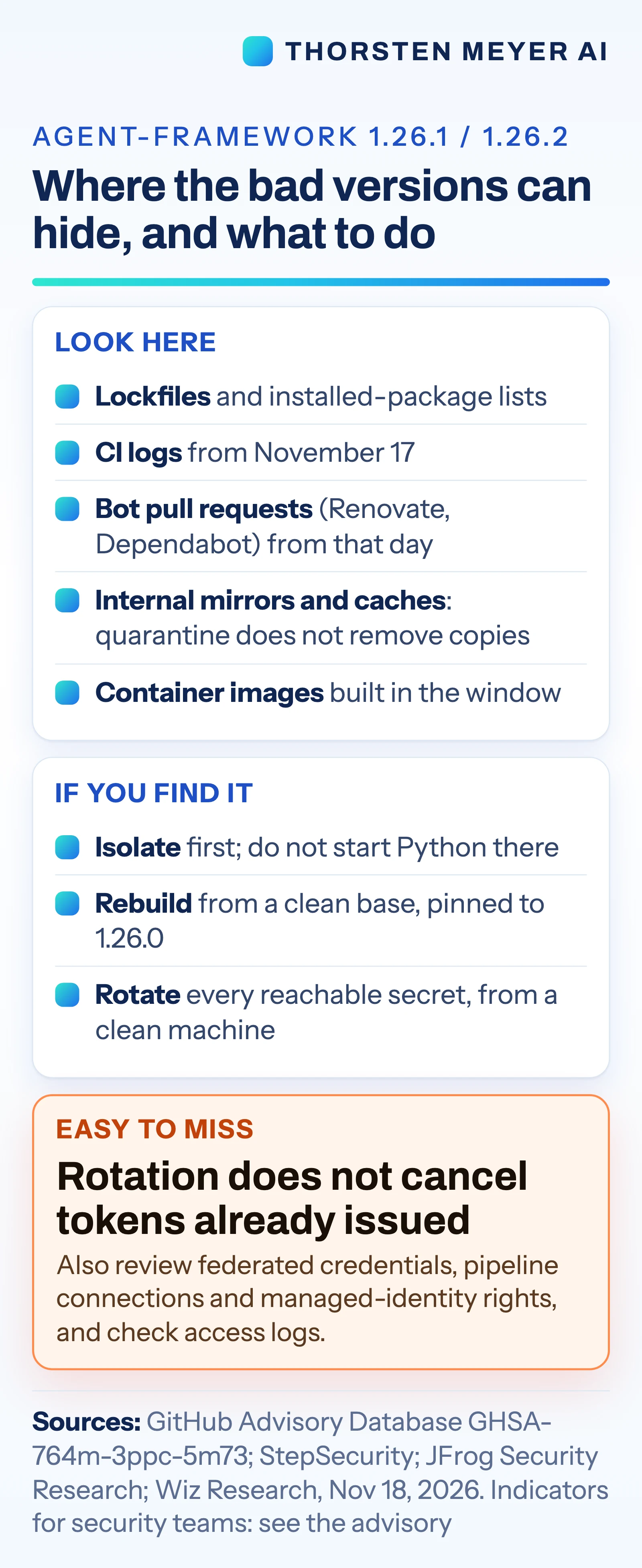
- Find out whether you had it. Check lockfiles, CI logs, installed-package lists, internal package mirrors, dependency caches and container images for 1.26.1 or 1.26.2. JFrog also suggests reviewing Renovate or Dependabot pull requests opened on November 17.
- If you find it, isolate first. StepSecurity advises isolating the affected host, container or runner before doing anything else, and warns that starting Python or pip in that environment “can run the hook again”. Inspect with tools that do not start the affected interpreter.
- Rebuild, do not clean. Replace the environment or image from a known-clean base and pin agent-framework to 1.26.0, ideally with a hash-pinned lockfile, as StepSecurity recommends.
- Rotate from a clean machine. Treat every credential the environment could read as exposed: cloud keys, CI and GitHub Actions secrets, package-registry and container-registry tokens, Git credentials, Hugging Face and AI service keys.
- Do not stop at rotation. StepSecurity: “rotating static secrets does not necessarily invalidate already-issued identity tokens.” Review federated credentials, pipeline service connections and managed-identity role assignments, and check sign-in and access logs for the exposure window. Wiz says stolen managed-identity and pipeline tokens “are valid for up to 24 hours.”
- Use the advisory for the technical checks. File names, hashes and network indicators are in GHSA-764m-3ppc-5m73 and the researchers’ write-ups. Your security team or provider should use those, not a blog summary.
Why AI agent tooling is such a tempting target
This case shows why attackers aim at the tools used to build AI agents, not just at the agents themselves.
- The keys are all in one place. A developer environment for an AI agent typically holds keys for one or more model providers, for a cloud account and for code hosting. The stealer’s target list, with OpenAI, Hugging Face and Microsoft’s AI service Foundry next to Azure and GitHub, reads like the inventory of a typical agent project.
- It runs where the power is. Agent frameworks run in CI pipelines and cloud workloads that have identities of their own. A stolen token from there can reach storage, key vaults and deployment systems.
- Fast release cycles train people to update. StepSecurity says the project has released “on a steady weekly-to-biweekly cadence since April 2025”. When new versions arrive that often, a new patch release on a Tuesday evening raises no eyebrows.
- A trusted name lowers the guard. This was not a fake package with a similar name. It was the official one, published through the official project.
The lesson is not to avoid open source or agent frameworks. It is that the build environment of an AI product deserves the same protection as the product: pinned versions, short-lived credentials with narrow rights, and secrets that are not simply lying around in environment variables.
What it means for businesses
If your teams build with Microsoft Agent Framework, ask them today whether any environment installed the two versions. If yes, treat it as a security incident, not an IT ticket: credentials have to be rotated, identity logs reviewed and the people responsible for cloud access involved. If no, use the moment to check whether your pipelines would have pulled an unpinned update automatically. The next poisoned release may sit in a different package.
What it means for ordinary users
If you only use AI apps, chatbots or Microsoft products, there is nothing for you to install or remove. The stealer targeted the machines where the software was installed and built, not the people who use the finished apps. The real risk for users is indirect: if a company’s cloud keys were stolen, data that company holds could be at risk. So far no company has said that happened because of this incident.
If you write Python yourself, even as a hobby, and installed or updated agent-framework on November 17, follow the steps above. Rotating your API keys for AI services and your code-hosting tokens is the minimum.
What is not known
- How the attacker got publishing access. Wiz says the attacker “appears to have compromised a client certificate and private key” for Microsoft’s internal release pipeline, and that “How the credentials were obtained is not yet known.” JFrog says the package was repacked locally rather than built by Microsoft’s pipeline. The Register points to a possibly compromised administrator account. StepSecurity says the evidence “does not establish the initial access vector”. Microsoft has not explained it.
- Whether the access has been closed. StepSecurity notes the second upload showed continued access at the time, but “does not establish whether that access remains available now.”
- How many installs and victims there were. No install count has been published for the two versions. Wiz’s figure of three confirmed victim cases covers only the requests the attacker’s free service stored.
- Who did it. The GitHub advisory says: “We have not attributed this to a known campaign.”
- What else was affected. Microsoft told The Register it made “some repositories private”; it did not name them. When we checked on November 19, the framework’s GitHub repository, which PyPI links as the source, returned “Not Found”. Wiz mentions that another Microsoft Python package was compromised earlier this year and says: “We have not linked the two incidents.”
Sources
- GitHub Advisory Database: GHSA-764m-3ppc-5m73, Malicious code in agent-framework (PyPI), published November 18, 2026
- OpenSSF Malicious Packages via OSV: MAL-2026-20101, published November 17, 2026
- PyPI: agent-framework project page and release history, checked November 19, 2026
- The Register: Microsoft’s official Python agent framework hijacked to distribute malware, November 18, 2026 (Microsoft statement)
- Wiz Research: Microsoft agent-framework Compromised: Credential Stealer Targets Azure and CI Pipelines, updated November 18, 2026
- StepSecurity: Microsoft agent-framework PyPI Package Compromised
- JFrog Security Research: Microsoft’s agent-framework Hijacked on PyPI via Silent .pth Startup Hook
- Endor Labs: agent-framework compromised: software supply chain attack
- Socket: Microsoft’s agent-framework PyPI package Compromised with Credential Stealer
The researchers’ write-ups contain technical indicators for security teams. We cite them for their findings and claims; Microsoft has not confirmed their analyses.
Further reading on ThorstenMeyerAI.com
- Java4Shell: CISA Says Patch Java Now. Who Is Affected, How Serious It Is, What to Do
- FBI Warns About the ARTEX AI Hacking Tool: What ‘Under Three Hours’ Really Means
- Malware Hit 178 Major Websites via Optimizely: What iPhone and Crypto Users Should Check
- California Sues OpenAI Over the Hugging Face Hack. What the State Alleges and What It Wants
I’m Thorsten Meyer. More reality checks are at thorstenmeyerai.com.
This article is for information only. It is not security-consulting or legal advice, and it deliberately leaves out technical attack details and indicators. Researched and drafted with AI assistance, including Anthropic’s Claude. The stealer also targeted keys for AI services such as OpenAI’s; that does not change the facts reported here. No company or organization named here reviewed or sponsored this article. Our own text and graphics contain no affiliate links; offer and product boxes added by the site may contain Amazon affiliate links. Sources checked on November 19, 2026. Images: AI-generated illustration (Runware), animation and charts by Thorsten Meyer AI from the published information; our own images show no real people or logos. Boxes added by the site may show product photos or people.