By Thorsten Meyer | November 19, 2026 | ThorstenMeyerAI.com

Get business pricing on tech for your team
- Business-only prices and quantity discounts
- Tax-exempt purchasing
- Multiple users, one account, clear invoices
Disclosure: This article was researched and drafted with AI assistance, including Anthropic’s Claude, and Anthropic is its subject. Anthropic did not review or sponsor it. It is not investment advice and does not discuss share prices or trading.
On Thursday, November 19, the shares of Anthropic, the company behind Claude, made their debut on the Nasdaq. The night before, it set the terms of its initial public offering, and the headlines did the rest: $107.3 billion raised, more than SpaceX in June, the biggest stock market debut on record. German-language outlets ran the same story: “KI-Firma Anthropic schafft Rekord-Börsengang.”
Behind that headline sit three different numbers, a list of seven suppliers who are also buying in, and a prospectus that is unusually blunt about what the money is for and what could go wrong. This piece leaves the trading to others. It looks at what the record raise means for the AI race, for the companies that run their work on Claude, and for the people whose jobs AI is changing.
Key takeaways
- Three numbers, one deal. Bloomberg and Reuters put the total deal at $107.3 billion, including a $26 billion private placement. The share sale alone, the “base deal”, is $81.3 billion, above SpaceX’s $75 billion, Bloomberg reports. Anthropic itself says it will receive net proceeds of about $78.8 billion from the share sale and $26.0 billion from the placement.
- Suppliers pay in. AMD, Broadcom, Google, Micron, Microsoft, Nvidia and TSMC are buying the placement shares. Most of them also sell Anthropic chips, cloud capacity or software, and Google also competes with it.
- The money goes to compute and people. The filing names “investments in compute and infrastructure” and “hiring and retention of highly skilled personnel”, and says Anthropic “will have broad discretion in using these proceeds.”
- The bill is bigger than the raise. Anthropic reports compute and infrastructure commitments of about $900.9 billion, about $451.6 billion of it before the end of 2030. The new money covers roughly a quarter of the part due by 2030.
- Control does not change hands. Anthropic stays a public benefit corporation, and its Long-Term Benefit Trust elects a majority of the board.
- Critics are loud. About 80 researchers and executives called Anthropic reckless on the eve of the listing, The National reports, and an early investor told the New York Times he invested “to promote safety, not racing.”
The record raise, step by step
Where the money comes from, and where it goes
The headline says $107.3 billion. This is how Anthropic’s own notices and prospectus break it down.
- Step 1 · Share sale980 million shares≈ $78.8B netAnthropic sells 956,351,354 shares. 23,648,646 come from existing holders and bring Anthropic nothing.Anthropic notice, Nov 19
- Step 2 · Private placementSeven suppliers buy in$26.0BAMD, Broadcom, Google, Micron, Microsoft, Nvidia and TSMC, at the IPO price, no underwriting fees.Prospectus, p. 10
- Step 3 · To AnthropicTogether, after costs≈ $104.8BOur addition of the two net figures. Reported total deal: $107.3B.Anthropic notice · Bloomberg
- Step 4 · Uses in the filingNo order of priority
- Compute and infrastructure
- Hiring and retention
- Working capital, operating costs
- Taxes on employee stock units
- No agreed acquisitions
What it is not: a statement about the share price. Net figures are Anthropic’s estimates after underwriting discounts and offering costs; an option on up to 147,000,000 more shares is still open.
Sources: Anthropic, notice of the final number of European retail shares (November 19, 2026) and pricing release (November 18, 2026); European prospectus approved November 11, 2026 (PDF page 10); Bloomberg via Hindustan Times (November 19, 2026). $104.8B: Thorsten Meyer AI arithmetic.
Animation: Powered by Thorsten Meyer AI
Products Worth Considering

LG 27GR83Q-B 27-inch Ultragear QHD IPS Gaming Monitor

Samsung Galaxy Tab A11+ Kids Edition, 128GB, Royal Blue

Sony WH-1000XM6 Wireless Noise-Canceling Headphones, Black
As an affiliate, we earn on qualifying purchases.
Three numbers for one record
The headline figure and the company’s own figure differ, and both are correct.
- $107.3 billion is the total deal size reported by Bloomberg and Reuters. It counts all 980 million shares sold in the IPO plus the $26 billion private placement. Germany’s tagesschau uses the same total.
- $81.3 billion is the share sale alone. That “base deal” topped “SpaceX’s at $75 billion,” Bloomberg reports, and Der Standard gives the same comparison. The National puts SpaceX’s IPO at $86 billion instead, so the size of the old record depends on how it is counted.
- About $104.8 billion is what reaches Anthropic, by our own addition of the two net figures in Anthropic’s notice of November 19: about $78.8 billion from the share sale and $26.0 billion from the placement.
The gap to the headline has two causes the filing names. Of the 980 million shares, 956,351,354 are sold by Anthropic and 23,648,646 by “certain selling stockholders”, and “Anthropic will not receive any proceeds” from those. The net figure for the share sale is also after underwriting discounts and offering costs. On top, the underwriters hold a 30-day option to buy up to 147,000,000 more shares.
According to Anthropic’s release, the SEC declared the registration statement effective on November 18, trading on the Nasdaq Global Select Market under “ANT” was set to begin on November 19, and the offering is expected to close on November 20, “subject to the satisfaction of customary closing conditions.” Reuters reported that Anthropic raised the number of shares by about 19% to 980 million before pricing.
We covered the price range and the filing and the week of the IPO before. This piece is about the completed deal.
Who is putting in the $26 billion
The private placement is the part of the deal that says most about the AI industry. According to the prospectus, AMD, Broadcom, Google, Micron, Microsoft, Nvidia and TSMC agreed to buy “an aggregate of $26.0 billion” of a separate share class, Class N, “at a price per share equal to the initial public offering price.” Google is “funding a portion of its previously committed investment obligations.” Anthropic receives the full amount and pays no underwriting fees on it. Nvidia “is set to buy $10 billion of Anthropic stock as part of the private placement, the filings show,” according to Bloomberg.
Most of these buyers sell Anthropic what it spends its money on: chips, memory, cloud capacity and chip manufacturing. Google is also one of Anthropic’s main rivals with its Gemini models. We looked at suppliers turning into shareholders last week. For outsiders, that circle is worth keeping in mind: some of the money raised from suppliers will flow back to the same suppliers.
What the filing says the money is for
Anthropic’s prospectus is specific about the categories and vague about the split. It intends to use the net proceeds “for general corporate purposes, including working capital, operating expenses, and capital expenditures, including investments in compute and infrastructure, as well as hiring and retention of highly skilled personnel.” A portion will also pay taxes the company owes when it settles employee stock units. It may buy businesses, but says it does “not have agreements or commitments for any material acquisitions or investments at this time.” There is “no order of priority” for the uses, and Anthropic “will have broad discretion in using these proceeds.”
The scale of the compute bill puts the record into perspective. Anthropic reports purchase commitments and leases with “an aggregate committed spend of approximately $900.9 billion,” including “approximately $451.6 billion” expected before December 31, 2030.
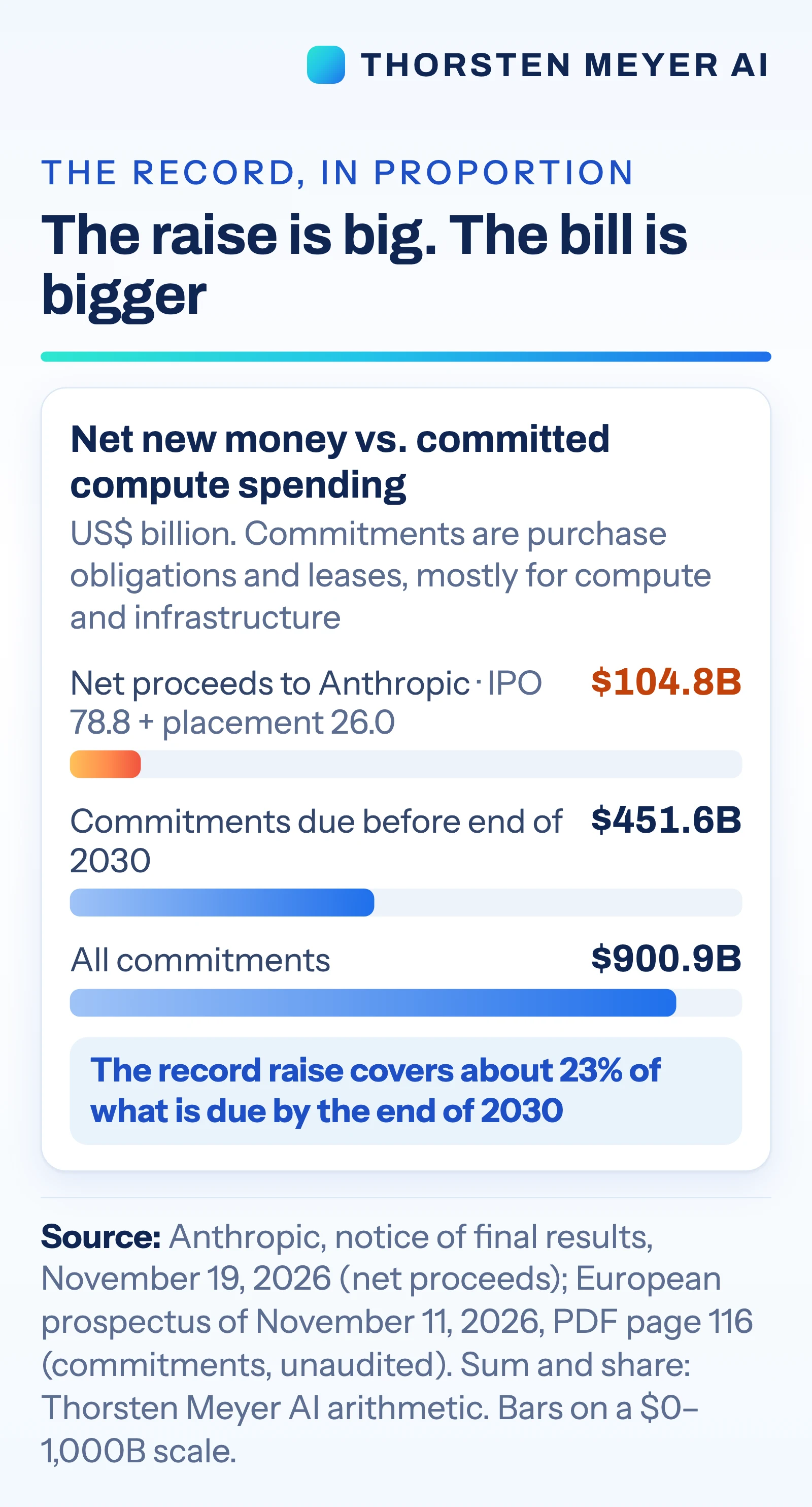
Measured against that, the new money covers about 23% of what is due by the end of 2030 (our arithmetic). The rest has to come from revenue, debt or more capital. The filing also warns that its compute partners depend on outside financing: if that “becomes unavailable or more costly, contracted capacity may be delayed, repriced, reduced, or not delivered,” Anthropic says, as quoted by Reuters.
What the record means for the AI race
Compute is the battlefield. Anthropic’s own risk factors warn that “access to sufficient compute on economical terms could become the primary constraint on our ability to train and serve competitive models.” Cash buys that access, and no company has raised more in a stock market debut, Bloomberg and Reuters report.
OpenAI is not public yet. Bloomberg calls Anthropic’s listing “the first ever by a frontier AI lab” and says OpenAI “isn’t planning to go public before 2027.” The Decoder reports that OpenAI has confidentially filed for an IPO planned for 2027. Until then, Anthropic has to publish its numbers every quarter while its largest rival does not.
The lead in business AI is contested. Reuters, cited by Daily Sabah, reports that OpenAI’s GPT-6 Astra accounted for about 13% of enterprise AI spending tracked by the expense platform Ramp in September, against about 8% for Anthropic’s Claude Fable. It also cites a Capgemini study in which 59% of executives at large companies plan to use more open-weight models over the next year, and reports that Meta, one of Anthropic’s largest customers, has been looking to reduce its use of Anthropic’s models. Anthropic’s filing itself warns that open models “could exert pricing pressure on our offerings.”
Google sits on both sides. It is a shareholder, a cloud and chip supplier, a buyer in the placement and a direct competitor with its Gemini models. For customers who use both, that is a reminder that the biggest AI companies are tied to each other by money as well as by competition.
Our own tests
Benchmarks do not decide an IPO, but model quality is what customers pay for. We test Anthropic’s current models against their rivals in two tests of our own. Our judges and graders include models from vendors in the comparison, among them Anthropic’s Claude.
Lexassay, our legal spot check at lexassay.com, gives every model the same fixed legal tasks without tools or web access: 15 tasks, 10 published, 5 hidden. Every cited statute and case is checked against the primary source, and the answers are graded blind by Claude agents against gold answers. It is a spot check, not a benchmark in the strict sense, and nothing in it is legal advice. Figures as shown on the leaderboard, each model at its “high” setting, Gemini at its default:
- Published tasks: Claude Fable 5.2 scores 88 (run page), Claude Opus 5.5 86 (run page). For comparison: GPT-6.2 Astra 86, Gemini 4 Neon 82, GPT-6.2 Sol 80.
- Hidden set: Fable 5.2 73, GPT-6.2 Astra 71, Opus 5.5 62, GPT-6.2 Sol 62, Gemini 4 Neon 51.
- All criteria met: 8 of 10 published answers for Fable 5.2, 7/10 for Opus 5.5 and GPT-6.2 Astra.
Our Model-Status production test gives every model the same news-writing job our newsroom runs every day: 12 articles from real sources with our production prompt, in English and in German. Two judges, GPT-6.1 Sol and Claude Opus 5.5, grade each article with the source in context, on a scale of 1 to 100. The GPT and Claude models ran through their subscription command-line tools (Codex and Claude Code), Gemini through the API. The Claude results come from earlier 12-article runs with the same judges (October 8 and November 11, 2026); the latest batch is from November 19, 2026. This is our internal test; we publish the results here.
| Model | English (1–100) | German (1–100) |
|---|---|---|
| GPT-6.2 Astra | 72 | 70 |
| GPT-6.2 Sol | 68 | 69 |
| Claude Fable 5.2 | 66 | 65 |
| Claude Opus 5.5 | 63 | 59 |
| Gemini 4 Neon | 56 | 59 |
Thorsten Meyer AI, Model-Status production test, Batch 4, November 19, 2026. For Fable 5.2 and Opus 5.5, the 1–100 values are converted from the reported 1–5 judge averages with the test’s linear scale (1 = 1, 5 = 100).
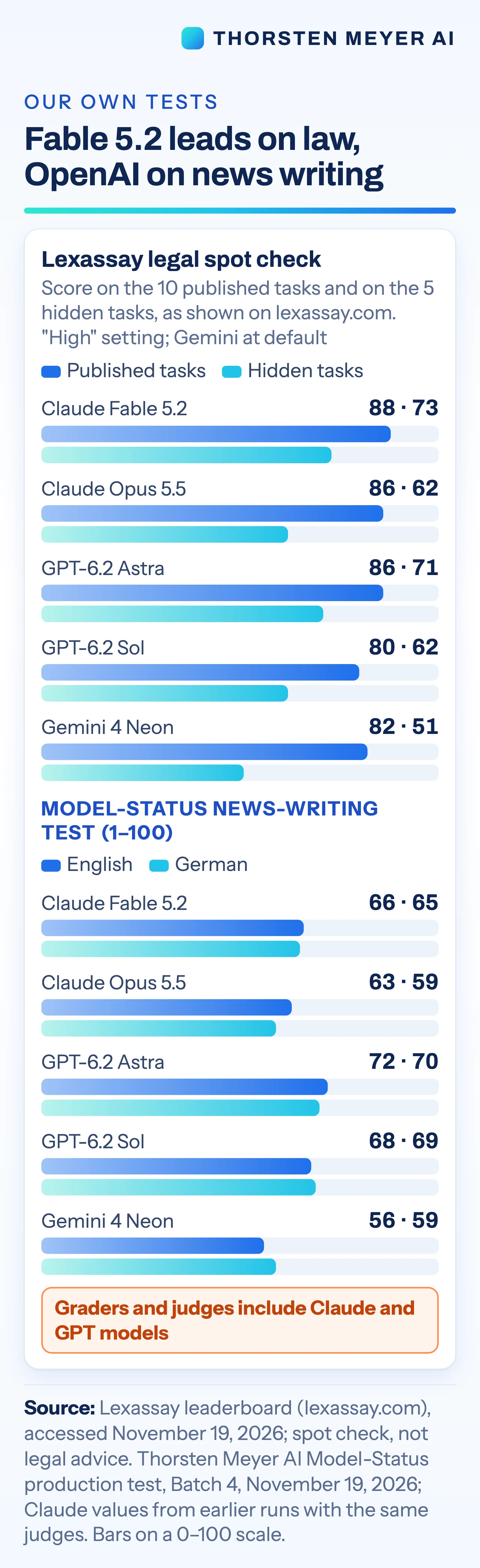
The picture is mixed, and that is the point for buyers. On legal questions, Claude Fable 5.2 leads our spot check, including the hidden tasks. On everyday news writing, both new OpenAI models beat both Claude models in English and German. The race the IPO money is meant to fund is close.
What it means for businesses that rely on Claude
- More cash, same contract. The listing does not change your terms or your model. What it changes is the money behind the service: Anthropic now has more capital to buy the compute that its filing calls a constraint on serving customers.
- Prices: two forces. The filing credits part of its growth to “lower prices and improved capability,” and says customers moved to Opus 5.5 for “a lower cost per task.” It also lists “pricing pressure” from competition among its risks. Both point to falling prices per task; neither guarantees it.
- Quarterly scrutiny. As a listed company, Anthropic reports every quarter. Daily Sabah quotes Armina Rosenberg of Minotaur Capital: “Once Anthropic reports publicly, it becomes one of the clearest tests of whether the economics of AI are holding up.” Expect usage limits, model retirements and prices to be read in that light. The filing says the company has “changed, and may in the future change, usage limits, rate limits, or model and product capabilities.”
- Governance stays as it was. Anthropic remains a public benefit corporation that must balance shareholders, “the best interests of those materially affected by our conduct” and its stated purpose. Its Long-Term Benefit Trust, “intended to operate as an independent body of five financially disinterested trustees,” elects a majority of the board, and under Nasdaq rules Anthropic counts as a “controlled company.” New shareholders do not take over. Whether that reassures you depends on how much you trust the current leadership.
- What to do: write notice periods for model retirements and written usage limits into contracts, keep prompts and tools portable between vendors, and track Anthropic’s first quarterly report as a public company.
What it means for workers
Inside Anthropic. As of September 30, 2026, Anthropic had “approximately 5,300 employees worldwide, a majority of whom work in research, engineering, and product development functions.” Hiring and retention are named uses of the money, so the company can keep competing for scarce AI talent.
Building the data centers. The compute build-out needs people the filing says are hard to find: energy projects require “specialized expertise that is currently in short supply.” For electricians, grid engineers and construction crews, that is leverage, as long as the investment keeps flowing.
Everyone else. Anthropic’s prospectus is direct about its own role in job change. It warns that public perception that its products “contribute to job displacement or economic disruption” could bring backlash, and that “to the extent the rate of job displacement rapidly increases,” governments “may intervene to slow the rate of adoption of AI.” It may take voluntary steps “intended to ameliorate the impact of such displacement,” but says there is “no assurance” they would work. At the Nasdaq on Thursday, CEO Dario Amodei acknowledged concerns that AI could cause labour disruption, The National reports, and said: “We discuss these risks not because we think they are inevitable and we are building anyway, but because we think they are avoidable.”
The critics
The record did not come with applause alone.
- An early backer objects. Dustin Moskovitz, an investor in Anthropic’s first funding round, distanced himself from the IPO, The Decoder reports, citing the New York Times. “Cari and I invested in Anthropic to promote safety, not racing,” he told the paper. According to the report, he and his wife moved their stake to a nonprofit in early 2025.
- An open letter. About 80 technology researchers, executives and academics called Anthropic reckless on Wednesday, The National reports, over AI’s growing ability to build new versions of itself. Signatories include Judea Pearl, Max Tegmark and Tristan Harris. Demonstrators protested outside the Nasdaq.
- Business doubts. Malik Ahmed Khan of Morningstar told The National that Anthropic “will need to sustain rapid growth while managing the enormous cost of developing and running its models, and there is still considerable uncertainty around how the competitive landscape and economics of generative AI will evolve.”
- The company’s own warning. The filing says its “development of highly advanced models, platforms, and applications and expansion of use cases could further increase the risk that our models cause harm,” as quoted by Reuters.
What is not known
- The final size. If the underwriters use their option on up to 147,000,000 more shares, the raise grows. Anthropic has not said whether they will.
- How the money is split. The filing sets no order of priority between compute, hiring and other uses.
- The old record. Outlets give SpaceX’s IPO as $75 billion or $86 billion, so the new record holds on both counts, but by different margins.
- What public reporting changes. How quarterly results will shape Anthropic’s choices on prices, limits and model retirements will only show over time.
- The critics’ claims. The concerns in the open letter are the signatories’ view; Anthropic had not responded to The National’s request for comment.
The record answers one question: investors were willing to fund a frontier AI lab at a scale never seen on a stock exchange. It does not answer the harder ones, about prices, safety and jobs. Those answers come with the first quarterly reports.
I’m Thorsten Meyer. The full sources are below, and more reality checks are at thorstenmeyerai.com.
Further reading: Anthropic’s IPO range and what the filing reveals · Nvidia’s results and Anthropic’s IPO week · SpaceX’s AI campuses in Texas and Arizona · Anthropic’s S-1, read critically · GPT-6.2 Astra and Sol, tested · Gemini 4 Neon, checked
Sources
- Anthropic: Anthropic prices initial public offering, November 18, 2026; notice of the final number of European retail shares, November 19, 2026; notice of the final offering price, November 18, 2026; BaFin-approved European prospectus of November 11, 2026 (PDF pages 4, 5, 10, 11, 17, 21, 27, 37, 50, 116, 130, 149); IPO website, all accessed November 19, 2026
- Bloomberg, via Hindustan Times: Anthropic IPO raises $107.3 billion to top SpaceX’s record debut, November 19, 2026
- Reuters, via Daily Sabah: Anthropic raises $81B in record IPO, eclipsing SpaceX debut, November 19, 2026
- The National: Anthropic IPO is largest in history, overtaking SpaceX, November 19, 2026
- The Decoder: Anthropic’s $81.3 billion IPO shatters SpaceX’s record, November 19, 2026 (citing CNBC, the Wall Street Journal and the New York Times)
- tagesschau: Rekord an der Börse: Lehren aus dem Anthropic-Börsengang, November 19, 2026; Der Standard: KI-Firma Anthropic schafft Rekord-Börsengang, November 19, 2026
- Our own tests: Lexassay leaderboard and run pages, accessed November 19, 2026; Thorsten Meyer AI Model-Status production test, Batch 4, November 19, 2026 (internal test, results published here)
Researched and drafted with AI assistance, including Anthropic’s Claude. Anthropic is the subject of this article, and its Claude models appear in our own tests; I have reported the risks its filing names and the criticism the sources give, and our tests show where Claude trails as well as where it leads. Lexassay is our own project; its answers are graded by Claude agents. Our Model-Status test is also our own; its judges are GPT-6.1 Sol and Claude Opus 5.5, from vendors whose models it compares. Anthropic did not review or sponsor this article. Not investment advice: this article gives no view on whether to buy, sell or hold any share. Our own text and graphics contain no affiliate links; offer and product boxes added by the site may contain Amazon affiliate links. Images: AI-generated illustration (Runware) and graphics by Thorsten Meyer AI, built from the published sources; our own images show no real people or logos. Boxes added by the site may show product photos or people.