
The richest company in technology, the one with the deepest pockets and the longest-dated supply contracts, just ran out of road.

Get business pricing on tech for your team
- Business-only prices and quantity discounts
- Tax-exempt purchasing
- Multiple users, one account, clear invoices
Two days after Apple raised prices across its Mac and iPad lines — its first big hardware hikes in years, blamed explicitly on the memory shortage — the Financial Times reported that Apple is lobbying the Trump administration for clearance to buy memory chips from CXMT, a Chinese manufacturer the Pentagon has placed on its blacklist of companies with alleged ties to the People’s Liberation Army.
Read that sequence again, because the order matters. Raise prices on Thursday. Lobby Washington for blacklisted Chinese RAM by the weekend. When the company that insulated itself longest against the squeeze is reduced to courting a designated Chinese military supplier to protect its margins, the story stops being about Apple and starts being about how total the memory crunch has become.
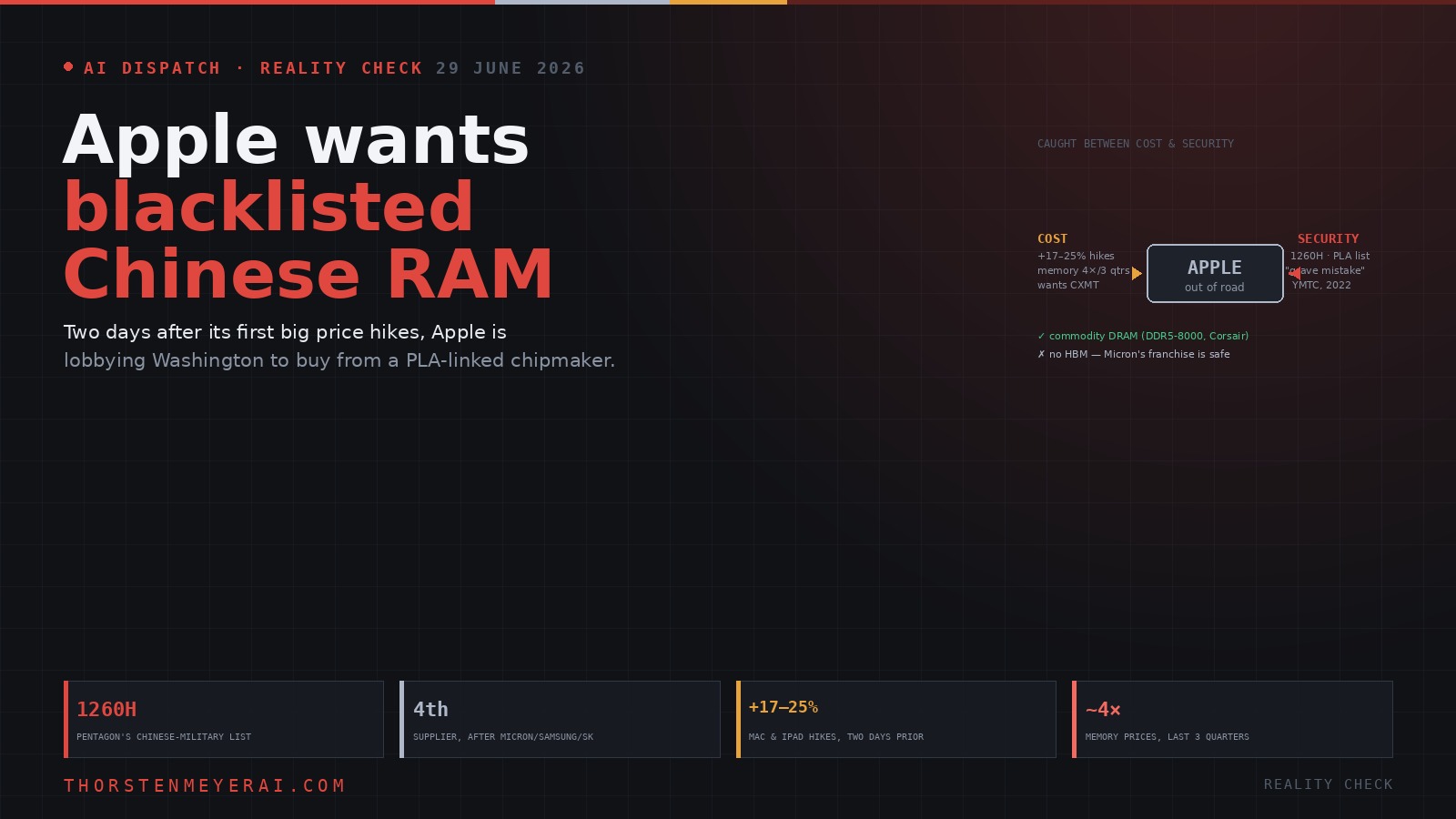
Apple wants blacklisted Chinese RAM
Two days after its first big price hikes, Apple is reportedly lobbying Washington to buy memory from a PLA-linked Chinese chipmaker. When the best-insulated company in tech runs out of road, the story isn’t Apple — it’s how total the squeeze got.
- +17–25% Mac & iPad price hikes, blamed on memory
- Memory prices ~4× in 3 quarters (Counterpoint)
- Cook: had no choice; “everything on the table”
- CXMT prices commodity RAM saner — no AI/HBM chase
- CXMT on Pentagon’s 1260H list (alleged PLA ties)
- Rep. Moolenaar: a “grave mistake” — deepens dependence
- Precedent: YMTC, 2022 — Congress warned, Apple backed off
- Reputational + political radioactivity for a US icon
DDR5 (PC/server), LPDDR5X/4X, RDIMM/MRDIMM. Demonstrated DDR5-8000; found under retail Corsair Vengeance kits; Dell & HP use it in region RAM. Open question: volume.
CXMT doesn’t make the stacked high-margin memory feeding AI accelerators — so Micron’s HBM franchise is untouched. This is a fight over cheap commodity RAM, not the AI-memory frontier.
Strip away the brand and this is what supply dependence under stress looks like: the richest hardware company on earth, unable to buy its way out, courting a supplier its own government flags as a military risk — and spending political capital to do it. It rhymes with the European bind — when you don’t control the supply, the shortage writes your policy. Approved or not, the CXMT gambit is a symptom, not a strategy. And the lesson for everyone else is blunt: if Apple can’t buy its way out, neither can you. What’s left is discipline.
What Apple is actually asking for
The reporting, attributed to six people familiar with the matter, is specific. Apple approached the Commerce Department roughly a month ago and has since widened a lobbying campaign across the administration and its contacts in Washington. The goal isn’t a one-off purchase — it’s assurance. Apple wants confidence that a supply deal with CXMT won’t later be blown up by US trade restrictions, and specifically that Commerce won’t add CXMT to the Entity List, which would impose licensing rules and choke the company’s access to US technology.
Here’s the nuance that makes this a lobbying story rather than a violation. Apple is not currently barred from buying from CXMT. The company sits on the Pentagon’s 1260H list — the roster of “Chinese Military Companies” — which is a designation, not a prohibition. It doesn’t automatically block a commercial deal the way the Entity List would. What it does is make any such deal radioactive: the Defense Department can’t contract with 1260H firms or use their products through third parties, and an American icon sourcing RAM from one invites exactly the political firestorm now forming. CXMT would become Apple’s fourth memory supplier, alongside Micron, Samsung, and SK Hynix — a diversification play, with national-security strings attached.
As an affiliate, we earn on qualifying purchases.
Why now: the price hikes Apple swore it would avoid
The timing isn’t a coincidence; it’s the whole point. On the same week, Apple pushed through hardware increases of roughly 17–25% across Macs and iPads — a 1TB M5 MacBook Pro up $300, iPad Pros up $200, even the entry MacBook Neo up $100 — explicitly citing soaring memory and storage costs from AI data-center demand. Tim Cook told the Wall Street Journal the company had no choice, and, tellingly, signaled openness to Chinese memory if Washington allowed it: everything, he suggested, needed to be on the table. He has said the constraints will likely persist for months, and he hands the problem to incoming CEO John Ternus on September 1.
The pressure is real and quantifiable. By Counterpoint’s reckoning, memory prices have roughly quadrupled over the past three quarters — the same structural AI-driven reallocation that has lifted Micron, Samsung, and SK Hynix to record profits has turned Apple’s bill of materials into a problem it can no longer absorb quietly. Apple held out longer than most through long-term contracts. Those contracts ran out, and the wafer math caught up with Cupertino like it caught up with everyone else.
As an affiliate, we earn on qualifying purchases.
The collision: cost relief vs. national security
This is where it gets genuinely hard, and worth presenting from both sides rather than refereeing.
The opposition is already loud and bipartisan in instinct. House China Committee chair John Moolenaar called a possible Apple–CXMT arrangement a grave mistake, arguing it would deepen American dependence on Chinese supply chains precisely as Washington tries to decouple from them. The precedent is unflattering: in 2022, Apple considered sourcing from YMTC — another blacklisted Chinese memory maker — and backed off after members of Congress warned of legislative consequences. Both YMTC and CXMT were recently restored to the 1260H list after a brief removal. The White House hasn’t said whether it will approve anything, and Apple declined to comment.
Apple’s defenders would counter that the company is doing the responsible thing — seeking legal clarity before committing, not after; that supplier diversification is basic risk management in a shortage; that CXMT makes capable, modern memory at saner prices; and that, faced with a genuine supply crisis, refusing to even ask would be negligence to customers and shareholders. Both arguments are coherent. The question Washington has to answer is whether short-term cost relief for one American company is worth normalizing a PLA-linked supplier in the US electronics base — and that is a political judgment, not a technical one.
As an affiliate, we earn on qualifying purchases.
What CXMT actually is — and what it isn’t
A lot of the panic and the reassurance both hinge on understanding what CXMT can and can’t make.
CXMT manufactures commodity DRAM: DDR5 for PCs and servers, LPDDR5X and LPDDR4X for phones, and enterprise RDIMM and MRDIMM modules. It does not make HBM — the stacked, high-margin memory that feeds AI accelerators and drives Micron’s earnings. That single distinction defrays most of the investor anxiety: even if Apple gets its way, Micron’s HBM franchise is untouched, because CXMT isn’t in that business. This is a fight over cheap commodity RAM, not the AI-memory frontier.
And CXMT is not a backwater. Late last year it demonstrated production-ready DDR5-8000 and LPDDR5X-10667 modules; its chips were recently found underneath retail Corsair Vengeance DDR5-6000 CL30 kits, and Dell and HP have adopted Chinese-made RAM in region-bound systems. Beijing has clearly learned to make performant memory. The open question is volume — whether CXMT can supply at Apple’s scale — and, crucially, that it has little incentive to chase the AI/HBM gold rush, which is exactly why it can offer commodity RAM at prices the big three no longer will.
As an affiliate, we earn on qualifying purchases.
The irony nobody at Apple will say out loud
There’s a deeper twist worth naming. Apple is, in part, asking for relief from a fire it helped set. During the last memory downturn, Apple’s famously aggressive price negotiations pushed DRAM so low that suppliers — Micron included — saw gross margins fall into negative territory. That punishing pricing discouraged the very capacity investment that might have softened today’s shortage. The squeeze has many parents — AI demand, years of underinvestment, the HBM pivot — but the buyer now lobbying for an emergency fourth supplier was one of the forces that taught the industry not to build ahead of demand.
The sovereignty read
Strip away the brand names and this is a story about what dependence looks like under stress. The most powerful hardware company on earth, facing a shortage it cannot buy its way out of, is willing to court a supplier its own government flags as a military risk — and to spend political capital in Washington to do it. That is not a position of strength; it’s the behavior of a company that has discovered it doesn’t actually control its own supply chain.
It rhymes with the European bind I’ve written about repeatedly: when you don’t command the production, the shortage ends up writing your policy for you. America’s version is playing out in real time — industrial cost on one side, national security on the other, and a blacklisted Chinese chipmaker sitting in the gap because the domestic and allied supply simply isn’t there at a price Apple will pay. Reshoring is the obvious retort, and Micron, Samsung, and SK Hynix are all expanding US capacity — but those fabs don’t produce at volume until 2027 and beyond, which is precisely why Apple is lobbying now rather than waiting.
The take
Whether or not Washington grants the request, the CXMT gambit is less a strategy than a symptom. It is the clearest signal yet that the memory squeeze has crossed from a budgeting problem into a geopolitical one — bending not just price tags but the calculus of which suppliers a flagship American company is willing to risk its reputation on.
For everyone else, the lesson is bracing in its simplicity. If Apple — with all its leverage, all its cash, all its contracts — can’t buy its way out of the squeeze and is reduced to lobbying for blacklisted chips, then neither can you. The move that’s left isn’t a clever supplier; it’s discipline: buy what you need, right-size what you have, and stop assuming the cheap memory is coming back. Even Cupertino has stopped assuming that.
Sources: Financial Times (original reporting by Demetri Sevastopulo and Michael Acton) as relayed by 9to5Mac and Engadget; Notebookcheck and Analytics Insight (CXMT 1260H status, Commerce Department approach, price-hike timing); Tom’s Hardware (CXMT capabilities, Corsair/Dell/HP adoption, DDR5-8000 demonstration); 24/7 Wall St. (Micron/HBM analysis, the pricing-history irony); Counterpoint Research (memory-price increase). Apple and the White House have not commented on the reported lobbying as of publication; figures are point-in-time, late June 2026. Analysis and opinions are the author’s; this is not investment advice.
Fall Picks
fall essentials
As an affiliate, we earn on qualifying purchases.