
Executive summary
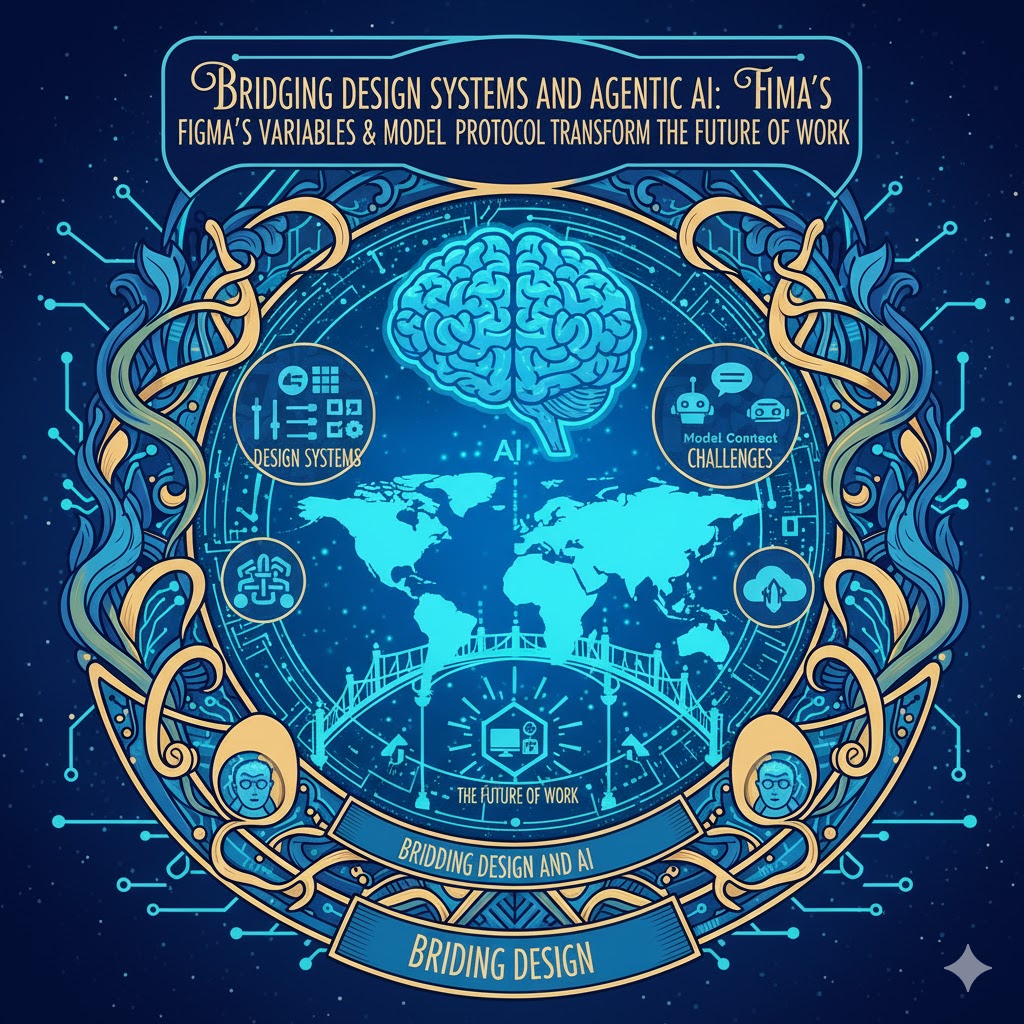
The convergence of design tooling and generative AI promises to change how digital products are built. Figma’s variables and Model‑Context‑Protocol (MCP) server move design artefacts closer to code by exposing structured design data—such as tokens, component hierarchies and layout metadata—directly to intelligent agents. This white paper, written for Thorsten Meyer AI, synthesises industry research, 2025‑era best practices and Thorsten Meyer’s own agentic‑economy framework. It argues that mastering design orchestration—the art of directing AI agents across the design–development pipeline—will be as valuable as traditional coding once wasthorstenmeyerai.com. The paper provides a structured examination of design tokens, Figma’s variables and MCP server, real‑world use‑cases, limitations (including security vulnerabilities) and their implications for the agentic future of work. Recommendations are offered for design leaders, developers and policy‑makers.

Figma Bible for Modern Teams: A Practical handbook for UI, UX, Motion, Accessibility, and Developer Collaboration (Just-in: Embedded Systems, IoT, and Edge Intelligence Development)
As an affiliate, we earn on qualifying purchases.
As an affiliate, we earn on qualifying purchases.
Introduction: the digital shift toward orchestration
Over the last decade digital design and software development have been reshaped by two parallel forces: 1) the maturation of design systems and their token‑driven architectures, and 2) the emergence of generative AI that can code, write and even design. Thorsten Meyer’s writings on the “Age of the Agent Orchestrator” capture the resulting skill inversion: executing specific tasks (coding, copywriting, analysis) is becoming automated, while orchestration knowledge—the ability to direct AI agents effectively—will command premium valuethorstenmeyerai.comthorstenmeyerai.com. In this context, Figma has expanded its role from a collaborative design canvas to a semantic design API. With variables, modes and MCP, Figma intends to make design context consumable by AI tools to support design‑to‑code automation, continuous integration and multimodal experiences.

Mojo Programming in Action: Write Fast, Reliable, and Python Compatible Code for AI, Systems, and Beyond
As an affiliate, we earn on qualifying purchases.
As an affiliate, we earn on qualifying purchases.
Foundations: design tokens, variables and modes
Why tokens matter
Design tokens are atomic, platform‑agnostic variables that store visual and functional values—colours, spacing, typography, radii, shadows and even text strings. By 2025, tokens have become “the backbone of digital product development,” offering a single source of truth across brands, platforms and devicesdesignsystemscollective.com. A mature token system reduces rework, accelerates product launches and maintains accessibility. However, complexity grows with multi‑brand portfolios, global markets and accessibility mandatesdesignsystemscollective.com; thus structure and governance are essentialdesignsystemscollective.com.
Sixfold token structure
Claus Nisslmüller’s 2025 deep‑dive proposes a six‑pillar token structure—Colors, Foundations, Measures, Themes, UX Writing & Meta, and Accessibility—that ensures clarity and scalabilitydesignsystemscollective.com. Each pillar has explicit best practices:
- Colors – define atomic colour tokens (
brand‑primary,gray‑100) with semantic aliases (e.g.button‑primary‑bg) and document contrast ratios; Figma’s variable modes allow instant preview of light, dark and high‑contrast themesdesignsystemscollective.com. - Foundations – store spacing, sizing, typography scales, radii and shadows as numeric strings; maintain responsive readiness across devicesdesignsystemscollective.com.
- Measures – capture component‑specific sizes and stateful values (e.g., input padding when focused) and alias back to foundations to avoid value driftdesignsystemscollective.com.
- Themes – orchestrate brand and mode variations; define tokens for each mode (light, dark, high‑contrast) and support rapid theme switchingdesignsystemscollective.com.
- UX Writing & Meta – tokenise UI text, alt text and metadata, enabling localisation, accessibility and A/B testingdesignsystemscollective.com.
- Accessibility – formalise ARIA labels, focus indicators and screen‑reader text; document compliance with WCAG, ADA and similar standardsdesignsystemscollective.com.
This structured approach positions tokens as strategic assets rather than low‑level variables, enabling global design operationsdesignsystemscollective.com and future‑proofing systems for multimodal interfaces such as voice or AR/VRdesignsystemscollective.com.
Variables and modes in Figma
Figma introduced variables and modes to manage design tokens natively. Variables allow designers to store reusable values and apply them across designs; modes (e.g., light, dark) provide alternate values for the same token. By 2025 Figma’s variable system supports cross‑file references, global updates and high‑contrast accessibility previewsdesignsystemscollective.com. Designers can organise variables into collections and modes, then synchronise them with code via Figma’s REST API, as shown in Tony Ward’s tutorial: variables are retrieved as collections with mode definitions and mapped to CSS variables for seamless design–code consistencytonyward.devtonyward.dev. However, multi‑brand and multi‑mode token management remains challenging; consistent naming, careful organisation and separation into primitives, semantic and component layers are critical to avoid overwhelming teamsbordercrossingux.com.

LESSBLE 10-Pack NFC Coins, NTAG215 Rewritable Tags, 540 Bytes Memory, Waterproof PVC NFC Token for Smart Automation and Gaming Compatibility, White
【High-Capacity NTAG215 Chip】 Features the reliable NTAG215 chip with 540 bytes of rewritable memory, providing ample space for…
As an affiliate, we earn on qualifying purchases.
As an affiliate, we earn on qualifying purchases.
Figma’s Model‑Context‑Protocol (MCP) server
What is MCP?
The Model Context Protocol is an open standard from Anthropic that enables AI agents (clients) to retrieve and operate on rich context from external applications (servers). In the Figma implementation, MCP provides AI coding assistants with structured access to design data—component hierarchies, design tokens, layout metadata and interactive elements—via a local or remote server endpointskywork.ai. Figma’s MCP server lives inside Dev Mode and can be accessed locally (http://127.0.0.1:3845/mcp) or via a hosted endpoint (https://mcp.figma.com/mcp) skywork.ai. The server adheres to the MCP specification, returning design context in JSON‑RPC format and enabling operations such as reading node structures, extracting variables and generating code.
Code Connect
Complementing MCP, Figma’s Code Connect library maps design components to their code equivalents. MCP exposes this mapping so AI agents can reuse existing code rather than generate it from scratch. The Siemens blog summarises that Code Connect enables accurate code generation, reduces manual mapping errors and ensures consistent component usageblog.siemens.com. When combined with MCP, Code Connect transforms Figma into a semantic API that AI code assistants can query for component definitions and style tokens.
Key features and benefits
According to the Siemens article, MCP offers several capabilities:
- Semantic design understanding – AI can access component hierarchies, design tokens, layout specifications and interactive definitionsblog.siemens.com. This moves code generation from pixel‑recreation to semantic interpretation, improving fidelity.
- Code Connect library – provides direct links to code components, enabling reuse and reducing errorsblog.siemens.com.
- Accelerated delivery – design‑to‑code time is reduced from days to hours by allowing AI agents to generate production‑ready codeblog.siemens.com.
- Improved accuracy – elimination of manual interpretation errors and better alignment with design intentblog.siemens.com.
- Seamless iteration – designers and developers can iterate via near‑real‑time feedback loops; updates in Figma automatically propagate to code when variables are syncedblog.siemens.com.
In addition to code generation, the MCP server supports tasks such as design audits, token drift detection and multi‑mode preview generation. AI agents can summarise design changes, check accessibility compliance or even propose responsive adjustments.
Implementation and best practices
Deploying MCP effectively requires strong foundations:
- Design system maturity – organisations with well‑maintained component libraries and token structures see the most benefit; these ensure consistent, brand‑aligned code outputblog.siemens.com.
- Semantic layer naming – layers, components and tokens should have clear, descriptive names; consistent naming improves AI interpretationblog.siemens.com.
- Effective prompting – AI agents need explicit instructions: specify target frameworks, design constraints and preferred coding patternsblog.siemens.com.
- Security – MCP servers run locally or on self‑hosted infrastructure; Figma warns against exposing endpoints without authentication. A 2025 vulnerability (CVE‑2025‑53967) in the open‑source
figma‑developer‑mcpserver demonstrated that unsanitised command‑line parameters could allow remote code executionthehackernews.com. The exploit, triggered via an AI agent’stools/callrequest sequence, has been patched in version 0.6.3thehackernews.com. Teams must keep MCP servers up‑to‑date and avoid building untrusted inputs into shell commands.
Figma variables and modes accessories
As an affiliate, we earn on qualifying purchases.
As an affiliate, we earn on qualifying purchases.
Real‑world use cases and experiences
AI‑assisted design flows via Cursor
Designer Maria Margarida described how using Cursor with Figma’s MCP server enabled her to generate nearly pixel‑perfect multi‑screen flows from a single natural‑language prompt within five minutesmedium.com. Cursor’s integration runs inside the code editor and leverages MCP to access design context; the AI then outputs React code and updates the Figma file. Compared to other tools like v0/Lovable (which require plugin installations and provide less direct Figma interaction), Cursor felt more fluid and required fewer prompt iterationsmedium.com. Although occasional follow‑ups were needed to fix positioning or interactions, the process saved hours of manual prototypingmedium.com.
Design team productivity
Margarida’s experience echoes a broader trend: AI tools integrated via MCP accelerate design–development cycles by automating routine tasks such as generating flows, aligning layouts and wiring up interactions. They allow designers to focus on user experience rather than pixel‑pushing, and they empower developers to concentrate on business logic instead of translating design details.
Design system audit and accessibility
Beyond code generation, AI agents can use MCP to audit design systems for consistency. For instance, they can identify when a component uses a hard‑coded colour instead of a token (token drift), or check that dark‑mode variants meet contrast ratios. In large organisations, these automated checks act as a guardrail, preserving the integrity of the token architecture.designsystemscollective.com.
Limitations and challenges
Despite the promise of MCP, several challenges remain:
- Dependence on design system quality – AI is only as good as the design context it receives. Without a well‑structured token system, agents may output inconsistent or inaccessible codeintodesignsystems.com. Multi‑brand systems require careful variable organisation and naming conventions to prevent confusionbordercrossingux.com.
- Manual oversight – early MCP implementations still require human review. Builder.io notes that AI‑generated code may include one‑off styles and lacks awareness of final output; developers must perform manual QA and integrate the code into existing projectsbuilder.io.
- Security risks – as seen in the MCP command‑injection vulnerability, poorly sanitised servers can expose local systemsthehackernews.com. Organisations must follow secure coding practices and restrict network access.
- Prompt engineering – effective AI generation depends on clear instructions. Ambiguous prompts or poorly named layers can lead to undesirable output, requiring iterative refinementblog.siemens.com.
Implications for agentic AI and the future of work
Thorsten Meyer’s concept of the Agent Orchestrator provides a useful lens to understand these developments. Meyer argues that as AI automates execution tasks, the scarce skill will be the ability to direct AI agents and allocate resources effectivelythorstenmeyerai.comthorstenmeyerai.com. Figma’s variables and MCP server turn design systems into machine‑readable inputs, enabling code assistants to generate user interfaces with minimal human effort. The designer’s role shifts from drawing screens to orchestrating a network of agents: instructing the MCP server, selecting appropriate code mappings via Code Connect, and evaluating AI outputs against user needs and ethical considerations.
In this agentic economy, design tokens become not just variables but economic levers: they determine how quickly a product can adapt to new branding or accessibility requirements, and they influence the speed at which AI models can generate accurate UI code. Organisations that invest in structured tokens, accessible design and secure MCP implementations will gain leverage—similar to how early adopters of Excel or data analytics gained competitive advantagethorstenmeyerai.com.
The implications extend to labour markets. With AI taking on execution tasks, the demand for agent orchestrators—people who can define problems clearly, design workflows, determine when human judgment is needed and allocate compute, data and capital efficiently—will rise. Meyer predicts that these orchestrators will command premium salaries because they create exponential value by managing AI systemsthorstenmeyerai.com. For designers and developers, learning to work with variables, tokens and MCP is an entry point into this new profession.
Recommendations
- Adopt a structured token architecture – implement the six‑pillar model (Colours, Foundations, Measures, Themes, UX Writing & Meta, Accessibility)designsystemscollective.com. Document naming conventions, mode definitions and accessibility requirements. Invest in tools like Tokens Studio or build custom API bridges for synchronisationdesignsystemscollective.com.
- Prepare for MCP integration – upgrade to Figma’s Dev Mode and configure the MCP server locally or via Figma’s hosted endpointskywork.ai. Maintain up‑to‑date versions and apply patches for known vulnerabilitiesthehackernews.com. Use Code Connect to link design components with code and avoid reinventing componentsblog.siemens.com.
- Invest in prompt engineering – develop internal guidelines for effective MCP prompts. Provide explicit instructions (frameworks, design constraints, technical limitations) and use descriptive layer names to improve AI interpretationblog.siemens.comblog.siemens.com.
- Train agent orchestrators – encourage designers and developers to learn orchestration skills: system design, resource allocation, ethical considerations and human‑in‑the‑loop decision‑making. Use Figma variables and MCP as practical tools for learning.
- Monitor security and ethics – integrate security reviews into the design‑to‑code pipeline; enforce sanitised inputs and local firewall rules for MCP serversthehackernews.com. Consider privacy and data minimisation when exposing design context to AI.
- Experiment with multimodal design – prepare token systems for voice, AR/VR and motion‑sensitivity; tokenise UX writing and accessibility metadata to support future modesdesignsystemscollective.com.
Future outlook
Design tokens and MCP will continue evolving. Industry experts anticipate AI‑driven token management, real‑time compliance checks and decentralised token governancedesignsystemscollective.com. Figma and the W3C design tokens community are working on universal token exchange formats, making it easier to share and adopt token libraries across tools. Multimodal experiences (voice, AR/VR, haptics) will demand new token types and deeper integration with accessibility standardsdesignsystemscollective.com. For Thorsten Meyer AI, these developments align with the vision of agentic commerce: self‑coordinating AI ecosystems where human orchestrators focus on creativity, strategy and values. As design context becomes machine‑readable and AI models become agents, the boundary between design and development dissolves.
Conclusion
Figma’s variables and Model‑Context‑Protocol server represent a paradigm shift in digital product development. They turn design data into machine‑consumable context, enabling AI agents to generate code, audit systems and adapt user interfaces faster than ever. Yet the success of this new workflow depends on the human orchestration skills championed by Thorsten Meyer. Structured design tokens, accessible and ethical design practices, secure MCP configurations and thoughtful prompts are the foundations upon which the Age of the Agent Orchestrator will be built. Organisations that embrace these tools and cultivate orchestration expertise will lead the post‑labor, agentic economy.