
For two years, the standard advice on sovereign AI went like this: if you care about control, self-host — and accept that you’ll be running a visibly weaker model.

Get business pricing on tech for your team
- Business-only prices and quantity discounts
- Tax-exempt purchasing
- Multiple users, one account, clear invoices
That trade is dead. What replaced it is more interesting, and more uncomfortable for both camps.
The capability gap between open-weight and frontier closed models has nearly closed. The cost gap between self-hosting and buying managed inference has not — and on most realistic utilization profiles, it runs the opposite direction from what the sovereignty crowd assumes.
This is part three of the Forge series. Part one looked at what Mistral Forge actually is; part two walked through the decision framework. This piece does the arithmetic: what sovereignty actually costs when you build it yourself, what it costs when you buy it from a European vendor, and why cost was never the right reason to self-host in the first place.
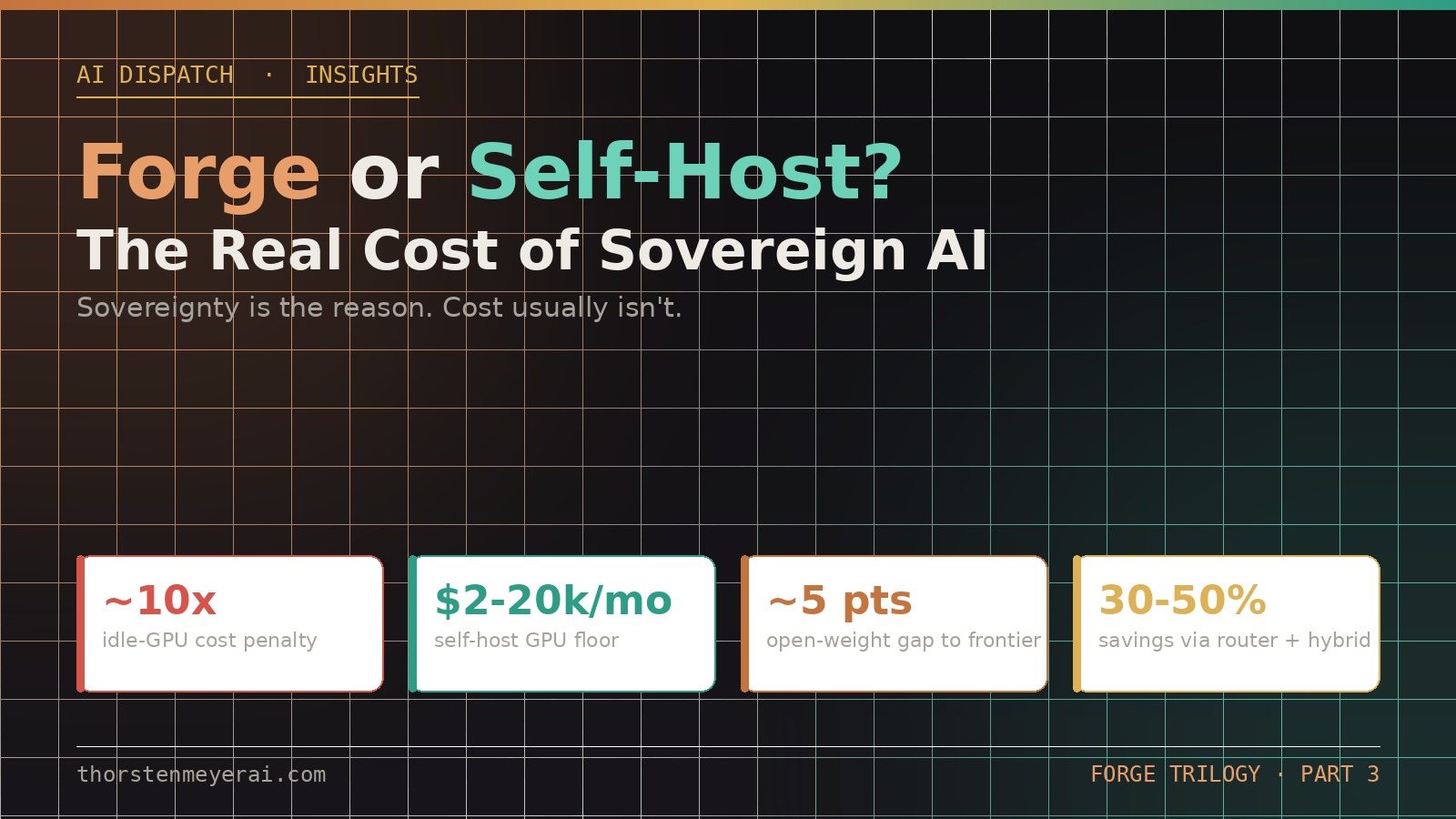
Forge or Self-Host?
The Real Cost of Sovereign AI
Sovereignty is the reason. Cost usually isn’t. — Forge Trilogy, Part 3
Two ways to buy control
Managed sovereignty (Forge-style)
- Full lifecycle: pre-training, post-training, RL on your data, in your jurisdiction
- Vendor’s training recipes + orchestration — no ML-infra team required
- Platform dependency: Mistral architectures only, for now
- Open question: do most enterprises need custom-trained models at all?
DIY self-hosting (open weights)
- Maximum control: air-gap capable, no vendor can switch you off
- GPU floor $2–20k/mo; H100 rates rose ~14% y/y
- Idle penalty ~10× below ~30% utilization — the silent budget killer
- The human: DevOps/MLOps runs €62–89k gross in Germany, seniors €100k+
The capability excuse evaporated — GLM-5.2 (open, MIT) vs Claude Opus 4.8
The answer that works: route, don’t choose (Bifröst pattern)
The verdict: self-hosting usually isn’t cheaper — but the capability tax on sovereignty has collapsed to a few points. You no longer sacrifice quality for control; you only pay for it. Price it honestly, then decide whether you’re buying insurance or ideology.
enterprise GPU server for AI self-hosting
As an affiliate, we earn on qualifying purchases.
As an affiliate, we earn on qualifying purchases.
What Forge is selling
A quick recap for anyone landing here first. Mistral launched Forge at NVIDIA GTC in March 2026: a full-lifecycle platform for building custom models on proprietary data — pre-training, post-training, reinforcement learning — running on the customer’s own infrastructure or Mistral’s European cloud. The launch partners tell you who it’s for: ASML, Ericsson, the European Space Agency, and two Singaporean defense and homeland-security agencies. This is a product for organizations whose compliance teams can veto a vendor on data residency alone.
Forge’s pitch is managed sovereignty: your data, your jurisdiction, your model — but Mistral’s training recipes, Mistral’s orchestration, and (for now) Mistral’s model architectures, since support for non-Mistral open architectures is promised but not yet shipped.
The alternative Forge is implicitly priced against isn’t OpenAI. It’s you, a rack of GPUs, and a stack of open weights. So let’s price that honestly.
As an affiliate, we earn on qualifying purchases.
The self-host bill nobody itemizes
Three line items dominate, and most sovereignty enthusiasts only budget for the first.
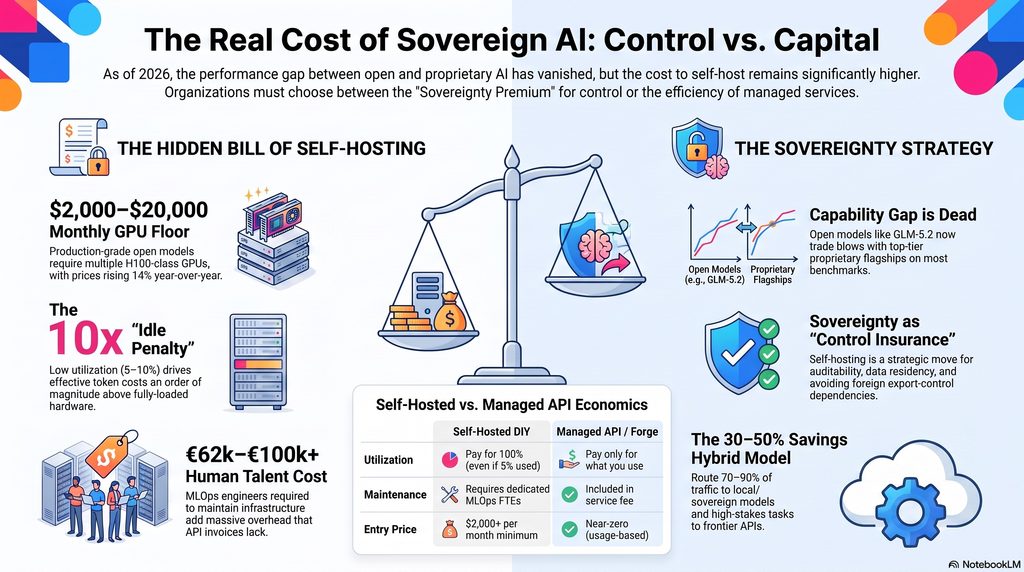
The GPU floor. A single 48GB card in a bare-metal server runs roughly $400–700 a month — enough for a quantized mid-size model, the kind of setup my own DojoClaw fleet approximates on Apple silicon. But a production deployment of a serious open model needs multiple H100-class GPUs, and dual-to-quad H100 bare-metal configurations run about $4,000–10,000 per month. Hyperscaler on-demand pricing is worse: $7–12 per GPU-hour puts an 8×H100 node north of $20,000 a month before storage and egress. Call the realistic production floor $2,000–20,000 a month depending on how much model you need and where you rent it. And note the direction of travel: average H100 on-demand pricing rose about 14% year-over-year to roughly $3.90/hour, because demand recovered faster than supply. The “GPUs get cheap” assumption baked into many self-hosting business cases has not held in 2026.
The idle penalty. This is the one that kills quietly. A dedicated GPU bills 720 hours a month whether you push tokens through it or not. If your actual utilization is 5–10% — which is where most internal tools, agent experiments, and departmental deployments genuinely sit — your effective cost per token runs roughly an order of magnitude above what the same hardware delivers fully loaded. That’s not a market failure; it’s arithmetic. API providers pool demand across thousands of customers and bake high utilization into their pricing. You can’t. Serverless GPU billing helps at the margins, but the break-even sits around 30% utilization — below that, dedicated hardware is the expensive option, full stop.
The human. Somebody has to patch the inference server, rotate the models, watch the queue, and answer the page when generation quality falls off a cliff after a driver update. In Germany, a DevOps or MLOps engineer runs roughly €62,000–89,000 gross on average, with seniors at €100,000+; fully-loaded US costs for the same role run roughly double. Even at a quarter-FTE allocation — a common and optimistic assumption — that’s €1,500–4,000 a month of engineering time that the API invoice simply doesn’t have.
Add it up and the honest conclusion is: for most organizations, at most utilization levels, self-hosting is not cheaper than buying inference. It’s frequently 2–5× more expensive per useful token. Anyone selling you self-hosting as a cost play is either running at sustained high utilization or hasn’t done the math.
high-performance GPU for AI training
As an affiliate, we earn on qualifying purchases.
As an affiliate, we earn on qualifying purchases.
Meanwhile, the capability excuse evaporated
Here’s what makes 2026 different from 2024: the other argument against self-hosting — that open models were simply worse — has almost nothing left to stand on.
In June, Z.ai released GLM-5.2, a 753B-parameter mixture-of-experts model under a genuinely permissive MIT license, with a 1M-token context window. Independent tracker Artificial Analysis ranked it the top open-weight model on its Intelligence Index, third overall behind only two proprietary flagships. On agentic coding benchmarks it lands within one to four points of Claude Opus 4.8 — 81.0 versus 85.0 on Terminal-Bench 2.1 — and it wins a handful of evaluations outright under its best harness.
Two honesty notes, because this is where coverage tends to get sloppy. First, most of the head-to-head scores originate from Z.ai’s own published cross-model table — vendor-reported numbers that independent replication has so far supported in part, not in full. Second, the frontier still leads clearly where it matters most for autonomous work: on ultra-long-horizon software engineering tasks, the gap widens to double digits. If your workload is multi-hour agentic runs, the closed flagship remains meaningfully better, and pretending otherwise is cope.
But for the broad middle of enterprise workloads — summarization, extraction, RAG, code assistance, moderate-horizon agents — an MIT-licensed model you can download, fine-tune, and run air-gapped is now trading blows with the best money can buy, at list prices three to six times lower when you do buy it hosted.
Which brings us to the real question.
As an affiliate, we earn on qualifying purchases.
If self-hosting isn’t cheaper, why do it?
Because sovereignty was never a cost argument. It’s a control argument — and the control argument has gotten stronger, not weaker.
Control means your regulator can audit the deployment. It means a foreign export-control decision can’t switch off your production system. It means your engineering data never crosses a jurisdiction you don’t choose. Gartner pegs European sovereign-cloud infrastructure spending at $12.6 billion for 2026, up 83% in a year — that money isn’t chasing savings, it’s chasing the ability to say no to dependencies. GDPR, the EU AI Act, and sector rules in finance, health, and defense have turned data residency from preference into procurement gate.
Steelman the pure-API position, because it deserves it: managed frontier APIs give you the best models, zero idle cost, zero ops burden, and contractual data-processing terms that satisfy most regulators most of the time. For the majority of companies, that is the rational default, and the sovereignty premium is money spent on a risk that never materializes.
Steelman managed sovereignty too: Forge-style platforms exist precisely because full self-hosting is brutal. You get residency and model ownership without hiring an ML-infrastructure team. The bear case is equally real — you’ve swapped hyperscaler dependency for a smaller vendor’s platform dependency, Forge currently supports only Mistral architectures, and analysts openly question whether more than a niche of data-mature enterprises need custom-trained models at all when fine-tuned generic models cover most gaps.
And the bear case on DIY self-hosting: model churn is relentless (GLM-5.2 obsoleted its own predecessor in six months), your quantized deployment silently degrades against the moving frontier, and the FTE you budgeted becomes two.
The answer that actually works: route, don’t choose
The framing “Forge or self-host or API” is the mistake. The deployments that make economic sense in 2026 are hybrid, with a router in front.
The pattern I run on my own fleet — I call it Bifröst — is simple: a local-first router classifies every request. The 70–90% of traffic that a strong open model handles well goes to local or self-hosted inference, where high, pooled utilization makes the hardware pay. The long-horizon, high-stakes tail goes to a frontier API. Sensitive-data requests are pinned local regardless of difficulty, which is the sovereignty guarantee doing its actual job.
Run that way, the idle penalty largely disappears — the local hardware stays busy because it catches the bulk of requests — and the frontier bill shrinks to the tasks that genuinely need it. In my own operation this lands at 30–50% total inference savings versus all-API, while keeping the sensitive path entirely on hardware I control. Your percentages will differ; the structure is what transfers.
That’s also the honest way to read Forge: not as a competitor to self-hosting or to APIs, but as one more tier in a routed stack — the tier you buy when you need a custom sovereign model and can’t or won’t build the training pipeline yourself.
The verdict
Self-hosting usually isn’t cheaper. The idle penalty is real, the GPU floor is $2,000–20,000 a month and rising, and the human costs more than the hardware. Anyone whose sovereign-AI business case rests on saving money should rerun the numbers with honest utilization figures.
But the capability tax on sovereignty has collapsed to a few benchmark points, and for most workloads it rounds to zero. That changes the decision fundamentally: you no longer sacrifice quality for control — you only pay for it. Whether through Forge-style managed sovereignty, DIY open weights, or a routed hybrid of both, control is now a line item you can price rather than a compromise you must swallow.
Price it honestly. Then decide whether your organization is buying insurance or ideology. Both are legitimate purchases — but only one of them belongs in a business case.
Sources: Mistral AI / VentureBeat / CIO.com / Futurum Group (Forge launch and positioning, March 2026); Z.ai published benchmarks via llm-stats.com and CodingFleet (GLM-5.2 vs Opus 4.8, June 2026, vendor-reported); Artificial Analysis Intelligence Index v4.1; getdeploying.com and Thunder Compute H100 price trackers (July 2026); Spheron and SitePoint self-hosted LLM TCO analyses (2026); Glassdoor / SalaryExpert Germany DevOps-MLOps compensation data; Gartner European sovereign-cloud IaaS estimate via buildmvpfast.com.
Columbus Day / Indigenous Peoples' Day Picks
long weekend sales
As an affiliate, we earn on qualifying purchases.