
Almost every news product is a list. A vertical river of headlines, newest at the top, context stripped away, scrolling forever. It’s efficient and it’s everywhere — which is exactly the problem. When every feed looks the same, the feed itself stops being worth anything.
Get ready for Prime Big Deal Days — try Prime free
Exclusive member deals on October 6–7, plus fast free delivery. Cancel anytime.
Start your free trialAs an affiliate, we earn on qualifying purchases.
Stenvrik starts from a different question: not what is the news, but where is it happening?
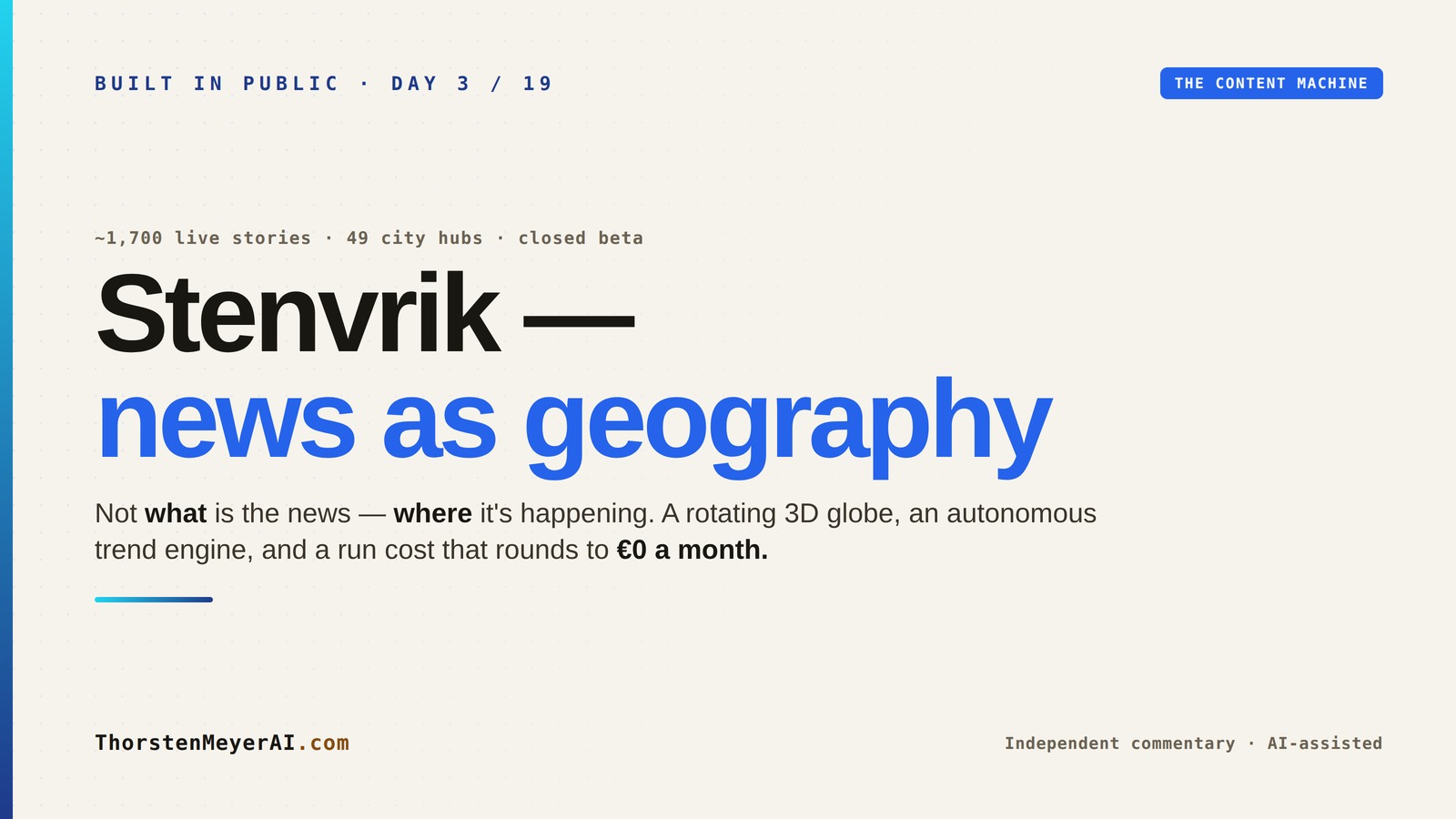
It presents news as geography — roughly 1,700 live stories pinned to 49 city hubs on a rotating 3D globe. Spin the world, and the news organizes itself by place: what’s breaking in Tokyo, what’s developing in Berlin, where the clusters are forming tonight. Behind that surface sits an autonomous trend engine that finds and clusters the stories, pins them to cities, and — importantly — feeds signal back into the wider publishing network.
One more detail that matters for the business case: Stenvrik began life as a throwaway. It was a Claude Design “News Globe Demo” — a prototype — that turned out to be worth keeping, and was rebuilt for production running at roughly €0/month. It’s currently in closed beta, so availability is limited and what’s described here may change.
Stenvrik — news as geography
Not what is the news — where is it happening. ~1,700 live stories pinned to 49 city hubs on a rotating globe, with an autonomous trend engine that also feeds the network.
Spin the world; the news sorts itself.
A 60fps 3D globe where every story is pinned to the city it belongs to. Clusters, gaps, regions heating up — context a vertical feed throws away.
Independent commentary, produced with AI assistance under human editorial oversight. The views are the author’s own and may change. Stenvrik is in closed beta; features, availability, and behavior may change and it is provided without guarantee of uptime or fitness for a particular purpose. The autonomous trend engine clusters and places stories programmatically and may contain errors, mis-placements, or omissions — verify independently before relying on any of it. Product and company names are trademarks of their respective owners; mention does not imply endorsement.
The interface is the argument
It would be easy to file the globe under “nice visualization.” That undersells what it’s doing. In a market where news aggregation has collapsed into interchangeable feeds, the interface is the differentiation — and geography is a genuinely different organizing principle, not a skin on the same list.
A feed answers “what’s newest.” A globe answers “what’s happening, and where” — which is the question a lot of people are actually asking, especially about a world where a story in one city reshapes markets, supply chains, and politics three time zones away. Place is context. Pinning stories to 49 city hubs turns a flat stream into a map you can reason about: clusters, gaps, regions heating up. The globe isn’t decoration; it’s the information architecture.
Whether that’s enough to change anyone’s habits is a fair question — and one the bear case below takes seriously. But the bet is sound in principle: when the commodity version is free and identical, the durable move is to organize the same information in a way no one else does.
As an affiliate, we earn on qualifying purchases.
What’s under the hood
The globe is the part you see. The part that makes it a system is the autonomous trend engine behind it.
That engine does the unglamorous work continuously: surfacing stories, clustering them into coherent topics, and pinning each cluster to the city it belongs to. It runs on its own, not on a human refreshing a dashboard — which is the only way “1,700 live stories” across “49 hubs” stays current without a newsroom’s headcount.
And it doesn’t only power Stenvrik. The same trend signal feeds the network — the broader fleet that the content engine runs on. That’s today’s connection on the operator constellation: Stenvrik → the network. A product that looks like a consumer news toy is, underneath, also a trend-detection input for the rest of the portfolio. One build, two jobs — which is the kind of leverage the whole series keeps circling.
In keeping with the portfolio’s spine, the engine is provider-agnostic and local-first by design: the clustering and ranking aren’t welded to a single model, and the heavy lifting runs where it’s cheapest to run.
As an affiliate, we earn on qualifying purchases.
The €0-a-month story
The most quietly impressive number isn’t 1,700 or 49. It’s the run cost.
A live, 60fps 3D globe sounds expensive. It mostly isn’t, because the rendering happens client-side — the work runs in the visitor’s browser, not on a server you pay for by the request. The trend engine runs on owned compute, so its marginal cost is electricity rather than a metered cloud bill. Put those together and you get a live news product with a cost structure that rounds to roughly zero per month.
That’s not a vanity stat; it’s the business model. A product that costs almost nothing to run can afford to exist while it finds its audience. It doesn’t need to monetize on day one to justify its server bill, because there barely is one. In a category where most experiments die from infrastructure costs before they find product-market fit, near-zero run cost buys the scarcest thing a new product has: time.
It’s also the clearest example in the portfolio of a prototype-to-production path that didn’t blow up into a budget. A design demo became a running product without a rebuild-the-world project in between — which is exactly what the “built by a non-developer, with agentic AI” thesis is supposed to make possible.
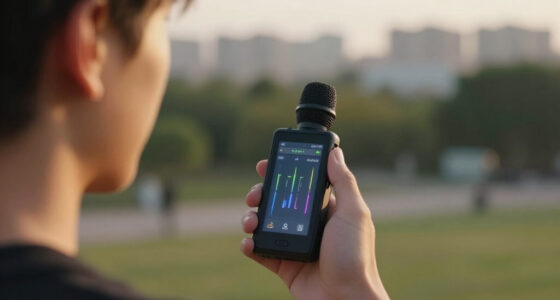
geography-based news visualization device
As an affiliate, we earn on qualifying purchases.
As an affiliate, we earn on qualifying purchases.
The second job: trend detection
It’s worth dwelling on what “feeds the network” actually buys, because it’s the part that turns a clever interface into a strategic asset.
An engine that’s continuously detecting which stories are clustering, where, and how fast is — almost as a side effect — a leading indicator. Knowing that a topic is heating up in a particular region, before it’s obvious, is exactly the kind of signal a content operation can act on: what to cover, when to cover it, which regional demand is building. The same machinery that pins stories to a globe for a reader is, underneath, market intelligence for the rest of the portfolio.
That reframes the whole economics. The consumer-facing globe doesn’t have to carry the product on its own, because the engine behind it is already earning its keep by informing the network’s decisions. In effect, the front-end is a nearly-free distribution channel wrapped around an internally valuable signal. One build, two payoffs — and the less glamorous of the two is arguably the more durable.
virtual globe with live news stories
As an affiliate, we earn on qualifying purchases.
As an affiliate, we earn on qualifying purchases.
Why it started as a demo
The origin story isn’t a footnote; it’s the thesis in miniature.
Stenvrik exists because the cost of trying it was almost nothing. A Claude Design “News Globe” demo — the kind of thing that usually gets admired once and forgotten — turned out to be worth keeping, and the path from prototype to running product didn’t require a rebuild-the-world project to get there. When experiments are cheap, you can afford to keep the accidents that turn out to matter, which is a different posture from the usual one where every new idea has to justify a budget before it’s allowed to exist.
That’s the practical meaning of “built by a non-developer, with agentic AI”: not that no skill is involved, but that the cost of a serious attempt has collapsed far enough that a design demo can graduate into production without a team and a quarter. Most of those attempts won’t matter. The point is that the ones that do — like a news globe that doubles as a trend engine — get to survive long enough to find out.
The honest bear case
Start with the obvious: a globe can be a beautiful way to make information harder to use. The risk with any striking interface is that the wow-factor masks thin utility — that people spin it once, say “neat,” and go back to their feed. Novelty is not retention. If geography-first browsing doesn’t actually fit how people want to consume news, then the globe is a gorgeous answer to a question nobody asked. That has to be proven, not assumed, and it hasn’t been yet.
It’s in closed beta for a reason. The model is unproven at scale, availability is deliberately limited, and there’s no settled monetization story. “Costs nearly nothing to run” removes the pressure to monetize — it does not remove the eventual need to.
There’s also a news-data dimension worth naming. Aggregating and re-presenting news at scale raises real questions about sourcing, attribution, and the terms under which content is used. That’s a domain where care matters and where the rules are not always settled — it deserves attention, not a shrug.
And “autonomous” cuts both ways. An engine that clusters and pins stories without a human in the loop will occasionally mis-cluster, mis-place, or amplify the wrong thing. Automated news handling can introduce errors and bias; the honest framing is that it’s a fast, cheap first pass that still needs oversight, not an oracle.
The bull case, plainly
With the risks acknowledged: Stenvrik is the rare thing that is both genuinely differentiated and nearly free to operate. It organizes a commoditized category in a way competitors don’t, it’s memorable in a market starved for memorability, and underneath the consumer surface it’s a trend-detection engine that earns its keep by feeding the network regardless of how the front-end performs.
That dual role is the hedge. Even if the globe never becomes a mass-market habit, the engine behind it is still a useful input to the rest of the portfolio — so the downside is capped and the upside is a distinctive product that costs almost nothing to keep alive while it finds out whether the world wants to read the news by spinning it. For a closed-beta experiment, that’s close to the ideal risk profile: little to lose, a real signal either way, and a memorable front-end that doubles as the cheapest market research the portfolio runs.
Stenvrik is in closed beta; features, availability, and behavior may change, and it is provided without guarantee of uptime or fitness for a particular purpose. This article was produced with AI assistance and reviewed under human editorial oversight — it is independent commentary and analysis, and the views are the author’s own and may change. The autonomous trend engine surfaces and clusters stories programmatically and may contain errors, mis-placements, or omissions; verify independently before relying on any of it. Product and company names are trademarks of their respective owners; mention does not imply affiliation, sponsorship, or endorsement. © 2026 Thorsten Meyer · Powered by Thorsten Meyer AI. See Imprint/Impressum and Privacy Policy.
Fall yard work Picks
leaf blowers
As an affiliate, we earn on qualifying purchases.