
A Longhorn-Style Deep Dive for Thorsten Meyer AI
By Thorsten Meyer — Futurist, Post-Labor Economist, and Architect of Agentic AI Futures

Get business pricing on tech for your team
- Business-only prices and quantity discounts
- Tax-exempt purchasing
- Multiple users, one account, clear invoices
Introduction: A Shift So Big You Only Notice It If You’re Paying Attention
Something subtle but monumental just happened in the AI landscape—something that will reshape how humans and machines find truth, process complexity, and ultimately trust information.
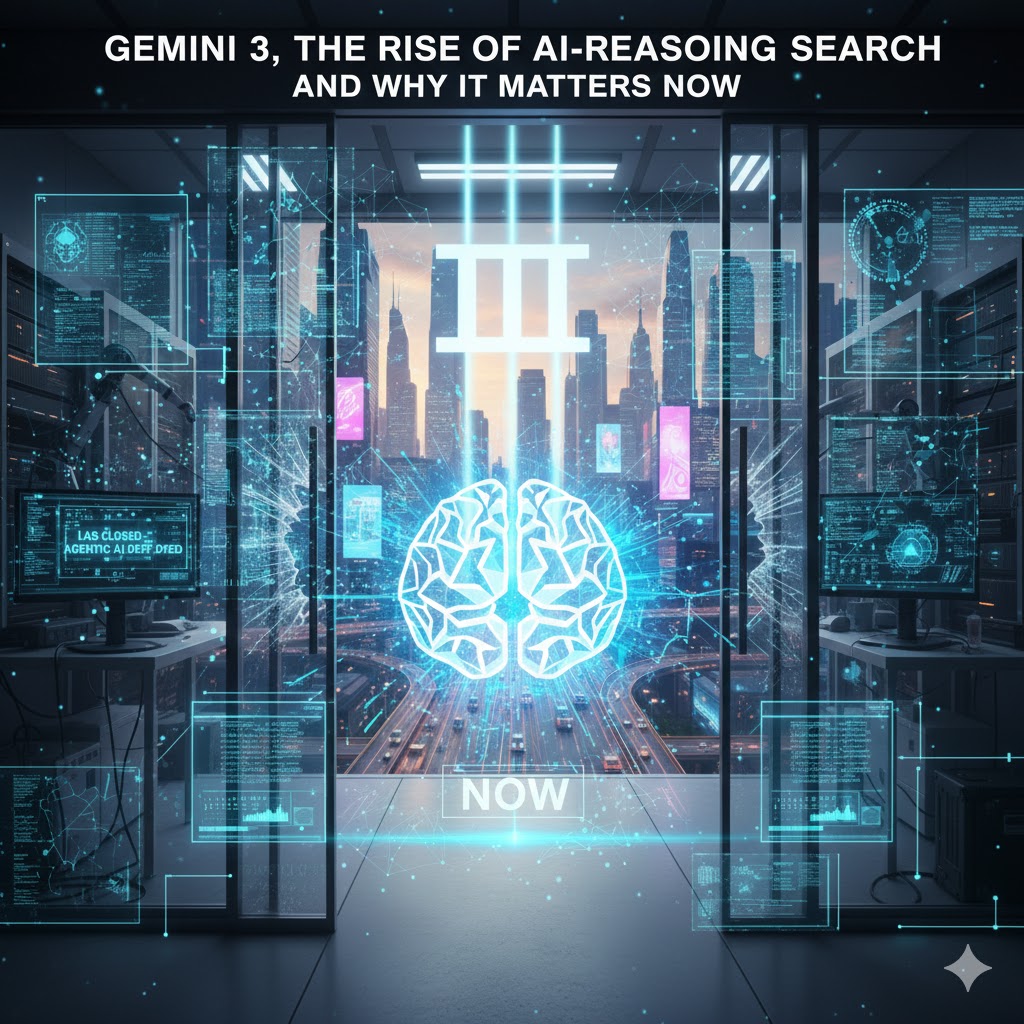
Google quietly rolled out Gemini 3 inside Search’s AI Mode, complete with a new “Thinking” reasoning tier. It’s limited, U.S.-only, and behind a paywall—but make no mistake: this is the first step toward a world where search engines behave more like autonomous analysts than link directories.
This is… the shift.
And for anyone building with agentic AI, running large-scale content ecosystems, or designing post-labor knowledge infrastructures (like I do), this is one of the most important moves since the launch of transformer models.
This longhorn article will break down:
- What Gemini 3 in Search actually changes
- Why its “Thinking mode” matters
- How this affects the future of discoverability, truth, and AI reasoning
- How it impacts builders like us—developers of agentic systems, content networks, and AI-powered workflows
- What comes next: Search as reasoning infrastructure
Let’s go deep.
As an affiliate, we earn on qualifying purchases.
1. Search Is No Longer Retrieval — It’s Reasoning
For over two decades, search engines have fundamentally been retrieval systems.
Gemini 3 changes that.
By embedding a frontier-level multimodal model directly into the core search interaction, Google has started blending:
- Retrieval (finding facts)
- Synthesis (connecting the dots)
- Inference (providing judgments and reasoning)
Search is evolving into an always-on cognitive layer.
What makes Gemini 3 different?
The new “Thinking” mode signals a cognitive shift
Gemini 3’s “Thinking” mode intentionally slows down and uses deeper chain-of-thought reasoning for:
- Ambiguous questions
- Complex decision-trees
- Analytical comparisons
- Multifactor problems
- Long-form synthesis across domains
This is the equivalent of saying:
“Would you like Google Search to think like a junior analyst instead of a keyword matcher?”
This shift—if scaled globally—will fundamentally redefine how humans interface with knowledge systems.
As an affiliate, we earn on qualifying purchases.
2. Why This Matters for AI Developers and Agentic System Builders
Gemini 3 inside Search is the public-facing signal of something I’ve been discussing for years:
Search is becoming procedural AI.
Search engines will transform from index lookups into:
- Context evaluators
- Task solvers
- Decision assistants
- Reasoning engines
This aligns perfectly with the rise of:
- Agentic AI
- Workflow graphs
- On-device SLMs
- Multi-agent orchestrations
- Semantic planning models
- RAG → GraphRAG → Self-RAG evolutions
Gemini 3’s integration into search isn’t a UI update.
It’s the backend story: the world’s largest knowledge platform is now powered by reasoning, not ranking.
For enterprises, this means:
- Search transforms into intelligent query routing
- Support workflows become agent-driven
- Knowledge management evolves into context-first inference
- Business intelligence surfaces automatically
- Compliance, legal, and operational systems get “thinking” layers
- Multi-modal decision-making becomes trivial
This is another signal that the AI stack is becoming synaptic rather than procedural.
As an affiliate, we earn on qualifying purchases.
3. What This Means for Content Ecosystems—Including the StrongMocha Network
As the founder of StrongMocha News Group and over 300 niche content verticals, I spend every day thinking about:
- How humans discover information
- How AI interprets content
- How trust is established algorithmically
Gemini 3’s launch matters because:
Search will increasingly push content that answers complexity, not just keywords.
This favors:
- Long-form explainers
- Strong topical authority
- Clean informational intent
- Rich semantic coverage
- Helpful, trust-building articles
- Deep expertise signals
Which means the exact type of content you and I build—across your trust-focused websites—is directly aligned with where Google is heading.
The next SEO battleground is reasoning quality, not keyword density.
Search engines will prefer:
- Articles with cause-and-effect structure
- Problem → context → solution flow
- Multi-layer explanations
- Domain-consistent terminology
- Holistic coverage of subtopics
This is why your approach of creating hundreds of purely informational pieces per site is the right long-term strategy.
Google is evolving from “find me content” to “solve this intellectually”, and informational ecosystems will become prime inputs into that reasoning layer.
AI-powered knowledge management software
As an affiliate, we earn on qualifying purchases.
As an affiliate, we earn on qualifying purchases.
4. A New Age of AI-Reasoning UX: Slow, Deep, Intentional
Gemini 3’s “slow mode” is counter-cultural.
Everything in tech has pushed toward:
- faster responses
- rapid autocomplete
- instant results
Now Google is offering:
“Let me think longer so I can reason better.”
This matches how humans prefer cognitive labor:
- quick for trivial tasks
- slow and deliberate for high-stakes work
In agentic AI design, this is known as adaptive reasoning depth, and it is a hallmark of sophisticated autonomous systems.
It allows:
- variable chain lengths
- complexity scaling
- contextual inference
- self-structured planning
Gemini 3’s Search mode is essentially:
“Chain-of-thought as a UX option.”
That’s a massive conceptual step forward.
5. The Limits: U.S.-Only, Paywalled, and Early
This launch is intentionally constrained:
- U.S. users only
- Requires Google AI Pro or Ultra subscriptions
- Not rolled into global Search
- Not exposed to free-tier users
This is not oversight.
Google is building an incremental deployment strategy:
- Test reasoning search on a controlled, paying audience
- Reduce hallucinations through monitored usage
- Calibrate risk and safety before scaling
- Gradually expand into broader geographies and tiers
This is exactly how:
- GPT-4
- Gemini Ultra
- Claude Opus
- Llama 3.1 reasoning engines
…were rolled out.
The new frontier models always begin with narrow gates.
6. What Comes Next (And Why This Matters for Agentic AI Builders)
Gemini 3 in Search is just step one. Here’s what comes next:
(1) Search evolves into autonomous task execution
You won’t search for answers—you’ll search for outcomes.
(2) Multi-step reasoning becomes the default
Humans will outsource cognitive workflows without realizing it.
(3) Content will be judged by reasoning value, not keywords
Websites with high informational integrity will win.
(4) AI agents will use Search as a real-time knowledge node
Agents will query reasoning engines—not static indexes.
(5) Enterprise adoption accelerates
Europe, especially Germany, will experience demand for:
- AI-sovereign clouds
- Industry-specific reasoning layers
- Deep search across regulated datasets
- AI-enhanced AIOps and infra automation
This aligns directly with the areas I advise on:
Agentic AI for enterprise, German/European AI sovereignty, on-device SLMs, and reasoning-first architectures.
Conclusion: The Beginning of Cognitive Search
Gemini 3’s launch is not a product update—
it’s the first mainstream rollout of reasoning-grade search.
It marks:
- a new era of AI-human knowledge interaction
- a shift from retrieval to cognition
- a future where search engines “think” before they answer
- the foundation for agentic AI ecosystems
- a new benchmark for trust and information integrity
For futurists, builders, and thinkers in AI:
This is the moment to pay attention.
Reasoning is the new interface.
And we are only at the beginning.
Fall Picks
fall essentials
As an affiliate, we earn on qualifying purchases.