
Every modern AI system is bottlenecked by the same thing: data that actually reflects the problem it has to solve. For battlefield machine vision, that data has been almost impossible to get. You cannot scrape it. You cannot synthesize a convincing substitute. It only exists where drones are actually flying into electronic warfare and getting shot at.
Play games included with Prime
Start a Prime free trial and play with Amazon Luna on your devices.
Start playingAs an affiliate, we earn on qualifying purchases.
Ukraine now controls most of it — and has decided to rent it out.
The vehicle is Avengers Labs, a partnership platform run by Ukraine’s Ministry of Defense inside the Brave1 defense-innovation cluster. It lets domestic and foreign defense companies train their AI models on millions of annotated frames captured during tens of thousands of real combat drone missions. The price of admission is unusual: Ukraine keeps the improved, finished models the participants produce.
It is one of the clearest signals yet that the next phase of the war — and of defense AI broadly — will be won less by who builds the cleverest model and more by who owns the training set.
Avengers Labs
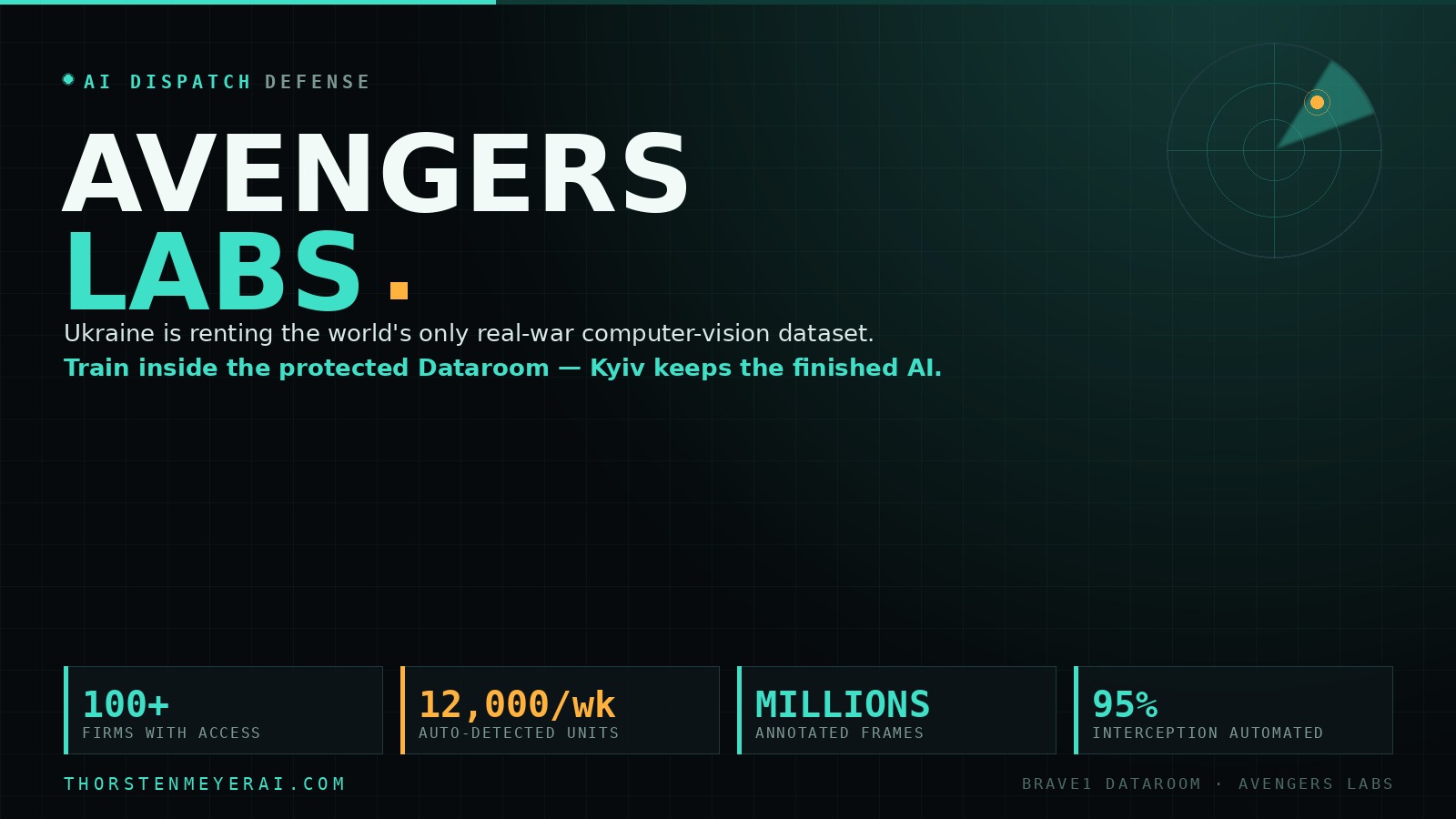
Ukraine’s Ministry of Defense is renting access to the world’s only large-scale, real-war computer-vision dataset. The terms: train your model inside the protected Dataroom — Ukraine keeps the finished AI.
Inside the Dataroom
- Structured visual & thermal imagery of aerial and ground targets
- Hard cases: camouflaged armor, night, fog, rain, multiple sensors
- Feeds the Avengers platform inside the DELTA / VEZHA system
- Focus track: automatic detection & interception of enemy drones
The goal
- 100% of frontline drones with onboard machine vision
- Autonomous navigation in GPS-denied / jammed (EW) skies
- Autonomous Shahed interception — human keeps the trigger
- Scaling vs. Shahed launches rising ~35% / month
The asset: a war's worth of labeled reality
Defense Minister Mykhailo Fedorov has been blunt about what Ukraine is sitting on. The country, he has said, holds a body of battlefield data unmatched anywhere in the world: millions of annotated frames gathered across tens of thousands of combat drone sorties. Thermal signatures. Camouflaged armor against tree lines. A Shahed crossing a night sky. The same target in fog, in rain, at dusk, seen through different sensors.
For a computer-vision model, that variety is the whole game. A detector trained on clean daytime imagery collapses the moment a tank hides in a forest or a launcher is dragged onto a muddy road. The Ukrainian corpus contains exactly those hard cases, already labeled, because someone's life depended on getting the label right.
That is the resource Fedorov — the former digital-transformation minister and architect of the "Army of Drones" who took over the defense ministry in January 2026 — is now treating as a sovereign export product rather than a byproduct of fighting.
AI training dataset storage solutions
As an affiliate, we earn on qualifying purchases.
As an affiliate, we earn on qualifying purchases.
How Avengers Labs works
The mechanics matter, because they are designed to share the data's value without surrendering the data itself.
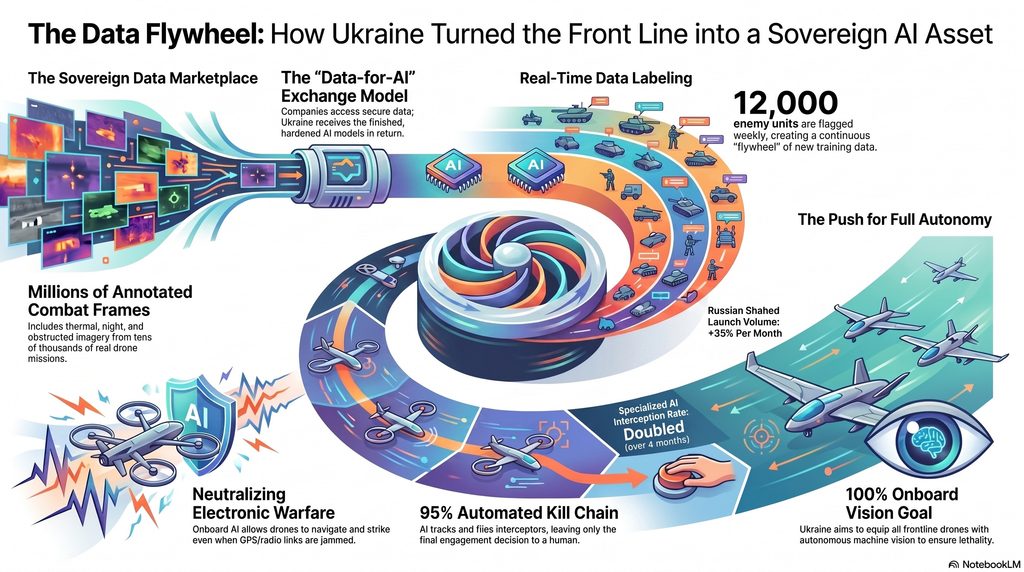
Companies do not walk away with raw combat footage. They work inside the Brave1 Dataroom, a secure environment that exposes structured, annotated datasets — visual and thermal imagery of aerial and ground targets recorded under real operational conditions — for training, validating, and fine-tuning models. The Dataroom was built jointly by the Ministry of Defense, the Ministry of Digital Transformation, the Armed Forces, the military-intelligence research institute, and the U.S. software firm Palantir.
More than 100 Ukrainian companies already have access, with international developers brought in through the Avengers Labs partnership layer. The arrangement is explicitly framed as "win-win": foreign firms get to harden their algorithms against the reality of modern combat, and Ukraine receives the resulting models back. Sensitive material stays inside the protected environment; what leaves is capability.
This is the part worth dwelling on. Ukraine has effectively built a two-sided market where the scarce commodity is verified combat data and the currency is finished AI. It is the defense-tech equivalent of a foundation-model lab licensing its data pipeline — except the pipeline is the front line.
As an affiliate, we earn on qualifying purchases.
Avengers, the platform doing the seeing
Sitting beneath the partnership program is the operational system it is named after. The core Avengers platform, developed by the Defense Ministry's Innovation Center, uses computer vision to automatically detect, classify, and track hostile targets in near real time by chewing through video from drones and fixed cameras.
By the ministry's own account, it flags on the order of 12,000 enemy units per week, and it already feeds the VEZHA streaming module inside DELTA, Ukraine's situational-awareness and battlefield-management system. The pitch is not that the machine pulls the trigger; it is that it removes the fatigue, latency, and missed detections that come from humans staring at thousands of hours of drone feeds.
Avengers is, in other words, both a weapon-adjacent tool and a data flywheel. Every detection it makes, confirmed or corrected by an operator, is another labeled example flowing back into the corpus that Avengers Labs then lets the world train on.
As an affiliate, we earn on qualifying purchases.
The real target: every drone, fully autonomous, in a jammed sky
The stated goal behind all of this is aggressive: equip 100% of Ukraine's frontline drones with onboard machine vision and AI. The reason is electronic warfare. Russia jams GPS and radio links relentlessly, and a drone that loses its link is a drone that misses. AI that can navigate by what it sees and lock onto a target without a live human connection is the only durable answer to jamming.
The most visible payoff so far is Shahed interception. Ukrainian interceptor drones are already autonomously tracking and destroying Russian Shahed attack drones. One system, from Brave1 participant MaXon Systems, plugs into the national radar network: an operator selects a target and authorizes the engagement, and the software flies the interceptor the rest of the way without manual piloting — roughly 95% of the kill chain automated, with the human retained at the moment of decision.
It is scaling against a hard clock. Fedorov has said Russian Shahed launches are climbing about 35% a month, even as the share knocked down by these specialized interceptors has doubled over four months. Related work includes AI-controlled turrets — already fielded by units like the K-2 Brigade — that can engage fiber-optic-guided drones immune to jamming. None of it works without the vision models, and the vision models do not improve without the data.
As an affiliate, we earn on qualifying purchases.
Data as the new defense-industrial base
Step back and the strategy snaps into focus. Ukraine is converting a wartime necessity into industrial infrastructure.
The Avengers Labs dataroom is one node in a deliberate build-out: BraveTech EU, a joint Ukraine–EU fund seeded with €50 million from each side; Brave Germany, signed with Berlin in May 2026 to co-develop unmanned systems, AI, and other tech; the Battle Proven international startup competition set for the Defense Tech Valley 2026 summit in Lviv in September; and "Test in Ukraine," which lets partners trial systems in live combat and collect feedback from soldiers. Allied firms — Palantir, Shield AI with its Hivemind autonomy stack, and others — are already inside the ecosystem.
Danylo Tsvok, who heads the defense ministry's AI center, frames the stakes in generational terms: AI, he argues, is forming a new paradigm of warfare, with systems linking into networks that compress the kill chain from planning to strike. The center counts hundreds of AI developments registered on Brave1 and dozens already in active battlefield use, from autonomous targeting to detecting camouflaged personnel to automated firing positions.
For Ukraine the logic is existential and economic at once. It cannot out-mass Russia, so it intends to out-iterate it — and to finance and entrench that advantage by becoming the place every Western defense-AI company has to come to make its models actually work.
What it means for the wider AI race
For people who build AI outside the defense world, three things are worth internalizing.
First, data provenance is becoming the moat. The Ukrainian corpus is valuable precisely because it cannot be replicated by anyone not fighting this war. As frontier models commoditize, proprietary, hard-to-collect, well-labeled data of exactly the right kind is what separates a system that works in the lab from one that works in the rain at 2 a.m. That principle generalizes far beyond targeting.
Second, the win-win licensing model is a template. Trading access to a unique dataset in exchange for the finished model — rather than selling the data or buying the software outright — is a structure other data-rich, capital-poor actors (hospitals, ports, utilities, governments) could copy. Ukraine has essentially shown how to monetize a dataset without ever letting it leave the room.
Third, the governance questions are now concrete, not hypothetical. These systems already automate most of an interception and keep a human only at the authorization step. As autonomy creeps further up the chain, the debates over meaningful human control, dual-use civilian computer vision, export rules, and who ultimately owns the models trained on a partner nation's combat data stop being academic. The technology is in the field; the rules are still being drafted around it.
The bottom line
Avengers Labs is not, at heart, a software story. It is a data story wearing software's clothes. Ukraine has recognized that in an AI-defined conflict, the front line produces something the rest of the world can't buy at any price — verified, labeled, adversarial reality — and it has built the marketplace, the security model, and the alliances to turn that into both a battlefield edge and a durable industry.
The drones get the headlines. The dataset is the weapon.
Reporting drawn from statements by Ukraine's Ministry of Defense and Defense Minister Mykhailo Fedorov, and coverage by Reuters, the Kyiv Post, the Kyiv Independent, Ukrinform, and UNITED24 Media (March–June 2026). Figures such as the ~12,000 weekly detections reflect Ministry of Defense reporting.
Fall Picks
fall essentials
As an affiliate, we earn on qualifying purchases.