
Introduction
In late‑2024 the normally collaborative WordPress ecosystem was rocked by a public dispute between Automattic (the for‑profit company behind WordPress.com and led by co‑founder Matt Mullenweg) and WP Engine, one of the largest managed WordPress hosting providers. The conflict centred on Automattic’s allegations that WP Engine misused the WordPress trademark and disabled core features to reduce costs, while WP Engine accused Automattic of extortion and abuse of power. The dispute escalated rapidly: Mullenweg publicly called WP Engine “a cancer to the system” and urged users to switch hoststorro.io; Automattic banned WP Engine‑hosted sites from accessing the WordPress plugin/theme repositorytorro.io; WP Engine sued Automattic alleging anticompetitive behaviour and false statementshosted.com; and Automattic counter‑sued for trademark infringement and deceptive brandingtechcrunch.com. A preliminary injunction in December 2024 restored WP Engine’s access to wordpress.org resources, but litigation continues and several claims (interference with contractual relations, unfair competition, Lanham Act false advertising, Computer Fraud and Abuse Act) will go to trialhosted.com.
Top picks for "market impact automattic"
Open Amazon search results for this keyword.
As an affiliate, we earn on qualifying purchases.
Legal context and timeline
- September 2024 – August 2025: escalations and lawsuits. After Mullenweg criticised WP Engine’s contribution levels and trademark usagetorro.io, WordPress.org banned sites hosted on WP Engine from requesting plugin updatestorro.io. WP Engine responded with a cease‑and‑desist letter and eventually filed an antitrust lawsuit accusing Automattic of abuse of market powerblog.pragmaticengineer.com. Automattic counter‑sued, alleging that WP Engine marketed itself as “The WordPress Technology Company” and used names like “Core WordPress” and “Headless WordPress” that infringed the WordPress marktechcrunch.com.
- December 2024: injunction. A U.S. federal judge granted WP Engine a preliminary injunction requiring Automattic to restore access to the wordpress.org API for plugin and theme updateshosted.com. WP Engine argued that the ban was endangering customer security and causing significant harm.
- October 2025: surviving claims. In September 2025 the court dismissed WP Engine’s antitrust and extortion claims but allowed most other counts—including intentional interference with contractual relations, defamation, false advertising and unfair competition under the Lanham Act—to proceedsearchenginejournal.com. Automattic’s counterclaim regarding trademark misuse also survivedtechcrunch.com. The protracted litigation means that final outcomes could still reshape how companies use the WordPress brand and access the wordpress.org platform.
Market impact on the CMS and hosting landscape
Disruption of WP Engine’s growth and reputation
WP Engine built its business on providing managed hosting for WordPress; prior to the dispute it enjoyed steady growth. Dataprovider.com, which tracks CMS adoption across the web, notes that Automattic demanded “8 % of WP Engine’s revenue” and publicly criticised the company for not contributing to WordPressdataprovider.com. In September 2024 WordPress.org blocked update requests from sites hosted on WP Engine, effectively preventing customers from retrieving plugin updates and causing operational and security issuesdataprovider.com. The article reports that after years of steady growth, WP Engine experienced a notable decline in growth following this episodedataprovider.com. Although access to updates was later restored, the reputational damage and uncertainty led many site owners to reevaluate their hosting provider.
Declining dominance of WordPress and rise of SaaS builders
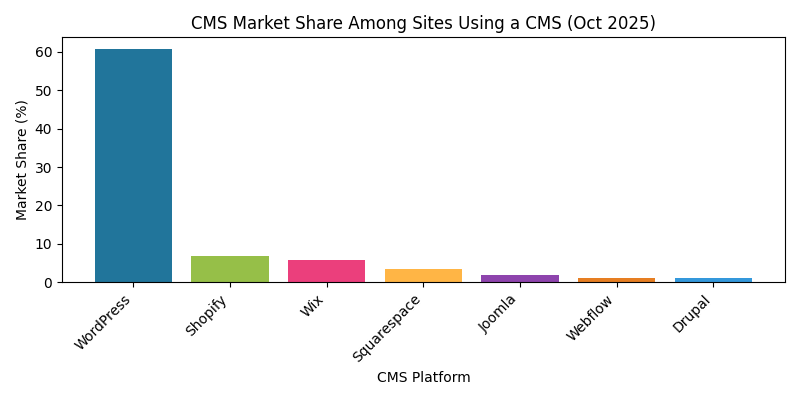
The wider CMS market has also shifted. According to Search Engine Journal’s October 2025 market‑share report, WordPress remains the dominant CMS, powering 43.3 % of all websites and holding a 60.7 % share among CMS‑powered sitessearchenginejournal.com. However this share has declined steadily from a peak of 65.2 % in 2022searchenginejournal.com. The report notes that SaaS website builders like Shopify, Wix and Squarespace are gaining traction, offering simpler, managed solutions with lower technical overheadsearchenginejournal.com. As of October 2025, Shopify has a 6.8 % CMS market share, Wix 5.7 %, Squarespace 3.4 %, and emerging competitors like Webflow and Drupal are below 1.5 %searchenginejournal.com. The shift suggests that a growing segment of businesses—especially small to mid‑sized firms—prefer platforms that combine hosting, updates and design tools in a single package.
The following bar chart visualizes the relative market share of the top CMS platforms (among sites that use a CMS) as of October 2025:
Changing perceptions of open‑source governance
The conflict has spotlighted governance issues in open‑source ecosystems. Dataprovider.com highlights that Automattic simultaneously leads the WordPress project and competes in the managed hosting market, prompting accusations of conflict of interest. WP Engine’s ban raised questions about whether WordPress.org is truly a neutral hub or an extension of Automattic’s commercial interestsdataprovider.com. Joost de Valk (creator of Yoast SEO) publicly called for leadership changes and warned that concentrating control in one individual risks stifling innovationdataprovider.com. Mullenweg responded by suggesting that dissatisfied developers could “create their own alternative” CMSdataprovider.com, underscoring the fragility of collaborative communities when trust erodes.
Vertical‑by‑vertical analysis
Managed WordPress hosting providers
Impact: Competing managed WordPress hosts—including Automattic’s own Pressable and WordPress.com, as well as independent providers like Kinsta, Bluehost, Hostinger, DreamHost and SiteGround—benefited from the uncertainty surrounding WP Engine. CmsMinds’ September 2025 guide to WP Engine alternatives notes that WordPress.com and Pressable offer full access to core updates and a seamless connection to the WordPress ecosystemcmsminds.com. Kinsta is praised for its Google‑Cloud‑based architecture, automatic updates and backupscmsminds.com; Bluehost, Hostinger and DreamHost are highlighted for affordability and automatic updatescmsminds.comcmsminds.com; and SiteGround is lauded for its strong security and daily backupscmsminds.com.
Competition shift: The conflict effectively served as free advertising for WP Engine’s competitors. Many site owners—particularly agencies and businesses with critical update needs—sought hosts that guarantee uninterrupted access to plugin and theme repositories. Pressable and WordPress.com, being under Automattic’s control, are positioned as “safe” choices for those who want to avoid future bans. High‑performance hosts like Kinsta and SiteGround differentiate themselves with robust infrastructure and security, while budget hosts attract cost‑conscious small businesses. WP Engine therefore faces intensified competition across all price tiers.
Small businesses and e‑commerce merchants
Impact: The ban forced WP Engine customers to manually update plugins and themestorro.io, a task that many small business owners are ill‑equipped to handle. Unchartified’s March 2025 article warns that without regular updates, websites face security vulnerabilities, degraded performance and broken functionalityunchartified.com. The piece encourages WP Engine customers to consider alternatives and lists visual/headless CMS options like Webflow, Framer, Contentful and Wix Studiounchartified.com. These platforms bundle hosting with visual design tools, reducing reliance on external plugins and eliminating update friction.
Competition shift: SaaS builders such as Shopify, Wix and Squarespace are gaining market share as they provide turnkey solutions for online stores and marketing websitessearchenginejournal.com. Shopify in particular benefits from strong core‑web‑vital performance and built‑in e‑commerce featuressearchenginejournal.com. For merchants who previously relied on WooCommerce on WP Engine, migrating to Shopify or Wix reduces complexity and ensures consistent updates. This shift could accelerate the trend toward integrated e‑commerce platforms and away from self‑hosted WordPress setups.
Digital agencies and web developers
Impact: Agencies building and maintaining client sites on WP Engine were suddenly forced to implement manual update workflows and manage security risks. Many agencies reassessed the resilience of their technology stack and began exploring headless architectures and alternative CMSs. The CMS market‑share decline of WordPress and the growth of Webflow and other no‑code builders suggest that agencies are diversifying their offeringssearchenginejournal.com. Dataprovider.com notes that the conflict has spurred discussion about creating a new, community‑driven CMS (nicknamed “JKPress”)dataprovider.com, reflecting a desire among developers for governance models that separate open‑source leadership from commercial interests.
Competition shift: Agencies previously aligned with WP Engine are now cultivating partnerships with multiple hosts. Providers like Kinsta and SiteGround are courting agencies with partner programmes, while headless CMS vendors (e.g., Contentful, Strapi, Sanity) and frameworks such as Next.js are gaining traction among developers who prefer decoupled front‑ends. WordPress theme and plugin shops may broaden their products to support multiple CMS ecosystems, reducing reliance on a single platform.
Enterprises and regulated industries
Impact: Large organisations rely on predictable update cycles and compliance guarantees. The WP Engine ban exposed how quickly open‑source governance decisions can disrupt enterprise sites. In Brightspot’s February 2025 analysis, the authors note that enterprises were left outdated and insecure during the ban, raising concerns about patch management and compliancebrightspot.com. Even though the injunction restored access, the incident prompted enterprise IT teams to reconsider open‑source dependencies.
Competition shift: Enterprises may favour closed or hybrid CMSs that offer contractual guarantees and vendor‑controlled update pipelines. Platforms like Brightspot, Adobe Experience Manager, Sitecore and Salesforce Experience Cloud promote their controlled architectures and security certifications. Headless CMS solutions with enterprise support may also gain traction. Within the WordPress ecosystem, WP Engine must reassure enterprise customers that it can maintain update access and legal stability; otherwise they may migrate to other hosts or CMSs.
Plugin and theme developers / broader WordPress ecosystem
Impact: Plugin and theme authors rely on wordpress.org to distribute updates and maintain user trust. The ban signalled that access to this distribution channel can be controlled by one party. Developers worry that similar bans could cut off their users, and some are exploring alternative distribution models (own update servers or cross‑platform plugins). The dispute has also raised questions about trademark usage and whether third‑party products can reference WordPress in their names, an issue central to Automattic’s counterclaimstechcrunch.com.
Competition shift: Some developers may invest in plugins for SaaS CMSs (Shopify apps, Wix modules) or headless frameworks to diversify revenue. The legal precedent set by this case could dictate how other CMS ecosystems enforce trademarks. If courts affirm Automattic’s right to restrict access, large platforms could exert more control over third‑party ecosystems, potentially stifling innovation. Conversely, a ruling favouring WP Engine might encourage greater independence and competition within open‑source platforms.
Conclusion
The Automattic–WP Engine dispute extends far beyond a legal tussle between two companies. It has exposed the fragile balance between open‑source ideals and commercial interests, triggered a decline in WP Engine’s growthdataprovider.com, and contributed to a broader re‑evaluation of WordPress’s dominancesearchenginejournal.com. Across verticals—from hosting providers and agencies to small businesses and enterprise clients—stakeholders are reassessing their reliance on a single platform. Competitors such as Shopify, Wix, Squarespace, Kinsta and SiteGround are capitalizing on the uncertainty by offering integrated, managed solutionssearchenginejournal.comcmsminds.com. The case may also influence how trademarks are enforced in open‑source ecosystems and whether new community‑driven CMS projects emergedataprovider.com. In the short term, WP Engine faces stiffer competition and must restore trust by demonstrating commitment to the WordPress community and diversifying its own platform beyond traditional WordPress hosting.