

Get business pricing on tech for your team
- Business-only prices and quantity discounts
- Tax-exempt purchasing
- Multiple users, one account, clear invoices
Introduction
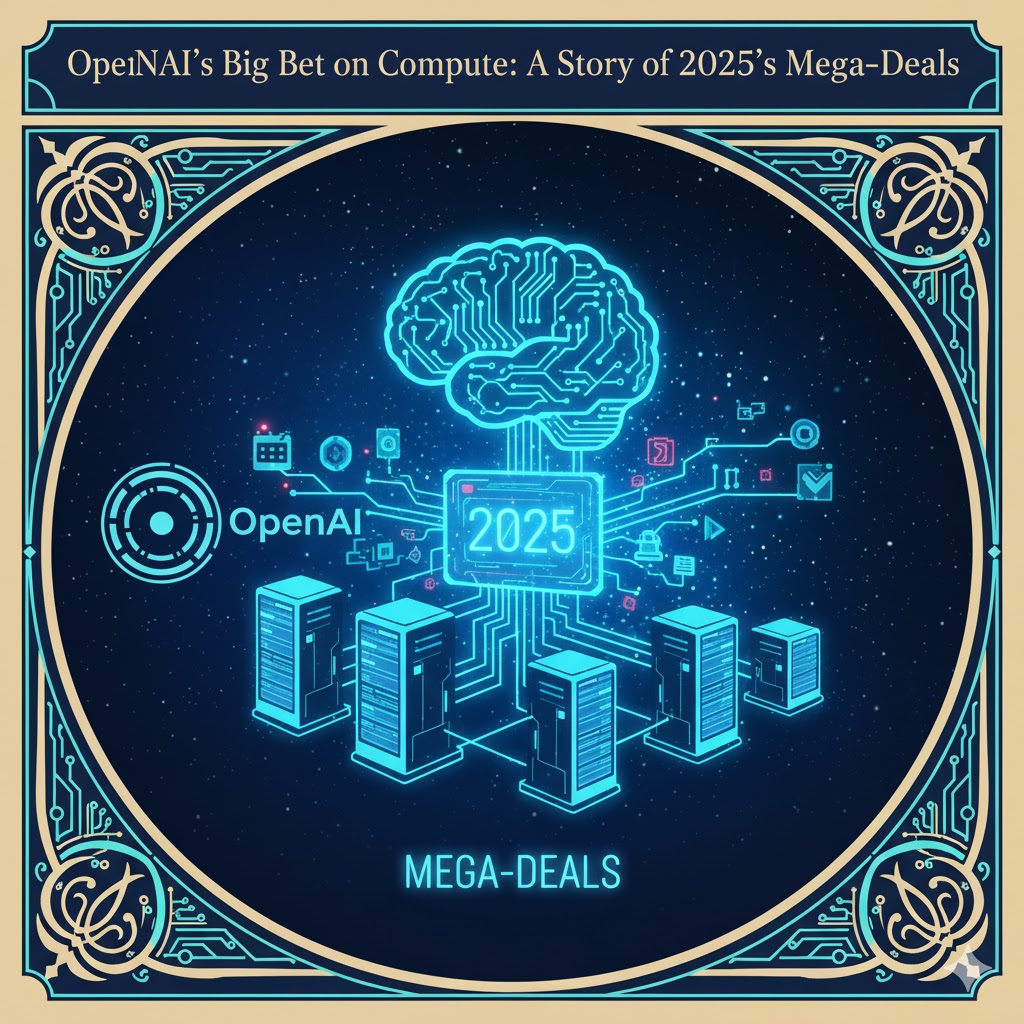
In 2025 generative‑AI went from buzzword to backbone of the global economy. ChatGPT became a household name and OpenAI’s models powered everything from code to videos to enterprise workflows. This explosion of demand triggered an unprecedented scramble for compute, forcing the San‑Francisco–based lab to remake itself and strike deals rarely seen in the technology sector. By the end of October OpenAI’s executives were talking about plans to build 30 GW of datacenter capacity – enough to power roughly 25 million U.S. homes – and estimated it would cost around $1.4 trillionreuters.com. The company’s public benefit corporation (PBC) restructuring allowed it to raise the capital needed and diversify cloud partnersreuters.com. This story traces the cascade of partnerships and infrastructure commitments that defined 2025 and examines why compute has become the “oil” of the AI age.
As an affiliate, we earn on qualifying purchases.
Breaking the Microsoft‑Exclusive Lock
Early moves: diversifying beyond Azure
Since 2019 OpenAI had been tethered to Microsoft’s Azure cloud and a complex revenue‑sharing agreement. As ChatGPT’s user base ballooned to 800 million weekly usersreuters.com, those constraints became untenable. Reuters reported in June that OpenAI quietly signed a deal to use Alphabet’s Google Cloud, marking the first time the ChatGPT maker turned to a direct competitor of Microsoftreuters.com. Sources said the arrangement, finalized in May, gave OpenAI access to Google’s tensor processing units (TPUs) and allowed it to diversify its compute sourcesreuters.com. An updated vendor list published on OpenAI’s website in July confirmed Google as a supplier alongside Microsoft, Oracle and CoreWeavereuters.com.
Google’s willingness to rent its in‑house chips to rivals was part of its strategy to turn Google Cloud into a growth engine. Executives told Reuters that the company shifted from a “loose” research culture to a revenue‑focused one; it opened new offices in cheaper regions and reallocated TPUs to Cloud customersreuters.com. By late 2025 analysts said the three leading cloud platforms – AWS, Azure and Google Cloud – were on “roughly equal footing”reuters.com. This competitive landscape set the stage for OpenAI’s most audacious deals.
The Microsoft–OpenAI restructure
On 28 October 2025 OpenAI and Microsoft announced a recapitalization that turned OpenAI’s for‑profit arm into OpenAI Group PBC, a public benefit corporation controlled by a nonprofit foundation. Reuters reported that the deal freed OpenAI from capital‑raising constraints and would likely pave the way for an eventual public listingreuters.com. Microsoft’s stake in the new entity was set at about 27%reuters.com, valued around $135 billionopenai.com. Importantly, Microsoft gave up its right of first refusal to provide compute, allowing OpenAI to buy cloud capacity from other providersopenai.com. In exchange, OpenAI committed to purchase an additional $250 billion of Azure servicesopenai.com, and Microsoft’s IP rights to certain OpenAI models and research were extended through 2032openai.com.
The restructuring announcement emphasised transparency and mission. Board chair Bret Taylor wrote that the nonprofit OpenAI Foundation now holds equity valued at roughly $130 billion, making it one of the most‑resourced philanthropic organisations everopenai.com. The foundation committed $25 billion to health and AI‑resilience initiativesopenai.com, reflecting OpenAI’s promise that its commercial success will fund public‑good projects.
As an affiliate, we earn on qualifying purchases.
The Compute Arms Race: Hardware & Cloud Deals
Nvidia’s $100 billion letter of intent (September 22, 2025)
The first big jolt came in September when Reuters revealed that Nvidia agreed to invest up to $100 billion in OpenAI and supply at least 10 GW of data‑center systemsreuters.com. The transaction involves two parts: Nvidia invests in OpenAI (for non‑voting shares) and then OpenAI uses that cash to purchase Nvidia’s hardwarereuters.com. This arrangement allows OpenAI to secure Nvidia’s next‑generation Vera Rubin platform, with the first 1 GW of compute scheduled for the second half of 2026reuters.com. OpenAI CEO Sam Altman declared that “compute infrastructure will be the basis for the economy of the future”reuters.com, signalling that hardware is now central to economic competitiveness. Analysts noted that the 10‑GW deployment would consume electricity equivalent to more than 8 million U.S. householdsreuters.com, underscoring the massive energy demands of AI training.
AMD’s 6‑GW GPU pact (October 6, 2025)
Just weeks later, AMD announced a multi‑year agreement to deliver 6 GW of Instinct GPUs to OpenAI. Reuters reported that AMD will supply “hundreds of thousands” of chips beginning in the second half of 2026, starting with a 1‑GW facility using the MI450 seriesreuters.com. The power draw—equivalent to the needs of about 5 million U.S. homesreuters.com—illustrates the scale of the order. The deal includes a warrant allowing OpenAI to purchase up to 160 million AMD shares (roughly 10% of the company) at $0.01 per share, vesting in tranches tied to chip shipments and AMD stock price milestonesreuters.com. AMD executives said they expect more than $100 billion in new revenue from OpenAI and other customers as a resultreuters.com. Commentators viewed the agreement as both a validation of AMD’s AI chips and a hedge by OpenAI to reduce reliance on Nvidiareuters.com.
Broadcom’s custom‑chip collaboration (October 13, 2025)
A week later, OpenAI signed an agreement with Broadcom to co‑develop custom AI accelerators and an Ethernet‑based scale‑out fabric. Reuters noted that OpenAI will design the chips, while Broadcom will develop and deploy 10 GW of custom systems starting in the second half of 2026, with completion targeted by 2029reuters.com. The 10‑GW build‑out requires electricity equivalent to more than 8 million U.S. homesreuters.com and will challenge Nvidia’s dominance by using Broadcom’s networking gear instead of InfiniBandreuters.com. Analysts cautioned that designing, scaling and manufacturing new chips is difficult, but the partnership reflects OpenAI’s desire to control its hardware stack and reduce costsreuters.com. Sam Altman called the collaboration “a critical step in building the infrastructure needed to unlock AI’s potential”reuters.com.
AWS’s $38 billion mega‑deal (November 3, 2025)
The year’s most eye‑popping contract arrived days after the Microsoft restructuring. Amazon Web Services (AWS) announced a seven‑year, $38 billion agreement to run OpenAI’s workloads on EC2 UltraServersaboutamazon.com. Reuters reported that the partnership gives OpenAI immediate access to hundreds of thousands of Nvidia GPUsreuters.com and will expand to tens of millions of CPUs to support agentic workloadsaboutamazon.com. All planned capacity is scheduled to come online by the end of 2026, with room to scale further in 2027aboutamazon.com. Altman said that “scaling frontier AI requires massive, reliable compute” and that AWS’s infrastructure would help “bring advanced AI to everyone”aboutamazon.com. The deal demonstrates AWS’s determination to be a leading AI infrastructure provider and signals OpenAI’s commitment to multi‑vendor cloud strategies.
Oracle, SoftBank and the Stargate data‑center program
To complement these chip deals, OpenAI pursued its own Stargate infrastructure initiative—an ambitious plan to build 10 GW of data‑center capacity through partnerships with Oracle, SoftBank and CoreWeave. In September OpenAI announced five new U.S. Stargate sites, bringing planned capacity to nearly 7 GW and investments to over $400 billionopenai.com. An October update identified one of the sites as a Wisconsin facility developed with Oracle and Vantageopenai.com. OpenAI said the combined Oracle agreement could exceed $300 billion over five years and deliver 4.5 GW of additional capacityopenai.com. On 30 October OpenAI announced a new Stargate campus in Saline Township, Michigan, which will push total planned capacity above 8 GWopenai.com. Construction will begin in 2026 and create more than 2,500 union construction jobsopenai.com. The project aims to re‑industrialize regions like Michigan by building AI infrastructureopenai.com.
As an affiliate, we earn on qualifying purchases.
The Retail Pivot: Turning ChatGPT into a Shopping Cart
Compute deals weren’t the only headline. On 14 October 2025 Walmart announced a partnership with OpenAI that enables customers and Sam’s Club members to buy products directly within ChatGPT using an “Instant Checkout” featurereuters.com. Shares of Walmart rose 5% after the announcementreuters.com. The retailer had already been experimenting with a generative‑AI assistant called Sparky to help customers with product suggestions and review summariesreuters.com. The ChatGPT integration aims to close the gap with Amazon’s AI‑powered shopping assistant, Rufus, by turning conversational queries into ordersreuters.com. Analysts noted that ChatGPT referrals accounted for about 15% of Walmart’s referral traffic in September, though they still represented less than 1% of overall web trafficreuters.com. Walmart’s corporate blog framed the partnership as part of a shift from reactive to proactive shopping, where AI can anticipate needs and personalize experiences.
As an affiliate, we earn on qualifying purchases.
Why These Deals Matter
Compute is the new strategic bottleneck
OpenAI’s 2025 deals highlight a seismic shift: the bottleneck for AI is no longer algorithms but scalable computing power. Building a gigawatt‑scale AI data center costs $50–60 billionreuters.com, and OpenAI’s plan to add 30 GW implies spending well over a trillion dollarsreuters.com. To secure supply, OpenAI is turning vendors into investors (Nvidia), taking equity stakes in chip suppliers (AMD), co‑designing hardware (Broadcom), and locking in massive cloud commitments (AWS, Azure, Oracle). Each deal reduces reliance on any single company and gives OpenAI leverage to negotiate better pricing and performance.
Multi‑vendor ecosystems and antitrust scrutiny
The diversification strategy also reshapes power dynamics among tech giants. By partnering simultaneously with Microsoft, Amazon, Google, Nvidia, AMD and Broadcom, OpenAI is catalyzing an ecosystem where suppliers compete for its business. Reuters noted that the Nvidia deal may attract antitrust scrutiny because it blurs the line between supplier and investorreuters.com. Similarly, the AMD warrant gives OpenAI potential influence over AMD’s strategyreuters.com. Regulators are already probing whether Microsoft and OpenAI have too much market power; the U.S. Justice Department and FTC agreed in 2024 to divide oversight of the companies and Nvidiareuters.com.
Financial engineering and risk
OpenAI’s deals rely on complex financing structures. The Nvidia agreement involves non‑voting shares; the AMD warrant’s value depends on future stock prices; the Broadcom and Stargate projects require tens of billions in financing before revenue materialises. Reuters’ Breakingviews column noted that Altman is committing to buy 16 GW of compute across Nvidia and AMD, which at $50 billion per gigawatt could cost around $800 billionreuters.com. While OpenAI’s annualized revenue run rate was projected to reach about $20 billion by year‑endreuters.com, the company is still loss‑making and will need external capital to fund its obligationsreuters.com. Its conversion to a PBC and eventual IPO are thus not optional but necessary steps to sustain the spending spreereuters.com.
Impact on the AI ecosystem
OpenAI’s deals reverberate across the industry. AMD’s stock surged over 34% on the day of the announcementreuters.com, adding roughly $80 billion to its market value; Broadcom’s shares jumped about 10%reuters.com. AWS’s contract signalled that Amazon remains a formidable AI player despite earlier perceptions of lagging behind. The Stargate program promises tens of thousands of jobs and a revival of manufacturing in America’s heartlandopenai.comopenai.com. At the consumer level, the Walmart partnership demonstrates how generative AI is shifting commerce from search‑based browsing to agentic, conversational experiences. In the long term these moves may accelerate the adoption of AI across sectors—from healthcare and education to logistics and entertainment—by making compute and advanced models more accessible.
Conclusion
The story of OpenAI in 2025 is one of infrastructure ambition. Confronted with surging demand and the physical limits of existing data centers, the company embarked on a global campaign to secure chips, build power‑hungry campuses and remake its corporate structure. Partnerships with Nvidia, AMD, Broadcom, AWS, Microsoft, Google, Oracle, SoftBank and even Walmart reflect an understanding that no single player can provide the scale required for next‑generation AI. As Sam Altman put it, “compute infrastructure will be the basis for the economy of the future”reuters.com. Whether the investments pay off—and whether regulators allow these alliances to persist—remains to be seen. What is clear is that in the race to build artificial general intelligence, gigawatts of compute have become the currency, and 2025 was the year OpenAI staked its claim.
Fall Picks
fall essentials
As an affiliate, we earn on qualifying purchases.