
By Thorsten Meyer — May 2026

Get business pricing on tech for your team
- Business-only prices and quantity discounts
- Tax-exempt purchasing
- Multiple users, one account, clear invoices
On May 25, the fan editor Kaylor releases Rogue One: The Andor Cut — a remix of the 2016 Gareth Edwards / Tony Gilroy film, re-presented as if it were the finale of the Andor television series, made afterward rather than before. 4K. 5.1 surround. Available, like all such projects, through the half-clandestine channel-and-Drive distribution model that fan edits have lived in for the better part of two decades.
The premise is structurally interesting in a way most fan edits aren’t. Andor (2022-2025, two seasons of twelve episodes each) is a prequel to Rogue One in narrative terms but a sequel in production terms — the show was conceived, written, scored, and shot after the film, by some of the same hands, and arrived at a distinctly different aesthetic. Slower. More political. Theatrically dialogued. Fascism rendered through its bureaucratic infrastructure rather than its uniforms. Resistance rendered through its costs to the people who try it. No Jedi. No Force. No mysticism. Nicholas Britell’s score works against the John Williams tradition rather than within it, and the show’s two seasons accumulate into something that — when Cassian Andor finally walks into the Rogue One scenario in the show’s final moments — implicitly recontextualizes everything that follows.
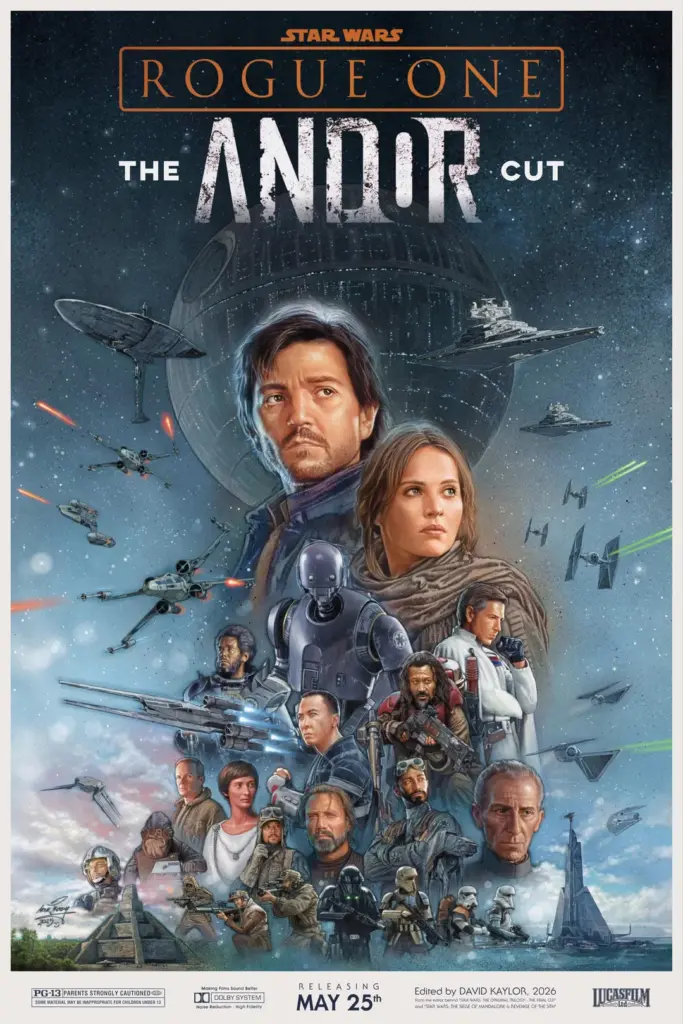
What Kaylor’s edit asks is a question that’s been latent in the Andor / Rogue One relationship since the show ended: what would Rogue One look like if it had been made after Andor, in Andor’s voice, by people who had seen what the show accomplished? Not a different movie — the same footage, the same actors, the same plot beats. A re-cut, re-scored, lightly augmented version that pulls the existing material toward the tonal register the prequel established.
I think this is a serious question. I also think the honest answer is that the edit cannot fully deliver on it, and that the editor knows this, and that this is fine.
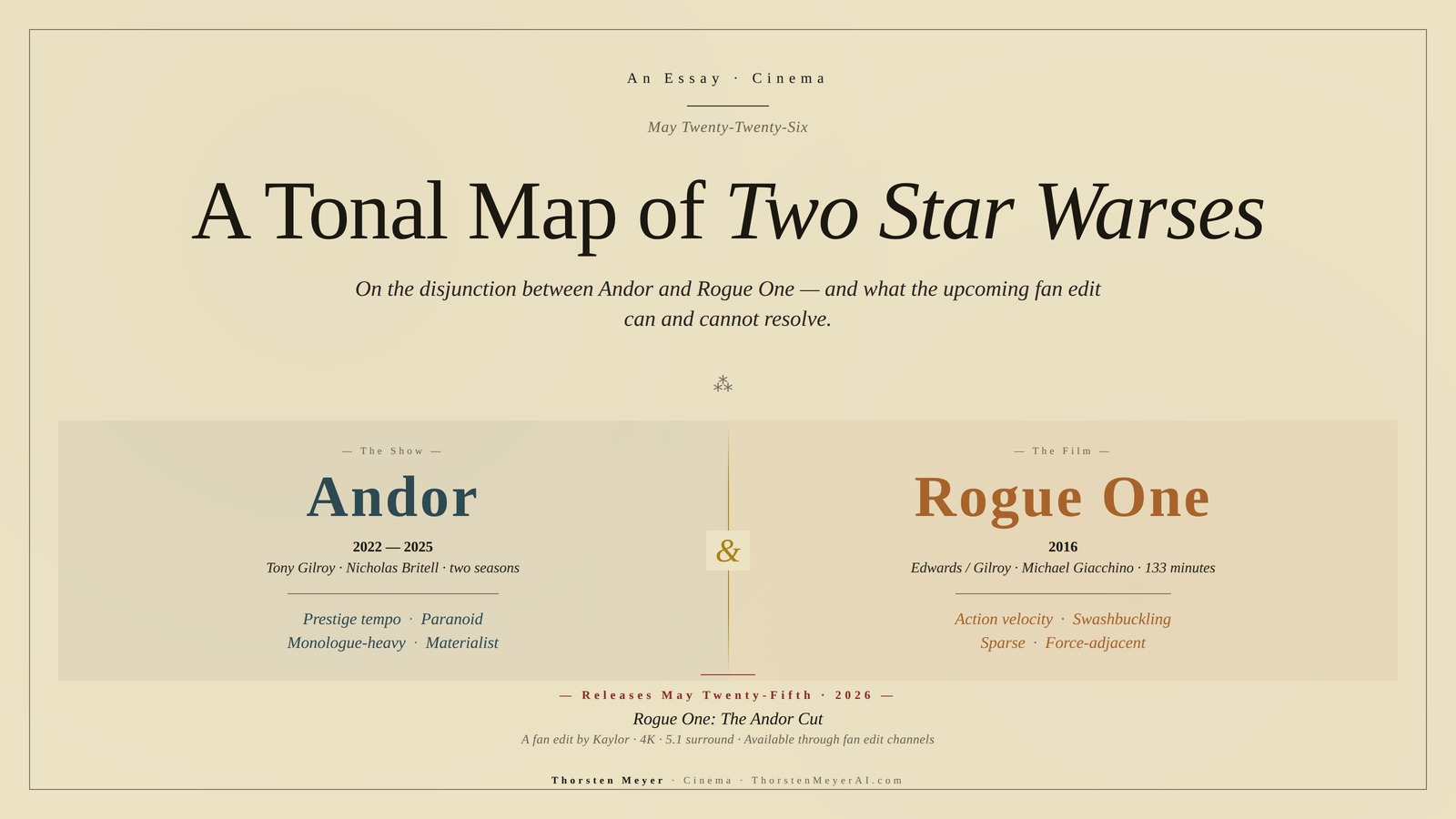
A Tonal Map of Two Star Warses
On the disjunction between Andor and Rogue One — and what the upcoming fan edit can and cannot resolve.
Andor and Rogue One occupy a peculiar place in the Star Wars catalogue. The film was released in 2016; the show concluded in 2025. The film is a prequel to A New Hope in narrative terms; the show is a prequel to the film. But Andor was made after Rogue One, and arrived at a distinctly different aesthetic — slower, more political, theatrically dialogued, scored against rather than within the John Williams tradition. When Cassian Andor finally walks into the Rogue One scenario in the show’s final moments, the two works sit together in visible tonal disagreement. This is a map of where they disagree.
The same galaxy. Two languages.
A reading of how the show and the film differ on the dimensions that the upcoming Andor Cut will most attempt to reconcile.
i · Pacing
Twenty-four episodes accumulating across two seasons. Whole hours given to a funeral, a heist, a prison escape, a senate vote. Accretion as structural principle.
133 minutes carrying setup, mission, and battle. Three-act structure in classical proportion. Forward motion as structural principle.
ii · Score
Strings, percussion, dissonance. The Williams orchestral grammar deliberately set aside. Music as political mood rather than emotional cue.
Brass, motifs, quotation. Williams’s grammar honored, occasionally evoked. Composed in four weeks after the original Desplat score was abandoned.
iii · Mood
The texture of authoritarianism rendered through dread. Surveillance as ambient atmosphere. Dialogue scenes that shimmer with unspoken threat.
The texture of war rendered through adventure. Action as ambient atmosphere. Set pieces that sustain emotional weight by accumulation.
iv · Politics
Fascism through paperwork. Resistance through years of small choices. Luthen’s network. The ISB as bureaucratic machine. Politics rendered procedurally.
The Empire through visible force. Resistance through one decisive act. Mon Mothma’s chamber. Saw’s cell. Politics rendered ceremonially.
v · Force & Mysticism
No Jedi. No Force. No destiny. The galaxy operates on human stakes and human costs. Materialism as theological commitment.
Chirrut Îmwe’s faith. The Whills. The Kyber crystal mythos kept at the periphery but present. Mysticism as available but lightly held.
vi · Violence
Bix’s torture. Narkina 5’s prison labor. Ghorman’s massacre. Surveillance, interrogation, summary execution rendered with their administrative machinery on screen.
Scarif beach assault. Vader’s hallway. Action-movie casualties at scale. Violence rendered as tactical event rather than systemic condition.
vii · Dialogue
Luthen’s “I burn my decency” speech. Maarva’s funeral oration. Karis Nemik’s manifesto. Words as substance. Cassian’s lines often the least interesting in the room.
Lines as gear-changes between action sequences. “Rebellions are built on hope.” “I am one with the Force.” Words as cue. Function preferred to figure.
viii · Cost of Resistance
Bix. Maarva. Brasso. Cinta. Nemik. Costs measured over years, paid in pieces. The cost is the texture of the show itself.
Every member of the team dies for one objective. Costs measured in the final act, paid in a single sequence. The cost is the climax.
Kaylor’s Andor Cut can re-tone what is already on screen. It cannot change pacing without footage that does not exist. What it can foreground is the version of Rogue One that was always reaching toward Andor — and was never quite allowed to arrive.
I burn my decency for someone else’s future. Like sunlight through dust.
The Andor Cut releases May 25, 2026. Available in 4K with 5.1 surround through fan edit channels.
The film is still the film. The question is whether, with Britell’s themes underneath and the show’s accumulated weight beneath every Cassian close-up, it finally sounds like the show that grew out of it.
4K surround sound home theater system
As an affiliate, we earn on qualifying purchases.
As an affiliate, we earn on qualifying purchases.
The relationship between the two works is genuinely unusual
Most prequels are written to fit their existing sequels — they’re constrained by what’s already been shown. Andor had this constraint formally but ignored it tonally. The show is plainly its own thing. The Rogue One that Cassian eventually walks into is a different kind of object than the Aldhani heist or the Ferrix funeral or the Narkina 5 prison sequences — faster, more conventional, more concerned with action set pieces, more in the swashbuckling Star Wars tradition. When the show concluded, this tonal disjunction sat there, visible. The film hadn’t moved. The show had moved away from it.
This is partly an artifact of how Rogue One actually got made. Gareth Edwards’s original cut was reportedly more meditative, more morally ambiguous, more willing to sit in discomfort. Tony Gilroy came in for substantial reshoots in 2016 and pushed the film toward the more conventional Star Wars register that ended up in theaters. Andor, also Gilroy’s project, then spent two seasons exploring exactly the meditative-and-morally-ambiguous register that the Rogue One reshoots had moved away from. There’s an interpretation of the Andor / Rogue One pairing where Gilroy has been arguing with his own reshoots for nine years, and Andor is the longer, fuller, more uncompromised version of the case the original Edwards cut might have made.
Kaylor’s edit cannot put the Edwards footage back — it doesn’t exist outside of Lucasfilm’s archives. But it can approximate the recovery of that lost register through tonal re-engineering. Britell’s themes replacing or sitting alongside Giacchino’s. Slower edits where the original cut hurried. Continuity errors removed. Flashbacks inserted to bridge the show’s emotional weight into the film’s plot. The point is not to make a different movie. The point is to make the existing movie sit in conversation with the show that retroactively became its prequel.
As an affiliate, we earn on qualifying purchases.
What the edit actually does
The mechanical changes Kaylor describes are modest in scope and considered in selection. Andor’s musical themes and leitmotifs — particularly Britell’s central melodies — replace or supplement Giacchino’s score in scenes where the show’s emotional vocabulary is more appropriate. A handful of continuity errors are removed; small ones, the kind that watching the film and the show in order makes visible. Flashbacks are inserted at points where Cassian’s history with the show’s events would deepen the film’s stakes.
The most ambitious element is the deepfake replacement of Grand Moff Tarkin and Princess Leia. The 2016 CGI work on these characters was technically impressive at the time and immediately dated. Tarkin sat at the bottom of the uncanny valley with visible plastic-skin artifacts; Leia’s brief appearance was somehow worse, the kind of moment that pulled you out of the film entirely. Both have since been re-rendered by hobbyist deepfake artists working on consumer hardware with open-source tools, and the results — at least the better examples — are widely considered to have surpassed the studio’s original 2016 work. There’s something quietly deflating about that as a fact about the state of generative video, but it’s the fact, and the edit incorporating those fan renders is incorporating what is genuinely the better version of those scenes.
The flashbacks are the choice I’m most curious about. Andor accumulates an enormous amount of context for who Cassian is and what he’s lost — Maarva’s funeral on Ferrix, the prison on Narkina 5, the relationship with Bix that the show lets play out across two seasons of intermittent loss, the politics of the rebellion that takes years to coalesce. Cutting any of that into Rogue One risks two failure modes: either the flashbacks slow the film’s pacing in ways the action structure can’t sustain, or they feel like fan-service callouts that don’t earn their inclusion. The right flashbacks, placed well, could deepen Cassian’s death scene materially — the show’s accumulated weight bearing on his final moments — but the wrong ones would just feel like editing for the sake of editing. Without seeing the cut, I can’t say which way Kaylor has gone.
As an affiliate, we earn on qualifying purchases.
What the edit cannot do
The structural truth is that Rogue One is fundamentally a different kind of object from Andor, and no amount of re-scoring or editing changes that. The film moves at a Star Wars action movie’s pace because that’s what it was constructed to be — the third act is a sustained battle sequence, the second act is a planetary-hopping spy thriller, the first act establishes characters quickly because there are a lot of them and limited runtime to give each one. Andor moves at the pace of a prestige drama because the show had ten hours per season to fill and chose to use that time on character work, political development, and atmospheric world-building.
You cannot retrofit Andor’s pace onto Rogue One without either cutting the action sequences (which would gut the movie) or extending the dialogue scenes (which would require footage Kaylor doesn’t have). The edit can re-tone the existing material. It cannot reconstruct the movie’s underlying rhythm.
What it can do — and this is, I think, what the project actually delivers when it works — is foreground the elements of Rogue One that were always Andor-shaped, that were always operating on Andor’s wavelength, that have been there since 2016 but were partially obscured by the film’s own action-movie register. The opening scene where Cassian shoots his informant rather than risk capture. The Saw Gerrera material. The cost of the rebellion as it sits with Galen Erso’s recorded confession. The final beach sequence, where Cassian and Jyn hold each other as the Death Star fires. These were always the most Andor-like moments in the film. Re-scored, lightly re-cut, sitting in tonal context that takes them seriously, they should feel less dissonant. The film won’t transform. The film will become legibly the same film it always was, with the parts of it that were aspiring toward Andor’s register more clearly visible.
That’s the realistic ambition. It’s a real ambition. It’s not nothing.
As an affiliate, we earn on qualifying purchases.
The Rogue One Arc, by way of comparison
Kaylor’s edit is not the only fan project working this seam. The earlier Andor: The Rogue One Arc, released through fanedit.org, takes a different approach — restructuring the film into three episodes in the style of an Andor season, with chapter breaks, cliffhangers, and pacing recalibrated to TV-episode rhythms rather than feature-film rhythms. That edit also leans heavily on Andor’s soundtrack, but its primary intervention is structural: making the film into the format the show used, on the theory that the format is part of why the show worked.
The two projects are after different things. The Rogue One Arc says: maybe the film should have been a TV arc. The Andor Cut says: maybe the film should have been the same film, but made by people who knew what Andor would become. Both are reasonable hypotheses. Neither can be definitively proven through fan edit because neither approach can give us the version of the movie that didn’t get made.
I’ve watched The Rogue One Arc and I’ll watch The Andor Cut. The thing I’m curious about is which of them ends up feeling more like a complete object — which of them survives the disjunction between the source film and the aspirational tone the edit is reaching for. My instinct is that the structural edit (Rogue One Arc) might cohere better as an artifact, while the tonal edit (Andor Cut) might be more emotionally interesting on a single watch. But I want to compare them.
The fan edit as a form
The fan edit is one of the more underrated forms of film criticism. The standard mode of film criticism is verbal — you write about a film, you describe what works and what doesn’t, you make a case. The fan edit is criticism as alteration. The editor is making the same case a critic would make (“this scene should have been cut,” “this score is wrong for this material,” “this character arc would have been stronger without these moments”) but rendering the case in the medium of the film itself. The argument is the new edit. You watch it and the case has been made to you in the language of the source.
The form has limitations — fan edits can’t generate new footage, can’t access deleted scenes that haven’t been released, can’t usually reach the technical quality of studio releases — but it has access to a kind of demonstration that prose criticism doesn’t. A critic can write that a film’s pacing is wrong; an editor can show you the same film with the pacing fixed.
What’s interesting about the Andor Cut as a critical statement is that it’s making a case about a relationship between two works rather than about a single work in isolation. The argument isn’t “Rogue One should have been edited differently.” The argument is “Rogue One and Andor exist in tonal disagreement, and that disagreement is partially a historical accident, and we can demonstrate what their tonal agreement might have looked like.” That’s a more sophisticated thesis than most fan edits attempt.
Whether the demonstration succeeds — whether the experience of watching Kaylor’s edit produces the recognition the thesis is reaching for — is what I’ll be looking for on May 25. If it works, the experience will be one of seeing Rogue One as the show’s natural conclusion rather than as the film the show grew out of. If it doesn’t work, the experience will be of two strong artistic visions sitting next to each other without resolving.
A note on the rewatch
The best argument for any of these edits is that they make you want to rewatch the show. I’ve been seriously considering another rewatch of Andor anyway — the second season’s Ghorman material has stayed with me, and the Luthen Rael speech (“I burn my decency for someone else’s future, like sunlight through dust”) sits at the front of my mind whenever I think about what political art is actually for in 2026. The Andor Cut releasing alongside that consideration feels timed — not by Kaylor, but by the way these projects accumulate around works that have lasting force.
Kaylor’s previous edits include cuts of all three original trilogy films, Star Wars: Episode III – The Siege of Mandalore & Revenge of the Sith (a hybrid of the third prequel and the seventh season of Clone Wars), and Star Trek: Picard: The Last Generation (a recut of Picard’s third season). The Picard project is the closest precedent — taking a season of television and reworking it as a feature-length cinematic statement. The Andor Cut is doing the inverse: taking a feature-length film and reworking it as a television finale. Different direction, similar instinct: that the right format for a story isn’t always the format the story originally got.
For now, the announcement is the announcement. May 25, 4K, 5.1 surround. If you have suggestions for additions or cuts to the edit, the editor is taking them. I’ll be watching and writing about it after.
May the Force be with you, and may your fan edits cohere.
About the Author
Thorsten Meyer is a Munich-based futurist, post-labor economist, and recipient of OpenAI’s 10 Billion Token Award. He spent two decades managing €1B+ portfolios in enterprise ICT before deciding that writing about the transition was more useful than managing quarterly slides through it. His Cinema Obscura series covers obscure and cult cinema. More at ThorstenMeyerAI.com.
Fall Picks
fall essentials
As an affiliate, we earn on qualifying purchases.