
By Thorsten Meyer — May 2026
DocuSign is a $9 billion company.
Their entire business is putting names on PDFs.
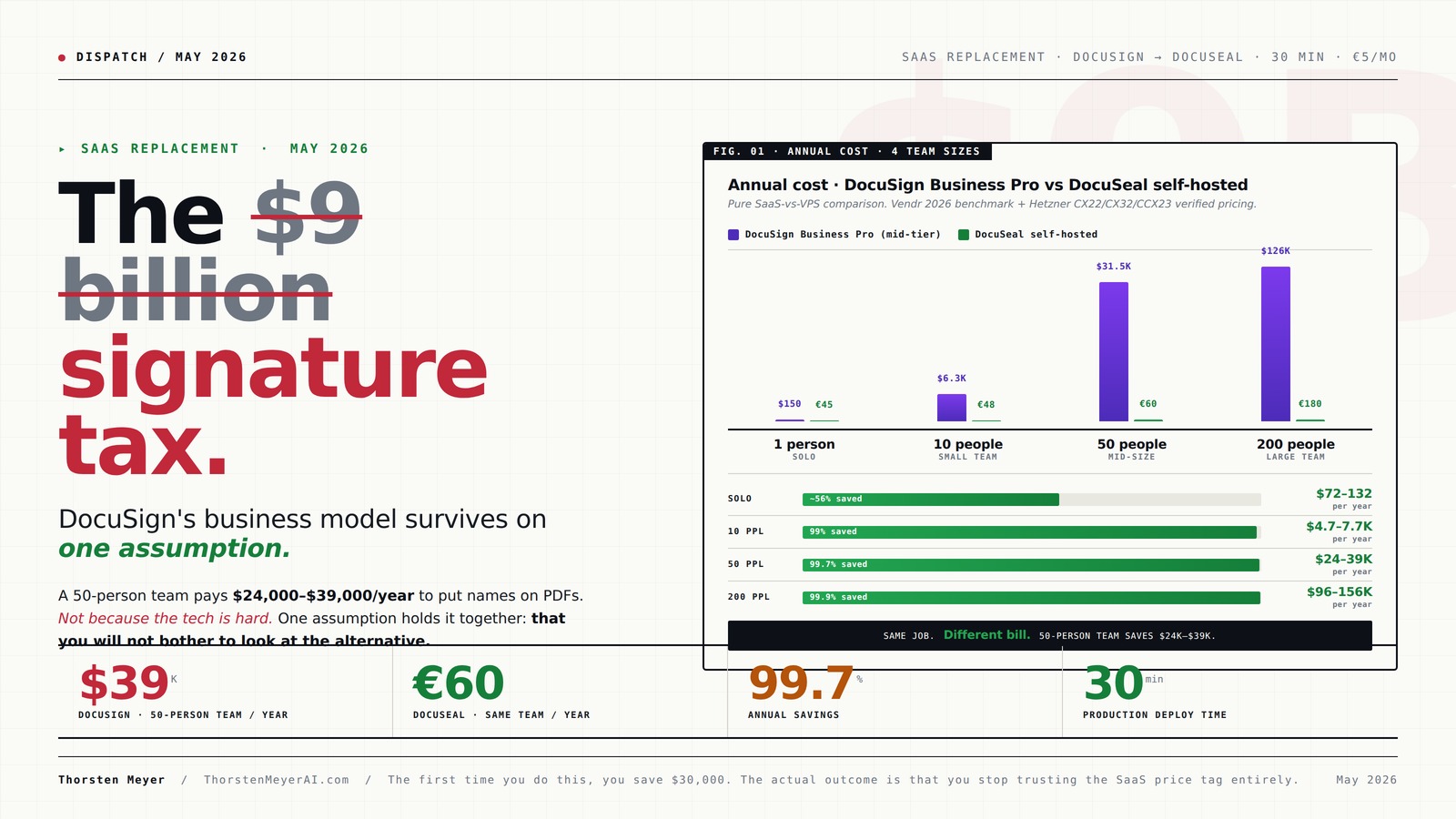
And they charge a 50-person team between $24,000 and $39,000 a year to do it.
This is not a company built on a hard technical problem. The cryptographic signature math has been solved for thirty years. The PDF spec is open. The legal frameworks (ESIGN in 2000, UETA across 49 states, eIDAS in 2014) are a quarter-century old. There is no moat. There is no proprietary technology. There is no network effect that holds it together.
There is one assumption that holds it together: that you will not bother to look at the alternative.
This dispatch is about the alternative — DocuSeal, open source, AGPL-3.0, deployed on a $5 VPS in 30 minutes — and what it tells you about the rest of your SaaS stack. Because DocuSign is not the only $9 billion company built on this assumption.
The $9 billion signature tax.
DocuSign’s business model survives on one assumption.
A 50-person team pays $24,000 to $39,000 per year to put names on PDFs. Not because the tech is hard. The cryptographic signature math has been solved for thirty years. The legal frameworks are a quarter-century old. There is no moat. There is one assumption holding it together: that you will not bother to look at the alternative.
You are rationing digital signatures in 2026.
Stop and look at that sentence again. You are rationing — keeping a count, watching the meter, deciding whether this contract is worth using one of your remaining envelopes — a function whose actual cost to perform is somewhere between zero and one cent per signature. You are doing this in 2026, on a function that has been a commodity since 1999.
![DeskFX Free Audio Effects & Audio Enhancer Software [PC Download]](https://m.media-amazon.com/images/I/41fXbDohyuS._SL500_.jpg)
DeskFX Free Audio Effects & Audio Enhancer Software [PC Download]
- Audio Transformation: Enhance sound from speakers and headphones
- Sound Quality Improvement: Adjust audio with various effects
- Audio Control: Manage sound through hardware settings
As an affiliate, we earn on qualifying purchases.
As an affiliate, we earn on qualifying purchases.
Same job. Different bill. Four team sizes.
Pure SaaS-vs-VPS comparison. As your team grows, the absolute savings grow linearly while relative savings asymptote at ~99.9%. The DocuSign business model assumes per-seat pricing on a function that has no per-seat marginal cost.
As an affiliate, we earn on qualifying purchases.
Five commands. Production-grade signature platform.
PostgreSQL 18 + DocuSeal app + Caddy reverse proxy with automatic Let’s Encrypt SSL. Verified against the official docusealco/docuseal repository at v2.2.9. 28 minutes if everything goes smoothly; 45 if DNS is slow.
Production deploy · $5/month VPS → live signature platform.
ssh root@IP
5 min
sign.you.com → IP · Cloudflare proxy OFF
5 min
curl -fsSL get.docker.com | sh · entire install
3 min
docker-compose.yml · set .env · docker compose up -d
10 min

LCD Electronic Signature Pad USB Digital Signature Tablet Handwriting Capture Sign Pad Support PDF Word Excel WPS Secondary Development Kit for Office Finance Hospital Government OA System Windows
- Display Shows Signature: Signature visible on tablet and computer
- Battery-Free Stylus: No charging needed for smooth drawing
- Versatile E-Signature Tool: Compatible with Office, Zoom, and more
As an affiliate, we earn on qualifying purchases.
As an affiliate, we earn on qualifying purchases.
DocuSign is not the only $9B company built on this assumption.
Same dynamic. Per-seat pricing on a function with near-zero marginal cost. Open-source alternative is mature, properly licensed, and runs on a $5 VPS. A typical 50-person company running 5–8 of these is paying $40K–$120K/year that’s structurally replaceable.
The first time you do this, you save $30,000. The savings are the surface. The actual outcome is that you stop trusting the SaaS price tag entirely.
How to Replace DocuSign in 30 Minutes for $5 a Month
The complete DocuSeal self-host guide for 2026. Every command tested. Every cost verified. Every workflow ready to run today.
- 30-min deploy walkthrough · v2.2.9
- 4 hosting options ranked by cost
- Production docker-compose.yml
- 13 field types · DocuSign mapping
- API patterns · CRM, billing, contracts
- Cost comparison · 1, 10, 50, 200 sizes
- Compliance · ESIGN, eIDAS, GDPR, HIPAA
- The 12-category replacement framework
- 5 questions before any SaaS swap
- Honest maintenance accounting
Docker-based document signing software
As an affiliate, we earn on qualifying purchases.
As an affiliate, we earn on qualifying purchases.
What you’re actually paying for
Let me read out the price card.
Personal: $10–$15 per month. 5 envelopes/month cap.
Standard: $25–$45 per user per month. 100 envelopes/year per user.
Business Pro: $40–$65 per user per month. 100 envelopes/year per user.
A 10-person team on Business Pro: $4,800–$7,800 per year.
A 50-person team: $24,000–$39,000 per year.
A 200-person team: $96,000–$156,000 per year.
Then the add-ons most people only see at renewal: $0.40 per SMS delivery. $2.50 per ID verification. $4.80 per envelope above the cap. $5,000–$50,000 a year for premium support. Vendr’s 2026 benchmark puts the median DocuSign contract at $17,250/year.
You are rationing digital signatures in 2026. To put names on PDFs.
Stop and look at that sentence again. You are rationing — keeping a count, watching the meter, deciding whether this contract is worth using one of your remaining envelopes — a function whose actual cost to perform is somewhere between zero and one cent per signature. You are doing this in 2026, on a function that has been a commodity since 1999.
The whole industry is built on the assumption that you will not realize there is a free alternative that ships in 30 minutes.
Executive summary · the math
| Team size | DocuSign Business Pro | DocuSeal self-hosted | Annual savings |
|---|---|---|---|
| 1 person | $120–$180/yr | €45 ($48) | $72–$132 (40–73%) |
| 10 people | $4,800–$7,800/yr | €48/yr | $4,752–$7,752 (99%) |
| 50 people | $24,000–$39,000/yr | €60/yr | $23,937–$38,937 (99.7%) |
| 200 people | $96,000–$156,000/yr | €180/yr | $95,808–$155,808 (99.9%) |
Median DocuSign contract per Vendr 2026 benchmark: $17,250. Self-hosted DocuSeal cost on Hetzner CX22: €45/year.
The alternative
It’s called DocuSeal. Open source, AGPL-3.0, built in 2023 by a Ruby developer who got quoted too much to sign one document and shipped a working alternative in three weeks.
Today: 11,800+ GitHub stars. 1,000+ forks. 50+ commits a month. Maintainers respond to most issues within 24 hours. Funded by a healthy commercial Cloud + Pro tier that subsidizes the open source development. This is the pattern of a sustainable open source project, not a side project.
What it does:
- 12 field types (Signature, Initials, Date, Text, Number, Checkbox, Multiple Choice, Select, File, Image, Stamp, Cells)
- WYSIWYG PDF form builder with drag-and-drop field positioning
- Multiple signers per document with order control
- Automated email and SMS delivery
- Bulk send with CSV/XLSX import
- API and webhooks for CRM/billing/contract management integration
- Conditional fields and formulas
- Mobile-optimized signing
- 14 signing languages
- Full audit log per document
- White-label / company branding
- Files stored on disk, S3, GCS, or Azure Blob
- SAML SSO (Pro tier)
What’s compliant:
- ESIGN Act — every requirement met by design
- UETA — same
- eIDAS — Simple Electronic Signature out of the box; Advanced Electronic Signature with SMS/ID verification; Qualified Electronic Signature via Trust Service Provider integration (same way DocuSign does it)
- GDPR — data residency under your control when self-hosted; you’re the data controller
- HIPAA — eligible deployment in HIPAA-compliant infrastructure (your AWS/Azure/GCP healthcare account, BAA with the cloud provider)
What’s missing compared to DocuSign:
- Federal government contracts that name DocuSign by name. Don’t fight that battle.
- A few EU member states’ notarial deed processes where DocuSign’s QES integration is more turnkey.
- Counterparty insistence — if your customer demands DocuSign, eat the $25/month for one Personal seat.
For everything else — and that’s the vast majority of business documents — DocuSeal is functionally equivalent.
The 30-minute deployment
The full step-by-step is in the paid guide. The compressed version: five steps, 28 minutes if everything goes smoothly.
Step 1 — Provision a VPS (5 min). Hetzner CX22 (€3.79/month), DigitalOcean droplet ($6/month), or your existing infrastructure. Ubuntu 24.04. SSH in.
Step 2 — Point your domain at the server (5 min). A record from sign.yourcompany.com to your IP. Cloudflare proxy off (gray cloud) so Caddy can handle SSL itself.
Step 3 — Install Docker (3 min). curl -fsSL https://get.docker.com | sh. Done.
Step 4 — Deploy DocuSeal (10 min). Drop the official docker-compose.yml (PostgreSQL 18 + DocuSeal app + Caddy reverse proxy with automatic Let’s Encrypt SSL) into /opt/docuseal/, set your .env with the domain and a secure database password, run docker compose up -d. First image pull is ~800 MB. Watch the logs until Caddy reports certificate obtained successfully.
Step 5 — Lock down the server (5 min). UFW firewall (22, 80, 443 only). Auto-updates via unattended-upgrades. Disable SSH password auth. Nightly cron backup of the two volumes.
That’s 28 minutes. The full paid guide includes every command, every environment variable, the production docker-compose file, the firewall rules, the backup script, and the troubleshooting tree for the eight things that go wrong on the first try.
By minute 28 you have a production-grade signature platform on your domain with valid SSL, automatic renewal, cryptographic signatures, audit logs, and unlimited everything. For €3.79 a month.
The pattern
DocuSign is not the only $9 billion company built on the assumption you won’t bother. The pattern repeats across the SaaS economy: per-seat pricing on a function with near-zero marginal cost, kept in place by switching friction that is much smaller than the marketing implies.
Twelve categories where the same pattern holds:
| You’re paying for | Try this instead | License | Annual savings (50-person team) |
|---|---|---|---|
| Calendly ($12–30/user/mo) | Cal.com | MIT | $7,200–18,000 |
| Notion ($10–20/user/mo) | AppFlowy | AGPL-3.0 | $6,000–12,000 |
| Mailchimp (scales w/ list) | Listmonk | AGPL-3.0 | $1,200–3,000 |
| Linear ($8–14/user/mo) | Plane | Apache 2.0 | $4,800–8,400 |
| Slack ($7.25–15/user/mo) | Mattermost | MIT | $4,350–9,000 |
| Loom ($15/user/mo) | Cap | AGPL-3.0 | $9,000 |
| Confluence ($5.75–11/user/mo) | Outline / BookStack | BSL / MIT | $3,450–6,600 |
| Zendesk ($55–115/agent/mo) | Chatwoot | MIT | $6,600–13,800 (10-agent) |
| Intercom ($74–395/seat/mo) | Chatwoot / Crisp | MIT / commercial | $8,880–47,400 (10-seat) |
| Tableau ($75/user/mo) | Metabase | AGPL-3.0 | $14,400–24,000 (20-analyst) |
| Hotjar ($32–171/mo) | PostHog | MIT | $1,200–2,000 |
| Webflow ($14–235/mo) | Statamic / Astro | Free / MIT | $200–2,800 |
A typical 50-person company running 5–8 of these tools is paying somewhere between $40,000 and $120,000 a year that could be replaced with $300–$500 a year of self-hosted infrastructure plus 30–60 hours/year of admin time.
The math is not subtle. The reason most companies don’t do it is not technical. It’s that nobody on the team has been paid to think about it.
The maintenance question
I want to be honest about what self-hosting actually costs. Because the marketing departments at the SaaS incumbents will tell you it’s “free for them, expensive for you.” It’s not free, but the order of magnitude is right.
Per service, per year:
- Quarterly version updates: 4 × 5 min = 20 min
- Quarterly PostgreSQL maintenance: 4 × 10 min = 40 min
- Quarterly backup verification: 4 × 15 min = 60 min
- Quarterly security log review: 4 × 10 min = 40 min
- Annual OS upgrade: 1–2 hours
- Annual unscheduled (outages, cert renewals, disk fills): 2–3 hours
Total: 6–8 hours per service per year.
At a US senior engineer rate of $100/hour: $600–$800/year of internal time per service.
For a 50-person team saving $30,000+/year on DocuSign alone, this is not a close call. For a 1-person freelancer saving $100/year on the same swap, it might not be worth it. The 10+ person team always benefits substantially. The 50+ person team is leaving meaningful money on the table by not doing this.
The five questions
Before you replace any SaaS tool with an open-source alternative, run it through these five questions. Some replacements are good ideas. Some aren’t. The questions filter them.
1. What’s the all-in cost including time? If the SaaS bill is under $1,000/year and the open-source replacement requires 8 hours of admin time, the math doesn’t work. If the SaaS bill is $30,000/year and the replacement needs the same 8 hours, it’s a four-figure-per-hour ROI on your time.
2. Is the open-source alternative mature enough for production? GitHub stars are noise. Real signals: 50+ commits in the last 6 months, maintainers respond to issues within a week, commercial backing or stable funding, security advisories handled within days. DocuSeal hits all four. So do most projects on the 12-category list above.
3. What’s the migration cost? For DocuSign, near zero — your existing signed PDFs are already PDFs and don’t need to migrate anywhere. For Notion, real — every active document has to come over. Run the math on a per-tool basis.
4. What happens if the project stalls? AGPL-3.0 means you can fork the code if you have to. Forking and maintaining a complex web application is non-trivial. Mitigation: stay on the latest stable release, monitor commit cadence quarterly, keep an exit plan that maps back to the SaaS option (you can always re-onboard DocuSign in 5 minutes).
5. Does this tool create lock-in I’m not aware of? Workflows, integrations, training, muscle memory. The biggest hidden cost of SaaS isn’t the bill. It’s the embedded patterns. Budget 1–2 weeks of organizational adjustment per significant SaaS replacement.
What this is really about
DocuSign is not actually the point. DocuSeal is not actually the point.
The point is that there’s a $9 billion company whose entire business model depends on you not spending 30 minutes once. And there are at least 12 more like it in your stack right now.
The first time you do the swap, you save $30,000 a year. The savings are the surface. The actual outcome is that you stop trusting the SaaS price tag entirely. You start asking, every time you see a per-seat price, “what’s the open-source equivalent and how long would it take to deploy it?” The answer is more often “yes” and “30 minutes” than the SaaS marketing departments would prefer.
That’s the change. Not the spreadsheet. The way you evaluate software.
DocuSign at scale is the proof-of-concept. The other 12 categories are the same exercise. The 30-minute walkthrough — every command, every environment variable, every troubleshooting step, plus the API integration patterns and the full compliance walkthrough — is in the paid guide.
But you don’t strictly need the paid guide. The official DocuSeal docs are excellent. The docker-compose.yml is in the public repository. The deployment is reproducible. What the paid guide gives you is the curated path through the eight things that go wrong on the first try, and the broader pattern for the other 12 categories.
The free version of this insight is enough to start. The paid version is the shortcut.
Either way, the SaaS industry’s most important assumption — that you won’t bother — is now optional.
✍️ The full guide: How to Replace DocuSign in 30 Minutes for $5 a Month — The Complete DocuSeal Self-Host Guide (2026). Every command tested. Every cost verified. Every workflow ready to run today. The 30-minute deployment walkthrough. The 4 hosting options ranked by cost. The exact docker-compose.yml. The 13 field types and what they replace. The API integration patterns for CRM, billing, and contract management. The full cost comparison at 1, 10, 50, and 200-person team sizes. The compliance walkthrough — ESIGN, UETA, eIDAS, GDPR, HIPAA. The 12 other SaaS categories where this pattern works. The 5 questions to ask before any SaaS replacement. The honest maintenance accounting.
Available to paid subscribers. Start your free 7-day trial. Cancel anytime. First subscribers get 50% off forever.
About
Thorsten Meyer is a Munich-based futurist, post-labor economist, and recipient of OpenAI’s 10 Billion Token Award. He spent two decades managing €1B+ portfolios in enterprise ICT before deciding that writing about the transition was more useful than managing quarterly slides through it. More at ThorstenMeyerAI.com.
Related Dispatches
- Your AI Vendor’s AI Vendor — agent supply chain compromise (Vercel × Context AI)
- Single Digits — the April 2026 open-weight inflection
- AI-Washed — the 47.9% / 9% layoff narrative gap
- The 27% Problem — Anthropic’s enterprise lead and Google’s $750M check
- The Bubble Is Not in Valuations — the productivity gap
- The Agent Trap — why 90% of AI launches are infrastructure liars
- The Channel Move — Anthropic × Wall Street PE channel acquisition
Sources
- DocuSeal official repository: github.com/docusealco/docuseal (verified May 2026, v2.2.9)
- DocuSeal documentation: docuseal.com/docs (deployment, API, compliance)
- Vendr 2026 SaaS pricing benchmark: DocuSign median annual contract = $17,250
- DocuSign pricing pages (Personal, Standard, Business Pro): docusign.com/pricing
- Hetzner Cloud pricing: hetzner.com/cloud (CX22 €3.79/month verified)
- Open source project verification: GitHub commit history and issue response times for all 13 projects referenced
- ESIGN Act 15 U.S.C. §§7001–7031; UETA (Uniform Law Commission, 1999, adopted by 49 states); eIDAS Regulation (EU) 910/2014 + eIDAS 2.0 (2024)