Where the German instinct is to save the job, the Nordic instinct is almost the opposite: let the job go — and catch the worker before they hit the ground.
It sounds harsh until you see the whole mechanism. The Danish model, coined “flexicurity” by a Social Democratic prime minister in the 1990s, rests on a deliberate bargain: make it easy for employers to hire and fire, and then make unemployment survivable and brief through generous income support and aggressive retraining. Jobs are treated as temporary arrangements; people are treated as permanent.
The result is genuinely counterintuitive. Because the worker is protected even when the job is not, Nordic unions are among the most pro-technology in the world — they tend to welcome automation rather than fight it. When a layoff doesn’t mean destitution, and the state will actively help you into the next role, there’s far less reason to barricade the old one.
For a map of post-labor responses, that’s a profound idea: the Nordics may have found the psychological precondition for embracing the transition rather than fearing it. On the Matrix they pull income, skills, and institutions hard, hold one lever the EU left empty — and pointedly decline to defend jobs at all.
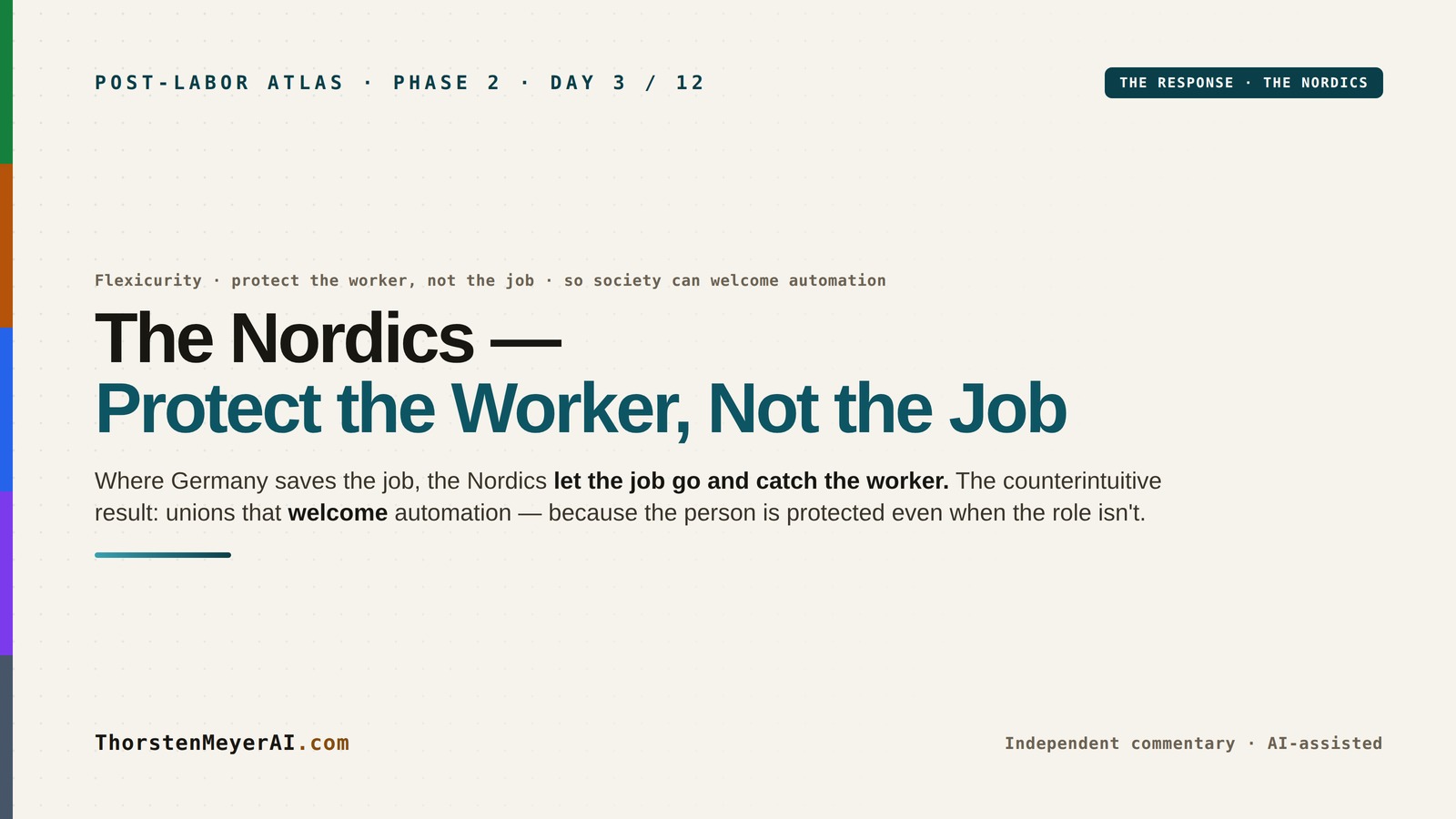
Protect the Worker, Not the Job
Where Germany saves the job, the Nordics let the job go and catch the worker. The counterintuitive result: unions that welcome automation — because the person is protected even when the role isn’t.
Independent commentary, produced with AI assistance under human editorial oversight. The views are the author’s own and may change. This is analysis, not policy, economic, investment, or legal advice. Descriptions of flexicurity, Nordic active-labor spending, Finland’s basic-income experiment, and Norway’s sovereign wealth fund reflect publicly reported information as of mid-2026 and may change. This phase maps differing approaches and endorses none; contested questions are presented with competing views, not a verdict. Country and program names are referenced for analysis and imply no affiliation.
The model’s logic
The Danish version is taught as a “golden triangle,” and the three corners are worth taking in order.
The first corner is flexibility. Denmark has relatively weak employment-protection law; employers can reconfigure their workforce quickly, and labor moves between jobs and in and out of work at rates that would alarm a German or French policymaker. This is the “flexi.”
The second corner is income security. A worker who loses a job lands on generous unemployment compensation with a high replacement rate — enough that a spell of unemployment is a transition, not a catastrophe. This is the “curity,” and it’s what makes the flexibility politically tolerable.
The third corner is active labor market policy — the part that does the real work. The Nordics spend on the order of eight to ten times what the United States spends, as a share of GDP, on retraining, job-search support, and activation programs. The governing principle is “right and duty”: you have the right to be supported, and the duty to work toward the next job. The state doesn’t just cushion the fall; it runs toward you with a ladder.
Set against Germany’s Kurzarbeit — which freezes the worker into the existing job through a downturn — flexicurity is the mirror image. Both are social-democratic, both keep people whole, but one preserves the job and the other preserves the person’s trajectory. In a world where many jobs may not be worth preserving, the Nordic version has an obvious appeal.
And it’s worth sitting with why the pro-technology stance matters so much for this Atlas specifically. The central political obstacle to almost every response to automation is fear — the entirely rational fear of the person whose livelihood is on the line, which hardens into resistance, which slows or blocks the transition. The Nordic model’s quiet genius is that it dissolves that fear at the source. A Danish worker can watch a task get automated with something closer to equanimity than panic, because the system has credibly promised that the automation won’t put them on the street. Resistance to change is, in large part, a function of how survivable change is. Make it survivable and you get a society that can metabolize technological disruption rather than litigate it. That is not a small thing; it may be the whole thing.
unemployment support and retraining programs
As an affiliate, we earn on qualifying purchases.
As an affiliate, we earn on qualifying purchases.
The levers it pulls
The Nordic row on the Matrix is distinctive. Income floor: strong — high-replacement unemployment support, and the region gave the world its most rigorous basic-income experiment, Finland’s 2017–18 trial. Skills and transition: strong, and this is the signature lever — no one in the rich world spends on active labor policy the way the Nordics do. Institutions: strong — very high union density and collective bargaining that sets wages directly (Denmark famously has no statutory minimum wage, because the unions and employers negotiate one), plus, as EU and EEA members, the AI Act’s guardrails.
Two cells are more interesting for what they reveal. Work and time: partial — and deliberately so. The Nordic model does not defend jobs; low employment protection is a feature, not a bug. The lever others use to preserve employment, the Nordics consciously leave loose.
And capital and ownership: partial — here the region holds something the European Union row left empty. Norway’s sovereign wealth fund, built from oil revenue, is the largest in the world, a national claim on capital that quietly answers the ownership question in a way co-determination does not. It’s framed as savings for future generations rather than a citizen dividend, but it is real collective ownership of capital at enormous scale — a lever the rest of Europe simply doesn’t pull.
It’s worth being precise about what the fund does and doesn’t do, because it previews a debate the Gulf states will raise more sharply later in this Atlas. What it does is make the Norwegian public a genuine owner of global capital, so that when returns shift from labor toward capital — exactly the dynamic the whole post-labor worry is about — Norway is on the right side of the shift at a national level. What it doesn’t do is hand citizens a direct, regular slice of those returns; the money is largely preserved and reinvested, with only a modest fiscal rule allowing some to be spent. So Norway has solved the ownership half of the problem without fully converting it into the income half. It’s a partial lever in the most literal sense — the structure is there, the dividend mostly isn’t — but it’s still more than almost anyone else in the rich world has built.
Knock 'em Dead Job Interview: How to Turn Job Interviews Into Job Offers (Knock 'em Dead Career Book Series)
As an affiliate, we earn on qualifying purchases.
As an affiliate, we earn on qualifying purchases.
The honest tradeoffs
The Nordic model is admired for good reason, but the bear case is substantial and mostly about preconditions.
It is expensive, and the expense is structural, not incidental. Eight-to-ten-times-US spending on active labor policy plus high-replacement benefits requires tax levels, and a tolerance for them, that most electorates won’t accept. The model runs on a fiscal engine others don’t have.
It runs on trust and scale. Flexicurity works because the safety net is reliable, the unions and employers actually cooperate (a habit Denmark traces back over a century), and the populations are relatively small, cohesive, and high-trust. Transplant the “easy to fire” half without the “reliably caught” half — as tempting as that is to a cost-conscious government elsewhere — and you don’t get flexicurity. You get precarity with a Scandinavian name.
It also has an honest limit on the basic-income question. Finland’s experiment is cited everywhere, including earlier in this Atlas — but it’s worth being clear that Finland ran it and did not adopt it. It improved wellbeing and didn’t reduce work, yet it remained a study, not a policy. Even the society best positioned to implement a basic income looked at the evidence and declined to scale it. That’s a data point cuts-both-ways: encouraging about the effects, sobering about the politics and the cost.
And there’s a structural worry the model hasn’t been tested against. Active labor policy assumes there’s something to retrain into — that displaced workers can be moved to new roles. That assumption held through every previous wave. If an AI-driven shift is broad enough that the new roles don’t appear fast enough, even the world’s best retraining machine is moving people toward a shrinking number of doors. Flexicurity is superb at managing churn; it has never had to manage disappearance.
Norway’s capital lever, finally, deserves an asterisk: it was funded by oil, not by policy genius. A country without a windfall to capitalize can admire the fund without being able to build one — unless the “resource” of the AI era turns out to be something every state can stake a claim in.

Advanced Analytics with Power BI and Excel: Learn powerful visualization and data analysis techniques using Microsoft BI tools along with Python and R … Automation — Excel & Power Platform)
As an affiliate, we earn on qualifying purchases.
As an affiliate, we earn on qualifying purchases.
What travels
The Nordic apparatus — the tax levels, the union density, the century of cooperative habit — does not transplant. But the principle might be the single most valuable export on this entire map: protect the worker, not the job. The mindset shift from defending positions to defending people, from fighting automation to funding the transition through it, is portable in a way the institutions are not. A country can’t copy Denmark’s golden triangle wholesale. It can copy the insight that made it work — that a society becomes brave about change only when it makes change survivable.
flexicurity policy guides
As an affiliate, we earn on qualifying purchases.
As an affiliate, we earn on qualifying purchases.
Row two
The Nordic bet is the most psychologically mature answer on the map: a society can be genuinely fearless about automation if, and only if, it makes displacement bearable — so don’t protect the job, protect the human being who held it. It’s coherent, humane, and evidence-backed.
It’s also the hardest model to copy, because most of what makes it work is upstream of policy: trust, cohesion, fiscal capacity, and in Norway’s case, oil. The Nordics show what the destination can look like. They’re considerably less help with the map of how to get there from somewhere that isn’t already Nordic. Row two.
Independent commentary, produced with AI assistance under human editorial oversight; the views are the author’s own and may change. This is analysis, not policy, economic, investment, or legal advice. Descriptions of flexicurity, Nordic active-labor-market spending, Finland’s basic-income experiment, and Norway’s sovereign wealth fund reflect publicly reported information and may change. This phase maps differing approaches and endorses none; contested questions are presented with competing views rather than a verdict. Country and program names are referenced for analysis and imply no affiliation. © 2026 Thorsten Meyer · Powered by Thorsten Meyer AI. See Imprint/Impressum and Privacy Policy.