
How are consulting and advisory firms affected when document intelligence is commoditised into Word?
Consulting and advisory firms sit further from the blast radius than LPOs or legal tech vendors, which is exactly why the effect on them is more insidious. The distance creates a false sense of immunity. The firms that feel safest right now — the ones whose partners will tell you “we sell judgment, not document review” — are often the ones whose judgment is most thoroughly scaffolded by document work they do not fully account for.
ThorstenmeyerAI.com · Analysis · April 2026
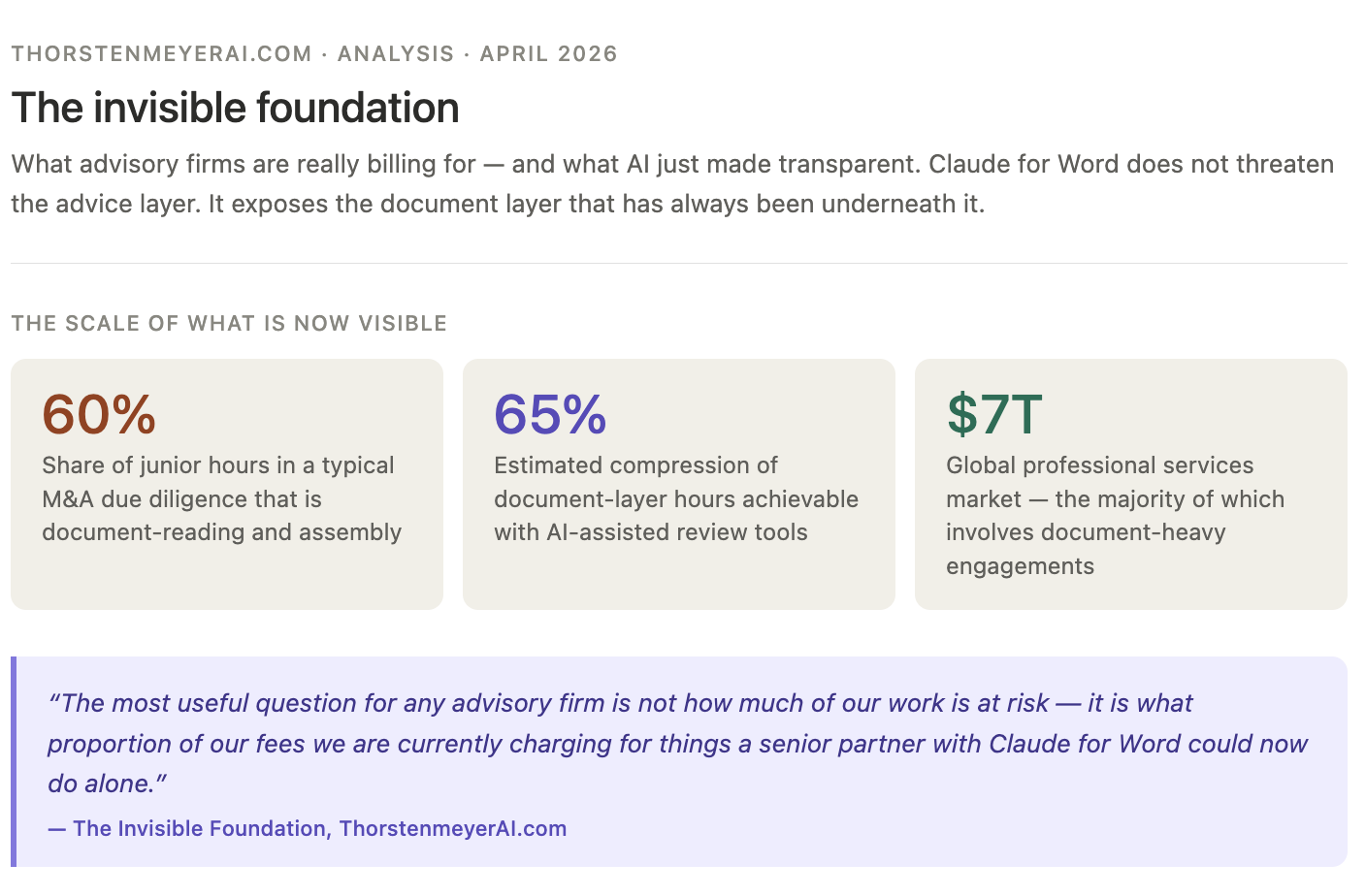
The invisible foundation
What advisory firms are really billing for — and what AI just made transparent. Claude for Word does not threaten the advice layer. It exposes the document layer that has always been underneath it.
The scale of what is now visible
How the engagement model shifts
The utilisation model: where the break occurs
Data is illustrative, based on industry analyst estimates and practitioner reporting. Compression figures reflect documented capability of AI-assisted document review tools across professional services contexts. Market size: Statista / IBISWorld global professional services estimates 2024–2025.
The invisible foundation of advisory work
Every consulting engagement that involves documents — which is most of them — has a research and assembly layer underneath the advice layer. A due diligence report does not begin with conclusions. It begins with someone reading the target company’s material contracts, its regulatory filings, its board minutes, its employment agreements, and its IP assignments. A compliance gap analysis begins with someone reading the relevant regulations, the client’s existing policies, and the delta between them. A restructuring advisory begins with someone mapping the debt instruments, the covenant packages, and the cross-default provisions across a credit facility.
That reading layer has always been treated as cost of goods — necessary but not the product being sold. Junior consultants and analysts do it. The billing rate on those hours is lower. The work is described internally as “research” or “diligence” rather than “advice.” Partners rarely think of it as the thing they are selling, because they are not — they are selling what comes after.
The problem is that “what comes after” is built on top of it. And when Claude for Word compresses the reading layer by sixty or seventy percent, the economics of the engagement change even if the advice layer is untouched.
The utilisation model is what actually breaks
Professional services firms — law firms, consulting firms, advisory boutiques — are fundamentally utilisation businesses. Revenue is a function of how many hours billed at what rate. The document-reading hours at the bottom of the engagement are low-rate but high-volume. They justify the staffing pyramid: many juniors billing modest rates fund the leverage that makes partner economics work.
When AI compresses the junior hours without compressing the scope of the engagement, one of two things happens. Either the firm passes the efficiency gain to the client through lower total fees — which is good for clients and bad for firm revenue. Or the firm maintains fee levels while reducing the hours deployed — which is good for margin in the short term but raises an uncomfortable question about what the hours were actually worth. Clients who understand what Claude for Word can do will eventually start asking that question directly, and the answer is going to reframe a lot of historical billing conversations.
The management consulting model, which tends to operate on value-based or project fees rather than hourly billing, is slightly more insulated from this specific pressure. But it faces an analogous version: when the research and document synthesis layer that underpins a deliverable becomes faster and cheaper to produce, the client’s sense of what a deliverable should cost shifts accordingly, even if the billing model does not expose the hours directly.
Due diligence is the most exposed practice line
Within the consulting and advisory universe, due diligence work is the most directly in Claude for Word’s strike zone. Commercial due diligence, legal due diligence, financial due diligence, ESG due diligence — all of them involve large volumes of documents being read, summarised, and translated into findings that inform a transaction decision.
The specific capabilities Claude for Word advertises map almost exactly onto what a due diligence team does: reading complex multi-section documents, finding every provision touching a theme, flagging deviations from standard positions, running consistency checks across a document set. A four-person due diligence team working a data room for two weeks is doing a version of exactly these tasks at scale. The AI does not replace the interpretive layer — the “this covenant package is unusually restrictive given the credit quality of this borrower” call still requires a human with market experience. But the reading that precedes that call is now automatable in ways it was not two years ago.
Firms that have built due diligence practices on the labour model — billing a team of analysts for the reading hours — are going to face fee pressure from clients who know the reading is getting faster. The response cannot be “we still use the same number of hours.” It has to be “here is what the hours we deploy now contain that the model cannot replicate.”
Regulatory and compliance advisory has a more complex exposure profile
Compliance advisory is interesting because the work is not primarily about reading a fixed document set — it is about understanding a regulatory environment that changes continuously, mapping it against a client’s specific situation, and providing defensible guidance. The document intelligence layer matters here, but it is a smaller proportion of the total value delivered.
What Claude for Word does compress is the gap analysis function: reading the regulation, reading the client’s current policies, and producing a structured comparison. That has historically been junior analyst work. The senior advisor’s value is in knowing which gaps are actually material given the enforcement environment, which regulators are currently focusing on which issues, and how to remediate in a way that is defensible if challenged. That judgment layer is not in the document.
The risk for compliance advisory firms is not that they get replaced. It is that clients start doing more of the gap analysis work themselves, using AI tools, and only engaging the advisory firm for the interpretation and remediation design. That is a smaller engagement, more focused on senior time, with less room for the junior leverage that funds the business model. The advice is still valuable. The billable hours supporting it compress.
The practices most insulated
Not all consulting and advisory work has the same exposure profile. The practices furthest from document processing are in the best position.
Transformation and change management consulting is almost entirely about human dynamics — stakeholder alignment, organisational redesign, culture change. There are documents involved, but the documents are not the product. The product is getting an organisation to behave differently, which requires presence, trust, and political navigation that has no document equivalent.
Strategic advisory at the highest level — board-level counsel, geopolitical risk advisory, CEO succession — operates in a relationship and judgment register that documents barely touch. The value is in who you are talking to and what they know, not in how fast you can read a filing.
Sector-specific technical expertise, where the advisory value comes from deep domain knowledge that took years to accumulate, is also relatively insulated. A firm advising on nuclear facility decommissioning or pharmaceutical regulatory strategy is not primarily selling document intelligence. It is selling the accumulated knowledge of people who have spent careers in that specific domain.
The strategic response available to advisory firms
The firms that handle this well will do something that sounds simple but is operationally difficult: they will redefine what they are selling at every level of the engagement, and price accordingly.
That means being explicit with clients about where AI is being used in the work and how. Firms that try to maintain the fiction that the same hours contain the same value as before AI will lose the credibility argument the first time a sophisticated client audits the engagement. Firms that say “here is what we do with AI, here is what we do with humans, here is why the combination delivers better work faster, and here is how we price it” are having an honest commercial conversation that most clients will respect.
It also means investing deliberately in the parts of the practice that AI cannot touch. The network, the sector knowledge, the regulatory relationships, the ability to walk into a boardroom and change a decision — these are not document skills, and they do not compress. Firms that have been coasting on the document layer as a profit centre need to decide whether they are going to rebuild differentiation in the judgment layer or whether they are going to compete on AI-augmented efficiency, which is a different business with different economics.
The framing that matters
The most useful way to think about this for a consulting or advisory firm is not “how much of our work is at risk” but “what proportion of our fees are we currently charging for things that a senior partner with Claude for Word could now do alone.”
In most firms, that proportion is higher than the partners want to acknowledge. The junior leverage model was built on the cost of human reading time. That cost is changing. The firms that look at that honestly now, and redesign their delivery model around it, will come out of this period with better margins and a clearer value proposition. The ones that wait until clients force the conversation will have less control over how it resolves.
Document intelligence is becoming infrastructure. The advisory firms that treat it as a capability they deploy, rather than a cost centre they bill for, are the ones that will find the transition navigable.
AI document review tools for consulting firms
As an affiliate, we earn on qualifying purchases.
As an affiliate, we earn on qualifying purchases.

Due Diligence for Business Owners Considering SEO
As an affiliate, we earn on qualifying purchases.
As an affiliate, we earn on qualifying purchases.
Applied Economic Analysis for Technologists, Engineers, and Managers
- Author: Michael S. Bowman
- Publisher: Prentice Hall College Div
- Page Count: 561 pages
As an affiliate, we earn on qualifying purchases.
As an affiliate, we earn on qualifying purchases.

Finding What Requirements Hide: AI-Assisted Detection of Ambiguity, Contradiction, and Gaps
As an affiliate, we earn on qualifying purchases.
As an affiliate, we earn on qualifying purchases.