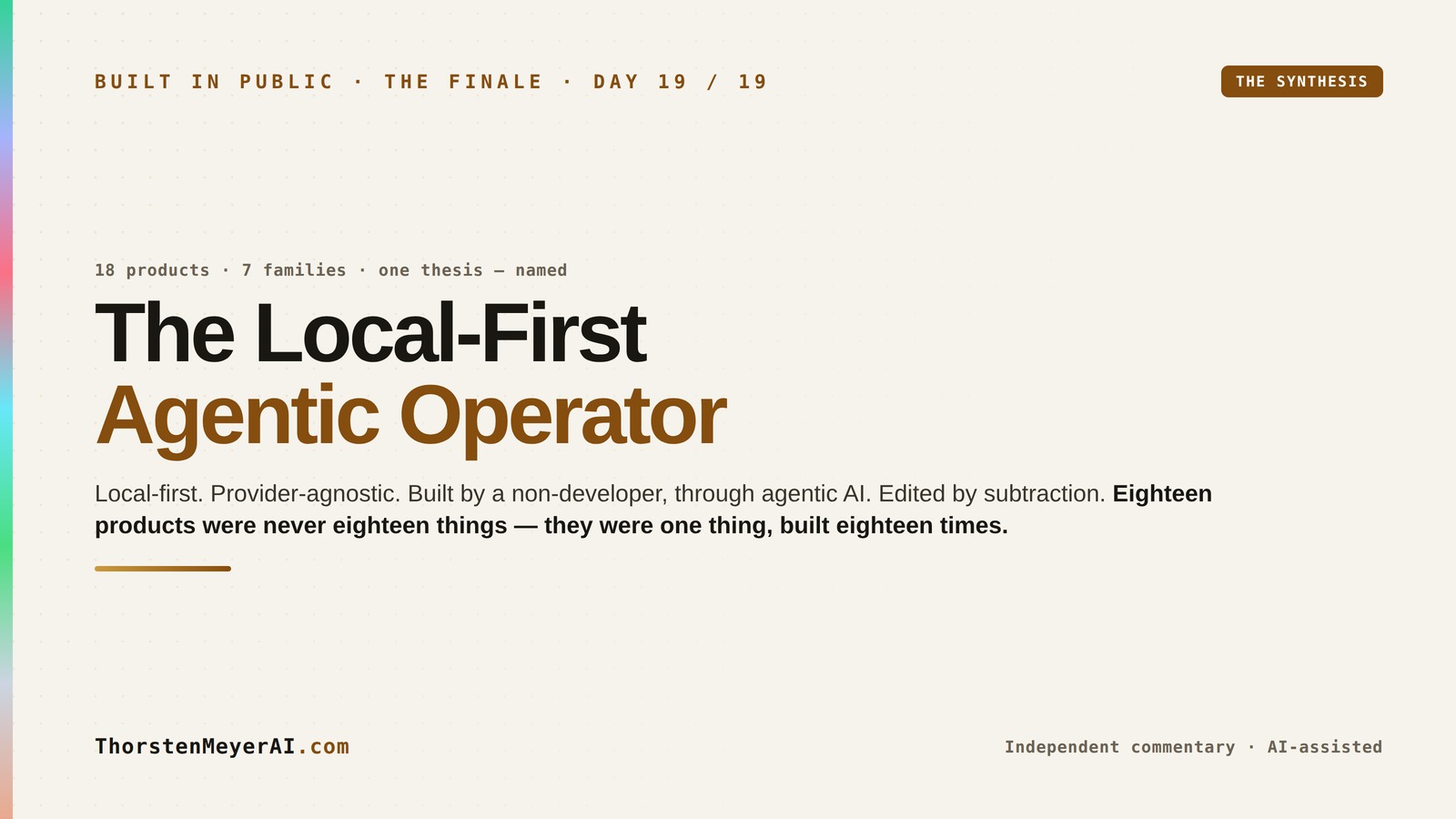

Eighteen days, eighteen products. Laid out end to end, they look like a sprawl: content engines and a news-as-geography globe, a validation council and a keep-change-kill filter, an operations platform and a self-building form, a transparency tool and a regulated-QA system, a prediction-market bot and a firm of trading agents, an OSINT analyzer and a satellite-radar ISR platform, a model benchmark and a readiness diagnostic. Seven families. It reads like a portfolio assembled by a committee that couldn’t agree on a market.

Get business pricing on tech for your team
- Business-only prices and quantity discounts
- Tax-exempt purchasing
- Multiple users, one account, clear invoices
It isn’t. These were never eighteen things. They were one thing, built eighteen times — and the last day of this series is for saying out loud what that one thing is.
The thesis has four facets, and every product in the series inherited all four: it’s local-first, it’s provider-agnostic, it was built by a non-developer through agentic AI, and it was edited by subtraction. Those aren’t four features. They’re one stance toward building, and the portfolio is what that stance produces when you run it for a while.
The Local-First Agentic Operator
Eighteen products that looked like a sprawl were never eighteen things. They were one thing, built eighteen times. This is the thesis underneath all of them — named.
- Not “solo beats funded team.” Depth still wins most single contests. The narrower, truer claim: the floor moved — one person can now do what recently took many.
- Breadth is strength and risk. Eighteen products is resilience and a focus problem; several are seeds, not trees.
- The AI part is assisted, not autonomous. Strip away human judgment and subtraction and you get faster mediocrity, not a portfolio.
- A pattern, not a prescription. This fit one operator, one skill set, one moment. The honest version of any manifesto includes “this worked for me.”
A synthesis and a statement of one operator’s working philosophy — independent commentary, produced with AI assistance under human editorial oversight. The views are the author’s own and may change. This is not business, financial, legal, or technical advice, and the four-facet framing is a personal operating pattern, not a prescription or a claim of results. Individual products carry their own terms, disclaimers, and limitations in their respective articles; several are early- or positioning-stage. Product, model, and company names are trademarks of their respective owners; mention does not imply endorsement.
One operator, not one company
Start with the premise underneath all of it, because it’s the part that’s genuinely new. For most of software history, building and running this many distinct products meant a company — teams, headcount, coordination, the whole apparatus. The interesting claim this portfolio quietly makes is that the floor has moved: a single operator, working with agentic AI, can now build and run what used to require an organization.
Not a founder with a roadmap and a hiring plan. An operator with a portfolio — someone who treats building software the way a publisher treats putting out titles, or a workshop treats turning out pieces. The unit isn’t “the startup.” It’s “the person, amplified.” That reframe is the ground everything else stands on, and the four facets are the operating principles that make it survivable rather than chaotic.
The seven families the series walked through — content, decision, platform, open-and-regulated, markets, defense-and-intel, diagnostic — were never the point. They were surface area: evidence that one way of working travels across wildly different domains, from a WordPress content engine to a satellite-radar ISR platform to a regulated-QA system for life sciences. A domain specialist would build any single one of these better than a generalist operator could, and the series never claimed otherwise. The claim was narrower and stranger: that one stance, applied consistently, can credibly reach all of them — and that the reaching is now possible for a single person where it recently took an organization. The families are the breadth. The four facets are the depth underneath it.
self-hostable local inference AI tools
As an affiliate, we earn on qualifying purchases.
As an affiliate, we earn on qualifying purchases.
Local-first
The first facet is the most concrete: own your compute and your data. Across the portfolio, that meant a fleet of machines running local inference, tools that are self-hostable, and sensitive data that never has to leave the building. The engine behind the fleet runs on owned hardware; the open and regulated tools can be run entirely on-premises; the OSINT analyzer keeps your watch list on your own infrastructure because what you’re watching is itself sensitive.
Why insist on it? Because renting your core capability is a quiet form of fragility. Costs you don’t control, data you’ve handed away, a vendor whose terms can change underneath you — local-first is the refusal to build your operation on someone else’s ground. It has real costs (you maintain what you own), and the series was honest about its exceptions: the hosted platform products are the deliberate trade where serving other people requires being a service. But the default, the gravity of the whole thing, points home.
provider-agnostic machine learning models
As an affiliate, we earn on qualifying purchases.
As an affiliate, we earn on qualifying purchases.
Provider-agnostic
The second facet is the one that turned out to matter most: never weld yourself to a single model or vendor. Every product in the series carries a swappable model layer. None of them assumes a particular provider is permanent, because — as anyone paying attention in 2026 knows — no provider is permanent. The frontier moves monthly.
This isn’t only hygiene; in places it’s survival. For the regulated-QA system, vendor lock-in is a validation risk: a model that changes underneath you can invalidate the thing you certified. And the principle got its own measuring instrument in the benchmark, whose entire finding is that there is no single best model — only the right model for a given context, which you can only choose if you never locked yourself out of choosing. Provider-agnostic is how you stay free to pick.
agentic AI building platforms for non-developers
As an affiliate, we earn on qualifying purchases.
As an affiliate, we earn on qualifying purchases.
Built by a non-developer, through agentic AI
The third facet is the meta one, and the portfolio is its own evidence. None of this was built by someone who considers himself a developer. It was built by an operator whose ability to make software was re-enabled by agentic AI — the shift from “I can describe what I want” to “I can build what I want” without first becoming an engineer.
That’s the part worth being precise and unromantic about. This isn’t “AI builds products for you while you sleep.” It’s AI-assisted, human-judged, and heavily edited — the machine does the typing and a person does the deciding. The capability is real and it’s genuinely new, but it’s a power tool, not a wish. The portfolio exists because someone pointed that tool at a clear stance and kept their hand on it. Which leads directly to the fourth facet, because the hand on the tool is mostly doing one thing: removing.
privacy-focused local data management software
As an affiliate, we earn on qualifying purchases.
As an affiliate, we earn on qualifying purchases.
Edit by subtraction
The fourth facet is the craft, and it showed up in every single piece. The validation council exists to kill ideas before they cost anything. The keep-change-kill filter is subtraction by name. The forms ask less. The trading systems mostly don’t trade. The OSINT tool throws away ninety-nine percent to surface the one percent. The benchmark subtracts the hype to score what actually decides deployment. The readiness diagnostic is about subtracting noise until you can see the few things that matter.
When the marginal cost of producing drops toward zero — which is exactly what agentic AI does — the scarce, valuable skill stops being generation and becomes judgment about what to remove. Anyone can now make more. The discipline is making less, but the right less. Subtraction is the part of the work that stayed stubbornly human, and it’s the part that separates a portfolio from a pile.
Why the four cohere
These aren’t four independent rules that happen to share a builder. They’re one posture viewed from four sides. Local-first and provider-agnostic are both refusals to be dependent — on a vendor’s servers, on a vendor’s model. Non-developer-via-AI and edit-by-subtraction are both consequences of the same shift — when building gets cheap, the leverage moves from who can build to who can choose well what to build and what to cut.
Put together, they describe an operator built to outlast any single model, vendor, or trend. That’s the actual point. Not any one of these eighteen products — most of which are early, several of which are explicitly positioning, all of which will change. The durable thing is the way of working that produced them, because it’s designed to keep producing when everything underneath it turns over.
What this isn’t
A finale earns its optimism by being honest about its limits, so here are the real ones.
This is not a claim that a solo operator beats a funded team at everything — it doesn’t, and depth still beats breadth in most single contests. It’s a narrower, truer claim: the floor moved, and one person can now credibly do what recently took many. Breadth is both the strength and the risk — eighteen products is resilience, and it’s also a focus problem; a portfolio this wide will always trade depth for range, and several of these are seeds rather than trees. The AI part is assisted, not autonomous — strip away the human judgment and the subtraction, and you get faster mediocrity, not a portfolio. Local-first has a maintenance tax, and the hosted exceptions prove the principle is a default, not a religion. And all of this is one operator’s way of working, offered as a pattern, not a prescription — it fit a particular person, a particular set of skills, and a particular moment, and the honest version of any manifesto includes the sentence “this worked for me.”
Built to stay ready
There’s a reason the series ended, the day before this one, on a readiness diagnostic. The entire point of building this way — owning your ground, refusing lock-in, treating AI as an editable power tool, and removing more than you add — is to stay ready for what’s next. The next model. The next paradigm. The shift, already beginning, from AI that describes to AI that predicts and acts.
So this series doesn’t really end on “look what I made.” It ends on how, and why the how is built to keep working when the what changes. Eighteen products were the visible part. The local-first agentic operator — adaptable, un-lock-in-able, AI-amplified, and disciplined by subtraction — was the thing they were quietly spelling out the whole time.
If there’s one idea to carry out of nineteen days, it’s that the leverage has quietly moved. For a long time the scarce thing was the ability to build, and so the people who could build, or could afford to hire those who could, held the cards. That constraint is loosening. When making becomes cheap and fast, the advantage stops being production and becomes taste, judgment, and restraint — knowing what’s worth making, what to own, what to refuse, and what to cut. None of those are things a model hands you. They’re the part that stays yours. A portfolio built on that premise isn’t betting on any particular AI; it’s betting on the durable value of the human standing at the controls, editing.
Eighteen builds. Seven families. One foundation. Now named.
This is a synthesis and a statement of one operator’s working philosophy — independent commentary produced with AI assistance under human editorial oversight; the views are the author’s own and may change. It is not business, financial, legal, or technical advice, and the four-facet framing is a personal operating pattern, not a prescription or a claim of results. Individual products referenced carry their own terms, disclaimers, and limitations in their respective articles; several are early-stage or positioning-stage. Product, model, and company names are trademarks of their respective owners; mention does not imply affiliation, sponsorship, or endorsement. © 2026 Thorsten Meyer · Powered by Thorsten Meyer AI. See Imprint/Impressum and Privacy Policy.
Evergreen bestsellers Picks
bestsellers
As an affiliate, we earn on qualifying purchases.