
Every week, a new model “tops the leaderboard.” The benchmarks that make those headlines — the big capability tests — measure one thing extremely well: how smart a model is on a battery of tasks. And then everyone reads the ranking as if it answered the question that actually matters, which it doesn’t. “Smartest” is not the same as “deployable,” and for anyone making a serious decision, the gap between those two is where all the real risk lives.
Because the questions that decide whether you can actually use a model in a serious setting are almost never on the capability leaderboard. Can it run air-gapped, on your own hardware, with no data leaving the building? Is it compliant with the EU AI Act and GDPR? Is it reliable — does it give the same answer twice — and robust when the input gets weird or adversarial? For a sovereign, regulated, or defense-adjacent buyer, those questions outrank another point on a trivia test, and the famous leaderboards are silent on all of them.
VigilSAR Benchmark is a public leaderboard built to score the things that actually decide deployment. It rates models on five axes — Capability, Reliability, Robustness, Safety & Compliance, and Efficiency & Deployability — across eight knowledge domains, and then does the move that makes it interesting: it re-ranks the models by who’s asking. Its core finding, baked into the design, is that there is no single “best” model. Best is a function of the buyer.
Two things stated plainly up front. First, the scope: this benchmark measures defense-relevant competence — domain knowledge, reliability, compliance, deployability — and it explicitly excludes weaponeering, targeting, CBRN, and exploit generation. It scores whether a model is trustworthy and deployable, never whether it’s dangerous. Second, it’s early — actively in development, with methodology that will evolve — so this is a description of what it’s built to do, not a claim that it’s a finished authority. It completes the portfolio’s Defense / Intel family, at vigilsar.com/benchmark.
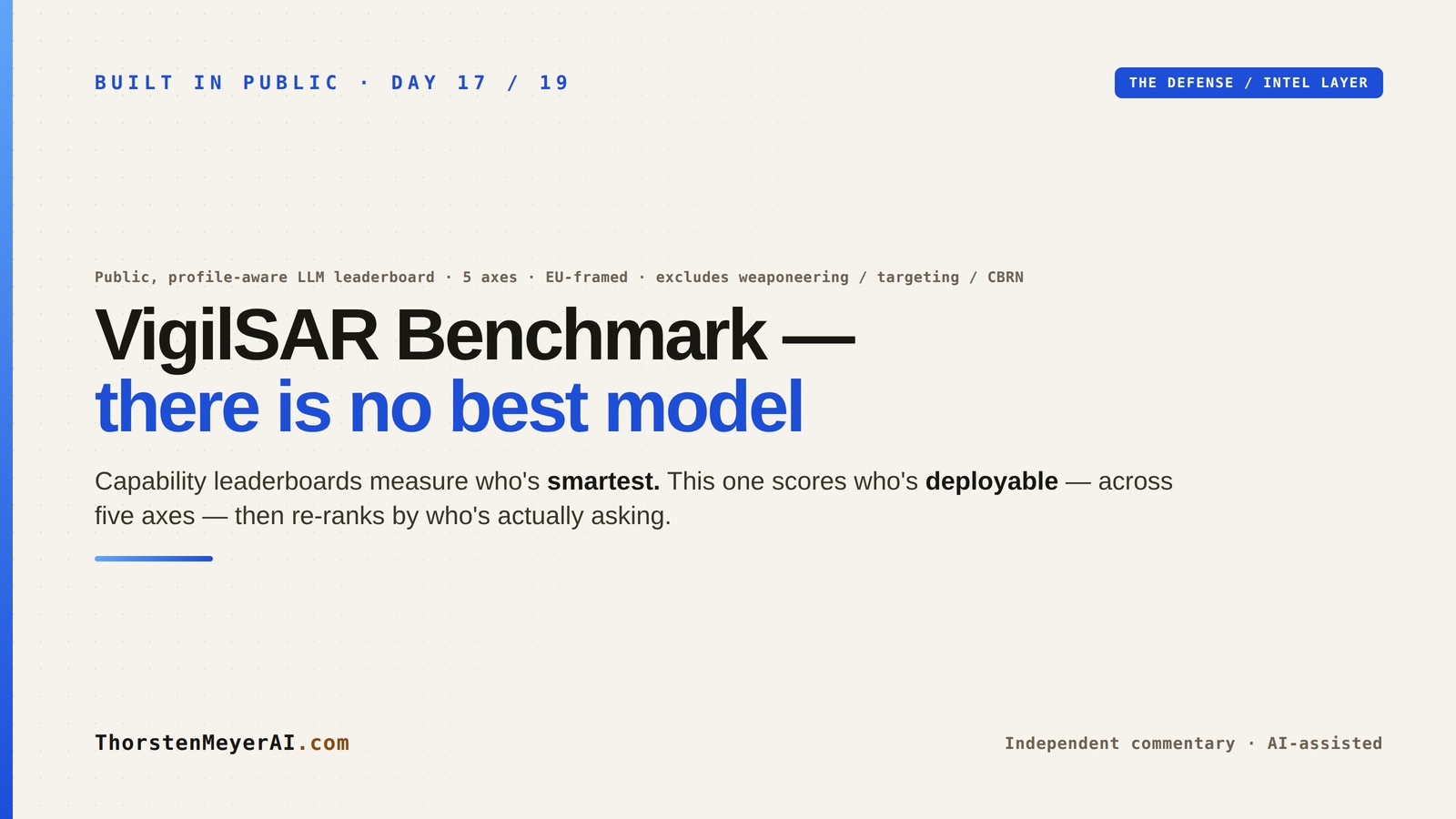
VigilSAR Benchmark — there is no best model
Capability leaderboards measure who’s smartest. This one scores who’s deployable — across five axes — then re-ranks by who’s actually asking.
Independent commentary, produced with AI assistance under human editorial oversight. The views are the author’s own and may change. VigilSAR Benchmark is an early-stage, in-development public benchmark; methodology, scope and results will evolve and are not a certification, authority, or guarantee of any model’s fitness, safety, or compliance. It scores defense-relevant competence and explicitly excludes weaponeering, targeting, CBRN, and exploit-generation tasks. Benchmark results are indicative, can be gamed or in error, and require independent verification; nothing here endorses any model. Model and company names are trademarks of their respective owners; mention does not imply endorsement.
Capability is one axis, not the score
The whole reframing starts here. A capability-only benchmark implicitly says the smartest model wins. But put yourself in the seat of someone who has to actually field a model and the ranking inverts in a hurry. A brilliant model you can’t run on-premises is useless to a sovereign buyer. A capable model that fails compliance review is a liability to a regulated one. A clever model that’s inconsistent — different answers to the same question — is dangerous anywhere correctness matters.
So VigilSAR-Bench treats capability as one axis among five, not the headline. Reliability asks whether the model is consistent, not just occasionally brilliant. Robustness asks how it holds up under stress and adversarial input. Safety & Compliance is scored as a first-class axis — meaning a model that behaves badly or can’t meet the rules ranks lower, which is the opposite of how capability leaderboards treat it. And Efficiency & Deployability asks the unglamorous, decisive question: can this thing actually run where you need it — including air-gapped, on your own hardware?
Scoring safety and deployability as first-class axes rather than asterisks is the quiet thesis of the whole thing. The benchmark refuses to let “smart” stand in for “fit for purpose.”

Local LLM Inference Optimization: A Comprehensive Guide to Quantization, Hardware Acceleration, and Efficient Private AI Deployment
As an affiliate, we earn on qualifying purchases.
As an affiliate, we earn on qualifying purchases.
The signature: best depends on who’s asking
Here’s the move that ties it together. The same models, scored on the same axes, are re-ranked through three buyer profiles — and the rankings genuinely change.
cloud_frontier is the profile that looks most like the famous leaderboards: maximum capability, cloud deployment is fine, you want the most powerful thing available. sovereign_edge is the opposite world: the model must run on-premises or air-gapped, which instantly disqualifies anything you can’t self-host, no matter how brilliant. compliance_first weights EU AI Act and GDPR alignment above raw power. Run the same models through those three lenses and the model that’s #1 for one profile can drop out of contention entirely for another.
That’s the same instinct as Glasspane’s one-dataset-three-views, applied to model selection: the right answer depends on who’s looking. And it’s the deepest expression of the thread that runs through this entire portfolio — the refusal to be locked to a single provider. If you believe no one model should own your stack, then you need a disciplined way to choose the right model for each context. VigilSAR-Bench is the provider-agnostic thesis turned into a measurement.

AI for Strategic HR Operations and Compliance: The HR Director’s Operating Manual for Running AI Across Hiring, Operations, and the EU AI Act
As an affiliate, we earn on qualifying purchases.
As an affiliate, we earn on qualifying purchases.
The exclusions are the design, not a disclaimer
The reason the scope sits near the top of this piece rather than in fine print is that for a defense-relevant benchmark, the boundaries are the most important design decision in it. A benchmark that scored offensive or harmful capability — how well a model does weaponeering, targeting, building CBRN knowledge, or generating exploits — would be the wrong thing to build, full stop. VigilSAR-Bench deliberately does not do that.
What it measures instead is whether a model is competent at legitimate, defense-relevant knowledge work and trustworthy enough to deploy — including a signature ISR domain track that connects to VigilSAR itself. The orientation is toward reliability and compliance, and because Safety & Compliance is a scored axis, the benchmark structurally rewards models that are safer, not models that are more dangerous. That’s the responsible posture: a defense-adjacent evaluation whose incentives point at trustworthiness, with the harmful capability surface explicitly walled off rather than quietly measured.
As an affiliate, we earn on qualifying purchases.
The EU lens
Most model leaderboards are implicitly US-centric, and they treat European requirements — the EU AI Act, GDPR, sovereignty, the practical reality of needing things to work in German and French and to run inside the building — as someone else’s problem. VigilSAR-Bench builds the European lens in: it evaluates with air-gapped, on-premises operation as a real scenario rather than a footnote, and it weights compliance as something that changes the ranking.
For an EU operator, “which model is best?” has a different and more demanding answer than the one a US leaderboard gives, and a benchmark that takes that seriously is filling a genuine gap rather than restating a familiar one.
Building Robust AI Evals: Proven Strategies for Testing, Monitoring, and Improving LLM Performance (Engineered: Data, AI, and DevOps Book 6)
As an affiliate, we earn on qualifying purchases.
As an affiliate, we earn on qualifying purchases.
The portfolio’s capstone
It’s fitting that this is one of the last products in the series, because it’s the one that’s about the others’ shared principle. The whole portfolio is built on the refusal to lock yourself to one AI provider — every product carries a swappable, provider-agnostic model layer. But that principle is only as good as your ability to act on it, and acting on it means being able to answer, rigorously and per-context, “which model should I actually use here?” VigilSAR-Bench is the instrument for that question. It turns a value the whole portfolio merely asserts into something you can measure.
It completes the Defense / Intel family at its most analytical and least operational end — a public measurement, bounded away from harm — and it sets up the thread the finale will name: that all of this is one thing, built one way.
The honest bear case
Several caveats deserve to be plain. First, it’s early and in development — the methodology is still being settled, and a benchmark is only as credible as its rigor, transparency, and reproducibility, which are hard-won over time rather than declared on day one. Second, benchmarks get gamed. The moment a leaderboard matters, people optimize to it rather than to the underlying quality it’s meant to proxy — Goodhart’s law is undefeated — and any benchmark has to keep evolving to stay honest. Third, judging models is itself hard: model-graded evaluation has well-known failure modes, and a benchmark has to be transparent about how it scores or its rankings are just another opinion with a number attached. Fourth, the “defense-relevant” framing invites scrutiny even with the exclusions clearly drawn — which is appropriate, and the right response is exactly the transparency about scope and method that the project will live or die by. And finally, maintaining a credible public leaderboard is heavy, ongoing work, not a launch-and-leave artifact.
The bull case, plainly
With those caveats standing: VigilSAR-Bench is pointed at a real and under-served gap. The famous leaderboards measure capability and call it a ranking; almost nobody publicly scores the things — reliability, robustness, compliance, deployability, sovereignty — that actually decide whether a serious organization can field a model. The profile-aware reframing (“there is no single best”) is genuinely useful and genuinely true. The EU lens fills a gap US-centric benchmarks ignore. The exclusions are responsible and the safety-as-an-axis design points the incentives the right way. And it operationalizes the one belief that ties the whole portfolio together.
It’s early, and credibility in benchmarking is earned slowly through transparency and rigor. But “stop asking which model is smartest and start asking which model is right for you” is a sharp, honest, and overdue question — and the right note to close the portfolio’s most carefully-handled family on. It reframes the whole leaderboard conversation from a single race into a fitting problem, which is what it always should have been.
VigilSAR Benchmark is an early-stage, in-development public benchmark; its methodology, scope, and results will evolve and should not be treated as a certification, an authority, or a guarantee of any model’s fitness, safety, or compliance. It measures defense-relevant competence (knowledge, reliability, compliance, deployability) and explicitly excludes weaponeering, targeting, CBRN, and exploit-generation tasks. Benchmark results are indicative, can be gamed or in error, and require independent verification; nothing here is an offer, an endorsement of any model, or legal/regulatory advice. This article was produced with AI assistance under human editorial oversight; the views are the author’s own and may change. Product, model, and company names are trademarks of their respective owners; mention does not imply affiliation, sponsorship, or endorsement. © 2026 Thorsten Meyer · Powered by Thorsten Meyer AI. See Imprint/Impressum and Privacy Policy.