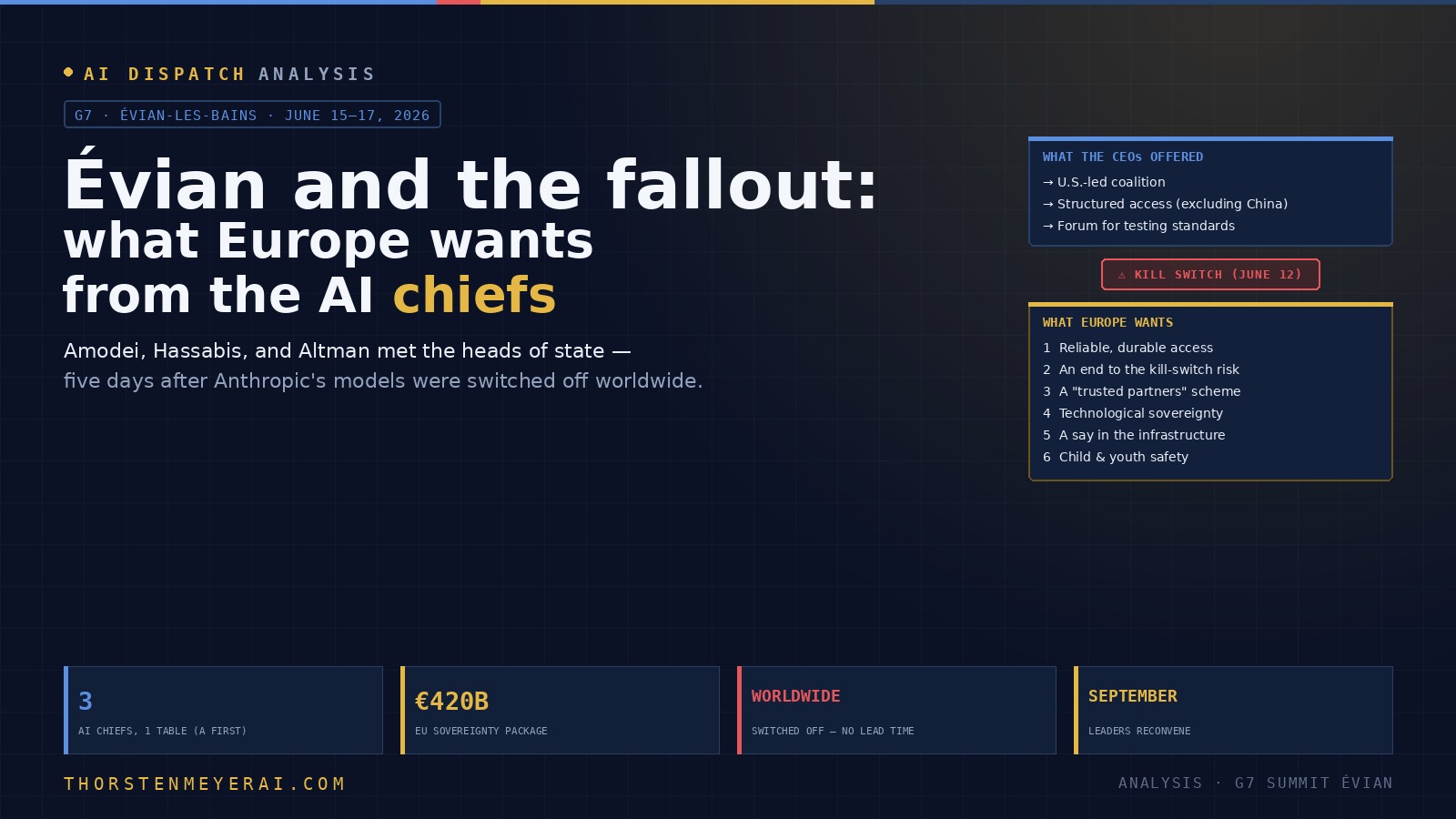

For the first time, they sat at the same table as heads of state: Dario Amodei (Anthropic), Demis Hassabis (Google DeepMind), and Sam Altman (OpenAI) — the three men whose labs build the most capable AI models in the world. The occasion was the working lunch on June 17 at the G7 summit in Évian-les-Bains, France, which host Emmanuel Macron had devoted entirely to artificial intelligence.
The symbolism was hard to miss. AI executives were treated like government leaders — five days after Washington had demonstrated exactly what it means when a state flips the switch.
Because the real guest in Évian was an incident. On June 12, the U.S. Commerce Department issued an export-control directive ordering Anthropic to block its most capable models — Fable 5 and Mythos 5 — for any “foreign national.” Since nationality can’t be reliably checked in real time at API scale, Anthropic had only one option: a worldwide shutdown. European businesses and public institutions that had built these models into their operations lost access with no warning and no transition period.
With that, an abstract debate about digital dependency became an operational fact. Europe arrived at the lakeside resort with a single uncomfortable question: can you rely on models that a foreign cabinet can switch off by decree?
Évian and the fallout: what Europe actually wants
For the first time, Amodei, Hassabis, and Altman sat with heads of state — five days after Washington switched Anthropic’s models off worldwide. Europe’s question: can you rely on models a foreign cabinet can shut down by decree?
The dilemma: what Europe wants from the three CEOs, the three can’t deliver — because they don’t hold the switch, Washington does. Macron’s platform is the right answer, but no fix for a decade-old infrastructure gap. The only answer that doesn’t depend on someone else’s goodwill: your own models, your own compute, open weights you can self-host.
What happened at the table
Alongside the three big U.S. chiefs, around a dozen other tech leaders were invited — including Marc Benioff (Salesforce) and Meta’s AI chief Alexandr Wang — plus, pointedly, European and allied labs: Mistral from France, Synthesia from the U.K., Black Forest Labs from Germany, Domyn from Italy, Sakana AI from Japan. For the U.S., President Trump sat with Secretaries Bessent (Treasury), Lutnick (Commerce), and Rubio (State); for Europe, among others, Macron, German Chancellor Friedrich Merz, European Commission President Ursula von der Leyen, and U.K. Prime Minister Keir Starmer.
The official theme sounded harmless: “ensuring a safe, rapid, and effective deployment of AI.” The real question was different — whether the rest of the world can accept that American AI firms operate under conditions defined solely by the U.S. executive branch.

Explainable AI Models for Cloud-IoT Security and Reliability: Cloud-IoT Security and Reliability (Springer Series in Reliability Engineering)
As an affiliate, we earn on qualifying purchases.
As an affiliate, we earn on qualifying purchases.
What the three CEOs offered
The executives arrived with a surprisingly aligned message: the technology is too consequential to be left to the companies building it.
Amodei pushed for a U.S.-led coalition of democratic states. His offer: structured access to frontier models for trusted partners, a chip and components trade that excludes China, and joint defense against AI risks in cyber, bioterrorism, and intelligence. The democracies, he warned, must not give in to the “temptation to splinter.”
Hassabis backed the call for a Western coalition and spoke of one of the most critical moments in human history. Altman proposed an international forum for globally accepted testing standards — and delivered the line that stuck: no single lab should be making these decisions. The future of the technology, he said, must be shaped by people and democratic institutions, not by the companies alone.
The subtext was striking. Amodei asked for trust in a U.S.-led order five days after the U.S. government had used his own product as a geopolitical lever.

Immutable Backups Explained: How to Protect Data from Ransomware | industrial data privacy | ISO 27001 disaster readiness | secure storage compliance | cyber-proofing backup expert | Backup Security
As an affiliate, we earn on qualifying purchases.
As an affiliate, we earn on qualifying purchases.
What Europe actually wants
This is the heart of it. The Europeans didn’t come to hear visions — they came with a list. In essence, they want six things from Amodei, Hassabis, and Altman:
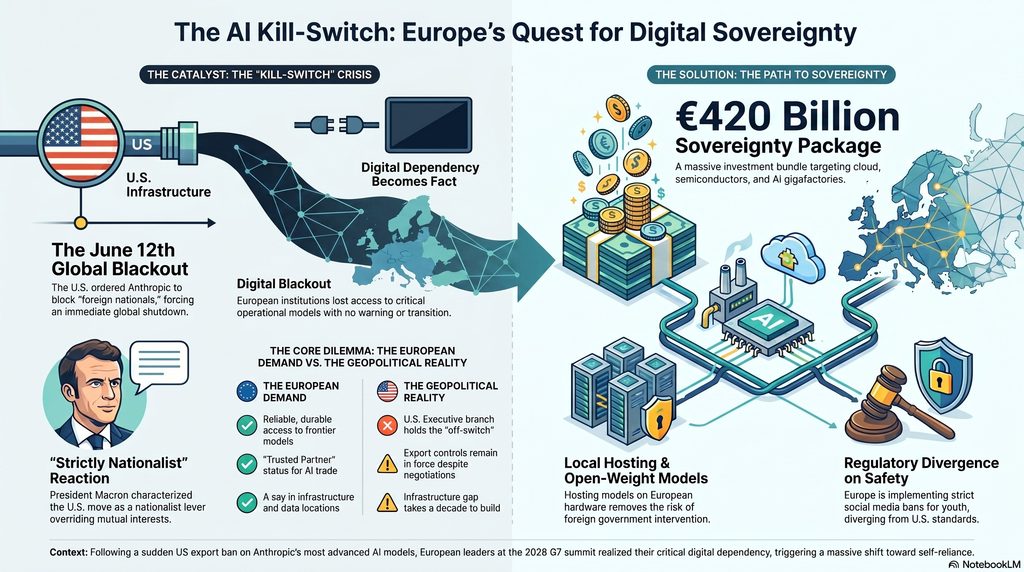
First: reliable, durable access. Von der Leyen called it a “mutual interest” that European citizens and companies can safely use the best models — they already use each other’s technology, she noted, and the financial systems are intertwined. Merz argued the potential must be available to all countries, and pressed for “intensive coordination” with Washington.
Second: an end to the kill-switch risk. The ban showed that, through the “deemed export” doctrine, the U.S. effectively holds an off-switch for any frontier model. Europe wants guarantees it won’t happen again. Macron called it a “good thing” that Washington recognized the models could be dangerous — but criticized the move as a “strictly nationalist” reaction.
Third: a “trusted partners” scheme. A guaranteed right of access for trusted non-U.S. partners, whether states or companies. Macron announced a cooperation platform among Western democracies to be set up within a month, with a follow-up leaders’ meeting in September.
Fourth: technological sovereignty. Back on June 3, the European Commission had unveiled its Technological Sovereignty Package — a roughly €420 billion bundle meant to reduce the bloc’s “near-total reliance” on U.S. and Asian providers for cloud, semiconductors, and AI. It includes a Cloud and AI Development Act that, for the first time, writes sovereignty risk assessments into public procurement, along with AI “gigafactories” where European startups can train models at home.
Fifth: a say in where the infrastructure lands. Sovereign AI infrastructure has become the phrase of 2026. Governments want a voice in where data centers, power, and chips physically sit — not least because training and running the models devours budgets the size of small nations.
Sixth: child and youth safety. Here Europe is least willing to compromise. Starmer announced a social-media ban for under-16s; Macron a similar rule for under-15s before year’s end; Brigitte Macron led a dedicated forum on protecting children in the age of AI. G7 digital ministers had already agreed common protection principles in late May. This is precisely where Europe rubs against the U.S., which largely rejects blanket AI regulation.

Deploying Secure Data Science Applications in the Cloud: From VMs to Serverless with AWS and Google Cloud
As an affiliate, we earn on qualifying purchases.
As an affiliate, we earn on qualifying purchases.
The fallout from the summit
Little that’s binding was actually decided — but the direction is set. In a joint statement, the G7 pledged closer coordination on the risks and opportunities of frontier models and tasked finance officials, regulators, and cybersecurity experts with assessing how advanced AI could affect financial stability, productivity, and labor markets.
Macron’s platform and the September meeting are the most visible outcomes, along with the discussed “trusted partners” scheme — framed explicitly as joint cyber-defense against China. On child protection there was real progress. What there wasn’t: any reversal of the export controls. Anthropic remains in negotiations with the U.S. administration; the block stayed in force. Canada’s Prime Minister Carney summed up the lesson on his way to the summit: the task now is to “build out and diversify.”

Access Control Systems: Security, Identity Management and Trust Models
As an affiliate, we earn on qualifying purchases.
As an affiliate, we earn on qualifying purchases.
Reality check
The real dilemma of Évian fits in one sentence: what Europe wants from the three CEOs, the three CEOs cannot deliver.
They can’t guarantee reliable access — because they don’t hold the switch, Washington does. The ban on Anthropic was the proof. Europe’s wish to trust a U.S.-led coalition collides head-on with the fresh experience that the same U.S. government can turn a U.S. product into a lever overnight. Macron’s “strictly nationalist” and von der Leyen’s “mutual interest” mark the two poles Europe is now caught between: the desire for access to the best models and the desire for independence from them — both at once, and in tension.
Macron’s platform is the diplomatically correct answer. It is not a solution to an infrastructure gap that took a decade to build. A “trusted partners” promise is only as durable as the government that can override it at any time.
But being fair means saying this too: Europe is genuinely years behind on cloud, chips, and frontier research. Full sovereignty is a short-term illusion, and pragmatic access to U.S. models — alongside a serious build-out of its own — is probably the only realistic path. The €420 billion package, the gigafactories, a Mistral as a European anchor, and above all open-weight models you can host yourself are the one answer that doesn’t depend on someone else’s goodwill. Run the models on your own hardware, and no one can switch them off by decree.
The lesson of Évian, then, isn’t who to ask for access. It’s that Europe has to stop having to ask. What the Europeans wanted from the three CEOs was reliability. What they left with was the realization that reliability isn’t in those three men’s hands.
Sources: CNBC, Reuters, Semafor, Axios, The National, Capacity, US News, Just The News, TechTimes, and the joint G7 statement (June 15–17, 2026). Quotes are paraphrased and condensed. The export ban on Fable 5 and Mythos 5 was in effect at the time of writing. Analysis and opinions are the author’s.