For about three years, the entire AI conversation has been about models that describe. Large language models write, summarize, answer, and explain — they are, in a real sense, book-smart. The next conversation, the one that’s arriving now, is about something different: models that predict and act. And almost nobody is structurally ready for it.
The shorthand for this shift is world models — AI systems that build an internal representation of how an environment actually works and predict how it will change, especially in response to actions. Where a language model predicts the next word, a world model predicts the next state: what stays stable, what moves, what breaks, what causes what, and what will happen if you do a particular thing. That difference sounds academic. It is the difference between an AI that can describe a problem and one that can anticipate the consequences of acting on it.
World Model Readiness is a diagnostic built for that transition. It doesn’t build world models; it’s a mirror — a structured way to assess how prepared you, or your operation, actually are for an AI era that moves from suggestion to action. It’s the Diagnostic node of this portfolio, and a deliberately honest one: the field it points at is real, fast-moving, and heavily hyped, so the most valuable thing a readiness tool can do is separate the genuine shift from the noise. One caveat up front, in keeping with the rest of this series: it’s an early, positioning-stage product, and what follows is as much about the case for such a diagnostic as the thing itself.
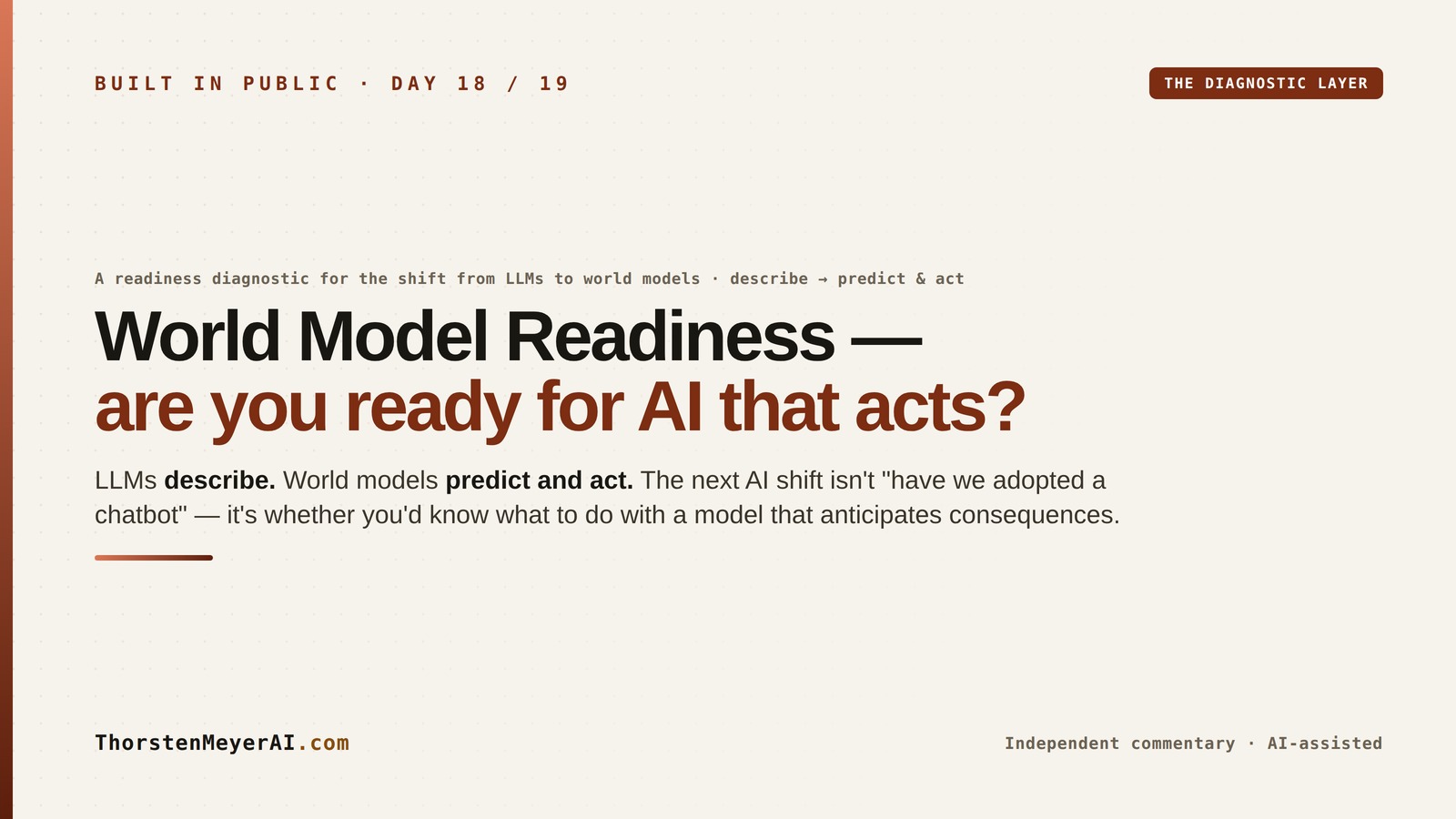
World Model Readiness — are you ready for AI that acts?
LLMs describe. World models predict and act. The next AI shift isn’t “have we adopted a chatbot” — it’s whether you’d know what to do with a model that anticipates consequences.
Independent commentary, produced with AI assistance under human editorial oversight. The views are the author’s own and may change. World Model Readiness is an early, positioning-stage diagnostic — an assessment framework, not a prediction, guarantee, or technical advice; its conclusions depend on the framework’s assumptions. “World models” are an emerging, rapidly-evolving area of AI; statements about the field reflect publicly reported developments as of mid-2026 and may quickly date. References to companies, labs, and products describe public reporting and imply no affiliation, endorsement, or verification. Product, model, and company names are trademarks of their respective owners.
What’s actually happening
It’s worth grounding this in what’s real, because “the next big thing” is a phrase that has cried wolf before. This time the activity is hard to wave away.
Yann LeCun — long one of the most prominent skeptics of the idea that language models alone lead to human-level intelligence — left Meta in late 2025 to found a startup, Advanced Machine Intelligence (AMI Labs), explicitly to build world models, reportedly raising on the order of a billion dollars to do it. Google DeepMind’s Genie 3, introduced in August 2025, generates photorealistic, interactive 3D worlds in real time from a prompt — a capability that turned world models from a research curiosity into something that looks production-grade. Meta released V-JEPA 2, a video-trained world model aimed at robotics; Fei-Fei Li’s World Labs is pursuing “spatial intelligence”; Nvidia, Waymo, and others have their own programs. By early 2026, essentially every major lab had a world-model effort, and the framing in the trade press shifted from “interesting” to “the next frontier — possibly the beginning of the end of LLMs’ dominance.”
The research itself splits along a useful line: some world models aim to understand the world by compressing it into internal latent states (the JEPA and Dreamer lineage), while others aim to predict and generate the future in convincing detail (the Genie and Sora lineage). Both feed the same destination — Vision-Language-Action systems that perceive an environment, understand a goal, and then do something about it.

Simulation Modeling and Analysis, Sixth Edition
As an affiliate, we earn on qualifying purchases.
As an affiliate, we earn on qualifying purchases.
Why this is a readiness question, not a tech-news item
Here’s the part that matters for anyone running an operation rather than a research lab. The move from describe to act changes what you have to be ready for, because — as practitioners keep pointing out — action is dangerous without prediction. You do not want an AI that clicks the buttons faster than a human if it doesn’t understand what those clicks will cause. An LLM that writes a wrong sentence wastes a minute. A grounded agent that takes a wrong action in your operation breaks something real.
Most organizations today are LLM-native: they’ve wired up chat, drafting, and summarization, and they implicitly assume AI is a thing that suggests and a human that acts. World models invert that assumption. Readiness for them isn’t “have we adopted a chatbot.” It’s a set of harder questions: Do we have world data — telemetry, video, simulations, the observational record of how our operation actually behaves — and not just documents? Are our processes even representable as states and dynamics a model could learn to predict? Can we supervise systems that act, with oversight that’s real rather than theatrical? Can we adopt a fundamentally new kind of model without being locked to one vendor’s stack? And do we understand the failure modes well enough — the reality gap between a model’s internal simulation and the messy world, the calibration problem, the seductiveness of a system that’s confidently wrong about consequences?
A world-model readiness diagnostic exists to ask exactly those questions and show you, honestly, where the gaps are. Not to sell you a world model — to tell you whether you’d know what to do with one.
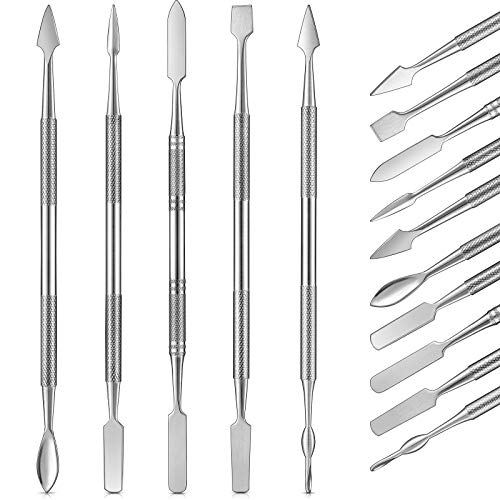
Honoson 5 Pcs Miniature Sculpting Tools, Double-Ended Steel Modeling
- Package Includes: 5 double-ended sculpting tools
- Tool Size: 17-18 cm for detailed carving
- Material Quality: Made of durable stainless steel
As an affiliate, we earn on qualifying purchases.
As an affiliate, we earn on qualifying purchases.
The most important feature is calibration
The thing that separates a useful readiness diagnostic from consultant-ware is that it has to be calibrated against reality, and reality says world models are early. For all the genuine momentum, today’s systems are data- and compute-hungry, most of their clean successes are in games and constrained simulations rather than the messy real world, and benchmark studies still find striking limitations in current general models’ basic world-modeling — including near-random performance on some elementary physical-reasoning tasks. The “reality gap” between simulation and deployment is real and unsolved.
That means readiness is posture, not panic. A diagnostic that screams “transform everything now” is selling fear; a useful one helps you tell the difference between the parts of this shift that will change your work in the next year and the parts that are still three labs and a breakthrough away. This is “edit by subtraction” applied to a hype cycle: the value isn’t chasing every announcement, it’s subtracting the noise until you can see the few developments that actually warrant a change in what you’re doing. The right posture toward world models is prepared and unhurried — and a diagnostic whose job is to produce exactly that posture is doing the most honest thing available in a field this loud.

Building Machine Learning Systems with a Feature Store: Batch, Real-Time, and LLM Systems
As an affiliate, we earn on qualifying purchases.
As an affiliate, we earn on qualifying purchases.
The thesis fit
World Model Readiness is, fittingly for the last individual product in the series, the one most explicitly about the future the whole portfolio was built for. It’s local-first in a way that’s newly literal: world models run on world data, and the readiness question includes whether you own the data and compute to feed them rather than renting your view of reality from someone else. It’s provider-agnostic at its core — because the entire readiness question is, at bottom, “can you adopt the next kind of model without being locked to the last one?” A portfolio built on never welding yourself to a single provider is, almost by definition, a portfolio built to be ready for whatever comes next. And it’s honest — calibrated to a real but hyped field rather than amplifying it.
On the constellation, it lights the final node. With it, all eighteen products are placed — which is the cue for tomorrow’s finale to do the one thing this series has been building toward: name the single thesis underneath all of them.

The Icarus Prediction: Betting it all has its price
As an affiliate, we earn on qualifying purchases.
As an affiliate, we earn on qualifying purchases.
The honest bear case
Several caveats deserve to be plain. First, it’s a diagnostic, and diagnostics are only as good as the framework behind them. A readiness assessment is a structured opinion; its value depends entirely on whether its questions are the right ones, and “AI readiness assessment” is a category that has produced a great deal of vague, hard-to-validate consultant-ware. The burden is on any such tool to be specific and falsifiable rather than reassuringly fuzzy.
Second, the target is moving fast. World models are early enough that any readiness framework will need continual revision; a snapshot taken today could be partly obsolete within a year, which is a real maintenance burden and a reason to treat any single assessment as a starting point, not a verdict.
Third, readiness is hard to measure and easy to fake. Unlike a benchmark with a score, “are you ready for AI that acts?” resists clean quantification, and there’s an ever-present risk of a diagnostic producing comforting numbers that don’t correspond to genuine preparedness.
And fourth, it’s early and positioning-stage — the case for it is stronger than the proof of it, and honesty requires saying so.
The bull case, plainly
With those caveats standing: the shift from describe to act is real, it’s accelerating, and remarkably few operators are thinking about it structurally rather than as a stream of impressive demos. A diagnostic that is calibrated, hype-aware, and specific about the dimensions that actually matter — data, representability, oversight, provider-agnostic adaptability, and risk literacy — is genuinely useful precisely because the alternative is reacting to each announcement without a frame. It operationalizes the one quality this entire portfolio is built around: adaptability without lock-in. And it asks the question that matters more than “which model is smartest” — are you ready for what models are about to become?
It’s the right diagnostic to close the portfolio on, because it points past the products to the reason they were all built the way they were. Everything in this series was made to stay ready. World Model Readiness is just the part that says so out loud — and then bridges to the finale, where the thesis under all eighteen finally gets named.
World Model Readiness is an early, positioning-stage diagnostic; it is an assessment framework, not a prediction, a guarantee, or technical advice, and its conclusions depend on the framework’s assumptions. “World models” are an emerging, rapidly-evolving area of AI; statements here about the field reflect publicly reported developments as of mid-2026 and may quickly date. References to specific companies, labs, and products describe public reporting and do not imply any affiliation, endorsement, or verification. This article was produced with AI assistance under human editorial oversight; the views are the author’s own and may change. Product, model, and company names are trademarks of their respective owners. © 2026 Thorsten Meyer · Powered by Thorsten Meyer AI. See Imprint/Impressum and Privacy Policy.