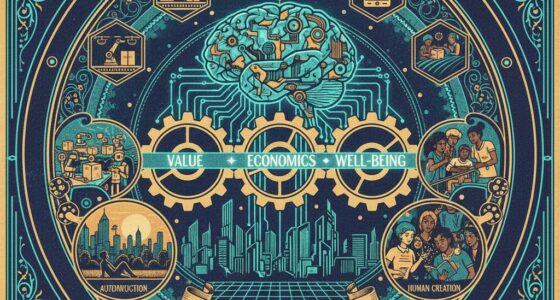

As automation transforms work, redefine productivity by focusing on impact, creativity, and continuous adaptation rather than traditional metrics like hours or tasks. Embrace new roles, develop skills in AI and data analysis, and foster a culture that values innovation and resilience. By shifting your perspective to meaningful contributions and agile practices, you can thrive in a post-labor world. Stay tuned to discover strategies that can help you harness this change effectively.
Key Takeaways
- Shift focus from hours worked to impact, innovation, and problem-solving as core productivity measures.
- Emphasize quality, collaboration, and creative contributions over quantity of tasks completed.
- Foster a culture of continuous learning and adaptability to keep pace with technological change.
- Redefine success through outcomes, innovation, and organizational resilience rather than traditional metrics.
- Leverage remote work and cross-functional teams to enhance flexibility, engagement, and sustained value creation.
The Changing Landscape of Employment and Automation

As automation accelerates, the employment landscape is undergoing a profound transformation. You’ll notice many jobs, especially in clerical, manufacturing, and customer service roles, face significant change or disappearance. By 2030, up to 30% of U.S. jobs could be fully automated, with 60% experiencing major task shifts. Globally, around 92 million roles are expected to vanish between 2025 and 2030. Yet, this shift also creates new opportunities. You’ll see a surge in roles like data specialists, green economy workers, and healthcare providers. The labor market is reshaping, affecting roughly one-fifth of current jobs. Automation boosts productivity and business growth, but it also demands that you adapt—learning new skills and embracing change to thrive in this evolving environment. Increased thickness can improve sleep quality significantly.
Rethinking Traditional Metrics of Productivity

You need to reconsider how you measure productivity, moving beyond hours worked or tasks completed. Focus on the value created through innovation and creativity, which drive long-term growth. By shifting your metrics, you’ll better capture the true impact of your efforts in a rapidly changing, automation-driven world. Recognizing the importance of active listening and empathy can further enhance collaborative success and innovation.
Shifting From Hours Worked
Traditional measures of productivity, such as hours worked or tasks completed, no longer capture the true value employees bring to their organizations. As automation handles routine tasks, your focus shifts from time spent to the impact of your work. Instead of counting hours, you’re evaluated based on the results you deliver, the problems you solve, and the innovations you contribute. This new approach encourages flexibility, emphasizing quality over quantity. It recognizes that meaningful progress isn’t tied to clock-in times but to the cultural intelligence created. You’re empowered to work smarter, prioritize high-impact activities, and develop skills that drive growth. Ultimately, redefining productivity means valuing adaptability, creativity, and outcomes—traits that matter far more than how long you sit at your desk.
Valuing Innovation and Creativity
Valuing innovation and creativity requires shifting our focus from simply measuring output by volume or hours to recognizing the unique contributions that drive progress. Instead of counting tasks completed, you should prioritize ideas, problem-solving, and adaptability. Creative thinking fuels breakthroughs, and innovative solutions often lead to significant value, even if they aren’t immediately quantifiable. You need to establish new metrics that capture the quality of work, collaboration, and the ability to develop novel approaches. Recognize that productivity isn’t just about speed or volume but about fostering an environment where new ideas flourish. By emphasizing these intangible yet impactful contributions, you enable a culture that values continuous growth, learning, and the human ingenuity essential for charting a course through a rapidly changing world. Incorporating curiosity as a key driver can further unlock creative potential and inspire ongoing innovation.
Measuring Value Creation
Measuring value creation in today’s evolving workplace requires us to move beyond simple metrics like hours worked or tasks completed. You need to focus on outcomes that matter—impact on innovation, customer satisfaction, and adaptability. Traditional measures fall short as automation and AI shift the nature of work. Instead, consider these factors:
- How effectively teams leverage technology to solve complex problems
- The quality and creativity of solutions delivered
- Speed of learning and skill development in employees
- Contribution to strategic goals and long-term growth
- Recognizing that creative practice and resilience are essential in cultivating innovative solutions and adapting to new challenges
Embracing New Roles and Skillsets for the Future Workforce

As automation transforms the workforce, embracing new roles and skillsets becomes essential for staying relevant and competitive. You need to develop proficiency in data analysis, programming, and AI/ML tools to meet evolving job demands. Soft skills like creativity, emotional intelligence, and problem-solving will remain crucial, complementing technical expertise. Continuous learning is critical, as the half-life of skills shortens, and adapting quickly can give you a significant edge. Wages for workers with advanced tech skills are rising, highlighting their importance. To thrive, you must stay curious, seek out training opportunities, and be willing to shift into emerging fields like green economy jobs, healthcare, or data-driven roles. Developing a deep understanding of projectors and display technology can also provide new opportunities in the growing home entertainment industry. Embracing these changes ensures you remain valuable in a rapidly evolving labor landscape.
Overcoming Barriers and Risks in the Transition to AI-Driven Work

Moving to AI-driven work presents significant challenges that organizations and workers must address proactively. Without careful planning, issues like resource gaps, data quality problems, and security vulnerabilities can stall progress. Resistance to change and slow adoption rates also threaten successful shifts. To navigate these risks, you need to focus on:
- Investing in employee training and upskilling to ease integration
- Implementing strong cybersecurity measures to protect automated systems
- Developing clear policies to manage ethical concerns and compliance
- Ensuring equitable automation adoption to prevent widening inequality
Leveraging Automation to Enhance Creativity and Innovation
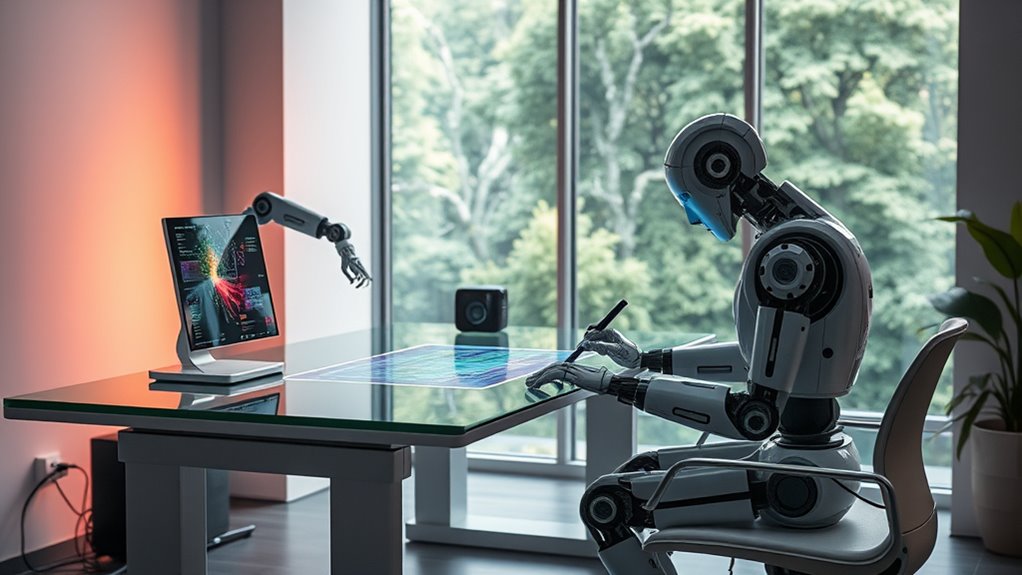
Automation isn’t just about increasing efficiency; it’s also opening new frontiers for creativity and innovation. By automating routine tasks, you free up time and mental space to generate fresh ideas and explore new solutions. AI tools can analyze data to uncover patterns, inspire new product designs, or optimize workflows, fueling innovation. Embracing automation empowers you to focus on complex, value-added activities that require human insight and creativity. Here’s a quick visual on how automation supports innovation:
| Idea Generation | Process Optimization | Collaboration Enhancement |
|---|---|---|
| Brainstorm faster | Streamline workflows | Improve team communication |
| Data-driven insights | Reduce manual errors | Facilitate remote teamwork |
| Creative problem-solving | Accelerate prototyping | Share knowledge effortlessly |
| New product ideas | Increase flexibility | Foster cross-functional synergy |
Strategies for Building a Resilient and Adaptive Organizational Culture

Building a resilient and adaptive organizational culture requires intentional strategies that foster agility, learning, and resilience among employees. You need to create an environment where change is embraced, and continuous improvement is prioritized. Encourage open communication, so teams can quickly identify and respond to new challenges. Invest in ongoing training that builds digital and soft skills, preparing staff for evolving roles. Promote psychological safety, allowing employees to experiment without fear of failure. Cultivate leadership that models adaptability and resilience. Incorporating remote work practices can significantly enhance organizational flexibility and employee satisfaction.
- Foster a growth mindset through regular feedback and development
- Implement flexible work arrangements to support agility
- Reward experimentation and innovative problem-solving
- Develop cross-functional teams to enhance collaboration and resilience
Frequently Asked Questions
How Will Automation Impact Income Inequality Across Different Socioeconomic Groups?
Automation may widen income inequality if lower-wage workers are displaced faster than they can adapt or upskill. You might find that high-skilled workers benefit from increased productivity and wages, while vulnerable groups struggle with job loss and limited access to new opportunities. To bridge this gap, you’ll need continuous learning, better access to training, and policies that support fair shifts , ensuring everyone benefits from technological progress.
What Ethical Considerations Arise From Increasing Reliance on AI in Decision-Making?
Remember, with great power comes great responsibility. As you rely more on AI for decision-making, ethical questions about bias, transparency, and accountability become critical. You need to guarantee AI systems don’t reinforce existing inequalities or make unfair choices. Prioritizing fairness, privacy, and human oversight helps prevent misuse and maintains trust. Balancing innovation with ethical standards is essential to harness AI’s benefits without compromising societal values.
How Can Organizations Ensure Equitable Access to Upskilling Opportunities?
You can guarantee equitable access to upskilling by creating inclusive programs that target all employee levels and backgrounds. Offer flexible learning options, such as online courses and workshops, and provide financial support or incentives for participation. Collaborate with community organizations and educational institutions to reach underserved groups. Regularly assess needs and adjust offerings to close skill gaps, making sure everyone has equal opportunities to grow and adapt in the evolving workforce.
What Policies Are Needed to Support Displaced Workers During Transitions?
You need policies that provide thorough retraining programs, income support, and job placement services to support displaced workers. Invest in accessible education and upskilling initiatives, ensuring barriers like cost and location are minimized. Encourage flexible work arrangements and partnerships with industries to create new opportunities. Strengthen social safety nets and implement transitional assistance, so workers can adapt smoothly and find sustainable employment during this shift.
How Will AI Influence Future Human Roles in Creative and Strategic Tasks?
AI will enhance your ability to focus on creative and strategic tasks by automating routine work. You’ll need to develop skills in data analysis, programming, and AI tools to stay relevant. Your soft skills—like emotional intelligence, problem-solving, and innovation—will become more valuable. Embrace continuous learning, adapt to new technologies, and collaborate with AI systems to generate impactful ideas, making your roles more dynamic and fulfilling.
Conclusion
As you navigate this new world, remember that redefining productivity is like tending a garden—you need patience, adaptability, and a willingness to embrace change. Automation isn’t the end but a new beginning for creativity and innovation. By staying resilient and open to learning, you’ll help shape a future where work evolves into something richer and more meaningful. Embrace these shifts, and you’ll thrive in a landscape as vibrant and dynamic as a blooming garden.