

Get business pricing on tech for your team
- Business-only prices and quantity discounts
- Tax-exempt purchasing
- Multiple users, one account, clear invoices
The bottom rung.
The numbers arriving this spring are the kind that make a trend feel like a fact. Entry-level job postings in the US are down roughly 35% since early 2023; junior postings in software and data analysis have fallen as much as 67%; hiring of recent graduates by the largest tech companies is down 50% from pre-pandemic levels; and the unemployment rate for college graduates aged 22 to 27 has climbed to nearly 6% — above the national rate, a reversal economists call almost unprecedented. The first rung of the career ladder is narrowing, and it is narrowing fast.
The instinct is to read this as a job-loss story: AI takes the entry-level jobs, the graduates can’t get hired, unemployment rises. That reading is partly right and mostly beside the point. The deeper story is not that entry-level jobs are disappearing in a single dramatic wave. It is that the apprenticeship layer is disappearing — the rung where junior workers did the rote tasks that taught them to become senior ones.
That is the part that matters, because it breaks something that does not show up in this year’s unemployment rate. AI is automating exactly the work that used to be the bottom rung: the basic coding, the first-draft research, the data cleaning, the document review — the “drunt work” that was simultaneously a junior’s job and a junior’s training. When the AI does the grunt work, the firm saves the junior’s salary today and loses the pipeline that produces its seniors tomorrow. The cost is deferred, which is exactly why it is being incurred.
So the question is not the one the headlines ask. It is not “are entry-level jobs vanishing” — they are demonstrably contracting — but “who trains the seniors a decade from now if the rung that produced them is gone.” And that question is genuinely unresolved, because the entry-level collapse is partly AI automating the training tasks, partly a cyclical hiring freeze that will reverse when rates fall, and partly a reshaping of junior work that may rebuild the rung in a new form. Disentangling those is the whole problem.
The structural argument I want to make: the entry-level hiring collapse is real and measurable, but its most important consequence is not the jobs lost today — it is the apprenticeship layer being dismantled, the rung where junior tasks trained workers into senior roles, which means the genuine risk is a deferred one: a pipeline that produces senior expertise being broken for short-term AI efficiency, with the cost appearing not in this year’s unemployment rate but in a decade’s shortage of people who learned the trade the old way — and whether that risk is real or whether the rung simply rebuilds in a new form is the unresolved question the data cannot yet settle. This is the news-flex companion to The labor share: where that dispatch asked whether the aggregate is moving, this zooms into the one place it demonstrably is — the entry level — and asks what the movement there actually threatens.
The headline integrative finding: The honest both-sides read is that the entry-level layer is unambiguously contracting and the meaning of that contraction is genuinely contested. One reading — call it the apprenticeship-severance view — holds that AI is corroding the pipeline: it automates the junior tasks that built expertise, firms cut the roles to capture the efficiency, and a decade from now there are no mid-career professionals because the roles that produced them are gone. The other reading — call it the reshaping view, advanced by the WEF and firms like McKinsey and Ropes & Gray that are increasing junior hiring and investing in AI apprenticeships — holds that entry-level work is not disappearing but transforming, from doing toward reviewing, from producing toward triaging, and that the rung rebuilds in a new form. The deepest point is that this is not a disagreement about whether AI is changing entry-level work — that is not in dispute — but about whether the change is compatible with the transmission of expertise or corrosive to it, and that question turns on a confound the data cannot yet resolve: how much of the collapse is AI automating the training layer (structural, permanent) versus a post-2022 interest-rate hiring freeze reversing the zero-rate overhiring of 2020-22 (cyclical, temporary). If it is mostly cyclical, the rung rebuilds when rates fall. If it is mostly structural, the rung is gone and the pipeline with it. The cost of being wrong is asymmetric: a cyclical problem misread as structural wastes effort; a structural problem misread as cyclical breaks the expertise pipeline before anyone notices.
This essay walks the measurable collapse, the apprenticeship-layer mechanism, the deferred-cost problem, the reshaping counter-case, the cyclical-versus-structural confound, the asymmetry that should drive the response, and the structural reading of a rung that is breaking faster than anyone can confirm why.
By Thorsten Meyer — June 2026
This is a news-flex dispatch in the Post-Labor and Enterprise tracks — the entry-level signal, promoted from a data point in The labor share to a subject in its own right. The labor share asked whether value is moving from labor to capital in the aggregate; this asks what is happening at the one margin where the movement is undeniable, and finds the threat is less about jobs than about the machinery that turns juniors into seniors.
The structural argument I want to make: every profession runs on an apprenticeship layer — a set of low-value tasks juniors perform that are simultaneously the firm’s grunt work and the junior’s education — and AI is the first technology to automate that layer directly, which means it does not just replace workers but removes the rung on which workers were made, and the consequences of removing a training layer are invisible until the people it would have trained are needed and absent. The rung is where expertise is transmitted; automate it, and you save money now and discover the cost when the senior pipeline runs dry.
The headline integrative finding: The entry-level collapse is the most legible labor signal of the AI transition and the least conclusive. Legible because the numbers are large and consistent across sources; inconclusive because the mechanism is confounded by an interest-rate cycle that independently suppresses junior hiring. The thing worth holding onto is the asymmetry: the apprenticeship layer, once dismantled, takes a decade to rebuild, and a firm that cuts it for AI efficiency will not feel the cost until its senior pipeline is empty — which is the worst possible time to learn the rung mattered. That asymmetry, not certainty about the mechanism, is the case for protecting the rung now: the cost of preserving it if it turns out cyclical is small; the cost of losing it if it turns out structural is a generation of missing expertise.
This essay walks the collapse (Section I), the apprenticeship mechanism (Section II), the deferred cost (Section III), the reshaping counter-case (Section IV), the cyclical confound (Section V), the asymmetry (Section VI), and the structural reading (Section VII).
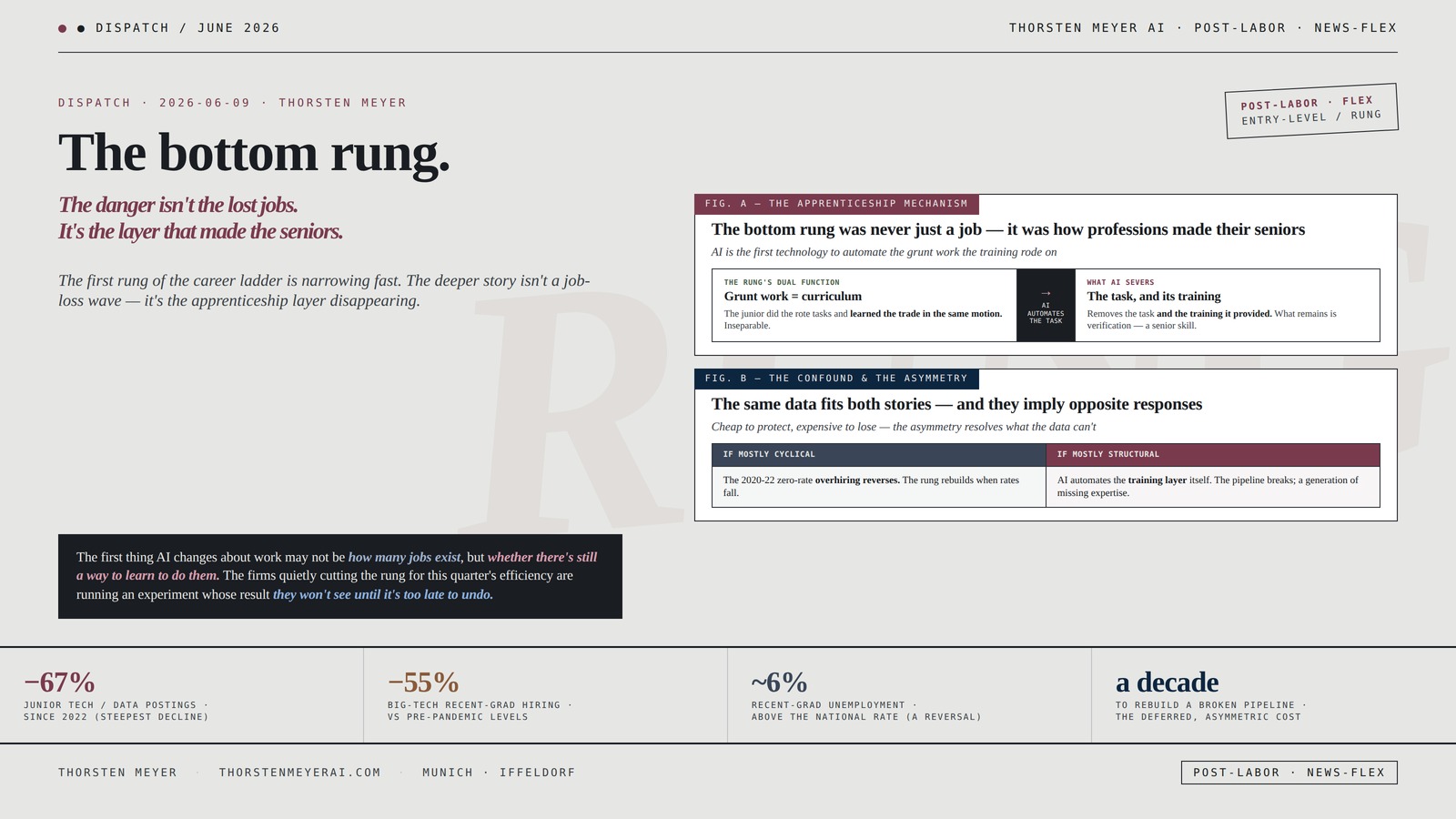
The bottom rung.
The danger isn’t the lost
jobs. It’s the layer that
made the seniors.
since 2022 (the steepest decline)
vs pre-pandemic levels
above the national rate (a reversal)
the deferred, asymmetric cost
automates
the task
The first thing AI changes about work may not be how many jobs exist, but whether there is still a way to learn to do them. The firms quietly cutting the rung for this quarter’s efficiency are running an experiment whose result they will not see until it is too late to undo.Thorsten Meyer · The Bottom Rung · Post-Labor news-flex
Products Worth Considering

DJI Osmo Mobile 7P Gimbal Stabilizer with Mic Mini Transmitter, Infinity Black

Apple iPad Air 13-inch (M4), 128GB, Wi-Fi 7, Space Gray

Bose TV Speaker Compact Soundbar with Bluetooth and HDMI-ARC, Black
As an affiliate, we earn on qualifying purchases.
I · The collapse · the numbers are large and consistent
The measurement crystallization. Begin with what is not in dispute. The entry-level layer is contracting, the numbers are large, and they are consistent across independent sources. Whatever the cause, the phenomenon is real.
The postings
Down a third, and far more in tech: entry-level job postings in the US are down roughly 35% since early 2023 (Revelio Labs); junior postings in software development and data analysis have fallen as much as 67% since 2022; hiring of recent graduates by the fifteen largest tech companies is down about 55% since 2019. LinkedIn’s entry-level hiring rate fell 6% between December 2025 and February 2026 alone. The contraction is sharpest exactly where AI is most capable — software, data, analysis — and that concentration is the first hint the cause is not purely cyclical.
The graduates
The unprecedented reversal: the unemployment rate for college graduates aged 22 to 27 has climbed to roughly 5.6-6%, above the national rate — a reversal the Federal Reserve calls a noticeable deterioration and economists note is almost without precedent (a degree usually buys a lower unemployment rate). Graduates aged 22-27 are 5% of the workforce but contributed 12% of the rise in national unemployment since mid-2023 (Oxford Economics). Underemployment among recent grads runs near 43%, the highest since the pandemic. The people the entry-level rung was built for are the ones it is failing.
The corporate signal
AI named as the reason: Challenger, Gray & Christmas reported AI was cited for 21,490 of April 2026’s announced job cuts — 26% of the month’s total, the top stated reason for the second consecutive month. SignalFire attributed a 25% drop in big-tech recent-graduate hiring directly to AI. Whatever the true cause, employers are increasingly naming AI as the reason — which shapes behavior even where it is not the whole story.
The collapse observation
The entry-level layer is unambiguously contracting: postings down ~35% (and up to 67% in tech), big-tech graduate hiring down ~55% from pre-pandemic, recent-grad unemployment above the national rate in a near-unprecedented reversal — large, consistent numbers across independent sources. The phenomenon is not in dispute. What is in dispute is the cause and the meaning — and the concentration of the collapse exactly where AI is most capable is the first reason to suspect this is more than a hiring cycle, even if a hiring cycle is part of it.
II · The apprenticeship mechanism · what the rung actually was
The structural crystallization. To see why the collapse matters beyond the jobs, you have to see what the bottom rung actually did. It was never just a job. It was the mechanism by which professions reproduced themselves.
The dual function of junior work
Grunt work and training, at once: entry-level work has always had a dual nature — the junior does the firm’s low-value tasks (basic coding, first-draft research, data cleaning, document review) and, in doing them, learns the trade. The rote work was the curriculum. A junior developer debugging simple code, a junior analyst building a first model, a junior associate reviewing documents — each was producing value and acquiring expertise in the same motion. The bottom rung was simultaneously the firm’s cheapest labor and its training pipeline, and the two functions were inseparable.
Why AI severs them
It automates the training tasks specifically: AI is the first technology to automate the junior tasks directly — the grunt work that was the training. When an AI generates the SQL query, drafts the brief, debugs the code at near-zero marginal cost, the economic rationale for paying a junior to do the same work collapses. But the junior was not only doing work; the junior was learning by doing it. AI removes the task and, with it, the training the task provided — it severs the grunt-work function from the training function by automating the grunt work the training rode on.
The verification shift
The job moves to a senior task: as AI does the production, the human job shifts from creation to verification — checking, judging, triaging the machine’s output. But verification is an inherently senior skill; you cannot verify code you never learned to write. The work that remains for humans is the senior work, and the entry-level rung that would have taught a junior to do it has been automated away — leaving early-career workers stranded between the AI agents below them and the senior incumbents above, with no rung to climb from.
The apprenticeship observation
The bottom rung was never just a job — it was the mechanism by which professions reproduced themselves: junior tasks that were simultaneously the firm’s grunt work and the junior’s training, inseparable functions, and AI is the first technology to automate the grunt work directly, severing it from the training it carried. The work that remains is verification — a senior skill a junior cannot acquire without the rung. This is why the collapse matters beyond the jobs: AI is not just removing entry-level positions, it is removing the apprenticeship layer those positions constituted — the layer where seniors were made.
III · The deferred cost · why the danger is invisible now
The temporal crystallization. The reason the apprenticeship collapse is dangerous is that its cost is deferred. A firm that automates the rung saves money this year and pays the bill a decade out — which is precisely why the bill gets run up.
The asymmetric timing
Savings now, shortage later: cutting the entry-level layer produces immediate, visible savings — fewer salaries, more AI efficiency. The cost — a shortage of mid-career professionals because the roles that produced them are gone — appears years later, when the current seniors retire and there is no one trained to replace them. The savings are concentrated and present; the cost is diffuse and future — the textbook structure of a problem that gets created because no one pays for it when they cause it.
Why leaders miss it
Labor markets adjust before they spike: the standard error is to wait for a spike in unemployment as the signal of structural change. But labor markets often adjust earlier and more quietly — through fewer hires, longer job searches, narrowed entry — without a dramatic unemployment number. By the time the senior shortage shows up in a metric, the rung will have been gone for a decade, and rebuilding a training pipeline takes another decade. The signal that matters (entry-level contraction) is not the signal leaders watch (aggregate unemployment).
The efficiency trap
Real gains, hidden dismantling: the AI efficiency gains are real — that is what makes the trap work. A firm captures genuine short-term productivity by automating junior tasks, and the dismantling of its talent pipeline happens silently underneath the gains. The efficiency is visible and bankable; the pipeline damage is invisible and deferred — so a rational firm optimizing for this quarter will cut the rung, and a whole economy of rational firms will dismantle the apprenticeship layer without any single one deciding to.
The deferred-cost observation
The apprenticeship collapse is dangerous because its cost is deferred: cutting the rung produces immediate visible savings and a diffuse future shortage of seniors, and labor markets adjust through fewer hires and longer searches before any unemployment spike — so the damage is done and invisible long before it registers in the metrics leaders watch. The efficiency gains are real, which is what makes the trap work. A rational firm optimizing for the quarter cuts the rung; an economy of rational firms dismantles the apprenticeship layer with no one deciding to — and discovers the cost a decade later, when it is too late to rebuild in time.
IV · The reshaping counter-case · the rung might rebuild
The strongest-counter crystallization. Intellectual honesty requires the best version of the argument that the apprenticeship layer is not being destroyed but transformed — and that case is real, advanced by serious institutions and backed by firms acting against the trend.
The reshaping thesis
From doing to reviewing: the WEF’s analysis argues entry-level roles are not disappearing but being reshaped — from task execution toward judgment, from drafting toward reviewing, from producing outputs toward triaging the machine’s. On this view, the rung is not gone; it is becoming a different rung, one where juniors learn to direct and verify AI rather than do the rote work themselves. The apprenticeship layer rebuilds in a new form: the junior still learns, but learns a different, arguably higher-order skill.
The firms acting against the trend
Increasing junior hiring, investing in AI apprenticeships: not everyone is cutting. McKinsey announced it would increase North American hiring 12% in 2026, arguing AI deployment needs more creative problem-solvers, not fewer. Law firms including Ropes & Gray built AI training programs treating junior experimentation as a firm-wide investment — reportedly letting first-years spend up to 400 of their 1,900 annual billable hours on AI work. Tech apprenticeships have grown 29% over four years; Accenture made apprentices 20% of North American entry-level hiring. Some of the most sophisticated firms are doing the opposite of cutting the rung — they are rebuilding it deliberately, treating the apprenticeship layer as an investment AI makes more valuable, not less.
Why this case is strong
The entry-level workers themselves are not panicking: PwC’s survey of 9,394 entry-level employees across 48 economies found them more curious (47%) and excited (38%) than worried (29%) about AI’s impact on their work. The people closest to the rung are, on balance, optimistic that it reshapes rather than vanishes. The reshaping case is not wishful thinking; it is backed by institutions acting on it, firms investing in it, and the affected workers’ own read.
The reshaping observation
The strongest counter is the reshaping case: entry-level work is not disappearing but transforming from doing toward reviewing, the rung rebuilding in a new form — and it is backed by serious institutions (the WEF), firms acting against the trend (McKinsey increasing hiring, Ropes & Gray investing 400 hours per first-year in AI training, Accenture’s apprenticeships), and the affected workers’ own optimism. This case deserves to be taken as seriously as the severance case. The reshaping view holds that AI makes the apprenticeship layer more valuable, not less, and that the firms cutting the rung are making a short-term error the smart firms are already correcting — which means the collapse could be a transition to a new rung rather than the loss of the rung itself.
V · The cyclical confound · how much is AI at all
The skeptic crystallization. Beneath both the severance and reshaping cases sits a harder question: how much of the entry-level collapse is AI at all, versus an interest-rate cycle that independently suppresses junior hiring? This confound is the one that could unravel the whole story.
The rate story
Zero-rate overhiring, then the reversal: from 2020 to 2022, the Fed held rates near zero, and big tech hired by the millions — Meta roughly doubled from 45,000 to 86,000 employees, Alphabet from 119,000 to over 190,000. When rates rose sharply, the cheap-money hiring reversed, and entry-level roles — the most speculative, least essential hires — were cut first. The entry-level collapse coincides almost exactly with the rate-hike cycle, and entry-level hiring is precisely what a rate-driven freeze cuts first.
The timing problem
Correlation that looks like causation: AI adoption surged at the same moment the rate cycle suppressed junior hiring, which makes AI a convenient and plausible-looking scapegoat for a collapse that monetary policy can explain on its own. The Stanford Review’s analysis argues the similarities to past rate-driven hiring freezes are “eerily close” — steep hikes, an entry-level freeze, a technological scapegoat, and (the prediction) a recovery once rates fall. If the collapse recovers when rates do, it was cyclical, and the apprenticeship-severance story was a misreading of a hiring cycle.
Why the confound matters
It changes everything about the response: if the collapse is mostly cyclical, the rung rebuilds when rates fall and the alarm is overblown. If it is mostly structural — AI automating the training layer — the rung does not come back and the pipeline breaks. The same data is consistent with both, and the two imply opposite responses. The confound is not a detail; it is the difference between a problem that solves itself and one that compounds — and the data cannot yet tell us which, because the rate cycle and the AI wave arrived together.
The cyclical observation
The hardest question is the confound: the entry-level collapse coincides almost exactly with the post-2022 interest-rate cycle, which independently suppresses junior hiring (the speculative hires cut first when cheap money ends), making AI a plausible scapegoat for a collapse monetary policy can partly explain on its own. The same data fits both a structural-AI story and a cyclical-rate story, and they imply opposite responses. Whether the rung rebuilds when rates fall, or stays gone because AI took the training tasks, is the question the data cannot yet settle — because the cycle and the wave arrived at the same time, and only their divergence will reveal which was doing the work.
VI · The asymmetry · why the response should not wait for proof
The decision crystallization. Having stated both the severance and reshaping cases, and the confound that unsettles both, the practical question is what to do under genuine uncertainty. The answer comes from the asymmetry of the costs, not from resolving the debate.
The asymmetric costs
Cheap to protect, expensive to lose: if the rung is protected (firms keep hiring and training juniors, supported by apprenticeship programs and incentives) and the collapse turns out cyclical, the cost is small — some redundant junior hiring during a downturn. If the rung is not protected and the collapse turns out structural, the cost is enormous — a broken expertise pipeline that takes a decade to rebuild and a generation of missing mid-career professionals. The downside of protecting the rung unnecessarily is small and recoverable; the downside of losing it mistakenly is large and slow to fix.
Why this favors action
The no-regrets logic, applied to the rung: under genuine uncertainty about a confounded mechanism, the rational move is the one robust to being wrong — and protecting the apprenticeship layer is robust: it helps if the collapse is structural (it preserves the pipeline) and does little harm if it is cyclical (it sustains some junior hiring through a downturn that would have recovered anyway). You do not need to resolve the cyclical-versus-structural debate to justify protecting the rung; you only need to recognize that the cost of being wrong is asymmetric — which is the same no-regrets logic the ownership case rests on, applied to the training layer instead of the income stream.
What protecting the rung looks like
Apprenticeships, incentives, redesigned junior work: the concrete responses follow the reshaping case’s playbook — registered apprenticeships (growing 29%), employer incentives for junior hiring, junior roles redesigned around judgment and AI-direction rather than rote tasks, AI-native vocational training. The firms already doing this (McKinsey, Ropes & Gray, Accenture) are hedging correctly: they are protecting the rung in its new form, which is the move that wins whether the collapse is structural or cyclical.
What this is not
It is not a claim that AI is destroying the entry-level layer. The layer is contracting; whether AI or the rate cycle is the primary cause is unresolved. The claim is about the apprenticeship function, not a verdict on the mechanism.
It is not a claim that the reshaping case is wrong. The rung may rebuild in a new form, and the firms investing in that are likely right. The claim is that the rebuild is not automatic and the cost of assuming it asymmetric.
It is not a prediction that the senior pipeline breaks. It may not. The claim is that the risk is deferred and asymmetric, which is why it warrants action before proof.
The synthesis observation
The entry-level collapse is real and measurable, but its most important consequence is the apprenticeship layer being dismantled — the rung where junior tasks trained workers into seniors — so the genuine risk is deferred: a broken expertise pipeline whose cost appears not in this year’s unemployment rate but in a decade’s senior shortage, and whether that risk is real or whether the rung rebuilds in a new form turns on a cyclical-versus-structural confound the data cannot yet resolve. The severance case and the reshaping case read the same contraction differently; the rate confound unsettles both; and the asymmetry of the costs — cheap to protect, expensive to lose — is what should drive the response.
There is no single answer. Anyone offering one is selling something. What is unambiguous is that the bottom rung is contracting faster than anyone can confirm why, that the rung was the mechanism professions used to make their seniors, and that automating it saves money now and defers a cost no one will feel until the pipeline runs dry. Whether the rung rebuilds in a new form or simply vanishes is genuinely unknown — but the asymmetry resolves the decision the data cannot: protect the rung now, because the cost of protecting it unnecessarily is small and the cost of losing it mistakenly is a generation of missing expertise. The firms quietly cutting the rung for this quarter’s efficiency are running an experiment whose result they will not see until it is too late to undo, and the firms rebuilding it deliberately are hedging the only way the uncertainty allows.
That is the structural editorial question the bottom rung sits on top of. It is a measurable collapse whose cause is confounded. It is an apprenticeship layer being automated away by the first technology that could. And it is a deferred, asymmetric cost that argues for protecting the rung before anyone can prove it needs protecting. And it is the most legible signal of the AI labor transition — the one place the aggregate-stable, margin-moving picture of The labor share resolves into something you can count — and what it reveals is that the first thing AI changes about work may not be how many jobs exist, but whether there is still a way to learn to do them.
About the Author
Thorsten Meyer is a Munich-based futurist, post-labor economist, and recipient of OpenAI’s 10 Billion Token Award. He spent two decades managing €1B+ portfolios in enterprise ICT before deciding that writing about the transition was more useful than managing quarterly slides through it. He runs StrongMocha News Group, a network of more than 450 niche WordPress magazines built on the DojoClaw editorial engine. More at ThorstenMeyerAI.com.
Related Reading
This dispatch
- This piece · The bottom rung · the entry-level-compression forensic — how the collapse’s real danger is the dismantled apprenticeship layer, why the cost is deferred and asymmetric, and why the cyclical-versus-structural confound argues for protecting the rung before proof · labor-rose dominant, structural-slate and alternative-sage balance
The track
- The labor share · Post-Labor 02 · the aggregate-versus-margin question this piece zooms into — the labor share asked whether the aggregate moves; this examines the one place it demonstrably does
- The stake · Post-Labor 01 · the ownership response, whose no-regrets logic this piece applies to the training layer instead of the income stream
Adjacent tracks · the rung in specific places
- The pyramid cracks · Enterprise Reorg 02 · the consulting pyramid whose junior tiers this collapse hollows out — the apprenticeship severance in professional services
- The runway · Enterprise Reorg 04 · the enterprise-AI capex whose efficiency gains are the visible side of the deferred-cost trap
Sources
The collapse
- Metaintro · Entry-level jobs are vanishing for 2026 — entry-level postings down 35% since early 2023 (Revelio Labs); junior software/data postings down as much as 67%; ~43% of grads aged 22-27 underemployed (Dec 2025), highest since the pandemic; a Harvard study of 62M workers across 285,000 firms finding junior positions “shrinking at companies integrating AI” since 2023 · metaintro.com
- MyMobileLyfe · Entry-level tech hiring dropped 67% — junior tech postings down 67% since 2022; LinkedIn entry-level hiring −6% (Dec 2025-Feb 2026), middle-management −10%; postings demanding 2-3 years’ experience for what used to be entry-level; “a career ladder with no first rung” · mymobilelyfe.com
- NewsNation / SignalFire · AI disrupting the entry-level market — big-tech recent-grad hiring down 25% in 2024, 50% vs pre-pandemic; grads 22-27 are 5% of the workforce but 12% of the unemployment rise since mid-2023 (Oxford Economics); recent-grad unemployment ~6% vs national 4.2%; Amodei’s “up to half of entry-level white-collar jobs” warning · yahoo.com
- TECHi · The missing rung in the career ladder — Challenger, Gray & Christmas: AI cited for 21,490 of April 2026’s job cuts (26%, top stated reason two months running); Gallup: half of US adults use AI at work, 18% think their job likely eliminated within five years; “the deeper story is the disappearance of the apprenticeship layer” · techi.com
The apprenticeship mechanism
- Rezi · The crisis of entry-level labor — the “drunt work” framing: AI mastering the grunt work (code generation, financial modeling) juniors learned on; “the traditional deal of entry-level work — rote labor for mentorship — is dead”; the trust gap (84% of developers use AI tools, 46% distrust output) shifting the job from creation to verification, “an inherently senior task”; tech apprenticeships +29% over four years, Accenture apprentices 20% of NA entry-level hiring · rezi.ai
- Great Leadership · AI cost-cutting is breaking the talent pipeline — “a structural contraction of the entry-level layer,” not cyclical softness; 957,000 UK young people NEET (second-highest in over a decade); US new-grad hiring at the 15 largest tech firms down 55% since 2019; CS-grad unemployment 6.1%; “breaking the pipeline that produces senior expertise a decade from now” · greatleadership.substack.com
The reshaping counter-case
- SmarterArticles · The apprenticeship severance — the reasonable-disagreement framing: “not whether AI is changing entry-level work, which is not in dispute, but whether the change is structurally compatible with the transmission of expertise or structurally corrosive to it”; McKinsey +12% NA hiring in 2026; Ropes & Gray letting first-years spend up to 400 of 1,900 billable hours on AI work; the WEF’s reshaping thesis (task execution → judgment, drafting → reviewing, producing → triaging) · smarterarticles.co.uk
- PwC / WEF · How AI is changing early careers — the Global Dialogue on AI and Entry-Level Work (200+ leaders); PwC’s survey of 9,394 entry-level employees across 48 economies finding them more curious (47%) and excited (38%) than worried (29%) · pwc.com
- Fortune (McAfee) · Automating Gen Z entry-level jobs could backfire — MIT’s Andrew McAfee on the risk of cutting the least-expensive talent and undermining long-term workforce development; Handshake postings −2% YoY, −12% vs pre-pandemic; recent-grad unemployment 5.6% (NY Fed); nearly 9 in 10 of the class of 2026 worried about AI replacing entry-level roles (up from 64% in 2025) · fortune.com
The cyclical confound
- Stanford Review · The class of 2026 — not because of AI — the rate story: the Fed’s near-zero rates (2020-22) fueling big-tech overhiring (Meta 45,000 → 86,000, Alphabet 119,000 → 190,000+), then the reversal when rates rose; “steep rate hikes, an entry-level hiring freeze, a convenient technological scapegoat, and a quick recovery once rates come down”; AI “is not what is keeping the Class of 2026 from getting hired” · stanfordreview.org
The asymmetry and the response
- The Tech Society · Impact of AI on entry-level jobs — labor markets adjusting earlier through fewer hires before any unemployment spike; the policy focus on transition capacity (apprenticeships, paid internships, AI-native vocational programs, employer incentives for junior hiring) over “reskill everyone” rhetoric; the concentration-of-gains question · digitalstrategy-ai.com
- HR Morning · 4 ways AI will shape entry-level jobs — workforce intermediaries (apprenticeships, skills-first staffing) to keep the pipeline strong; rebuilding the early-career experience to “cultivate problem-solvers, not task-doers”; tracking observable skills growth at 30/60/90 days · hrmorning.com
The track backbone
- The labor share / The stake · Thorsten Meyer · Post-Labor 02 & 01 · the aggregate-versus-margin question this piece zooms into, and the no-regrets ownership logic it applies to the training layer
Key reference figures crystallized
- The collapse: entry-level postings −35% since early 2023 (Revelio); junior tech/data −67% since 2022; big-tech grad hiring −55% vs pre-pandemic; recent-grad unemployment ~5.6-6% (above national); grads 22-27 = 5% of workforce, 12% of unemployment rise; ~43% underemployment; AI cited for 26% of April 2026 cuts (Challenger)
- The apprenticeship mechanism: the dual function (grunt work = training); AI automates the grunt work specifically; the verification shift (creation → verification, a senior skill); “stranded between AI agents and senior incumbents”
- The deferred cost: savings now, senior shortage later; labor markets adjust before any unemployment spike; the efficiency trap (real gains, invisible pipeline damage)
- The reshaping counter-case: WEF (doing → reviewing); McKinsey +12% hiring; Ropes & Gray 400/1,900 hours on AI; Accenture apprentices 20% of NA entry-level; tech apprenticeships +29%; PwC survey — workers more curious/excited than worried
- The cyclical confound: rates near zero 2020-22 → big-tech overhiring (Meta ~2x, Alphabet ~1.6x) → reversal on rate hikes; entry-level cut first; “eerily close” to past rate-driven freezes; recovery prediction if rates fall
- The asymmetry: cheap to protect (some redundant junior hiring), expensive to lose (decade to rebuild the pipeline); the no-regrets logic applied to the training layer; protect the rung before proof