For five rows of this Atlas, one lever has stayed almost completely dark.
The European Union, the Nordics, Britain, Canada, the United States — every one of them answered the post-labor question with some mix of rules, work, skills, and an income floor, and every one of them left the lever marked capital and ownership nearly untouched. Who owns the machines, and who gets the returns when the machines do the work, is the question Western models mostly decline to ask. The Gulf states ask it first.
They are the one place on the map that pulls the ownership lever hard. Their sovereign wealth funds — Saudi Arabia’s PIF, Abu Dhabi’s ADIA and Mubadala, Qatar’s QIA, and others — together hold something on the order of five trillion dollars. And the implicit bargain with citizens is, in effect, a capital dividend: a share of the nation’s wealth, paid out not as a monthly cheque but as guaranteed public-sector jobs, heavy subsidies, free or near-free services, and no income tax at all.
What makes this urgently relevant rather than merely petro-curious is what the Gulf is doing with that capital right now. It is spending it to buy into the AI economy — through G42 and MGX in the UAE, HUMAIN in Saudi Arabia, Qai in Qatar, the Stargate data-center build-out — so that when AI displaces labor, the Gulf owns a meaningful slice of the thing doing the displacing. It is “own the robots,” executed at the scale of a state.
But the whole story lives in the caveats, so hold them from the start: the dividend is gated by citizenship, bundled with authoritarian politics, and funded by a resource windfall almost no one else has.
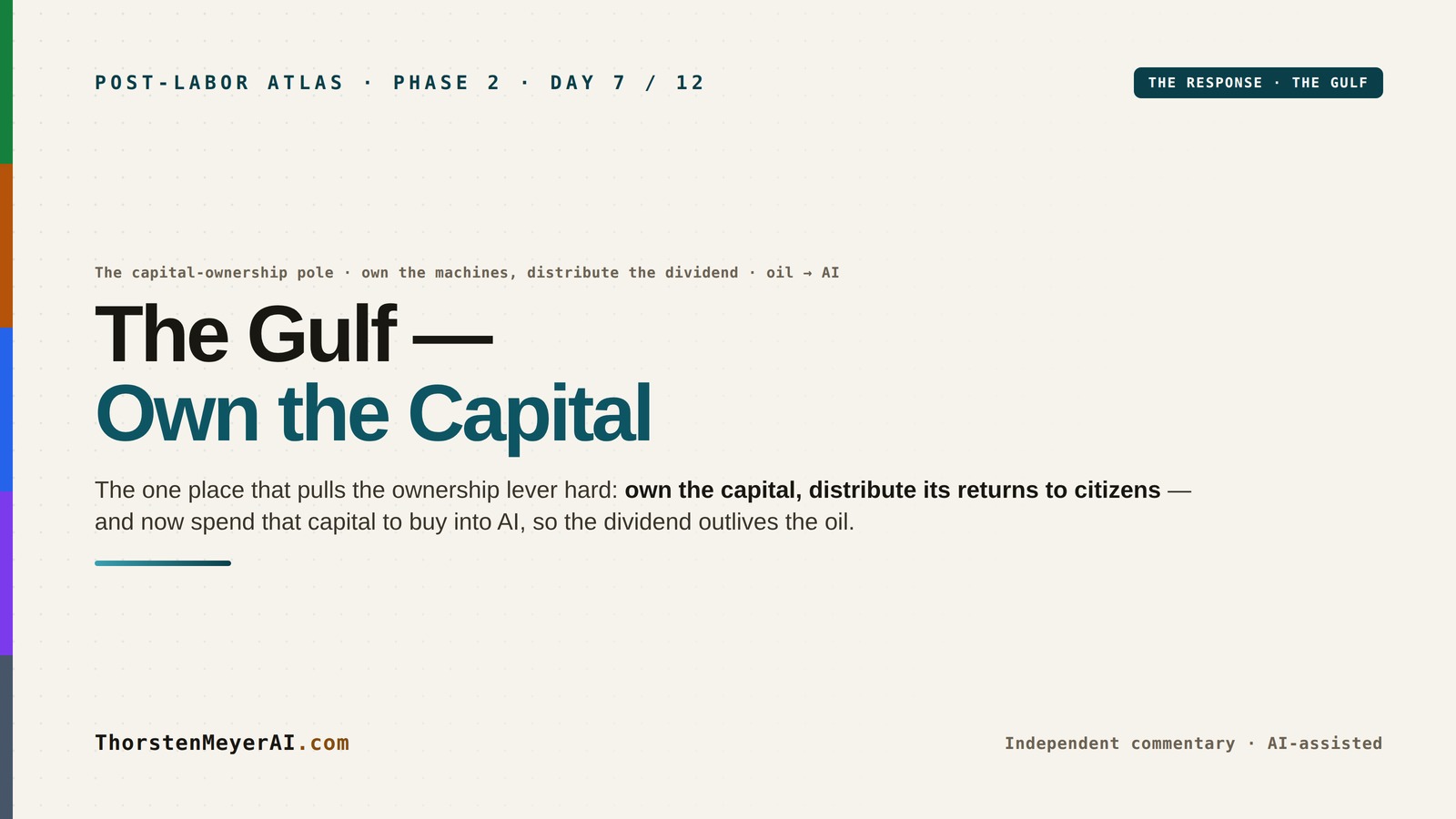
Own the Capital
For five rows, one lever stayed dark. The Gulf pulls it hard: own the capital, distribute its returns to citizens — and now spend that capital to buy into AI, so the dividend outlives the oil.
Independent commentary, produced with AI assistance under human editorial oversight. The views are the author’s own and may change. This is analysis, not policy, economic, investment, or legal advice. Descriptions of Gulf sovereign wealth funds, the rentier social contract, national AI champions (G42, MGX, HUMAIN, Qai), and AI-infrastructure investment reflect publicly reported information as of mid-2026 and may change; population, asset, and investment figures are indicative. This phase maps differing approaches and endorses none; characterizations of contested political and labor arrangements present competing views, not a verdict. Country, program, and company names are referenced for analysis and imply no affiliation.
The model’s logic
Strip away the petro-politics and the structure is, startlingly, close to what post-labor economists actually recommend.
The post-labor worry, reduced to one sentence, is that the returns to capital will swamp the returns to labor — that the people who own the productive assets will capture the gains while wages stagnate or fall. The textbook remedy is broad public or shared ownership of capital, with the returns distributed to the population. That is, almost exactly, what a Gulf rentier state does. The state owns the resource; the sovereign wealth fund converts it into a diversified capital base; the returns fund the citizenry’s livelihoods. The Gulf has been running a version of the ownership answer for half a century — it just happened to be funded by oil rather than by taxing the robots.
And the pivot underway is the genuinely clever part. Oil is a depleting, volatile base for a capital dividend. So the Gulf is using oil wealth to acquire the next means of production — compute, data centers, frontier-AI stakes — while it still can. Cheap energy and abundant solar make the region a natural home for power-hungry AI infrastructure, and sovereign funds can deploy capital at a scale and over time horizons no private investor can match. The bet is coherent and, on its own terms, far-sighted: convert a wasting asset into ownership of the asset that may define the next economy, so the dividend outlives the oil.
It’s worth pausing on how this differs from Norway, the other great sovereign-fund story on this map. Norway’s fund is fundamentally a savings vehicle — wealth preserved and largely untouched for future generations, with only a thin slice spent each year. The Gulf funds are distribution vehicles — they exist, in large part, to underwrite the present living standards of citizens. Norway hoards the dividend; the Gulf pays it out. That single difference is why the Gulf, for all its flaws, is the closest thing on the map to a working capital-dividend state, and why Norway, for all its prudence, is not.

Data Centers Explained: A Plain-English Guide to AI Infrastructure, Noise, Water Usage, Energy Demand, and Community Concerns
As an affiliate, we earn on qualifying purchases.
As an affiliate, we earn on qualifying purchases.
The capital pivot
The mechanics are worth seeing concretely, because they’re the signature of the whole model.
The UAE moved first and fastest: a Ministry of AI as early as 2017, the G42 conglomerate, and MGX — a roughly $100 billion AI-infrastructure investment vehicle backed by Mubadala — taking stakes across the AI stack and joining the Stargate data-center consortium. Saudi Arabia answered with HUMAIN, a wholly-owned PIF subsidiary launched in 2025 as the kingdom’s national AI champion, signing compute and chip partnerships and taking direct stakes in frontier labs. Qatar stood up Qai alongside its sovereign fund. Across the region, governments have committed enormous sums — by some counts well over two trillion dollars — to AI and US technology, part investment, part industrial strategy, part geopolitical insurance.
The through-line is unmistakable: these aren’t passive portfolios. Each is a national champion designed to concentrate capital, energy, and compute at country scale, and to make the state an owner of the AI economy rather than merely a customer of it. Of every response on this map, the Gulf’s is the most literal enactment of the post-labor instruction to own the capital.

320 Things to Know About Sovereign Wealth Funds
As an affiliate, we earn on qualifying purchases.
As an affiliate, we earn on qualifying purchases.
The levers it pulls
On the Matrix, the Gulf row finally lights up the column everyone else left grey. Capital and ownership: strong — the signature, and the only solid capital cell in the Atlas so far. Income floor: strong, with a crucial asterisk — the rentier provision is generous, but for citizens. Work and time: partial — guaranteed public-sector employment and nationalization quotas for nationals, alongside a flexible, rights-thin market for the expatriate majority. Skills and transition: partial — heavy investment in national talent through Vision 2030, new AI universities, and scholarships, concentrated on citizens. Institutions: minimal — the state’s posture toward AI is promotional and directive, built to attract and own the industry rather than to constrain it with rights-based guardrails, and civil and labor protections are limited.
It is the mirror image of the American row. Where the US runs minimal capital and a minimal floor and bets on private markets, the Gulf runs strong state capital and a strong floor and bets on public ownership. Same question, opposite answer.
Learning Robotic Process Automation: Create Software robots and automate business processes with the leading RPA tool – UiPath
As an affiliate, we earn on qualifying purchases.
As an affiliate, we earn on qualifying purchases.
The honest read
The caveats are not footnotes here. They are the model.
The first and largest: the generosity is gated by citizenship. The majority of the Gulf workforce are non-citizen expatriates — in the UAE and Qatar, nationals are a small minority of the population — and they are largely excluded from the dividend, holding far fewer rights under labor systems that have drawn sustained criticism. The uncomfortable truth is that the Gulf partly “solves” the income question for citizens by not extending citizenship to most of the people who actually do the work. The floor is real and the exclusion is real, and they are the same fact viewed from two sides.
The second: it is an authoritarian bargain. Scholars describe these as “authoritarian welfare states” — social rights extended in place of, not alongside, political and civil ones. The dividend functions as a tool of regime stability; provision substitutes for participation. You cannot lift the capital-distribution machinery out of the political system it’s wired into, and a dividend that arrives without a vote is provision, not empowerment.
The third: it is resource-funded and barely replicable. Like Norway’s fund, the capital base was a windfall, not a policy invention — only more so, since it underwrites entire societies. The AI pivot is precisely an attempt to make the dividend survive the windfall, but a country without oil has nothing to start the loop with.
And the fourth: the bargain is under strain. As populations grow and oil revenue swings, the cradle-to-grave version is being quietly trimmed — subsidies cut, value-added taxes introduced, nationalization quotas pushing citizens out of guaranteed state jobs and into private work. The model is being asked to do more with a base it’s trying to transform mid-flight.

Building AI-Powered Products: The Essential Guide to AI and GenAI Product Management
As an affiliate, we earn on qualifying purchases.
As an affiliate, we earn on qualifying purchases.
What travels
The principle the Gulf embodies — public ownership of capital with the returns distributed broadly — is the single most directly post-labor-relevant idea on the entire map, and it travels as a concept even though the Gulf’s particular oil-funded, citizen-gated, authoritarian version does not. A democracy could, in theory, build a citizens’ wealth fund and pay a genuine dividend without any of the exclusion or the autocracy; the Gulf shows the lever works, not that it must come bundled the way it does there.
The more immediately portable export is the sovereign-AI-fund playbook itself: a state buying into the AI capital stack to hedge the transition at the national level. That idea has already spread well beyond the Gulf, and it’s a rational move for any government with the fiscal capacity to make it. The cautionary lesson rides alongside it: a capital dividend gated by membership looks generous from inside and exclusionary from outside, and ownership without rights is a thinner thing than it first appears.
Row six
The Gulf is the one jurisdiction on this map that answers the ownership question directly and without flinching: own the capital, distribute its returns, and convert the base from oil to AI so the dividend can outlive the resource that built it. Of every model here, it does most literally what post-labor economics says to do — pull the lever the West keeps leaving alone.
It is also the model most entangled with everything that economics usually hopes to avoid: exclusion by nationality, provision without political voice, and a windfall that can’t be manufactured. The Gulf proves the ownership lever can be pulled, and pulled at enormous scale. It does not prove it can be pulled cleanly. Row six — and the first of the state-capital and technocratic models that the rest of this Atlas now turns to.
Independent commentary, produced with AI assistance under human editorial oversight; the views are the author’s own and may change. This is analysis, not policy, economic, investment, or legal advice. Descriptions of Gulf sovereign wealth funds, the rentier social contract, national AI champions (G42, MGX, HUMAIN, Qai) and AI-infrastructure investment reflect publicly reported information as of mid-2026 and may change. Population, asset, and investment figures are indicative estimates. This phase maps differing approaches and endorses none; characterizations of contested political and labor arrangements present competing views rather than a verdict. Country, program, and company names are referenced for analysis and imply no affiliation. © 2026 Thorsten Meyer · Powered by Thorsten Meyer AI. See Imprint/Impressum and Privacy Policy.