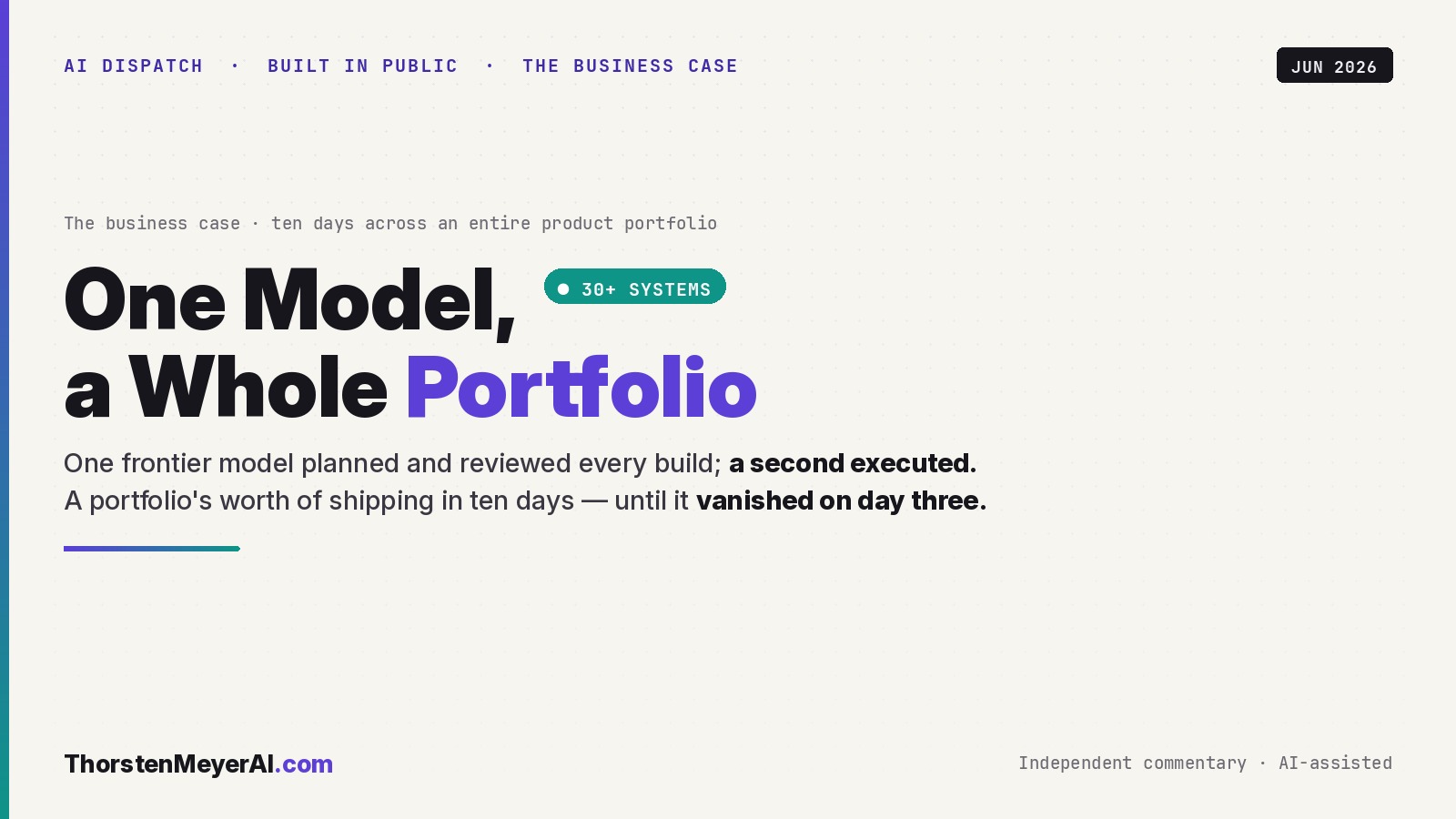

For ten days I ran almost my entire product portfolio through a single AI model — a publishing operation, a set of software products, an intelligence-and-analytics line, and a handful of consumer apps. At the end I had the same model write me a development report for each system. The reports are detailed and stay private. What I can share is the part that matters to anyone running a business on top of frontier AI: the impact, the operating model, the economics, and the catch.
Prime for Young Adults — start your free trial
Fast free delivery, streaming and member deals for eligible 18–24 year olds.
Try it freeAs an affiliate, we earn on qualifying purchases.
The short version: it was the most productive stretch I have ever had, and the engine behind it was Claude Fable 5 — Anthropic’s most capable public model, and the first of its new top tier. I have covered Fable’s launch and its abrupt suspension elsewhere. This is what happened in between.
Two things made the experience different from any sprint before it. The first is the cost, and it is not small: I ran two premium subscriptions in parallel and still exhausted a weekly usage limit on one of them inside a single day. The second is the part that should interest a board more than a budget line. By the end of the run, the model was not writing code at all. It was doing the architecture, the design, and the planning — and a second, cheaper model did the execution under its review.
And then the part that turns this from a technology story into a business one: the model was switched off on its third day, by government order, for every customer, over a contested security finding. I built a portfolio’s worth of work on a frontier capability with a kill switch I did not control — and the work survived, because of how it was built.
One Model, a Whole Portfolio
● 30+ systemsFor ten days one frontier model coordinated almost an entire product portfolio — it architected and reviewed; a cheaper model executed. The result was the most productive stretch I’ve had. The catch: the model was switched off on its third day by government order.
Aggregated across the portfolio, rounded conservatively. The line count is not the point — that one model coordinated this much, in parallel, is.
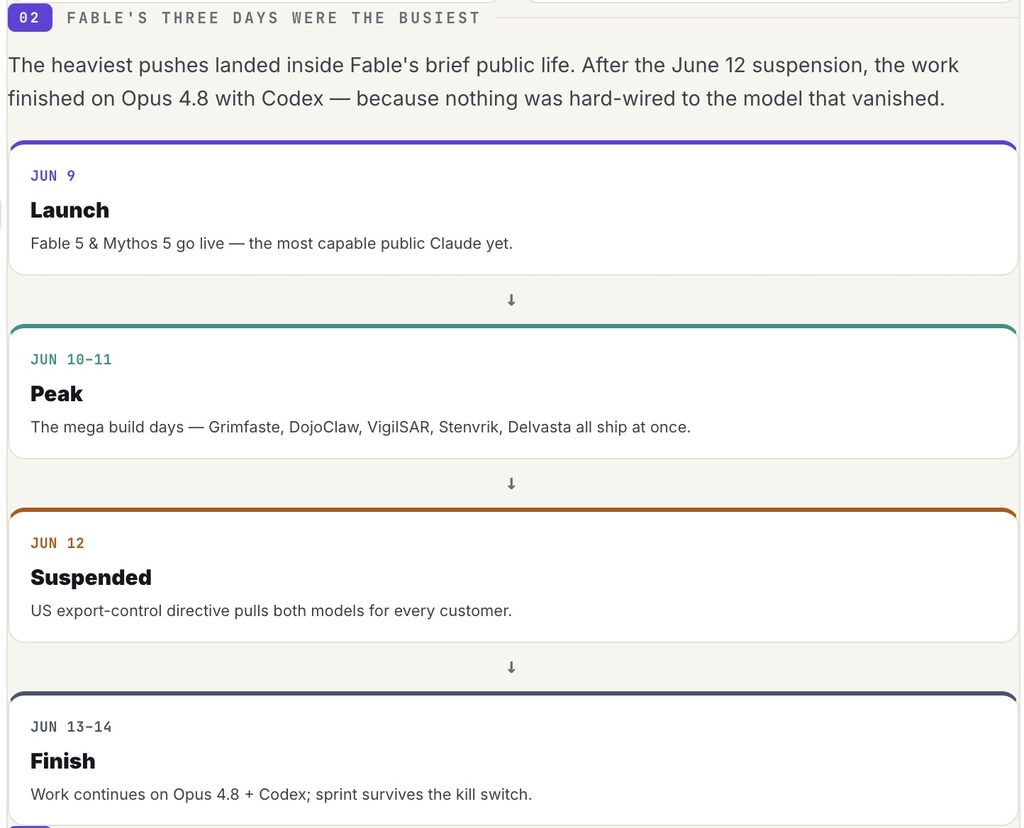
The heaviest output landed inside the model’s brief public life. After the suspension, the work continued on the tier beneath — because nothing was hard-wired to the capability that vanished.
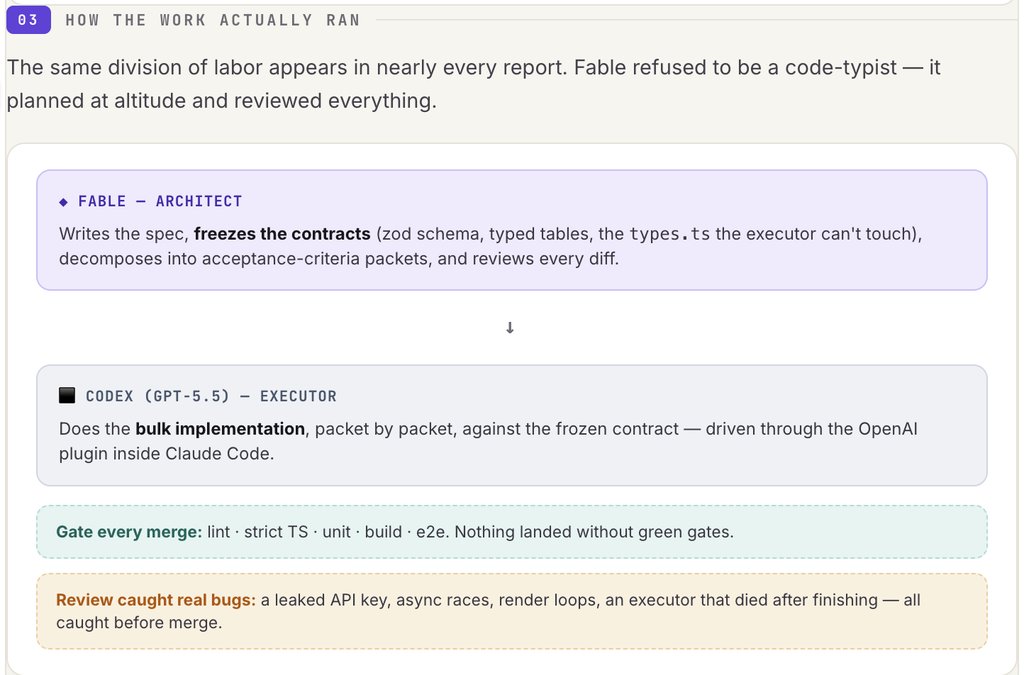
The bottleneck has moved. Generation is commoditized; what gates a project is architecture, decomposition, and verification — and that is where the premium model earned its price.
Vendor claims are marketing. This is from a skeptic: a deliberately hard, defense-relevant evaluation I maintain. After a fairness fix to the grader, the model’s score roughly tripled and it took the top spot.
The evaluation is intentionally brutal and every model on it is overconfident, so a modest absolute score is the expected outcome. The result that matters: on a hard, independent harness I built to be unkind, this model ranked first.
Described by function, not by name. Several of these went from an empty start to a shipped product inside the window.
- Fleet control + plain-English intelligence across several hundred sites.
- A seasonal revenue campaign of ~880 placements — zero failures, all compliant.
- Market- and news-intelligence systems made self-updating, not point-in-time.
- A self-hosted team knowledge-and-database workspace — empty start to v1.
- A local-first document & proposal generator grounded in a company’s own data.
- A media editor that edits video by editing the transcript, on-device.
- A customer-acquisition platform — first click to paid deal, AI-optimized.
- A defense-grade analytics platform given a cross-industry backbone.
- Sensor and signal processing added under the intelligence layer.
- Multi-asset forecasting research expanded — strictly paper-only.
- The independent benchmark above — built, hardened, and run.
- Original games taken to playable, all-original assets.
- One real-time simulation shipped to web, a spatial headset, and a console from one core.
- A privacy-first mobile app with a scalable content architecture.
Asked the same question across the portfolio — what is the highest-value next thing — the model rarely answered with another feature. It answered with structure: a way to connect the data, a shared backbone, a layer that turns a single-purpose tool into a platform. For a business, that is the bias that matters: durable advantage and pricing power come from connected systems and the moats they create, not from isolated tools.
- The bottleneck moved — buy the premium model as architect & reviewer, not as a faster typist.
- One model coordinates a portfolio — changing what a small team or solo operator can ship.
- It reorganizes problems — toward connected platforms that compound.
- Capability is real — first place on a hard evaluation I built myself.
- It’s expensive — two premium seats, a weekly limit gone in a day. Token appetite is a line item.
- It leans on a second model — a strength when both are available, a fragility when either isn’t.
- Access can be revoked in hours — by forces you don’t control, on rationale you can’t see.
- It’s a procurement risk — controls can turn on nationality, residency, and jurisdiction.
Independent commentary, produced with AI assistance under human editorial oversight; the views are the author’s own and may change. This is analysis, not investment, financial, legal, or technical advice, and it touches an actively developing situation. Development figures are drawn from automated reports generated from the underlying projects in June 2026, are approximate where aggregated, and reflect each project’s state at generation time; specific products, internal details, and implementation specifics are withheld by choice. Two of the underlying reports describe sprints that predate the model and are not attributed to it. Benchmark results are from the author’s own internal evaluation harness and are not an independent or peer-reviewed comparison. References to models, companies, and government actions are factual and analytical, not partisan, and imply no affiliation or endorsement.
The bet: one model, the whole portfolio
The usual way to evaluate a new model is to try it on one thing. I did the opposite. I pointed Fable at nearly everything I am building at once — content and publishing systems, customer-facing software products, an intelligence-and-analytics platform with a defense lineage, internal operations tools, and several consumer applications — and let it coordinate all of them in parallel for ten days.
That is a deliberately unfair test, and it is the one a real business faces. The question is never “can the model write a good function.” It is “can it carry a portfolio.” For ten days, it could.
AI development and analytics software
As an affiliate, we earn on qualifying purchases.
As an affiliate, we earn on qualifying purchases.
The real unlock: the bottleneck moved
Here is the finding I would put in front of any executive considering serious spend on frontier AI. The constraint in building software has moved.
For the last two years the pitch has been about generation speed — how fast a model can produce code. That is now close to commoditized; a competent execution model types fast and cheaply. What is scarce, and what actually gates a project, is architecture, decomposition, and verification: deciding the right structure, breaking work into safe pieces, freezing the contracts the rest of the team builds against, and checking that what comes back is correct.
That is exactly where Fable earned its premium. The operating model that emerged, and that I would now recommend deliberately, is architect-and-delegate: the strongest, most expensive model owns the design, writes the specification, freezes the interfaces, and reviews every change — and a cheaper execution model does the bulk of the building against that frozen plan, with automated quality gates on every step. Nothing merged without passing the full battery of checks.
The discipline is not bureaucracy; it is what made speed safe. Because the execution model worked in a sandbox that could not fully exercise the running product, the review step is where the real defects surfaced — including, in one system, a security flaw that was quietly exposing credentials, and in another, a process that reported success after silently failing. Those did not ship, because something competent was checking. For a business, that is the whole argument: the value of the premium model is not as a faster typist but as a tireless senior architect and reviewer sitting over everything at once.
As an affiliate, we earn on qualifying purchases.
The impact, in plain terms
Across the ten days, described by what each system does rather than what it is called:
A self-hosted, team knowledge-and-database workspace went from an empty start to a shipped first version. A local-first business-document generator — the kind that turns a company’s own data into branded decks and proposals without sending anything to the cloud — became a working product in days. A media editor that lets you cut video and audio by editing the transcript reached feature-complete, with transcription running on-device. A customer-acquisition platform gained the full path from first click to closed, paid deal, with AI-assisted optimization on top.
On the publishing side, a network of several hundred sites gained a control layer that can push updates across the entire fleet safely, and an intelligence layer that answers questions about the business in plain language — and it executed a large seasonal revenue campaign of roughly 880 coordinated placements with zero failures, every one compliant and correctly attributed. Supporting systems that track the market became self-updating rather than point-in-time.
The intelligence-and-analytics platform gained a general-purpose backbone that lets the same governed machinery serve very different industries, not just its original one. A research system for multi-asset forecasting expanded across asset classes — strictly in simulation, never with real money. A set of consumer applications and original games reached ship-readiness, including one real-time simulation delivered, from a single shared core, to the web, a spatial headset, and a game console.
The aggregate, rounded conservatively: around thirty systems advanced, several taken to a shipped first version, on the order of 850 commits, more than half a million lines of code, and thousands of automated tests — all green at the point each report was generated. The line count is not the point. The point is that one model coordinated that much, in parallel, at a standard I could not have matched by hand.
As an affiliate, we earn on qualifying purchases.
The pattern that compounds
The most strategically interesting behavior was one I did not ask for. When I posed the same question to each system — what is the highest-value thing to build next — Fable rarely answered with another feature. It answered with structure: a way to connect the data, a shared backbone, a layer that turns a single-purpose tool into a platform.
That instinct matters to a business more than any individual feature. Durable advantage and pricing power come from connected systems and the moats they create, not from isolated tools. A model that defaults to “make this compound” rather than “add one more thing” is, for a portfolio, the most valuable bias it could have.
As an affiliate, we earn on qualifying purchases.
The capability signal, on my own terms
Capability claims from a model’s maker are marketing. So here is one from a skeptic. I maintain a deliberately hard, defense-relevant evaluation that scores leading models on realistic tasks. After I corrected an unfairness in the grader, Fable ranked first of the frontier models tested, and its score roughly tripled — from the high teens to the high sixties in percentage terms. The evaluation is intentionally brutal and every model on it is overconfident, so a modest absolute score is expected. But on my own hard, independent harness, this model came out on top. That is the kind of evidence I trust, because I built the test to be unkind.
The economics
The cost is real and worth stating plainly. Two premium subscriptions running at once, and a weekly limit still burned through in a day. At this intensity, a frontier model’s appetite is a line item, not a rounding error.
But the architect-and-delegate model is itself a cost lever. You pay the premium model to think — to architect, decide, and review — and a cheaper model to build. That split is not just safer; it is more economical than asking the most expensive model to do everything. For a portfolio with enough surface area to keep the architect busy, the throughput dwarfs the spend. For a single product, the math is different, and the honest answer is that you may not need the top tier at all.
The catch that makes this a board-level question
And then the model was pulled. Three days after its public launch, the US government issued an export-control directive and the model was suspended for every customer — over a contested security finding the company considers narrow and the government treated as a national-security risk. The merits are still disputed. The lesson for a business is not.
Access to a frontier model is a supply-chain and geopolitical variable, not a line on a pricing page. It can be revoked in hours, regardless of your contract, your region, or your use case — and the controls in this case turned specifically on nationality and residency, which makes it a procurement question for any non-US company. The newest, most capable model is also the most exposed, because scrutiny concentrates exactly where capability is highest.
The mitigation is architectural, and it is the same posture that makes engineering resilient: route everything through an abstraction layer, keep a fallback wired in, and never hard-depend on a single frontier model — least of all the newest one. I had built that way, so when the model vanished mid-sprint, the work simply continued on the tier beneath it. Nothing was hard-wired to the capability that disappeared. That is the difference between a disruption and a disaster.
The honest read
Strip away the launch and the politics, and three things are left for anyone building a business on frontier AI.
The bottleneck has moved from execution to architecture and verification. Buy the premium model to be your architect and reviewer, not your typist, and pair it with a cheaper executor under hard quality gates.
One model can now coordinate an entire portfolio in parallel, at a standard that is difficult to match by hand — which changes what a small team, or a single operator, can credibly ship.
And the capability you build on can be switched off in an afternoon, by forces you do not control. So design for graceful degradation, and treat model access as a continuity and procurement risk, not just a cost.
The frontier is now strategic, controlled technology. Build so that your most capable model can vanish on a Thursday and your business keeps shipping on Friday. The model I built around for ten days proved it was worth the bet. The day it disappeared proved why you never make that bet your only one.
Independent commentary, produced with AI assistance under human editorial oversight; the views are the author’s own and may change. This is analysis, not investment, financial, legal, or technical advice, and it touches an actively developing situation. Development figures are drawn from automated reports generated from the underlying projects on June 14, 2026, are approximate where aggregated, and reflect each project’s state at the time of generation; specific products, internal details, and implementation specifics are withheld by choice. Two of the underlying reports describe sprints that predate Claude Fable 5 and are not attributed to it. Benchmark results are from the author’s own internal evaluation harness and are not an independent or peer-reviewed comparison. References to models, companies, and government actions are factual and analytical, not partisan, and imply no affiliation or endorsement. © 2026 Thorsten Meyer · Powered by Thorsten Meyer AI. See Imprint/Impressum and Privacy Policy.
Fall yard work Picks
leaf blowers
As an affiliate, we earn on qualifying purchases.