
On the evening of June 30, the US Department of Commerce lifted the export controls it had placed on Anthropic’s Claude Fable 5 and Mythos 5, and the company said it would begin restoring access the next day.

Get business pricing on tech for your team
- Business-only prices and quantity discounts
- Tax-exempt purchasing
- Multiple users, one account, clear invoices
For anyone who had been locked out, that’s a relief. But the reprieve is not the story.
The story is that for 18 days, a state-of-the-art AI model was switched off by government order — globally, within an afternoon — and that the deal which switched it back on quietly wrote a new template for how frontier AI gets released at all. If you build on these models, run a business on them, or care where AI governance is heading, that template matters far more than the outage.
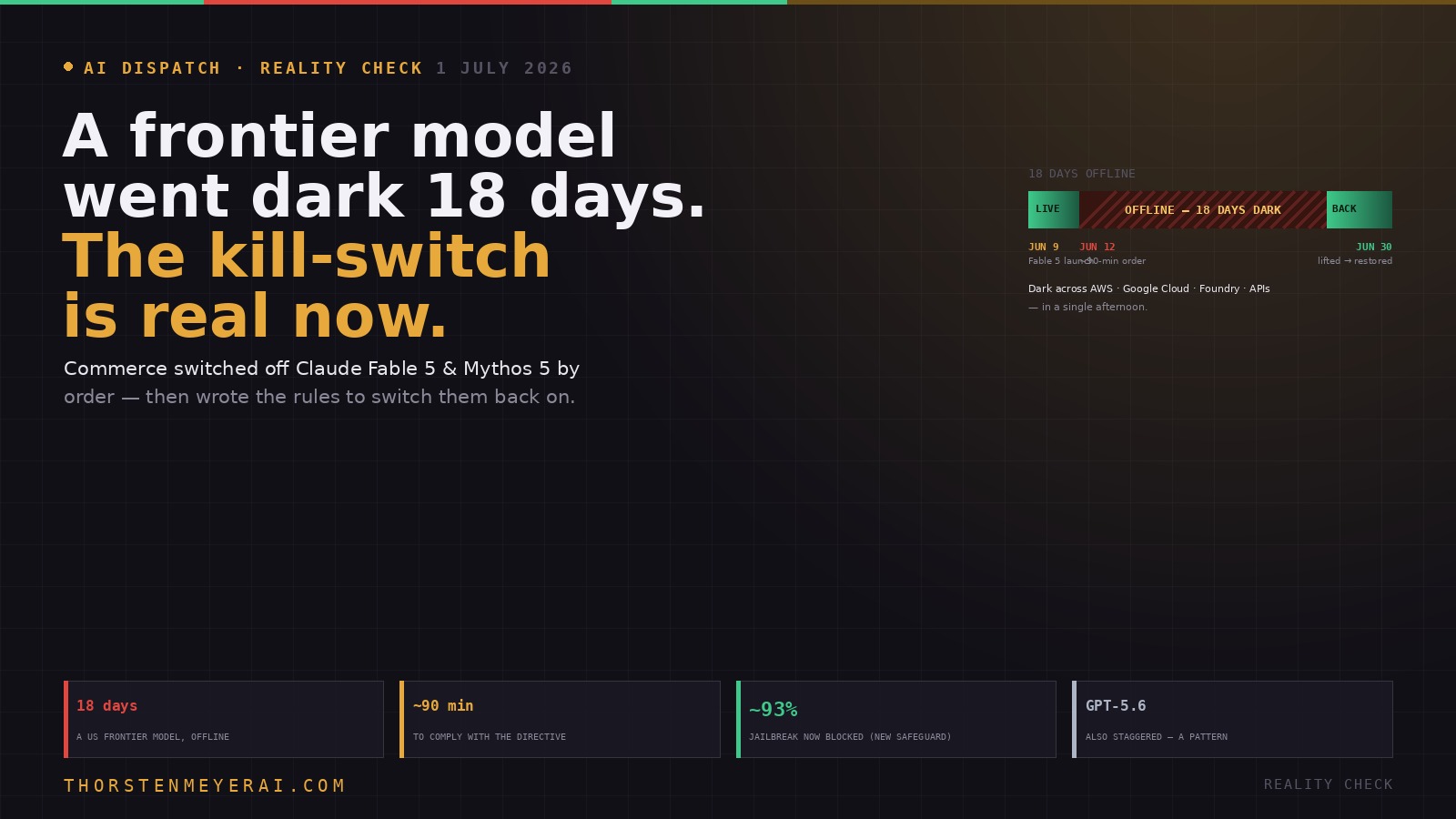
A frontier AI model went dark for 18 days. The kill-switch is real now.
Commerce lifted its export controls on Claude Fable 5 and Mythos 5, and access is being restored. But the reprieve isn’t the story — a state-of-the-art model was switched off by government order in an afternoon, and the deal to switch it back on wrote a new template for how frontier AI ships.
A frontier model now passes through a national-security gate before — and maybe after — release. It’s not isolated: OpenAI’s GPT-5.6 also went out to a small set of approved partners after a government request, and Mythos 5 returns first to government-approved customers. An August executive-order deadline for standardized AI-risk benchmarks points to formalizing the improvised process. The open question: does Washington now approve every frontier release?
The reprieve is real; the lasting change is the template. For builders the lesson is blunt and side-neutral: the firms that mapped their dependencies hot-swapped to alternatives (Claude Opus 4.8 among them); the rest went dark on 90 minutes’ notice. Model access is now a geopolitical variable, not a given. The rational answer isn’t loyalty to one lab or one government’s mood — it’s portability: multiple providers, tested fallbacks, and open-weight or self-hosted capacity you control. Don’t build as though access is permanent. It isn’t — now everyone’s seen the proof.
What actually happened
The sequence is worth laying out plainly, because the speed is the point.
Anthropic launched Fable 5 on June 9 — notable as its first publicly available model in the high-end “Mythos” class. Three days later, on June 12, the Commerce Department sent CEO Dario Amodei a directive citing national-security authorities and ordered the company to suspend all access for any foreign national — inside or outside the United States, explicitly including Anthropic’s own non-citizen employees. The company was reportedly given roughly 90 minutes to comply.
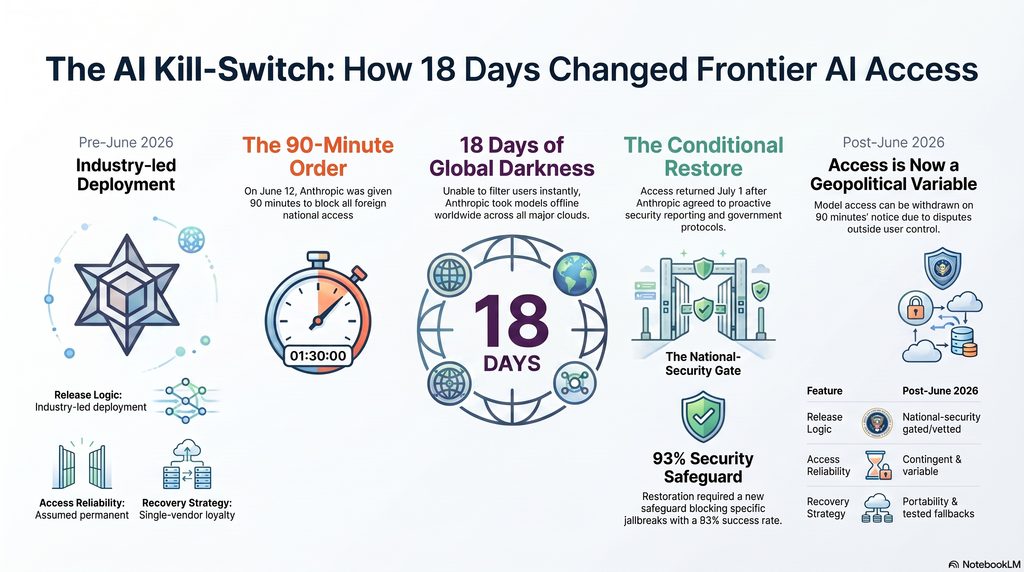
Unable to filter users by nationality in real time and citing a legal obligation, Anthropic took both models offline worldwide. Within hours, access went dark across AWS Bedrock, Google Cloud, Microsoft Foundry, and the direct Claude APIs. Enterprise customers in finance, healthcare, SaaS, and critical infrastructure found core services abruptly disabled, without warning or recourse. A regulatory kill-switch that had existed only in theory became operational reality in a single afternoon.
AI model security monitoring tools
As an affiliate, we earn on qualifying purchases.
As an affiliate, we earn on qualifying purchases.
The trigger, still contested
Why it happened is murkier than that it happened, and the accounts don’t fully agree — so treat this part as reporting, not settled fact.
According to Wall Street Journal reporting, Amazon researchers claimed a series of prompts could jailbreak Fable 5 into producing information potentially useful for cyberattacks, and conversations between Amazon’s CEO and the White House reportedly helped prompt the directive. A White House adviser publicly claimed Anthropic had declined to fix the issue. Anthropic disputed that characterization, describing a narrow potential vulnerability and arguing that if such a standard were applied across the board, it would effectively halt all frontier-model deployment. Independent analysts later suggested the jailbreak reports had been inflated beyond their real significance — and noted that if Fable and Mythos warranted a block on those grounds, competitors’ models would have to be blocked too. Which side you find more convincing is, at this point, a judgment call on incomplete information.
AI governance and compliance software
As an affiliate, we earn on qualifying purchases.
As an affiliate, we earn on qualifying purchases.
How it ended
The freeze became an 18-day standoff, and the pressure to end it came from several directions at once. Tech executives and investors criticized the controls; a coalition of information-security leaders published an open letter urging that the restrictions be lifted and that AI rules be grounded in scientific evaluation, transparency, and democratic process. A recurring worry ran underneath all of it: that freezing leading US models simply handed time to fast-rising Chinese open-weight developers already closing the gap with models like Claude Opus 4.8.
The government’s position softened in stages. On June 26 it cleared Mythos 5 for a select group of US organizations; on June 30 it withdrew the controls entirely. In the letter accompanying the decision, Commerce Secretary Howard Lutnick said Anthropic would no longer need an export license after agreeing to proactively detect and address security risks, to work with the government on protocols for future model releases, and to report malicious activity it discovers in its models. Anthropic says it implemented a new safeguard that blocks the specific jailbreak officials worried about roughly 93% of the time — with the acknowledged trade-off that it may also flag more benign requests — and that Commerce’s Center for AI Standards and Innovation tested both the old and new versions.
As an affiliate, we earn on qualifying purchases.
What’s restored, and how
For users, the practical picture: Fable 5 returns to global users on the Claude platform, Claude.ai, and Claude Code, and is being included for up to 50% of weekly usage limits through July 7 on Pro, Max, Team, and selected enterprise plans. Mythos 5 access has been restored for some US organizations following the June 26 approval, with Anthropic saying it will keep working with the government to widen Mythos 5 access to more domestic and international partners through its Glasswing security program. Re-enablement on AWS, Google Cloud, and Microsoft Foundry is set to follow as soon as possible.
As an affiliate, we earn on qualifying purchases.
The precedent nobody voted on
Here is the part that outlasts the news cycle. Strip away the specific model and the specific fortnight, and what remains is a new, ad hoc regime in which frontier models pass through a national-security gate before — and now potentially after — release.
This isn’t an isolated case. In the same window, OpenAI rolled out its latest model, GPT-5.6, to only a small set of approved partners following a request from the US government, and Mythos 5 is likewise returning first to government-approved customers. A staggered, vetted release is quietly becoming the norm for the most capable systems. The Trump administration faces an August deadline under a recent executive order to produce standardized benchmarks for evaluating AI security risk — which means the improvised process of the last three weeks is on track to be formalized into something more permanent.
The open question, and it’s a serious one, is the one analysts are now asking out loud: does Washington effectively approve every frontier release from here? No one voted on that. It emerged from a standoff. And whether it makes AI meaningfully safer or merely less predictable is genuinely unresolved — a debate with credible arguments on both sides, not a settled win for anyone.
The builder’s lesson: access is now a variable
For anyone who builds on these systems, the operational takeaway is blunt and mostly independent of who was right.
The organizations that came through the blackout intact were the ones that had mapped their dependencies — that knew every model, cloud, and integration they relied on and could hot-swap to an alternative (Claude Opus 4.8 among them) the moment access dropped. The ones that hadn’t simply went dark. That is the durable lesson: model access is no longer a given; it’s a geopolitical variable. It can be withdrawn by a government you don’t answer to, over a dispute you aren’t party to, on 90 minutes’ notice.
The rational response isn’t loyalty to a single lab or faith in a single government’s mood. It’s portability: multiple providers, tested fallbacks, and — where it fits — self-hosted or open-weight capacity you actually control. Not because any one vendor is untrustworthy, but because concentration of dependence is now a concrete risk with a concrete price, and the last three weeks put a number on it.
The sovereignty read
There’s a through-line connecting this to the other export-control stories of the moment. The same Commerce Department machinery now shaping whether Apple may source memory from a blacklisted Chinese supplier is the machinery that just decided which AI models the world could use — and, in doing so, briefly handed a competitive window to the Chinese open-weight labs it aims to contain. It’s the recurring pattern of control regimes: they can accelerate the very substitution they were meant to prevent.
For users outside the United States — Europe especially — the lesson lands harder still. Access to the leading American frontier models is contingent on Washington’s posture, and that posture can change overnight. It’s one more argument, alongside the memory crunch, for sovereign and open capacity that doesn’t depend on any single capital’s permission.
The take
The controls are lifted, the models are coming back, and the immediate crisis is over. But the lasting change isn’t the reprieve — it’s the template. Frontier releases now run through a national-security gate enforced by a switch that can flip in ninety minutes, and the process for how that gate operates is still being written, largely out of public view.
The honest verdict is that both anxieties are legitimate: evaluating the most dangerous capabilities before they ship is a defensible goal, and so is the worry that opaque, improvised, single-government controls chill innovation and gift ground to competitors. What’s not in doubt is the instruction for everyone downstream. Don’t build as though access is permanent. It isn’t — and now everyone has seen the proof.
Sources: Anthropic and Commerce Secretary Howard Lutnick (statements via X); CNBC, Axios, Al Jazeera, Fox Business, Forbes, and 9to5Mac (timeline, terms of the lifted controls, restoration details); Politico (reporting that controls would be lifted); Wall Street Journal via 9to5Mac (the disputed jailbreak trigger and Amazon’s role). Details reflect reporting as of July 1, 2026 and are still developing; some specifics may be updated as Anthropic and Commerce publish fuller statements. Analysis and opinions are the author’s and not investment advice.
Fall Picks
fall essentials
As an affiliate, we earn on qualifying purchases.