By Thorsten Meyer | November 29, 2026 | ThorstenMeyerAI.com

Get business pricing on tech for your team
- Business-only prices and quantity discounts
- Tax-exempt purchasing
- Multiple users, one account, clear invoices
Hackers got into Cloud One, the shared cloud platform that runs many US Air Force applications, Reuters reported on Friday. Nobody has said who they are or whether they took any data. If your own work runs on a big shared cloud, this case shows where the real risk sits.
The report rests on people familiar with the matter. The Air Force did not confirm or deny it. It said it does not comment on the security of specific systems.
This article sorts what is reported, what is only possible, and what is unknown. It also explains the one term that matters most here: the control plane. Reports as checked on Sunday, November 29, 2026.
Key takeaways
- What was reported: hackers breached Cloud One, the Air Force’s flagship cloud platform, three people familiar with the matter told Reuters.
- When it was found: within the past month or so, during work to upgrade the system, two of the people said.
- What is unknown: who the hackers are, how far they got, and whether any data was stolen. Reuters could not establish any of it.
- The way in: one source said the intruders used a software flaw to reach the “control plane”, the layer that steers the whole platform.
- The side effects: moving more applications onto Cloud One was paused, updates were blocked, and some users lost administrator rights, sources said.
- The Air Force’s answer: no comment on specific systems, but “prudent measures” to protect its information.
Reported breach · not confirmed by the Air Force
How the Cloud One breach unfolded, as reported
The Air Force does not comment on specific systems. Everything below rests on people familiar with the matter who spoke to Reuters.
- 2017Cloud One startsOne shared platform for the Air Force’s IT, built on four cloud operators.
- Past monthFound in an upgradeTwo people told Reuters the intrusion was discovered during work to upgrade the system.
- The way inThe control planeOne source said a software flaw let intruders reach the layer that steers the platform.
- Side effectsPlatform on holdMigrations paused, updates blocked, some administrator rights revoked, sources said.
- Still openWho, and whatReuters could not establish who the hackers are or whether any data was stolen.
- Blue: applications that run on the shared platform.
- Orange: the control plane, the layer one source said the intruders reached.
Sources: Reuters, as republished by CNA and The Straits Times, November 27, 2026. Schematic. Reported, not confirmed.
Graphic: Powered by Thorsten Meyer AI
Products Worth Considering

Apple MacBook Air 15-inch with M5 chip, 32GB memory, 512GB SSD, Midnight

Kindle Paperwhite Signature Edition, 32 GB (12th Generation, 2024), Metallic Black

Bose QuietComfort Headphones (2nd Gen), Wireless Noise-Cancelling Over-Ear Headphones, Black
As an affiliate, we earn on qualifying purchases.
What this means for you
- If your company runs on a shared cloud platform: ask who can reach its control layer, and how fast you would notice. In this case, the intrusion was found during work on an upgrade, according to the sources.
- If you manage IT updates: the blocked updates show a hidden cost. When a breach freezes a platform, you also lose the ability to patch other holes in it.
- If you work for a government supplier: Cloud One had a prime contractor, as many such platforms do. Expect more questions about who checks the checkers.
- If you are an ordinary user: there is no sign that consumer services are involved. Nothing in the reports calls for action from the public.
In plain words
- Cloud platform: rented computing power and storage that many programs share, instead of each running on its own machines.
- Control plane: the management layer that starts, stops and configures everything on a platform. One source compared it to a universal remote.
- Software vulnerability: a flaw in a program that an attacker can use to do something they should not be able to do.
- Administrator rights: the highest level of access, which lets a person change settings for others.
- Prime contractor: the main company that a government hires to run a project, often with other firms below it.
- Cyber Command: the US military’s own cyber force.
What exactly did Reuters report?
Reuters broke the story on Friday, November 27. Its report was republished by CNA and The Straits Times. Hackers “have breached the US Air Force’s flagship cloud computing platform”, three people familiar with the matter told Reuters.
The intrusion was “discovered within the past month or so during work to upgrade the system”, two of the people said. Investigators have called in Cyber Command to assess the damage, one source said.
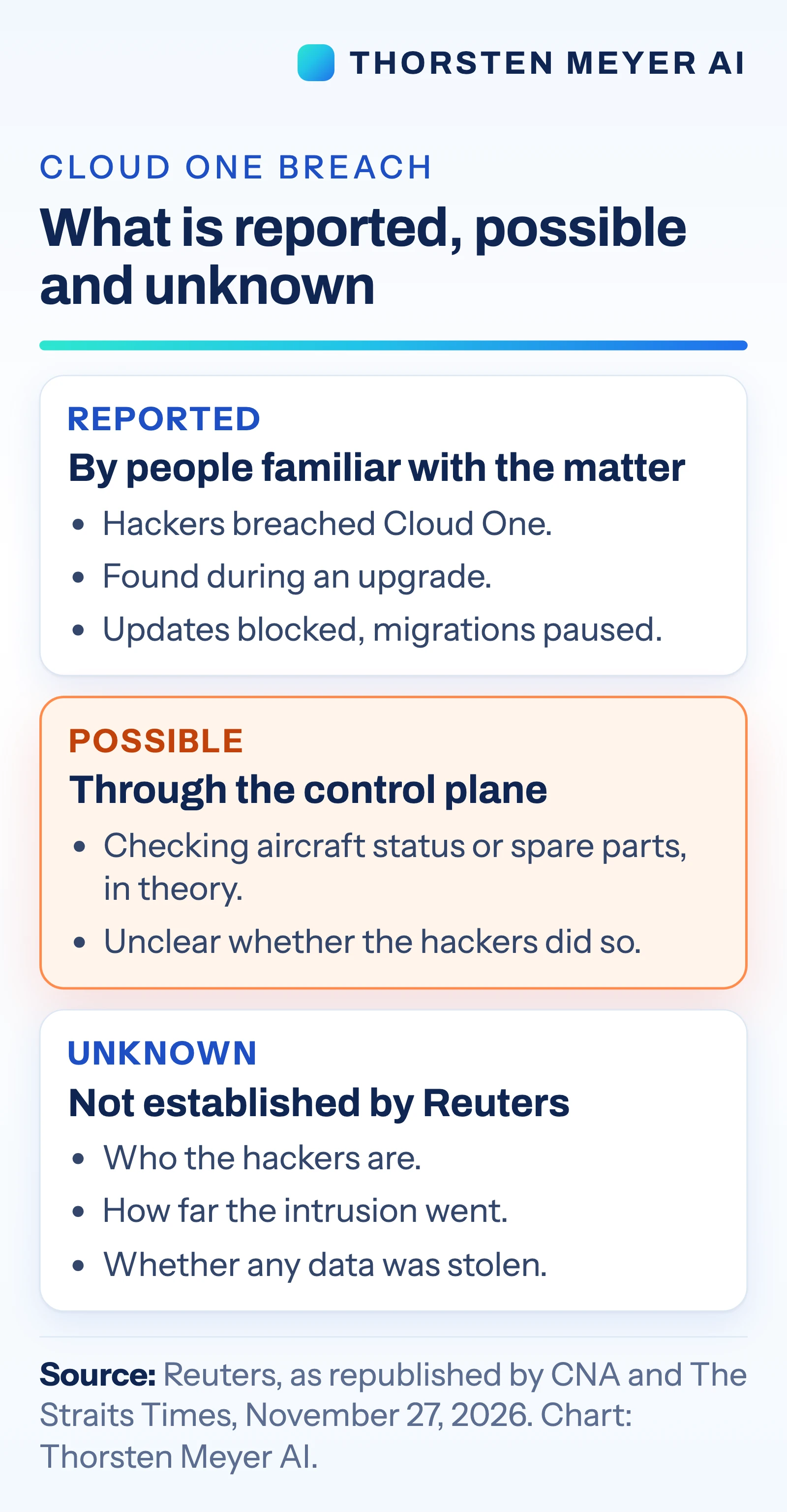
Let’s sort what we have. The breach itself is reported by several unnamed sources. The Air Force’s statement is documented. Who did it, and what they saw or took, is unknown. Reuters “could not establish the identity of the hackers, the full scope of the intrusion or whether any data had been stolen”.
What is Cloud One, and why does it matter?
Cloud One started in 2017. It was meant to be “a one-stop shop for the Air Force’s IT needs”, Reuters reported. It combines the resources of four operators: Microsoft, Amazon, Oracle and Alphabet.
On top of it run “scores of applications”. Some manage personnel data and pay. Others handle logistics and maintenance. Reuters named two military systems on the platform. One collects air defence radar data from across North America. The other tracks bombs and missiles across more than 200 Air Force locations worldwide.
Think of Cloud One like a large office building with many tenants. Each tenant has its own rooms. The building also has one control room for lifts, doors and power. A burglar in one office is a problem. A burglar in the control room is a much bigger one. The picture has a limit: in a cloud, the “doors” are software settings, and nobody has said which ones the intruders could touch.
What is a control plane, and what could someone do there?
One source said the intruders “exploited a software vulnerability to reach the control plane”. That person likened the control plane to “a universal remote”.
In plain words, the control plane does not hold the data itself. It manages the programs that do. In theory, the source said, access could let intruders check the operational status of military aircraft or the movement of spare parts. But “it was unclear whether the hackers did so in this case”.
So here is the honest line. A route to sensitive information is reported. That anyone used it is not.
What did the breach disrupt?
Several sources described knock-on effects. Moving back-office applications onto Cloud One, “a longstanding military priority”, was paused, two sources and a fourth person said.
Updates to applications already on the platform were blocked. That left staff “unable to apply fixes” just as a new batch of serious software flaws was disclosed across the industry. A fifth source said some users had their administrator rights revoked.
Here is why that matters beyond the Air Force. Security teams often face the same trade-off. Freezing a system stops an intruder from spreading. It also stops the defenders from patching. Every frozen day is a day with known holes left open.
Who runs it, and what did they say?
SAIC was the prime contractor for Cloud One until 2025, when Leidos took over, Reuters reported. SAIC did not respond to a request for comment. Leidos referred questions to the Air Force.
The Air Force said it “does not comment on the security posture, vulnerabilities or operational status of specific networks and systems”. It added: “We continuously take prudent measures to protect Department (of the Air Force) information, systems and mission capabilities.”
The report also recalls an older claim. In a 2023 commentary in FedScoop, Cloud One’s leaders described a “100% success rate” against what they called a “staggering” number of attempts to break in. “There is no room for error when it comes to security,” they wrote.
Does AI play a role?
Not in anything confirmed. Reuters placed the news in a wider worry about AI-powered intrusions. AI models can “swiftly detect weaknesses across wide surface areas”, which is a particular problem for cloud networks, Reuters wrote.
That is context, not a finding about this case. No source said AI was used here. The US government is also dealing with at least six other recently disclosed cyber incidents, Reuters reported, including two at the FBI and one at the Treasury Department. For an earlier case of an AI hacking tool, see our piece on the FBI’s warning about ARTEX.
What we know, and what we don’t know
What we know:
- Reuters reported a breach of Cloud One, citing three people familiar with the matter.
- The Air Force declined to comment on specific systems and said it takes “prudent measures”.
- Cloud One combines four cloud operators and runs personnel, pay, logistics and military applications.
What we don’t know yet:
- Who the hackers are. Watch for an attribution by the Air Force or Cyber Command.
- Whether any data was taken. Reuters could not establish it.
- How far the access went. The control-plane route is one source’s account.
- When updates resume. That would show the platform is back under control.
The bottom line
The scary part of this story is not a stolen file. Nobody has reported one. It is the place the intruders reportedly reached: the layer that steers everything else. For you, the lesson works at any size. The more programs share one platform, the more its control room needs its own alarm.
Further reading: TSMC Employee Data Breach Tied to a Cloud Provider: What Is Confirmed, What Is Claimed
I’m Thorsten Meyer. The full sources are below, and more reality checks are at thorstenmeyerai.com.
Sources
- Reuters, as republished by CNA: “Hackers breach US Air Force flagship Cloud One computing platform” (a Reuters exclusive), November 27, 2026, including the Air Force’s statement to Reuters
- Reuters, as republished by The Straits Times: “Hackers breach US Air Force flagship Cloud One computing platform”, November 27, 2026
- Sky News refused our request and is not cited. No official Air Force or Pentagon release on the incident was found.
—
Researched and drafted with AI assistance, including Anthropic’s Claude. No government, company or person named here reviewed or sponsored this article. Our own text and graphics contain no affiliate links; offer and product boxes added by the site may contain Amazon affiliate links. This article is for information only. It is not legal, security or investment advice. Reports as checked on November 29, 2026. Images: AI-generated illustration (Runware) and graphics by Thorsten Meyer AI; our own images show no real people or logos. Boxes added by the site may show product photos or people.