By Thorsten Meyer | November 29, 2026 | ThorstenMeyerAI.com

Get business pricing on tech for your team
- Business-only prices and quantity discounts
- Tax-exempt purchasing
- Multiple users, one account, clear invoices
Regional authorities in Belgium have ordered Google to stop building an AI data centre in Farciennes, in the south of the country. They say part of it was built without the right planning permission. Google says it has paused the works and will follow local law.
At the heart of the row is water. Google wanted to cool the site with water from a nearby river. The region said no, and work went on anyway, according to Greenpeace and the authorities.
This article explains what was ordered and why the permit matters. It also shows what it means for you. Reports as checked on Sunday, November 29, 2026.
Key takeaways
- What happened: Wallonia’s regional authorities ordered Google to suspend construction of a data centre at a former mining site, AFP reported.
- Why: officials found what they called “a major offense”: a building covering three hectares built without proper permission.
- The water question: Google had asked to switch from air cooling to water from the River Sambre. The region refused over the summer.
- Google’s answer: it paused the works “pending additional guidance” and said it remains “committed to complying with local laws”, the BBC reported.
- Next step: Google has challenged the refusal in court. A hearing is scheduled for January.
- Not alone: Finnish authorities halted work on two Google data centre sites in October, AFP reported.
Stop-work order · court hearing pending
How a cooling plan became a stop-work order
At the heart of the row is water: how the computers are cooled, and where the water comes from.
- The planAir coolingThe original project planned to cool the computers with air, Belgian media reported.
- The changeRiver waterGoogle applied to cool the site with water from the nearby River Sambre.
- SummerRequest refusedAfter a dry spring, regional officials refused the change. Google went to court.
- This weekStop-work orderInspectors told Google to halt building. Officials call it a major offence.
- NextCourt in JanuaryGoogle says it paused the works and will follow local laws.
- Blue: the former mining site, some 50 hectares.
- Orange: the building of three hectares that officials say lacks proper permission.
Sources: AFP, as published by Arab News, November 27, 2026; BBC News, November 29, 2026. Schematic.
Graphic: Powered by Thorsten Meyer AI
Products Worth Considering

LG UltraGear 32-inch 4K UHD OLED Gaming Monitor, 165Hz

Sonos One Two-Room Smart Speaker Set with Alexa, Black

Apple AirPods Pro 3 Wireless Earbuds with Active Noise Cancellation
As an affiliate, we earn on qualifying purchases.
What this means for you
- If you live near a planned data centre: permits are your lever. In this case, a refused permit change and a site inspection stopped the works. Local planning files are public in many places.
- If you work in construction or for a supplier: a stop-work order can freeze a site overnight. In our reading, permit risk is now part of every data centre timeline.
- If your company buys cloud or AI services: where your provider builds can change. Local fights over water and power can delay new capacity.
- If you follow the AI boom: this is one more sign that land, water and power, not only chips, set the pace.
In plain words
- Data centre: a building full of computers that run websites, apps and AI models. It needs a lot of power and cooling.
- Planning permission: official approval to build something in a certain way, at a certain place.
- Stop-work order: an instruction from the authorities to halt building until a problem is fixed.
- Air cooling versus water cooling: computers get hot. Air cooling blows air through them. Water cooling uses water to carry the heat away, and that water must come from somewhere.
- Hectare: an area of 100 by 100 metres. Three hectares is roughly the size of four football pitches.
What exactly did the authorities order?
Belgian authorities ordered Google to suspend construction “because of a lack of proper planning permission”, a regional official said on Friday, AFP reported.
“We have identified a major offense: the illegal construction of a building covering three hectares,” Nicolas Yernaux, spokesman for the Wallonia regional authorities, told AFP. Inspectors visited the site on Thursday to tell Google representatives to halt construction, the regional authority said.
Let’s sort what we have. The order and its reason are documented through the official’s statements to AFP and the BBC. We could not find the order itself online. Whether the building can be legalised later is unknown.
Why does the cooling system matter so much?
Think of a data centre as a huge room full of ovens that never switch off. All that heat has to go somewhere. You can blow it away with air, or carry it away with water.
The original project planned air cooling, according to Belgian media cited by AFP. Google then applied to change its permit, to cool the site with water drawn from the nearby River Sambre.
That request met local opposition. “Severe droughts since spring exacerbated fears about tapping the river”, AFP reported. Regional officials refused the application over the summer. The picture of ovens has a limit. Cooling systems differ a lot, and the reports do not say how much water this site would take.
Was Google building without a permit?
That is the accusation. Greenpeace Belgium said in a report this week that drone footage showed work was still going on. “The tech giant is currently continuing its work,” the group said. It added that the latest version of the planning permission had been revoked in August.
The authorities followed with the stop-work order. Google said it had paused the works in Farciennes “pending additional guidance”, the BBC reported. In a statement, Google said “we have operated in Belgium for over 15 years and remain committed to complying with local laws”.
Google has challenged the refusal in court, and a hearing is scheduled for January, AFP reported. So the legal question is open. The order stands for now.
How big is this site?
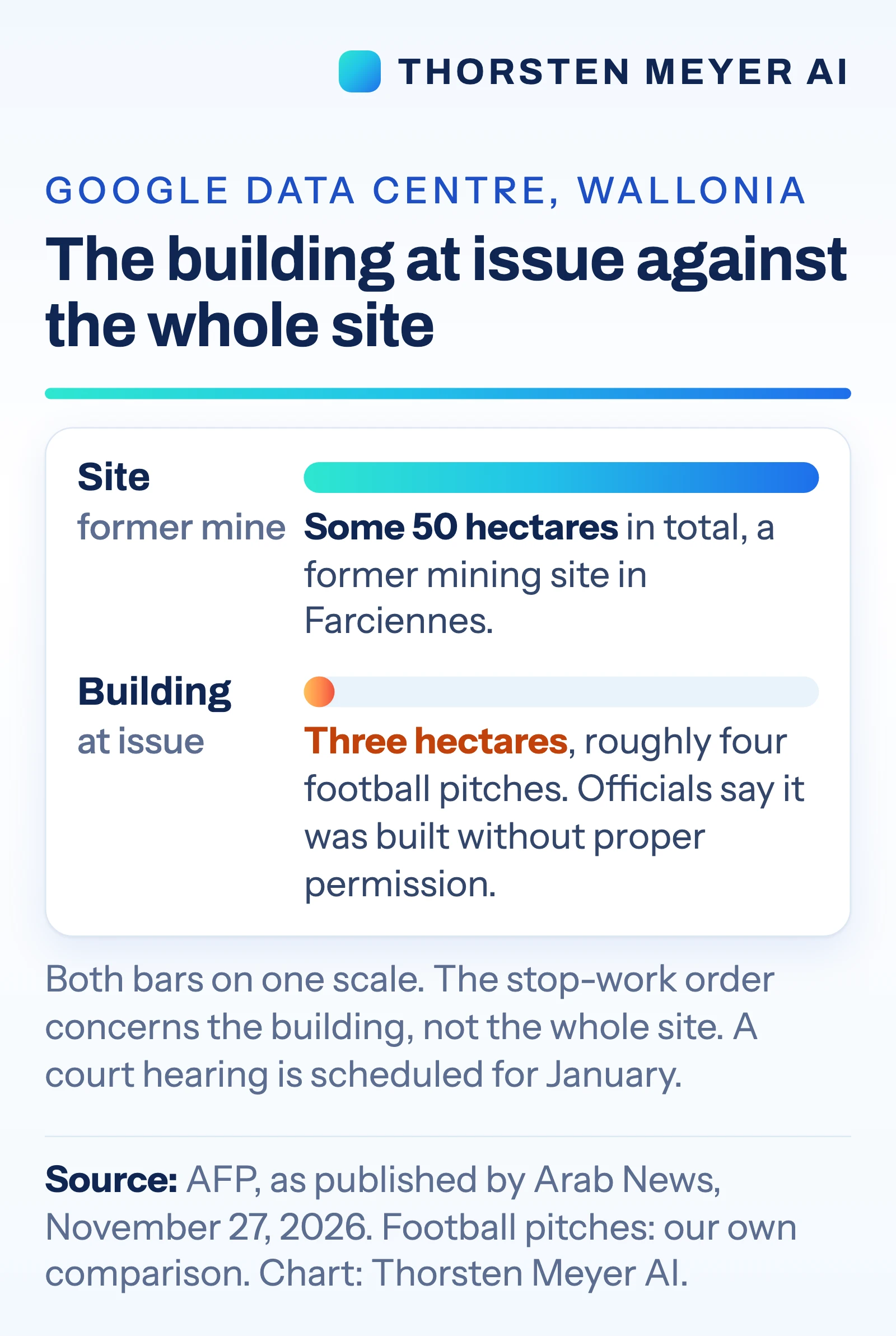
The building at issue covers three hectares. That is roughly four football pitches. It sits on a former mining site that covers some 50 hectares in total, AFP reported.
So the order concerns one building, not the whole site. For scale, there are around 13,500 data centres worldwide and 54 in Belgium, the BBC reported, citing the tracking site Data Center Map.
Why is this part of a bigger backlash?
Data centres are the factories of the AI boom. They also use large amounts of energy, and the BBC described “a growing backlash” over that.
Greenpeace put it sharply. “That Google continues to build without a permit is disrespectful to the environment, local residents, and the law,” said Joeri Thijs from Greenpeace Belgium. That is an accusation from a campaign group, not a court finding.
Belgium is not the only case. In October, Finnish authorities ordered work on two Google data centre sites to halt until environmental impact assessments were done, AFP reported. We looked at the wider European pushback after arrests at a Microsoft data centre site in Amsterdam.
What we know, and what we don’t know
What we know:
- Wallonia’s authorities ordered Google to stop construction over a lack of proper planning permission.
- The region refused Google’s request to cool the site with river water, and Google has challenged that in court.
- Google says it has paused the works and remains committed to local laws.
What we don’t know yet:
- What the court decides in January. That will show whether the water-cooling plan can go ahead.
- How much water the site would use. The reports give no figure.
- When AI services from the site would start. Google has not said.
- Whether fines follow. No report mentions any.
The bottom line
This is not a story about Google leaving Belgium. It is a story about who decides how a data centre is cooled. For you, the lesson is simple: the AI boom runs through local permits, and a river in a dry summer can matter as much as a chip.
Further reading: OpenAI Wants to Call Data Centers “Compute Campuses”. Who Pays for Their Power and Water?
I’m Thorsten Meyer. The full sources are below, and more reality checks are at thorstenmeyerai.com.
Sources
- AFP, as published by Arab News: “Belgian authorities force Google to halt data center construction”, November 27, 2026, including statements by Wallonia spokesman Nicolas Yernaux and Greenpeace Belgium
- BBC News: “Google halts ‘illegal construction’ of Belgian AI data centre”, November 29, 2026, including Google’s statement
- The Inquirer and SCMP refused our requests and are not cited. The order of the Walloon authorities and the Greenpeace report were not found online and are quoted as reported.
—
Researched and drafted with AI assistance, including Anthropic’s Claude. No government, company or person named here reviewed or sponsored this article. Our own text and graphics contain no affiliate links; offer and product boxes added by the site may contain Amazon affiliate links. This article is for information only. It is not legal or investment advice. Reports as checked on November 29, 2026. Images: AI-generated illustration (Runware) and graphics by Thorsten Meyer AI; our own images show no real people or logos. Boxes added by the site may show product photos or people.