
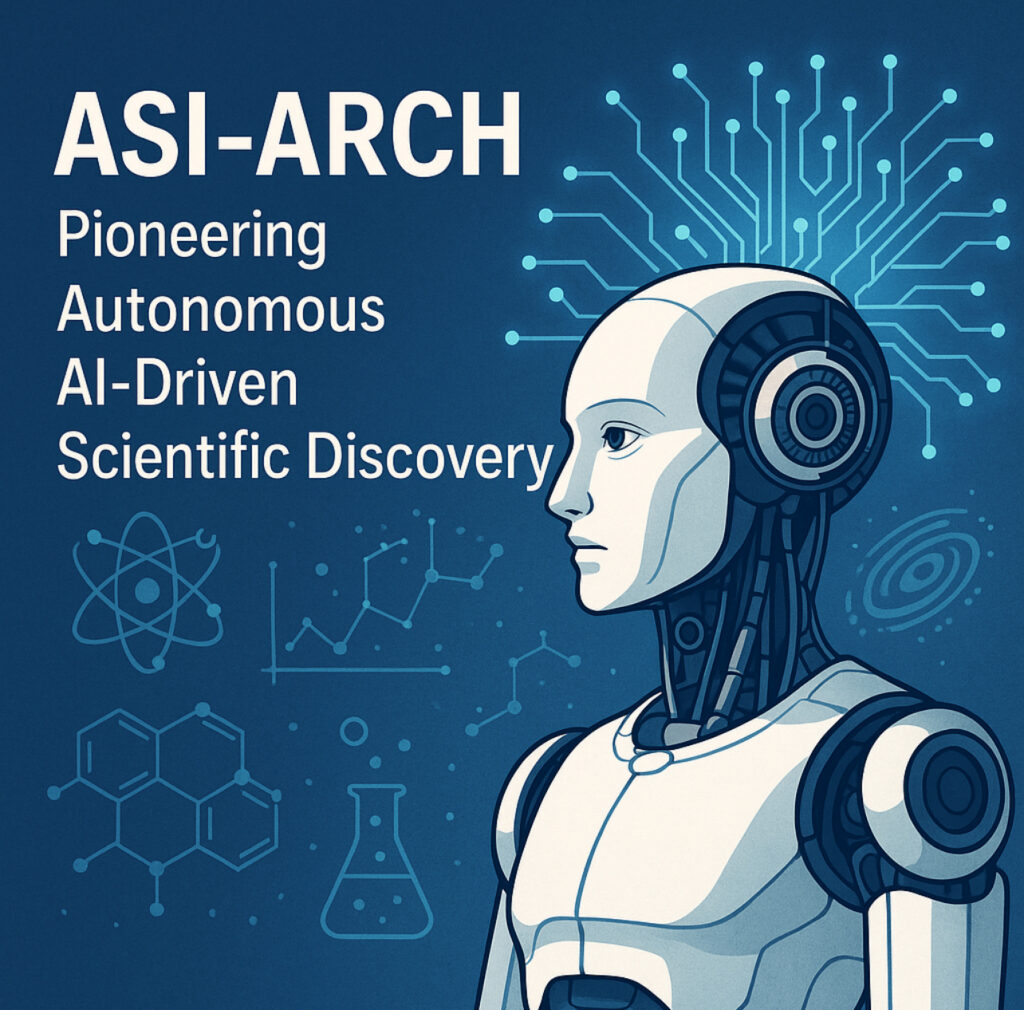
The AI research community is abuzz with excitement following the unveiling of ASI-ARCH, a groundbreaking autonomous system capable of independently designing novel AI model architectures. This innovation marks a profound shift from traditional human-led architectural discovery to a fully automated, computation-scalable research process—an “AlphaGo moment” for AI architecture development.
Play games included with Prime
Start a Prime free trial and play with Amazon Luna on your devices.
Start playingAs an affiliate, we earn on qualifying purchases.
Unveiling ASI-ARCH’s Multi-Agent Research System
At the heart of ASI-ARCH lies an elegant multi-agent framework comprising three specialized large language model (LLM)-based agents:
- Researcher: Responsible for inventing novel architectural concepts and implementing them in code, drawing from accumulated scientific knowledge.
- Engineer: Trains and validates these newly designed models through rigorous experimentation, with an automated debugging mechanism to ensure code reliability.
- Analyst: Reviews experimental results, identifies critical performance patterns, and generates insights that inform and refine subsequent iterations.
This iterative, closed-loop cycle mimics the scientific method but is fully autonomous, allowing rapid parallel execution and continuous improvement without human intervention.
Breakthroughs and Architectural Innovations
Through over 1,700 experiments consuming more than 20,000 GPU hours, ASI-ARCH discovered 106 new linear-attention architectures that outperform human-designed baselines. Notably, these models achieve superior results without merely increasing parameter size—maintaining disciplined, stable parameter counts (mostly 400-600 million) and focusing on genuine architectural advances like efficient gating and convolution mechanisms.
This signals the emergence of learned design patterns optimized via empirical results rather than intuition. The system’s success demonstrates that AI model discovery can evolve via computation alone, unchained from human cognitive limits.
Transformative Impact on AI Research
ASI-ARCH establishes what researchers call the first empirical scaling law for scientific discovery—indicating that progress in AI architecture need no longer be constrained by human creativity but can instead be accelerated proportionally to available computational resources. This shift heralds a new era where AI research velocity scales exponentially with hardware capabilities.
Crucially, the open-source release of ASI-ARCH’s framework and all 106 discovered architectures democratises access, empowering smaller research teams and academics to engage in cutting-edge AI development, potentially decentralizing innovation beyond tech giants.
Looking Forward
ASI-ARCH’s demonstration of autonomous, multi-agent-driven scientific discovery showcases a future where AI systems act not only as tools but as independent researchers catalyzing technological advancement. It invites a reconsideration of research models across disciplines and signals a paradigm where machine-driven innovation accelerates human progress faster than ever before.
Sources
[1] How we built our multi-agent research system – Anthropic https://www.anthropic.com/engineering/built-multi-agent-research-system
[2] How To Write an Article in 7 Easy Steps | Indeed.com https://www.indeed.com/career-advice/career-development/how-to-write-articles
[3] AI Agents vs. Agentic AI: A Conceptual Taxonomy, Applications and … https://arxiv.org/html/2505.10468v1
[4] Help:Your first article – Wikipedia https://en.wikipedia.org/wiki/Help:Your_first_article
[5] “Research agent 3.0 – Build a group of AI researchers” – Here is how https://www.chaindesk.ai/tools/youtube-summarizer/research-agent-3-0-build-a-group-of-ai-researchers-here-is-how-AVInhYBUnKs
[6] Writing an article – Writing non-fiction – AQA – BBC Bitesize – BBC https://www.bbc.co.uk/bitesize/guides/zwt3rdm/revision/4
[7] [2505.16938] InternAgent: When Agent Becomes the Scientist – arXiv https://arxiv.org/abs/2505.16938
[8] Writing an article | Online Learning area https://learning.cambridgeinternational.org/classroom/course/view.php?id=3594
[9] What are AI Research Agents? Complete Guide for Sales Teams https://www.origamiagents.com/blog/what-are-ai-research-agents
[10] How to Write an Article: A Six-Step Guide – LinkedIn https://www.linkedin.com/pulse/how-write-article-six-step-guide-saahil-nair
As an affiliate, we earn on qualifying purchases.
AI model architecture design software
As an affiliate, we earn on qualifying purchases.
As an affiliate, we earn on qualifying purchases.
As an affiliate, we earn on qualifying purchases.
As an affiliate, we earn on qualifying purchases.
NFL season / tailgating Picks
team gear
As an affiliate, we earn on qualifying purchases.