Ursula von der Leyen opened a door on Wednesday that would have sounded politically improbable a few years ago: Canada becoming the European Union’s first “associate member.”

Get business pricing on tech for your team
- Business-only prices and quantity discounts
- Tax-exempt purchasing
- Multiple users, one account, clear invoices
She made the proposal in her State of the Union address in Strasbourg on 16 September, with Canadian Prime Minister Mark Carney in the chamber. And she was explicit about what it would cover: advanced manufacturing, technology, defence production, the Arctic, energy, critical minerals, batteries, artificial intelligence, quantum computing, cybersecurity and economic security. “We will move from CETA to an Alliance for the Future.”
This is much bigger than another trade agreement. Canada and Europe would begin treating some of the defining technologies and supply chains of the coming decades as shared strategic interests.
For Europe, artificial intelligence may be the most consequential part of that proposition — because Canada brings something the EU urgently needs: another serious AI ecosystem.
Canada could be the AI partner Europe has been missing
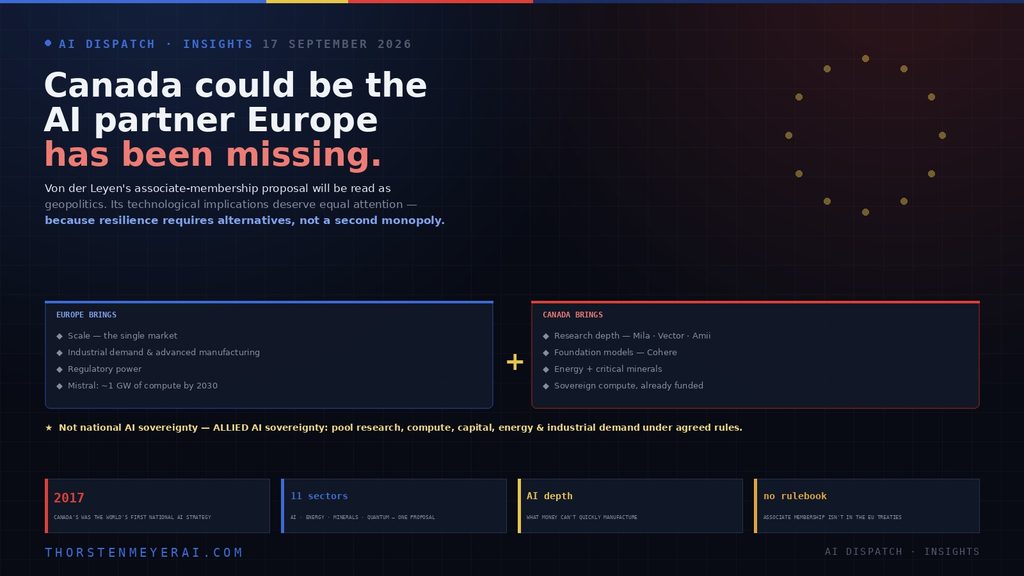
Von der Leyen’s associate-membership proposal will be read as geopolitics. Its technological implications deserve equal attention — because sovereignty can’t sensibly mean swapping dependence on a few American companies for dependence on a very small number of European ones. Resilience requires alternatives.
- Scale — the single market
- Industrial demand — the world’s deepest manufacturing base
- Advanced manufacturing
- Regulatory power — the ability to set rules others adopt
- A champion worth backing: Mistral, targeting ~1 GW of compute by 2030
- Research depth — three world-class institutes
- AI companies — Cohere and a commercialization ecosystem
- Talent — and the pipelines that produce it
- Energy + critical minerals — the binding constraint on the next phase
- Sovereign-compute ambitions already funded
Europe’s debate has been framed geographically — European AI versus American AI. But sovereignty doesn’t require isolation. A more practical definition: meaningful control over critical infrastructure, data, deployment and strategic choices. Instead of every country reproducing the whole stack domestically, trusted democracies could pool research, compute, capital, energy and industrial demand under agreed rules. AI policy is becoming energy policy, industrial policy and security policy simultaneously — and Canada is one of the few partners that answers all three at once.
Associate membership is not in the EU treaties. First floated by Merz for Ukraine; never applied to anyone. No one has said who approves it or how long it takes. The reported outline — summits, a Commission seat, budget access, no voting rights — is a sketch.
Carney’s office welcomed it (“to strengthen our sovereignty”), but Canada’s ambassador says Ottawa is “not there yet” — substance before the label. And with no geographic tie to the continent, it needs an entirely new legal architecture.
If sovereignty means meaningful control, alliance helps. If it means immunity from foreign legal reach, an ally isn’t automatically the answer — Canada is Five Eyes, and its EU adequacy was assessed on its commercial privacy framework, not its intelligence laws. “Not American” is a proxy, not the test.
Canada isn’t just another wealthy democracy to trade with more closely. It’s one of the countries that helped create modern AI — and still holds an unusually concentrated mix of research, companies, talent, energy and institutional expertise. Connecting that to Europe’s industrial base and single market could build something neither side manages alone. It won’t close the gap to the US or China. It would materially broaden Europe’s options. Canada becoming Europe’s first associate member would be historic politically. In artificial intelligence, it could be strategic — provided the documents get read as carefully as the speech.
Europe needs more than one AI champion
Europe has spent years discussing technological sovereignty while remaining heavily dependent on American technology platforms, cloud infrastructure and, increasingly, AI models.
EU + CANADA:
THE ALLIED AI STACK
What happens when Europe’s industrial scale meets Canada’s deep AI research ecosystem, talent, compute ambitions and resources?
World-Class AI Research
Mila · Vector Institute · Amii — institutions rooted in the development of modern deep learning.
Enterprise AI
Cohere and a growing ecosystem focused on enterprise models, secure deployment and real-world AI adoption.
Deep AI Talent
Researchers, universities, AI engineers and an established pipeline of machine-learning expertise.
Sovereign Compute
Expanding domestic AI infrastructure, supercomputing capacity and sovereign compute ambitions.
Power for AI
Significant energy resources and clean-power potential for increasingly compute-intensive AI infrastructure.
Critical Minerals
Strategic resources that matter across semiconductors, batteries, data centres and technology supply chains.
ALLIED AI SOVEREIGNTY
Sovereignty does not require isolation.
It requires options.
France’s Mistral AI has consequently acquired strategic importance far beyond that of an ordinary startup. It represents a serious attempt to build a European foundation-model company capable of competing internationally, and it continues to expand — with plans for additional European AI infrastructure and as much as 1 GW of compute capacity by 2030.
But technological sovereignty cannot sensibly mean replacing dependence on a few American companies with dependence on a very small number of European ones.
Resilience requires alternatives. Competing research centres. Competing model developers. Competing infrastructure providers and deployment platforms. Enough technological depth that governments and businesses can choose between credible suppliers rather than being pushed toward whichever domestic option happens to exist.
This is where Canada changes the equation.
Products Worth Considering

Bose SoundLink Plus Portable Bluetooth Speaker, Black

Jackery Explorer 300 Portable Power Station, 292Wh

Amazon Kindle Scribe Colorsoft, 64GB, 11-Inch Color Display with Premium Pen
As an affiliate, we earn on qualifying purchases.
Canada helped create modern AI
Canada isn’t arriving late to the artificial-intelligence race. It was there at the start — and not incidentally.

The foundational deep-learning work that produced the current generation of AI was done in substantial part in Canadian universities, sustained through the years when neural networks were unfashionable and funding was scarce. Geoffrey Hinton worked in Toronto. Yoshua Bengio built what became Mila in Montreal. Richard Sutton, whose work defined modern reinforcement learning, anchored the Edmonton cluster that became Amii. Between them, Hinton and Bengio hold a share of the 2018 Turing Award for precisely that work.
Canada also moved first at the policy level: the Pan-Canadian AI Strategy, launched in 2017 and administered through CIFAR, is generally recognized as the world’s first national AI strategy. Europe, the US and China all followed.
This distinction matters.
The strategic value of Canada is not that it could simply provide Europe with a Canadian alternative to Mistral. It is that Canada brings multiple layers of the AI stack:
- Fundamental research through Mila, Vector and Amii
- Enterprise foundation-model development through Cohere
- Reinforcement-learning expertise concentrated around Amii
- An expanding commercialization ecosystem
- And increasingly, compute
Canada launched its AI Sovereign Compute Infrastructure Program in April 2026, part of a broader effort to build large-scale domestic AI computing infrastructure — Canadian-owned infrastructure capable of supporting researchers, companies and institutions developing next-generation systems. Its broader AI for All strategy goes further, calling for a world-leading public AI supercomputer alongside additional sovereign compute and cloud infrastructure.
Put these pieces together and something important emerges. Europe would not merely be gaining access to another technology supplier. It would be connecting itself to an entire allied AI ecosystem.
The sovereign-AI map could become transatlantic
Europe’s AI debate has usually been framed geographically. European AI versus American AI. European cloud versus American hyperscalers. European models versus OpenAI, Anthropic, Google and Meta.
But sovereignty does not necessarily require technological isolation. A more practical definition is the ability to retain meaningful control over critical infrastructure, data, deployment and strategic choices.
Canada fits that model unusually well. Its government is explicitly pursuing sovereign AI infrastructure while simultaneously seeking deeper technological partnerships with trusted countries — its 2026 strategy calls for cooperation with international partners on research, talent, compute and procurement while expanding domestic control over compute, cloud, connectivity, data and talent.
That is remarkably compatible with what Europe is trying to achieve. And the result could be something more interesting than national AI sovereignty: allied AI sovereignty.
Instead of every European country attempting to reproduce the entire AI stack domestically, trusted democratic partners could pool research, compute, capital, energy and industrial demand — while maintaining agreed rules on data and strategic control.
Canada also solves another AI problem: energy
Artificial intelligence is rapidly becoming an infrastructure industry. Models require chips. Chips require data centres. And data centres require enormous quantities of electricity.
This changes the strategic calculation. Canada combines an advanced AI research ecosystem with substantial energy resources, access to critical minerals, and significant room for additional computing infrastructure.
It is therefore notable that von der Leyen’s proposal does not treat AI, energy, critical minerals and advanced manufacturing as unrelated subjects. They form part of the same proposed relationship — which is precisely how governments increasingly need to think about this.
AI policy is becoming energy policy, industrial policy and security policy simultaneously.
Europe should want Mistral and Canada
None of this diminishes the strategic importance of European AI companies. Quite the opposite.
Europe should want Mistral to succeed. It should want European AI infrastructure to expand. But it should also want Cohere competing for European customers. It should want European researchers working deeply with Mila, Vector and Amii. It should want Canadian and European companies sharing compute, research and capital. And it should want multiple credible suppliers operating inside a common trusted economic area.
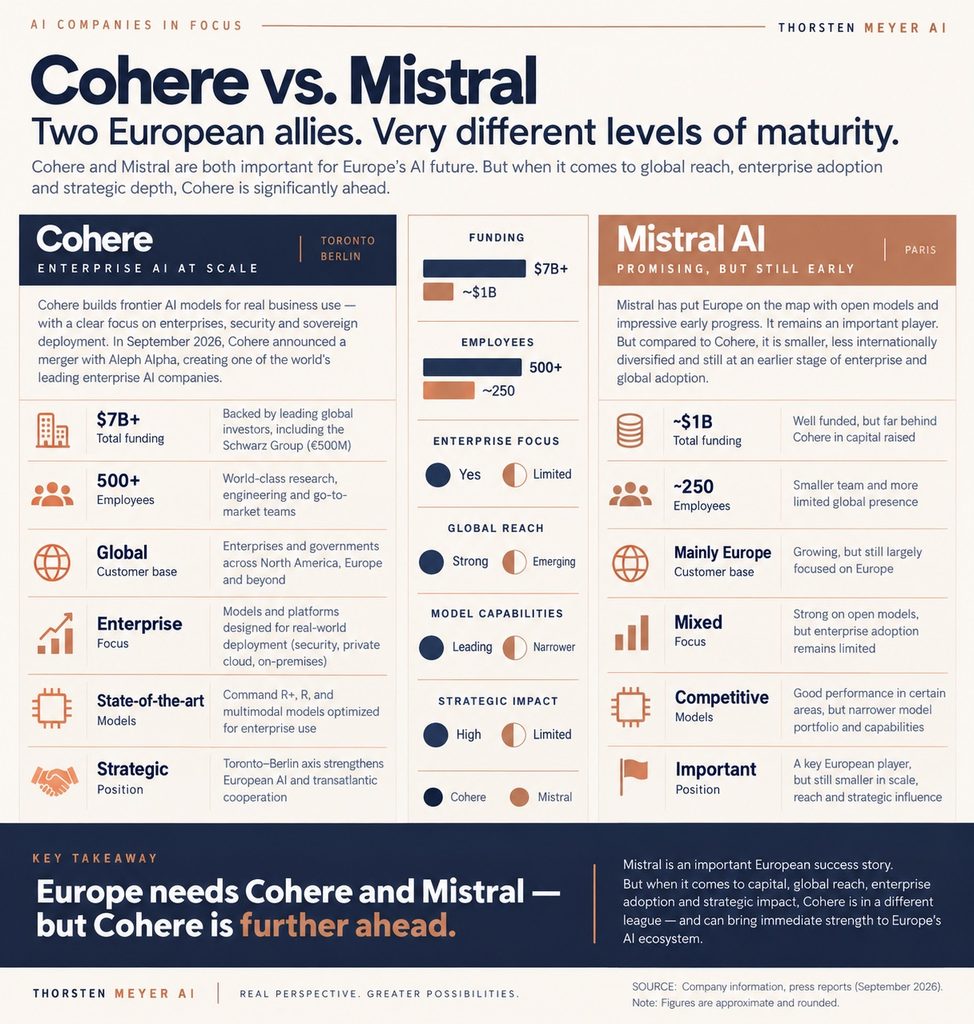
Competition within an allied ecosystem is healthier than dependence on any single champion.
Canada could therefore give Europe something money alone cannot quickly manufacture: AI depth. More researchers. More models. More enterprise platforms. More compute. More energy. More competition. And, crucially, more strategic options.
The caveats this proposal deserves
Three, and they should temper the enthusiasm rather than end it.
The status does not exist. Associate membership is not a category in the EU treaties. It was first floated by Chancellor Friedrich Merz in relation to Ukraine, and it has never been applied to anyone. Nobody has said who would need to approve it or how long it would take. Reported outlines — a seat at summits, representation in the Commission, access to parts of the budget, no voting rights on legislation — remain sketches.
Ottawa has not said yes. Carney’s office welcomed the overture and spoke of deepening ties “to strengthen our sovereignty,” but Canada’s own ambassador has been blunt that Ottawa is not there yet, and that both sides are deliberately settling the substance before the label. Canada also has no geographic relationship with the continent, which means an entirely new legal architecture.
And “allied” is not the same as “sovereign.” This is worth stating plainly, because it is the hard question underneath the optimism. If sovereignty means meaningful control, then deepening the alliance is genuinely useful. If it means immunity from foreign legal reach, an ally is not automatically the answer — Canada is a member of the Five Eyes intelligence arrangement, its EU adequacy decision was assessed against its commercial privacy framework rather than its intelligence laws, and “not American” is a proxy for a test rather than the test itself. The right questions remain the unglamorous ones: who can compel a provider, under what standard, with what redress for a non-national, and can you leave. Allied AI sovereignty is a real and valuable idea. It is not a substitute for reading the documents.
A technology alliance hiding inside an associate membership
Von der Leyen’s proposal will inevitably be discussed in terms of geopolitics, trade and Canada’s deteriorating relationship with Washington. But its technological implications deserve just as much attention.
Canada is not simply another wealthy democracy Europe could trade with more closely. It is one of the countries that helped create the modern AI revolution, and it still holds an unusually concentrated combination of research, companies, talent, energy and institutional expertise.
Connecting that ecosystem to Europe’s industrial base and single market could create something neither side can easily build alone. Europe brings scale, industrial demand, advanced manufacturing and regulatory power. Canada brings research depth, AI companies, talent, resources and growing sovereign-compute ambitions.
The combination would not instantly close the AI gap with the United States or China. But it could materially broaden Europe’s technological options — and that may ultimately be the most important meaning of the proposal.
Canada becoming Europe’s first associate member would be historic politically.
In artificial intelligence, it could be strategic.
Sources: von der Leyen’s 2026 State of the Union address (Strasbourg, 16 September 2026) and the associate-membership proposal, the named sectors, the “Alliance for the Future” framing and the “partnership not against anyone else” quotation via AP, NPR, Al Jazeera, Euronews and US News; the absence of associate membership from the EU treaties, its origin as a Merz proposal for Ukraine, the undefined approval path and the reported outline of the status via the same; Carney’s office’s response and the Canadian ambassador’s “not there yet” remark as reported; Canada’s AI Sovereign Compute Infrastructure Program (April 2026) and the AI for All strategy per Canadian government descriptions; the Pan-Canadian AI Strategy (2017, CIFAR) as the first national AI strategy; Hinton, Bengio and Sutton’s roles and the 2018 Turing Award as matters of public record; Mistral’s ~1 GW-by-2030 compute plans as reported. Canada’s Five Eyes membership and the commercial-framework basis of its EU adequacy decision are discussed at greater length in this publication’s earlier analysis of sovereignty standards. The associate-membership status remains a proposal with no agreed legal form; nothing here should be read as assuming it will be adopted. Not investment advice. Analysis and framing are the author’s.