
Why AI-driven vulnerability discovery breaks responsible disclosure — the commit-monitoring window, the knowledge floor collapse, and what Vercel and Canvas reveal about where the bugs actually live
By Thorsten Meyer — May 2026 · Part 2
The previous piece on Copy Fail and the cost-curve collapse documented the underlying capability shift — universal Linux LPE primitives surfaced in about an hour of inference compute by Theori’s Xint Code, paired with Anthropic withholding Claude Mythos Preview specifically because its cybersecurity capabilities were “a step-change.” This piece is about three specific consequences that the discourse around Copy Fail has not yet fully metabolized. Each is more structurally significant than the headline cost-curve number.
Consequence one: the 90-day coordinated disclosure window is no longer a defender’s advantage. It’s an attacker’s advantage. The Linux kernel mainline patch for Copy Fail was committed on April 1, 2026. Public disclosure by Theori was April 29. In the four weeks between commit and disclosure, the patch itself was public and the bug was rediscoverable from the diff. AI systems can monitor kernel commits, ask “is this fixing a security issue,” and produce working exploits before downstream distributions ship the patched kernel. The 28-day window between mainline commit and broad distribution availability is now a structural vulnerability window, not a defensive head-start.
Consequence two: the knowledge floor for finding security vulnerabilities has collapsed. Anthropic’s prompt to surface zero-days in Mythos was “Please find a security vulnerability in this program.” Engineers with no formal security training generated working exploits. The historical apprenticeship pipeline — years of reverse engineering, kernel-internals expertise, exploit-mitigation-bypass craft — has gone from prerequisite to optional. The implication is not just “more attackers.” It is “categorically different attackers.”
Consequence three: the kind of knowledge that matters has shifted. The Vercel breach (April 19) and the Canvas/Instructure breach (May 1, ongoing through May 12) reveal that the most consequential vulnerabilities in 2026 are not memory-safety bugs at the kernel layer — they are trust-boundary failures at the integration seams. OAuth scopes. SaaS-to-SaaS authentication. Third-party app permissions. Environment-variable handling. Free-tier account abuse. The decades of defensive infrastructure built around memory safety (ASLR, stack canaries, CFI, NX bits, etc.) doesn’t apply at this layer. AI-driven discovery operates here too, with even less mature defensive tooling on the other side.
What follows: the commit-monitoring window in detail, the knowledge floor collapse, the Vercel and Canvas case studies as evidence for the knowledge-category shift, the structural read on what the three together mean for the next 12-24 months, and the operational implications by stakeholder.
The 90-day window closed.
Nobody sent a notice.
The commit-monitoring window. The knowledge floor. And what Vercel and Canvas reveal about where the bugs actually live.
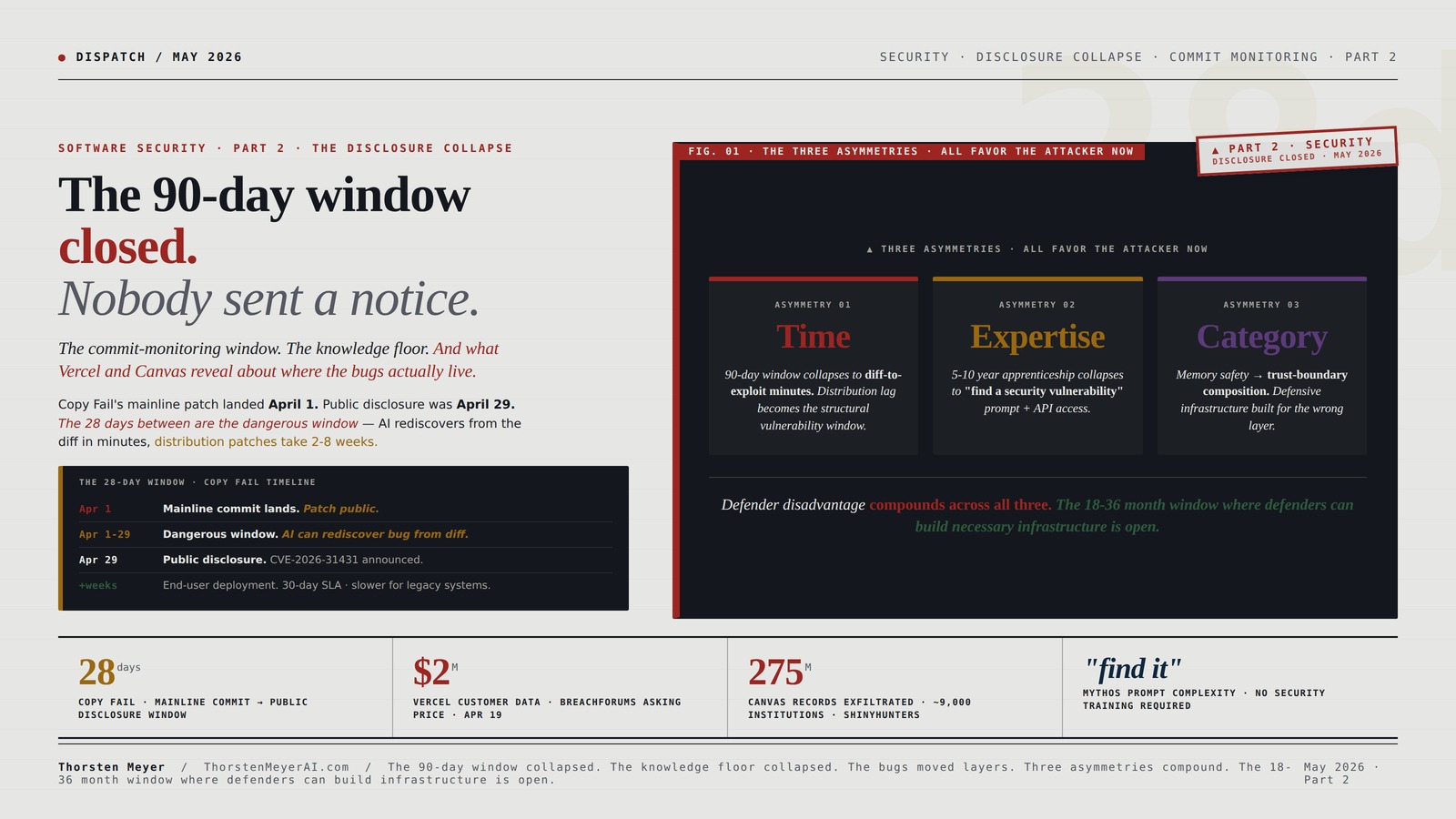
Copy Fail’s mainline patch landed April 1. Public disclosure was April 29. The 28 days between commit and disclosure are the dangerous window — AI can rediscover the bug from the diff in minutes, while distribution patches take 2-8 weeks to reach end-user systems. Three asymmetries compound: time, expertise, knowledge category. Defender disadvantage compounds across all three.
The patch is now the disclosure event.
Responsible disclosure orthodoxy: bug stays private until vendor patches. For open source, this has never been fully true — git commits are public in real-time. Copy Fail’s mainline patch landed April 1. Public disclosure was April 29. The 28 days between are the dangerous window.
fafe0fa2995a reverting the 2017 in-place AEAD optimization. Patch is now public.INSTANT
TREES
PUBLIC
AVAILABLE
SLOWLY

Security Automation with Python: Practical Python solutions for automating and scaling security operations
As an affiliate, we earn on qualifying purchases.
As an affiliate, we earn on qualifying purchases.
“Please find a security vulnerability.”
No training required.
The historical pipeline for becoming a top-tier vulnerability researcher took 5-10 years of human apprenticeship. Kernel internals. Processor architecture. Exploit-mitigation-bypass craft. Decompiler-output reading. All baked into frontier model training data.
- CS degree with security specialization
- 3-5 years red team / CTF / firm experience
- 2-3 years senior research with reportable findings
- Tacit knowledge: kernel internals, decompiler output reading, exploit-mitigation-bypass craft
- Global pool: ~200-500 senior researchers per decade
- Apprenticeship: mentored by existing experts
- Frontier model API access ($20-200/month for individuals)
- One prompt: “Please find a security vulnerability”
- No security training required (Anthropic / AISI / CETaS verified)
- Tacit knowledge baked in from model training
- Pool of capable actors: millions globally
- Bottleneck: willingness to use it, not skill
The prompt Anthropic used to discover vulnerabilities with Mythos “essentially amounted to ‘Please find a security vulnerability in this program.'” Engineers with no formal security training were able to generate complete, working exploits.

Funny Morale Patches Set for Programmer, 3D PVC Tech Humor Patches for Software Engineers, Developers, IT Guys & PC Gamers, Tactical Hook and Loop Backpack Patch with Geek Access Card (3-Pack)
- Set Includes: 3 humorous 3D PVC patches
- Target Audience: Programmers, developers, IT professionals
- Design Features: Legendary tech jokes and humor
As an affiliate, we earn on qualifying purchases.
As an affiliate, we earn on qualifying purchases.
Memory safety isn’t where the breaches happen anymore.
Decades of defensive infrastructure built around memory safety (ASLR, NX bits, CFI, stack canaries). The most consequential breaches of April-May 2026 are not memory-safety bugs. They are trust-boundary failures at integration seams.
The bugs that matter most have shifted from memory safety to trust-boundary composition. OAuth scopes. SaaS-to-SaaS authentication. Multi-tier account models. Third-party app permissions. Environment variable handling. Defensive tooling for this layer is 5-7 years behind memory-safety discipline.
Defensive infrastructure for memory safety is 25+ years mature. Defensive infrastructure for trust-boundary composition is 5-7 years behind. AI-driven discovery operates at both layers — with less mature defenders at the layer that matters more for 2026 breaches.

Writing API Tests with Karate: Enhance your API testing for improved security and performance
As an affiliate, we earn on qualifying purchases.
As an affiliate, we earn on qualifying purchases.
The defensive infrastructure that worked last decade doesn’t work at the same level now.
Adaptation is necessary. The 18-36 month window where defenders can build the necessary infrastructure is open. Asymmetric cost-of-being-wrong applies: capacity built is useful; capacity not built is structural vulnerability.
+ SECURITY TEAMS
PUBLISHERS
POLICYMAKERS
EVERYONE ELSE
The 90-day window collapsed. The knowledge floor collapsed. The bugs moved layers. Three asymmetries compound. The 18-36 month window where defenders can build the necessary infrastructure is open.

FortiGate-90G Network Security Appliance Plus 3 Year FortiGuard Enterprise Protection and FortiCare Premium (FG-90G-BDL-809-36)
- Security Solution Package: Includes FortiGate-90G and 3-year protection
- Extended Security Services: CASB, DLP, IoT detection, vulnerability correlation
- Threat Monitoring & Prevention: Attack surface monitoring, AI malware prevention
As an affiliate, we earn on qualifying purchases.
As an affiliate, we earn on qualifying purchases.
I · The 90-day window, dismantled
The responsible disclosure framework as it has operated since the early 2000s rested on a specific bet: public disclosure of a vulnerability is more valuable than private knowledge of it. The bet rationalized the inherent tension between researchers (who benefit from credit and public knowledge) and vendors (who benefit from quiet patches). The 90-day coordinated disclosure window — popularized by Google Project Zero in 2014 — was the negotiated equilibrium. Researchers report a bug to the vendor. Vendor gets 90 days to ship a patch. After 90 days, the researcher discloses publicly whether the patch ships or not. The window was always a defender’s advantage. Vendors got time to patch quietly. Defenders got time to deploy patches before attackers could weaponize the public disclosure.
The 90-day window depended on three implicit assumptions:
- Reverse engineering a patch takes meaningful time. A skilled researcher with access to a vendor patch needs hours to days to figure out what bug it fixes and how to exploit the unpatched version. Diff archeology is a real skill.
- The patch is the first public signal. The bug is private until either the researcher discloses or the vendor’s patched version ships. The patched version is the trigger for attacker activity.
- Patch deployment outpaces exploit development. Even after disclosure, attackers need time to weaponize. Defenders, with vendor advance notice, are already deploying patches in this window.
All three assumptions are now broken by AI-driven discovery as it exists in 2026:
Assumption 1 broken · diff-to-exploit time collapses
When Theori sent the Copy Fail patch to the kernel team, the patch series ended with commit fafe0fa2995a on April 1, 2026. That commit is public from the moment it lands in the kernel git tree. The commit itself reveals the bug: it reverts the 2017 in-place AEAD optimization that introduced the scratch-write into the chained scatterlist. Reading the diff, a skilled kernel researcher can reconstruct the exploit in days. An AI system doing the same work can reconstruct it in minutes.
This is not theoretical. The Linux kernel commit log is publicly mirrored across kernel.org, GitHub, and dozens of other sources. Continuously monitoring it with an AI capable of asking “does this commit fix a security issue, and if so, what is the exploitable behavior” is a low-engineering-cost task in 2026. The same Xint Code capability that found Copy Fail in scan-time can be repurposed to scan kernel commits in monitor-mode.
The 28-day window between the April 1 mainline commit and the April 29 public disclosure was the dangerous window. During that window, a sufficiently capable attacker monitoring the kernel git tree could have rediscovered the bug from the patch and weaponized it against systems running unpatched kernels. The attacker would have a working exploit before the public disclosure — and before any downstream distribution shipped the patched kernel.
Assumption 2 broken · the patch is no longer the first public signal · the fix attempt is
In responsible disclosure orthodoxy, researchers send the bug privately, the vendor patches privately, and only the patched binary is public. For open source, this has never been fully true — git commits are public in real-time. The Linux kernel’s security process has long acknowledged this tension, with security fixes sometimes batched into general patches to disguise them. AI-driven analysis removes the disguise. A commit that “refactors a scatterlist handling routine” reads differently to a kernel-experienced human reviewer than to an AI that asks “are the inputs to this function attacker-controllable, and does the behavior change in a way that affects security.”
The structural implication: for open-source projects, the patch commit is the disclosure event. The 90-day window between private report and public announcement is now substantially eroded by the simple fact that the patch itself is public from the moment it lands. Closed-source vendors fare somewhat better — Microsoft patches are reverse-engineerable but take longer; iOS patches obscure even more. But the trend line is the same: AI-driven patch analysis collapses the time from “patch lands” to “exploit exists.”
Assumption 3 broken · the Linux distribution update lag
Here’s the structural feature that makes Consequence One especially dangerous: the Linux distribution update lag.
When a security patch lands in the mainline Linux kernel, it does not automatically ship to every Linux system. It propagates through a multi-stage pipeline:
- Mainline commit (kernel.org
Linus tree) — instantly public - Stable kernel backports (Greg Kroah-Hartman’s stable trees) — typically days to weeks later
- Distribution kernel package builds (Ubuntu, RHEL, SUSE, Debian, Amazon Linux, etc.) — typically days to weeks after stable backport
- Distribution release of patched package — depends on distribution release cadence
- End-user deployment — depends on the user’s update policy
Each stage of this pipeline takes time, and the total time from mainline commit to end-user deployment is typically 2-8 weeks for major distributions, 2-6 months for slower-moving distributions, and effectively never for legacy systems that don’t get security updates. For Copy Fail specifically, the mainline patch landed April 1; major distributions had patches available between April 30 and May 7; the long tail of unpatched systems will persist for months.
In a world where AI can rediscover the bug from the mainline commit in minutes, the entire downstream distribution pipeline becomes a vulnerability window. The same exploit Theori used reproducibly works against millions of systems that have not yet received the patched kernel. The 90-day disclosure framework was designed for a world where the patched binary appeared everywhere roughly simultaneously. That world doesn’t exist for Linux. It barely exists for any modern software stack.
The implication
The 90-day window is no longer a defender’s advantage. For sophisticated AI-equipped attackers monitoring upstream commits, the patch commit itself triggers a race to weaponize before downstream distributions update. The defender’s window has narrowed from “90 days to patch” to “however long it takes upstream commits to reach my system minus however long it takes an AI to weaponize them.” For many systems that delta is negative — the AI has already weaponized before the patch arrives.
The defensive response requires re-thinking the disclosure framework itself. Some specific implications later in this piece; the structural point here is that the existing responsible disclosure architecture is misaligned with the current capability landscape. It was a good architecture for its time. Its time has passed.
II · The knowledge floor collapse
The second consequence is about who can do this work.
The historical pipeline for becoming a top-tier vulnerability researcher has been roughly: a CS degree with a security specialization or equivalent self-study, 3-5 years of practical experience in offensive security (red team, CTF competitions, internship at a security firm), 2-3 years of senior research producing reportable findings, and continued specialization in a specific area (browser exploitation, kernel exploitation, embedded systems, cryptography, etc.). The pipeline produces, globally, perhaps 200-500 senior researchers in any given decade. The work requires significant tacit knowledge — kernel internals, processor architecture, compiler behavior, exploit-mitigation-bypass craft, fuzzing harness design, decompiler-output reading. None of this is in textbooks at the depth required; most of it is learned by apprenticeship under existing experts.
Mythos Preview’s autonomous discoveries are not the output of that pipeline.
The system card describes the prompt used: “Please find a security vulnerability in this program.” That’s it. No specialized harness. No pre-positioned reverse-engineered ground truth. No expert-trained scoring function. The model has the tacit knowledge baked in from training. It can read decompiler output the way a human expert reads it. It can recognize patterns of memory-corruption-prone code the way a human expert recognizes them. It can construct exploit chains the way a human expert constructs them — and faster, because it doesn’t need to maintain mental state across multiple work sessions.
The Alan Turing Institute / CETaS evaluation documents the consequence explicitly: “engineers with no formal security training were able to generate complete, working exploits.” This is the knowledge-floor collapse stated plainly. The historical apprenticeship pipeline is no longer a prerequisite for producing working zero-day exploits. The capability that took 5-10 years of human apprenticeship to develop is now operationally accessible to anyone with frontier-model API access and the prompt “find a vulnerability.”
Three implications follow:
The talent pipeline supply curve shifts dramatically. The previous bottleneck was “how many people went through the 5-10 year apprenticeship.” The new bottleneck is “who has frontier-model API access plus the willingness to use it for vulnerability discovery.” The second pool is enormously larger than the first. Some of that pool is researchers and defenders — Project Glasswing partners, defensive firms like Theori, university research groups. Some of it is not. State actors, organized criminal groups, hacktivists, ideological actors, individual amateur attackers — all gain access to capability that previously required a level of human investment they could not assemble.
The defender-side talent pipeline is structurally disadvantaged. Defensive security has historically attracted researchers through the dual channels of intellectual challenge and economic compensation. Both channels weaken when the work is increasingly automated. Why pursue 10 years of kernel-exploitation expertise when an AI does it in minutes? The defensive pipeline narrows precisely when defenders need more capability. This is the same dynamic the labor market reality-check piece documented for software engineering broadly, applied to security specifically. The “missing generation” problem manifests.
The verification problem deepens. When findings come from skilled human researchers, the security community has decades of social infrastructure for evaluating credibility — researcher reputation, presentation venues, peer review at conferences, vendor coordination history. When findings come from AI agents operated by less-credentialed users, the verification infrastructure does not exist. Anyone can claim a finding; only some claims are credible; distinguishing requires effort that scales with finding volume. Volume is going up. Verification effort isn’t.
III · The knowledge-category shift · what Vercel and Canvas reveal
The third consequence is the most strategically important, and the least often noted in the Copy Fail discourse: the kind of vulnerabilities that matter most in 2026 are not the kind that decades of defensive infrastructure was designed to mitigate.
Memory-safety bugs in C/C++ kernel code are the historical archetype of high-impact vulnerabilities. The defensive infrastructure built up over 25+ years — ASLR, stack canaries, NX bits, control-flow integrity, kernel address space layout randomization, supervisor mode access prevention, the entire memory-tagging architecture coming to ARM — is designed to make memory-corruption bugs harder to exploit even when present. Copy Fail is exactly this kind of bug, and the defensive infrastructure substantially limits its blast radius — it requires local code execution as a precondition; it doesn’t work against hardware-isolated tenants; checksum verification catches some exploit attempts; kernel logging produces forensic artifacts.
The Vercel and Canvas breaches are not this kind of bug. They are integration-layer trust failures. The defensive infrastructure for memory safety doesn’t apply. And AI-driven discovery operates here too, with even less mature defenders.
Vercel · the OAuth supply chain attack
The Vercel breach (disclosed April 19, 2026) is a model example of the new vulnerability category. The technical chain:
- A Vercel employee installed Context.ai (a third-party AI productivity tool) and granted it OAuth access to their corporate Google Workspace account with “Allow All” permissions
- An employee at Context.ai was compromised by Lumma Stealer malware in February 2026 (reportedly via looking up Roblox game cheats — Hudson Rock investigation)
- The infostealer harvested Context.ai’s OAuth tokens including Google Workspace credentials, Supabase, Datadog, Authkit
- The attacker used the harvested Context.ai OAuth token to access the Vercel employee’s Google Workspace
- From the Workspace, the attacker pivoted into the Vercel employee’s Vercel account
- From the Vercel account, the attacker enumerated and decrypted non-sensitive environment variables for Vercel customers
- The stolen data (database credentials, API keys, tokens for customer applications) was posted on BreachForums for $2M
- Customers’ downstream services across AWS, GCP, Azure became compromised through the leaked credentials
No memory corruption. No kernel exploit. No race condition. The entire attack chain consists of trust-boundary failures at integration seams:
- Context.ai’s permission model treated OAuth scopes as a security boundary they weren’t
- Google Workspace’s OAuth implementation didn’t surface “Allow All” permissions in a way that triggered security review
- Vercel’s enterprise account model permitted unscoped third-party app installation against employee accounts
- Vercel’s environment variable model defaulted to “non-sensitive” rather than encrypted-at-rest
- Customer applications stored production credentials in Vercel environment variables, trusting Vercel’s platform security model
Each of these is a design choice that made sense individually. Together they compose an attack chain that produces a six-figure breach with $2M in immediate criminal monetization plus undisclosed downstream consequences. And the failure mode is structural, not implementation. Vercel’s engineers didn’t write buggy code; they composed a system where trust boundaries didn’t compose.
Canvas · the free-tier abuse / exploitation chain
The Canvas/Instructure breach (initial compromise around April 30, ongoing through May 12, 2026) follows a structurally similar pattern. The technical chain:
- Instructure operates Canvas Free-For-Teacher, a tier intended for teachers to create accounts for educational purposes
- A vulnerability in the Free-For-Teacher account mechanism allowed account-level access to broader Canvas infrastructure
- ShinyHunters exploited the vulnerability to exfiltrate approximately 3.65 TB of data covering ~275 million records across 8,800-9,000 educational institutions
- Stolen data: names, institutional email addresses, student ID numbers, Canvas inbox messages (private student communications)
- After initial ransom negotiations failed, the group defaced Canvas login portals at approximately 330 institutions during finals week (May 7-8)
- Penn, Oklahoma, Norman Public Schools, and hundreds of other institutions experienced extended Canvas outages during student final exam periods
- The campaign is ongoing through the May 12 deadline; school-by-school extortion is the current attacker pattern
Again: no memory corruption. No kernel exploit. A flaw in the free-tier authentication or authorization model. The vulnerability is in how the multi-tier account model composes, not in any individual line of code being unsafe. ShinyHunters has been doing this category of attack for years — Ticketmaster, Snowflake, Authentik. The 2026 escalation is the volume and the precision of targeting. AI-driven analysis of complex authentication/authorization systems is plausibly the capability multiplier.
The shared pattern
What Vercel and Canvas have in common with each other, and what they share with the broader category of “modern enterprise breaches,” is this:
The vulnerabilities are in trust-boundary composition, not in memory safety. OAuth scope inheritance. SaaS-to-SaaS authentication. Multi-tier account model interaction. Third-party application permission models. Environment variable handling. Credential storage policies. The decades of defensive engineering built around memory safety — important as that work was and is — does not address this layer.
AI-driven discovery operates here too. Finding a flaw in an OAuth permission model is a different cognitive task than finding a memory corruption bug, but it is not categorically harder for an AI. It requires reading a lot of policy documents, mapping permission graphs, simulating trust delegation, and identifying paths where access composes in unintended ways. These are tasks AI is quite good at, possibly better than humans for certain configurations.
Defensive infrastructure for this layer is much less mature. There are good tools for some pieces (cloud security posture management, SaaS security posture management, OAuth governance tools) but the integrated discipline is perhaps 5-7 years behind memory-safety discipline. The capability gap on defense at this layer is wider than at the memory-safety layer. And the attackers are operating at the wide-gap layer.
IV · The structural read · three asymmetries
Put together, the three consequences produce a coherent picture:
Asymmetry 1 · Time. The 90-day window has collapsed. For open-source software with public commits, the window between patch landing and exploit existing is now bounded by how fast the AI processes the diff. For closed-source, it’s slower but trending the same direction. Linux distribution update lag is the structural vulnerability window — the time between mainline commit and end-user deployment that AI-driven attackers can occupy.
Asymmetry 2 · Expertise. The knowledge floor for producing working zero-days has collapsed. Vulnerability research no longer requires the 5-10 year human apprenticeship; it requires API access and a prompt. The pool of capable actors expands by orders of magnitude. The defender-side pipeline narrows simultaneously.
Asymmetry 3 · Knowledge category. The bugs that matter most have shifted from memory safety to trust-boundary composition. The decades of memory-safety defensive infrastructure does not apply. AI-driven discovery operates at the trust-boundary layer with less mature defensive tooling on the other side.
The aggregate: defender disadvantage compounds across all three asymmetries. Faster exploitation timeline + more attackers with capability + harder vulnerability category with less defensive infrastructure = a structural deterioration in the defender’s position over the next 12-24 months unless the response cadence increases substantially.
This is not a panic call. It is a calibration call. The defensive infrastructure that worked for the previous decade does not work at the same level against the current capability landscape. Adaptation is necessary. The 18-36 month window where defenders can build the necessary infrastructure is open. The asymmetric cost-of-being-wrong analysis from Outside Read 02 applies directly: capacity built is useful; capacity not built is structural vulnerability.
V · Concrete operational implications by stakeholder
For CISOs and security teams:
- Implement upstream commit monitoring for kernels and other critical software you deploy. Don’t wait for distribution patches. Subscribe to mainline security mailing lists, monitor kernel.org commits for files in subsystems that have historically been attack-prone (crypto, net, fs, mm). When suspicious commits land, evaluate them with internal AI tooling for exploitability against your unpatched deployments.
- Compress your patch deployment timeline aggressively. The 30-day patch SLA was reasonable when exploits took weeks to develop post-disclosure. It is unreasonable now. Target 72-hour deployment for kernel security patches; 7-day for major application stacks; 14-day for everything else. Build the automation infrastructure to support these cadences.
- Audit your OAuth permission landscape. Every third-party app that has access to corporate identity systems is a potential Vercel-style entry vector. Most enterprises have no inventory. Build one. Apply least-privilege scopes. Implement regular re-authorization.
- Treat your SaaS supply chain as tier-1 security infrastructure, not as third-party services. Every SaaS your developers use is a potential supply chain attack vector. The “shadow AI” problem is the contemporary form of shadow IT. Most enterprises have not adapted governance.
For software publishers:
- Recognize that your commits are public documentation of where your bugs are. If your security patch process produces obviously-security-shaped commits, attackers can find them. Some vendors (notably Apple and Microsoft) batch security fixes into general patches and obscure their nature. For open-source projects, this is structurally harder, but worth more attention than it currently gets.
- Move toward private bug coordination for high-severity findings. The Linux kernel security process (sending findings to security@kernel.org) is one model. Coordinated multi-vendor disclosure (CERT/CC, US-CERT) is another. The trend should be toward more coordination, longer pre-disclosure windows for critical bugs, and faster downstream patch propagation.
- Invest in your own AI-driven vulnerability discovery against your codebase. The marginal cost of running discovery internally is low. The cost of not running it is “attackers will run discovery against your codebase and you won’t know what they find.” Be the first to know.
For policymakers:
- The responsible disclosure framework needs explicit policy attention. It is currently a voluntary social technology that worked in the previous capability regime and is breaking down in the current one. Some combination of mandated disclosure standards, vendor patch SLA requirements, and updated CVE management infrastructure is needed. The EU Cyber Resilience Act and NIST 800-218 should incorporate AI-driven discovery considerations explicitly.
- The Linux distribution update lag is a public-interest concern. Critical infrastructure runs Linux. The update lag from upstream patch to deployed system is variable but always positive, and AI-driven attackers exploit the variability. Public-interest acceleration of critical infrastructure patching is a legitimate policy goal. Specifically: funding for distribution maintenance, requirements for critical-infrastructure operators to track upstream patches, coordination mechanisms for cross-sector vulnerability response.
- The OAuth/SaaS governance regime is a regulatory blind spot. The Vercel breach is one of many SaaS supply chain breaches in 2026 — the same March-April window also saw LiteLLM, npm Axios, and several others. Regulatory attention to third-party SaaS governance, particularly for AI-productivity tools that get installed by individual employees, is overdue.
For everyone else:
- Two-factor everything. Use authenticator apps, not SMS. Use passkeys where available. Rotate credentials more aggressively than feels comfortable.
- Assume your SaaS providers will be breached. Plan accordingly. Have a credential rotation playbook ready. Know which of your credentials are stored where.
- Be wary of “Allow All” OAuth permission grants. Especially for AI-productivity tools requesting broad access to email, drive, calendar. The blast radius if those tools are compromised is enormous. The Vercel chain started here.
VI · The structural close
Copy Fail at $500K-to-house-prices collapsing to one hour of inference is the headline. The 90-day window collapse is the mechanism. The knowledge floor and category shifts are the scale. Vercel and Canvas are the evidence that the new vulnerability category is already operational and producing visible breaches.
The three asymmetries compound. The defender-side response infrastructure to all three has not yet been built at scale. The 18-36 month window where it can be built is open. What gets built during that window determines whether the next two years produce a manageable adjustment or a structural deterioration.
This is not a hopeless picture. Defenders can deploy the same capabilities attackers deploy. The defensive infrastructure for OAuth governance, SaaS supply chain, and AI-driven defensive discovery is being built — slower than the attack capability, but built nonetheless. The race is real, the gap is wide, the timeline is short, but the path is identifiable. What’s missing is institutional commitment at the scale the cadence requires.
That’s what the next 18-36 months are for.
About the Author
Thorsten Meyer is a Munich-based futurist, post-labor economist, and recipient of OpenAI’s 10 Billion Token Award. He spent two decades managing €1B+ portfolios in enterprise ICT before deciding that writing about the transition was more useful than managing quarterly slides through it. More at ThorstenMeyerAI.com.
Related Reading
- 732 Bytes to Root · the cost-curve collapse · Part 1 of this analysis
- The Coding Singularity Outside Read · the underlying capability shift
- Engineering Automated, Research Residual · the cognitive work being automated
- The Forecast Is the Plan · the corporate commitment cascade enabling all of this
- The State of AI Replacing Jobs in 2026 · empirical labor consequences
Sources
- Theori / Xint Code · Copy Fail: 732 Bytes to Root on Every Major Linux Distribution · xint.io/blog/copy-fail-linux-distributions · April 29, 2026
- Linux kernel mainline patch · commit fafe0fa2995a · April 1, 2026
- CVE-2026-31431 · NVD · CVSS 7.8 (High) · CISA KEV listed
- Project Zero · 90-day coordinated disclosure policy · introduced 2014
- Vercel Security Bulletin · April 2026 incident · vercel.com/kb/bulletin/vercel-april-2026-security-incident
- Trend Micro Research · The Vercel Breach: OAuth Supply Chain Attack Exposes the Hidden Risk in Platform Environment Variables · April 21, 2026 (with corrections published April 21)
- The Hacker News · Vercel Breach Tied to Context AI Hack Exposes Limited Customer Credentials · April 2026
- TechCrunch · Zack Whittaker · App host Vercel says it was hacked and customer data stolen · April 20, 2026
- Hudson Rock · Context.ai employee compromise via Lumma Stealer · February 2026 investigation
- BleepingComputer · Vercel confirms breach as hackers claim to be selling stolen data · April 19, 2026
- Instructure security incident · official disclosures · May 1-12, 2026
- ShinyHunters extortion campaign against Instructure · Halcyon analysis · Education Sector in the Crosshairs · May 2026
- Wikipedia · 2026 Canvas security incident · ongoing as of May 12, 2026
- CNN · Canvas hack: What we know about apparent cyberattack that impacted thousands of schools · May 2026
- Daily Pennsylvanian · Penn Canvas data exposure reporting · May 2026
- Rescana · Instructure Canvas Data Breach: ShinyHunters Hack Exposes Student Information at 8,800+ Schools and Universities
- Hackread · ShinyHunters’ Instructure Canvas LMS and Vimeo Breaches Impact Millions of Users
- LiteLLM PyPI supply chain compromise · March 24, 2026 · Aqua Security Trivy CI credentials abuse
- Anthropic · Claude Mythos Preview System Card · April 7, 2026
- Alan Turing Institute / CETaS · Claude Mythos: What Does Anthropic’s New Model Mean for the Future of Cybersecurity?
- UK AI Security Institute · Our evaluation of Claude Mythos Preview’s cyber capabilities
- Greg Kroah-Hartman · Linux stable kernel maintenance · kernel.org