
By Thorsten Meyer | November 11, 2026 | ThorstenMeyerAI.com

Get business pricing on tech for your team
- Business-only prices and quantity discounts
- Tax-exempt purchasing
- Multiple users, one account, clear invoices
Key takeaways
- What happened: On November 10, 2026, Amazon’s Ring announced Ring Robotics, a new product line of security cameras that move. It starts with two devices: Ring Drone Cam, a small drone that flies inside your home, and Ring Rover Cam, a wheeled patrol robot for businesses.
- How they work: Both run on a system Ring calls AI Pilot. It maps the space, suggests “patrol points” and steers around obstacles, using the device cameras, vision models, sensors and cloud processing. When another Ring camera, sensor or alarm is triggered, the device goes to look.
- When and what it costs: Ring’s announcement lists Rover Cam at $999.99, shipping in the US from December 16, 2026, and Drone Cam at $249.99, shipping in the US from January 27, 2027. Scheduled patrols require “a compatible Ring Protect plan.”
- The catch for the drone: Ring says Drone Cam “has not been authorized as required by the rules of the Federal Communications Commission” and may not be sold until it is.
- Privacy: Ring says privacy is “the default”: the drone’s camera is off in its dock, the robot has a sleep mode, and videos are protected by Ring’s new TAKE encryption. Critics point to Ring’s record. In 2023 the FTC charged Ring with letting any employee or contractor access customers’ private videos. The Electronic Frontier Foundation says TAKE is “still not even close to the privacy protections of end-to-end encryption.”
Products Worth Considering

Bose QuietComfort Wireless Noise-Cancelling Headphones, Sandstone

Amazon Kindle Paperwhite (2024, 16 GB) – 7-inch Glare-Free Display, Black

Samsung Galaxy Tab A9+ 11-Inch Android Tablet, 64GB, Graphite
As an affiliate, we earn on qualifying purchases.
A camera that comes to the problem
Most home security cameras stay where you screw them to the wall. Ring’s new idea is the reverse: one camera that goes to wherever something happens.
“For years, customers told us they wanted eyes in the places a fixed camera couldn’t reach, and peace of mind in the spots they’d never want one,” said Jamie Siminoff, Ring’s founder and chief inventor, in the announcement. Ring calls Ring Robotics “a new category of autonomous, mobile security—devices that patrol, investigate, and respond automatically.”
The idea is not new for Ring. CNBC notes that Ring first previewed an indoor drone, then called the Always Home Cam, in 2020. The Verge reports that Siminoff said Ring has been developing it since 2016.

Ring Drone Cam: a flying camera for the home
According to Ring, Drone Cam flies set routes on a schedule or on demand, and it takes off by itself when a Ring camera, sensor or alarm goes off. Ring lists a 148° field of view, 360° rotation, 2K video and two LED lights for the dark. When docked, it “powers down in its dock with its camera off.”
The details from the launch event come from reporters, not from Ring’s release. The Verge measured the pitch against a short demo: the drone weighs 165 grams, and “Ring claims the Drone Cam can fly for five to eight minutes on a charge.” CNBC reports two plastic-encased propellers that “emit a loud buzz.” TechRadar quotes Siminoff: “It’s loud — we think that’s a feature. This thing is not gonna sneak up on you.”
One design choice matters a lot. The Verge reports that Ring moved the drone’s “brains” to the cloud, and that it “depends entirely on an internet connection”. Without Wi-Fi, “all it can do is land.”
Ring Rover Cam: a patrol robot for shops and offices
Rover Cam is aimed at businesses. Ring says it grew out of feedback from Amazon Astro customers “who said the feature they loved most was roving security.” Ring says it “leveraged the best of Astro” to build “a purpose-built security robot.”
According to Ring, it patrols on a schedule, for example “after close or before open”, goes to patrol points when another Ring device is triggered, and does a 360° scan on arrival. A periscope camera on an adjustable mast looks over counters and shelves. It has a siren, a light tower and two-way audio. Ring says it “streams and records in up to 4K video whenever it is moving or patrolling, not just at designated stops,” and that it can start recording “the moment it detects motion in its view—even when docked.”
The Verge adds limits: about 30 minutes of battery, an estimated coverage of around 5,000 square feet, and a single floor only.
Amazon has tried this before. According to The Verge, Amazon launched Astro for Business in 2023 and discontinued it a year later.
Privacy: what Ring promises
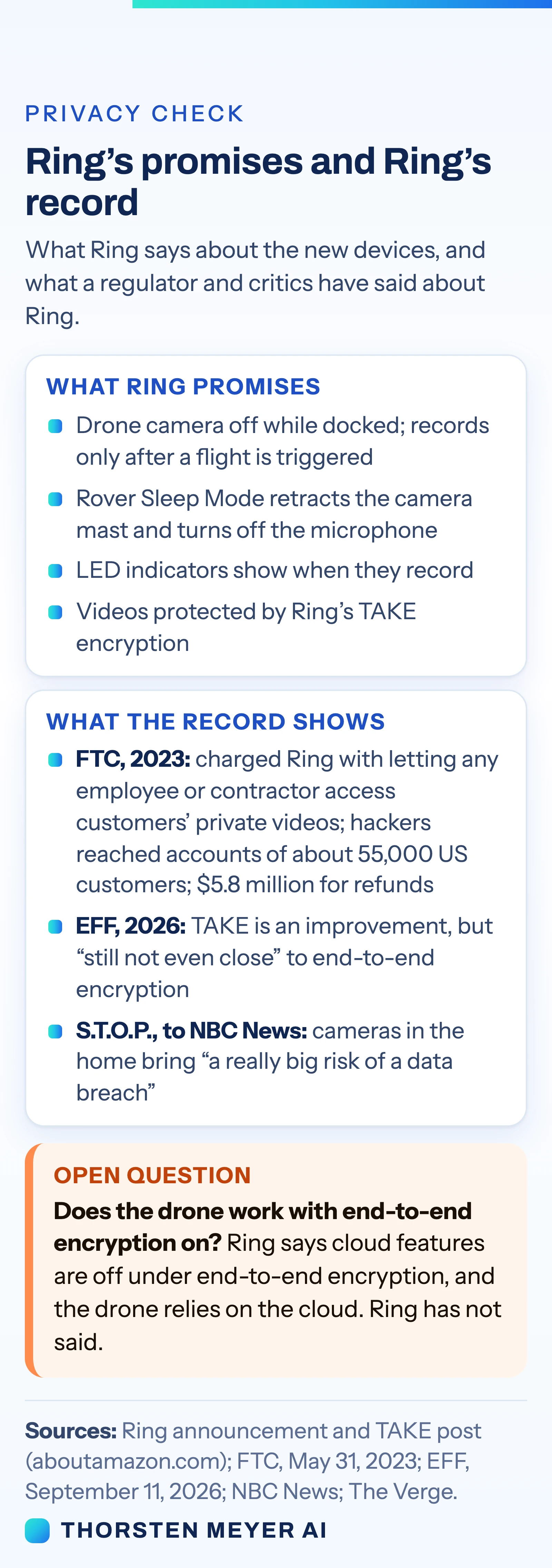
Ring addresses the obvious worry head-on. “Privacy isn’t just a feature of Ring Robotics; it is the default,” the announcement says. Its points:
- The drone records only after a flight is triggered; in the dock its camera is off.
- Rover’s Sleep Mode “retracts the periscope and turns off the microphone with a single tap.”
- “You’ll always know when the devices are recording”: both have LED indicators, and Rover shows it on its screen.
- Both are “designed to be seen and heard.”
- Videos are protected by “Throw Away the Key encryption (TAKE), Ring’s strongest default encryption yet.”
Ring announced TAKE on August 26, 2026. It describes it as “inspired by the privacy principles” of end-to-end encryption. Ring’s servers get temporary access to keys to run cloud features like smart alerts, then delete them. Full end-to-end encryption, where only the customer’s devices hold the keys, remains an optional setting.
Privacy: what regulators and critics say
Ring’s promises meet a long record. In May 2023, the US Federal Trade Commission charged Ring “with compromising its customers’ privacy by allowing any employee or contractor to access consumers’ private videos and by failing to implement basic privacy and security protections.” According to the FTC complaint, hackers accessed the videos, live streams and account profiles of “approximately 55,000 U.S. customers.” The proposed order required Ring to pay $5.8 million, to be used for consumer refunds.
The Electronic Frontier Foundation (EFF), a digital rights group, looked at TAKE in September 2026. It calls it “an improvement to the default settings Ring has now,” but adds that it “has some serious holes.” The core of its criticism: when a user wants to watch an old video or use smart features, the keys go back to Ring’s servers. In EFF’s words, the end result is “still not even close to the privacy protections of end-to-end encryption.” EFF says Ring should “open the entire infrastructure up to third-party auditors.” Ring told EFF it is “exploring options for further independent review.”
EFF’s wider concern is police access. In July 2025, it criticized Ring for “reintroducing new versions of old features which would allow police to request footage directly from Ring users.” CNBC reports that Ring faced renewed scrutiny this year over a Super Bowl ad for an AI pet-finding tool, and then canceled an integration with Flock Safety, a police technology provider.
Michelle Dahl, executive director of the Surveillance Technology Oversight Project, a privacy advocacy group, told NBC News: “When you are allowing cameras within your own home, there is a really big risk of a data breach.”
Two more points from the coverage. Ars Technica notes that Ring has not mentioned facial recognition for the new devices. Its “Familiar Faces” feature for fixed cameras is the subject of a proposed class-action lawsuit, according to Ars Technica and The Register. And The Register points out that the robots use Amazon’s cloud, which raises the question of “what footage and mapping data the company can access and retain.”
What it means for businesses
A camera that moves also films your staff. Rover streams and records whenever it patrols, and it detects people even when docked. If you schedule patrols while employees are in the building, they will be on video. Tell them before it starts, and check local rules on workplace video and audio recording.
It adds to fixed cameras; it does not replace an alarm system. Rover covers one floor and, per The Verge, runs about 30 minutes on a charge. It reacts to triggers from other Ring devices. Plan it as an extra pair of eyes, not as the only protection.
Check your network and your plan. Scheduled patrols need a Ring Protect plan, and the devices rely on cloud processing. A dead internet connection is a weak spot for a security device, as The Verge’s reporting on the drone shows.
Think about data before you buy. Ask what floor plans and patrol maps Ring stores, how long, and who at Ring can see them. Ring’s announcement does not say.
What it means for home users
Short flights, not a guard. At five to eight minutes per charge, according to Ring’s claim reported by The Verge, the drone is for quick checks after an alert, not for watching the house all night.
It flies through your private rooms. That is the point of the product, and the reason to think twice. A drone that maps your home and records each room on demand puts a lot of intimate footage in the cloud.
Use the strongest settings you can. Ring offers end-to-end encryption as an option. Whether the drone works with it switched on is not clear yet (see below).
Wait for the FCC. Drone Cam may not be sold before FCC authorization. The January 27 date depends on it.

What is not known
- FCC approval. Ring says it is “in the process of obtaining FCC certification,” according to The Verge. No date for a decision is public.
- End-to-end encryption. Ring’s TAKE post says cloud features are not available with end-to-end encryption on. The drone needs cloud processing to fly. Whether it works at all with end-to-end encryption enabled is not stated.
- Local storage. TechCrunch writes that it is “unclear whether there will be an option for local video storage.”
- Maps and floor plans. Ring does not say how long it keeps the floor plans AI Pilot creates, or whether they are covered by TAKE.
- Police requests. Ring does not say whether its features for police footage requests will apply to drone and robot video.
- Real-world reliability. The Verge saw a one-minute demo flight in a simple room. Stairs, pets and unexpected obstacles were not shown.
- Other countries. Both devices are announced for the US only.
The bottom line
Ring has turned a long-promised idea into a product with a date and a price. The technology is modest on purpose: a light, loud drone with short flights and a robot that covers one floor, both steered from the cloud. The harder part is trust. Ring promises privacy by default, but a camera that flies through your bedroom or rolls past your staff asks for more trust than a doorbell. Ring’s FTC record and EFF’s critique of TAKE are reasons to read the settings before you switch it on.
For more context, read about Meta’s humanoid robot for household chores, how hackers reached blood bank freezers, and what is left of Tesla’s robot promises.
I’m Thorsten Meyer. The full sources are below, and more reality checks are at thorstenmeyerai.com.
Sources
- Amazon / Ring: “Ring announces Ring Robotics, ushering in a new era of security”, aboutamazon.com, November 10, 2026
- Amazon / Ring: “Ring TAKE: How Throw Away the Key Encryption protects your videos”, aboutamazon.com, August 26, 2026
- US Federal Trade Commission: “FTC Says Ring Employees Illegally Surveilled Customers, Failed to Stop Hackers from Taking Control of Users’ Cameras”, May 31, 2023
- Electronic Frontier Foundation: “Cold TAKE: Amazon’s New Encryption Method Still Doesn’t Deliver Real Privacy”, September 11, 2026
- Electronic Frontier Foundation: “Amazon Ring Cashes in on Techno-Authoritarianism and Mass Surveillance”, July 18, 2025
- TechCrunch: “Ring, known for its doorbell cameras, launches a home security drone and an enterprise security robot”, November 10, 2026
- The Verge: “Hands-on with Ring’s new AI drone camera for your home” and “Amazon turned its Alexa robot into a Ring security patrol bot”, November 10, 2026
- CNBC: “Amazon’s Ring unveils flying drone and robot to patrol homes and businesses”, November 10, 2026
- NBC News: “Amazon’s Ring debuts security robots, including a drone”, November 10, 2026
- TechRadar: interview with Jamie Siminoff on Ring Drone Cam, November 10, 2026
- Ars Technica: “Ring cameras go mobile as Amazon debuts AI-powered security drone and robot”, November 10, 2026
- The Register: “Ring robots ready to patrol paranoids’ pads”, November 10, 2026
Researched and drafted with AI assistance, including Anthropic’s Claude. No company named here reviewed or sponsored this article, and it contains no affiliate links. Prices are list prices as stated in Ring’s own announcement; this article does not use retailer prices or ratings. This article is for information only and is not legal advice. Statements as published by Ring, the FTC, EFF and the outlets above as of November 11, 2026. Images: AI-generated illustration (Runware) and graphics by Thorsten Meyer AI; no real products, people or logos are shown.